


In the intricate tapestry of human thought, our decisions are rarely purely rational. They are profoundly influenced by how information is presented to us. This phenomenon, known as the framing effect, demonstrates that the way an issue is framed—whether in terms of potential gains or losses—can drastically alter our choices, even when the underlying facts remain the same.
💡 Key Takeaways
- The framing effect demonstrates how identical information, presented differently, alters perception.
- Decisions are heavily influenced by whether options are framed as gains or losses.
- Understanding this bias helps in recognizing manipulative communication and making rational choices.
- Framing is prevalent in marketing, politics, and everyday interactions, shaping our reality.
“The framing effect beautifully illustrates that our brains don’t operate on pure logic alone; context is everything. How information is packaged directly modulates neural responses, profoundly shifting our ‘rational’ choices.”
— Eleanor Vance, Neuroscience Communicator & Cognitive Psychologist
Understanding the framing effect bias is not just an academic exercise; it’s a critical tool for navigating the complexities of modern life, from making personal health decisions to evaluating political messages and consumer choices. As we delve into this powerful cognitive bias, we uncover how subtle shifts in language and context can sway our perceptions and ultimately, our actions.
This comprehensive guide will explore the mechanics of the framing effect, provide compelling examples, and offer practical strategies to recognize and counteract its influence, empowering you to make more informed and independent decisions within The Human Enigma: Unlocking the Secrets of Our Body and Mind.
In This Article
- — 💡 Key Takeaways
- → What Exactly is the Framing Effect?
- — The Core Concept
- — Prospect Theory’s Role
- — Gain vs. Loss Frames
- → 📈 Examples of the Framing Effect in Action
- — Health and Medical Decisions
- — Marketing and Sales
- — Politics and Public Policy
- — Everyday Scenarios
- → Why Are We Susceptible? The Psychology Behind the Bias
- — Cognitive Load & Heuristics
- — Emotional Responses
- — Defaults and Status Quo Bias
- → Recognizing and Overcoming the Framing Effect
- — Critical Thinking and Deliberation
- — Seeking Multiple Perspectives
- — Focusing on Objective Data
- → The Ethical Implications of Framing
- — Manipulative Practices
- — Responsible Communication
- → Conclusion: Mastering the Art of Unbiased Decision-Making
What Exactly is the Framing Effect?
At its core, the framing effect is a cognitive bias where people decide on options based on whether the options are presented with positive or negative connotations, rather than on their objective merits. It’s a cornerstone of behavioral economics and psychology, first popularized by Daniel Kahneman and Amos Tversky in their seminal work on Prospect Theory.
The Core Concept
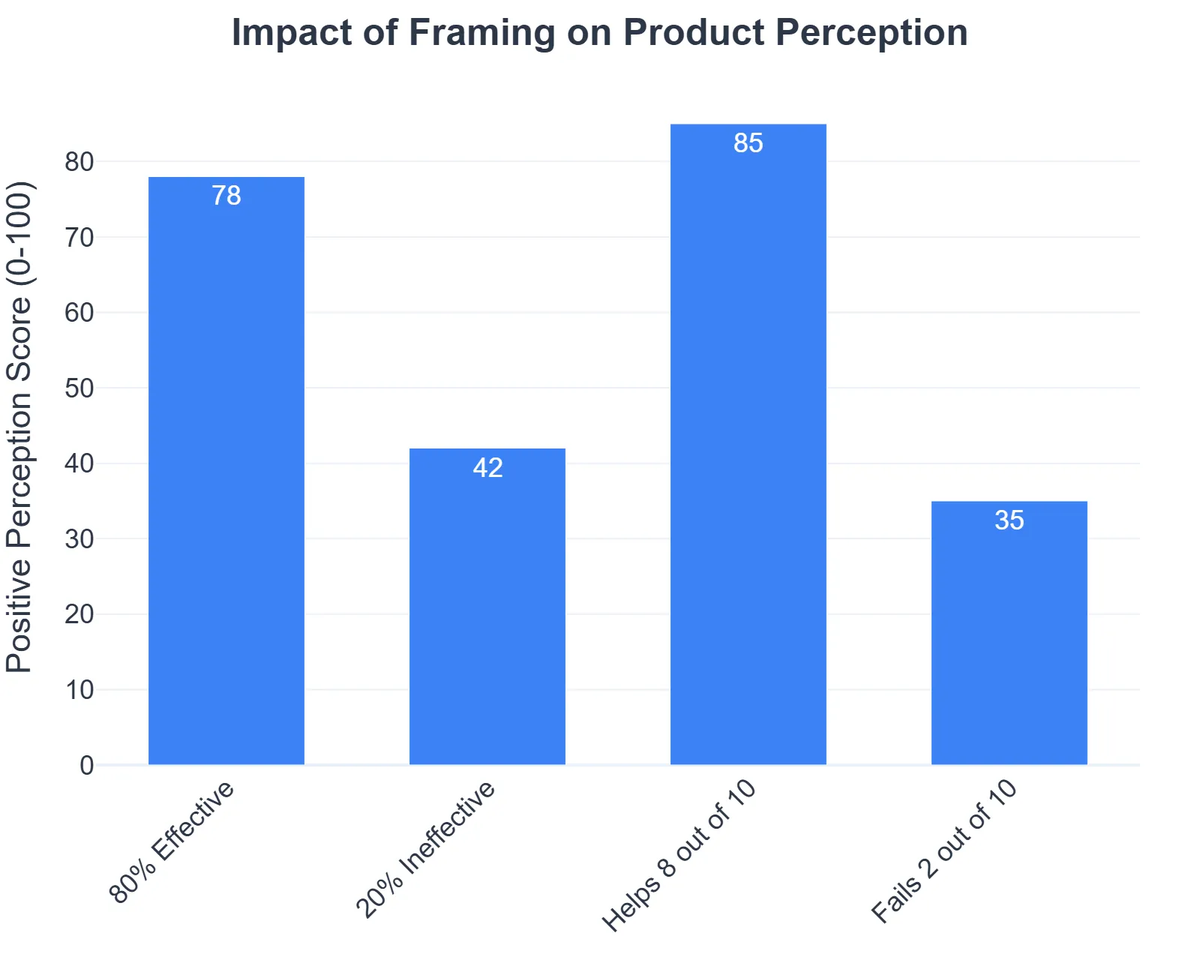
- ✅ Presentation Matters: The framing effect illustrates that the exact same information can be interpreted differently depending on its presentation. A statement framed as a gain often leads to risk-averse behavior, while one framed as a loss often leads to risk-seeking behavior.
- ➡️ Subjective Reality: Our perception of reality is not always objective. This bias highlights how our subjective interpretation of information, heavily influenced by its framing, dictates our subsequent choices.
Prospect Theory’s Role
The framing effect is deeply intertwined with Kahneman and Tversky’s Prospect Theory. This theory posits that individuals evaluate potential outcomes in terms of gains and losses relative to a reference point, rather than in terms of absolute wealth or utility. People are generally more sensitive to potential losses than to equivalent potential gains, a phenomenon known as “loss aversion.” This means that avoiding a loss feels more impactful than achieving an equivalent gain.
Gain vs. Loss Frames
The distinction between gain and loss frames is crucial:
- 💡 Gain Frame: When an outcome is framed positively (e.g., “80% success rate,” “20% fat-free”), people tend to be risk-averse, preferring a sure gain over a risky larger gain.
- 💡 Loss Frame: When an outcome is framed negatively (e.g., “20% failure rate,” “contains 20% fat”), people tend to be risk-seeking, willing to take greater risks to avoid a sure loss.
📈 Examples of the Framing Effect in Action
The ubiquity of the framing effect is evident across numerous domains. Once you recognize it, you’ll start seeing examples of the framing effect everywhere.
Health and Medical Decisions
Consider a medical procedure:
The Framing Effect: Pros and Cons
Pros
- ✔Can simplify complex information for better understanding.
- ✔Useful for effective communication and persuasion in marketing or policy.
- ✔Highlights specific aspects to guide beneficial choices (e.g., health campaigns).
Cons
- ✖Can lead to irrational or suboptimal decision-making.
- ✖Open to manipulation and misrepresentation of information.
- ✖Undermines objective assessment by focusing on select aspects.
- ✖Individuals may be unaware of its influence on their choices.
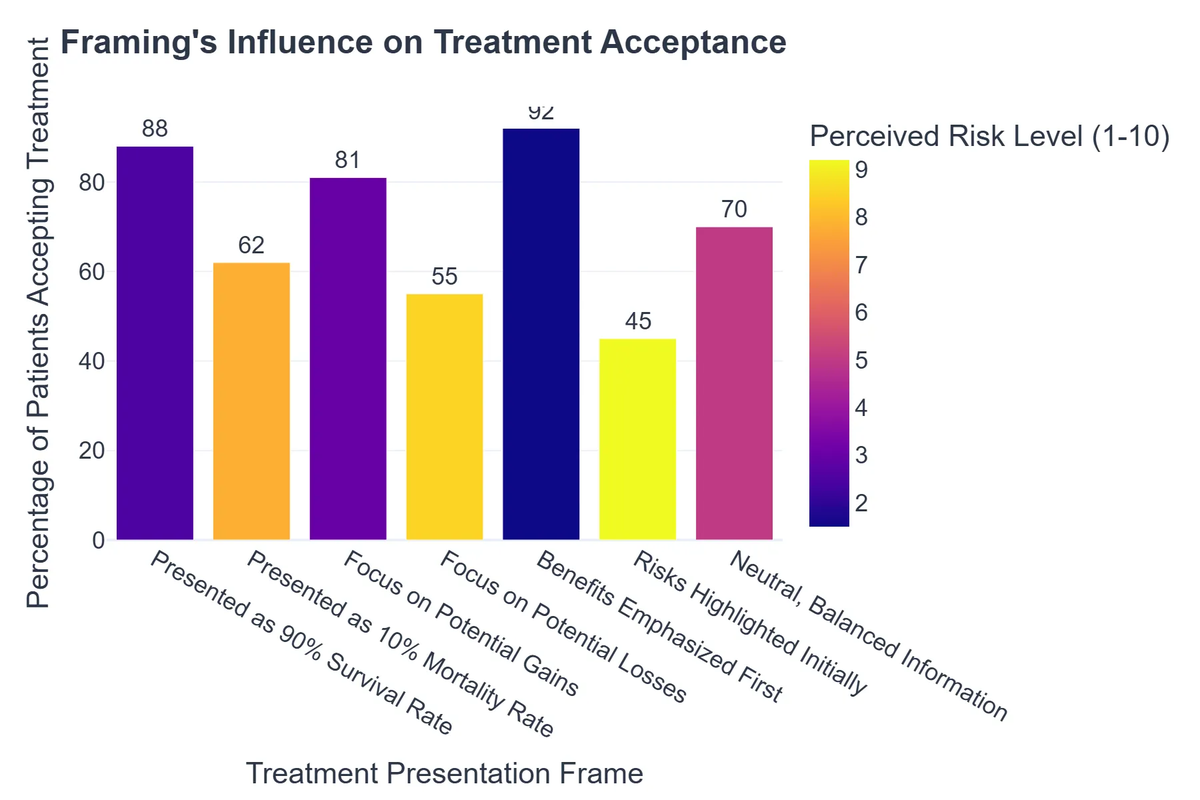
- ✅ Gain Frame: “This surgery has an 80% success rate.” (Patients are more likely to choose the surgery.)
- ➡️ Loss Frame: “This surgery has a 20% failure rate.” (Patients are less likely to choose the surgery, despite the identical statistical outcome.)
Similarly, public health campaigns often leverage framing. Telling people “90% of people who quit smoking live longer” is often more effective than “10% of people who smoke die prematurely,” even though both statements convey the same information.
Marketing and Sales
Marketers are masters of framing:
- 💡 “90% Fat-Free” vs. “Contains 10% Fat”: The former sounds healthier and more appealing.
- 💡 “Buy one, get one 50% off” vs. “25% off two items”: The first option feels like a better deal, even if the total discount is the same.
- 💡 Subscription Services: “Only $10 a month” sounds more affordable than “$120 a year,” even if the annual cost is identical or discounted for yearly payment.
Politics and Public Policy
Politicians frequently use framing to influence public opinion:
- ✅ “Tax relief” vs. “Tax cuts for the wealthy”: Both describe changes in tax policy, but evoke different emotional and ideological responses.
- ➡️ “Pro-life” vs. “Pro-choice”: These terms frame the abortion debate in starkly different ways, emphasizing either the fetus’s right to life or the individual’s bodily autonomy.
- 💡 “Investment in infrastructure” vs. “Government spending”: The former suggests positive future returns, while the latter can imply wasteful expenditure.
Everyday Scenarios
The framing effect is present in our daily interactions:

- ✅ Negotiations: Framing an offer as a “bonus” rather than a “cut from your previous salary” can make it more palatable.
- ➡️ Food Choices: A restaurant menu describing a dish as “slow-roasted, tender beef” is more appealing than “a beef dish.”
- 💡 Time Management: Framing a task as “an opportunity to develop new skills” can motivate more than “a mandatory chore.”
Why Are We Susceptible? The Psychology Behind the Bias
Our susceptibility to the framing effect stems from fundamental aspects of human cognition and emotion. It’s one of many Cognitive Bias: Understanding Our Brain’s Mental Shortcuts.
Cognitive Load & Heuristics
Our brains are constantly seeking shortcuts to process information efficiently, especially when faced with complex decisions or limited time. These mental shortcuts, or heuristics, can lead us to rely on the immediate presentation of information rather than deeply analyzing its objective content.
- ✅ Effort-Saving: It takes less mental effort to react to a positively or negatively framed statement than to strip away the emotional framing and analyze the raw data.
- ➡️ System 1 Thinking: As described by Kahneman, our fast, intuitive “System 1” thinking is highly susceptible to framing, reacting quickly to surface-level cues. Our slower, more analytical “System 2” thinking is required to overcome it.
Emotional Responses
Framing often taps directly into our emotions, particularly our strong aversion to loss. Losses feel disproportionately worse than gains feel good, pushing us towards behaviors aimed at avoiding that negative feeling, even if it means taking risks.
- 💡 Fear of Loss: A loss frame triggers fear, anxiety, or regret, prompting us to act to mitigate that potential loss.
- 💡 Hope of Gain: A gain frame evokes feelings of optimism or desire, encouraging choices that secure the perceived benefit.
Defaults and Status Quo Bias
The way options are framed can also create a default or a perceived status quo, making it harder to choose an alternative. For example, in organ donation programs, countries with “opt-out” systems (where everyone is a donor unless they explicitly say no) have significantly higher donation rates than “opt-in” systems.
Recognizing and Overcoming the Framing Effect
While powerful, the framing effect is not insurmountable. Awareness is the first step towards mitigating its influence. Here’s how to develop a more resilient decision-making process:
Critical Thinking and Deliberation
- ✅ Reframe the Problem: Actively try to rephrase the information presented in different ways. If it’s a gain frame, convert it to a loss frame, and vice versa. “80% success rate” becomes “20% failure rate.” This simple exercise can reveal how arbitrary the initial framing might be.
- ➡️ Slow Down: Resist the urge to make snap judgments. Engage your “System 2” thinking by consciously taking time to analyze the information before deciding.
Seeking Multiple Perspectives
- 💡 Consult Diverse Sources: Don’t rely on a single source of information, especially if it has a vested interest in your decision. Seek out varied viewpoints that may frame the issue differently.
- 💡 Ask Probing Questions: Instead of accepting information at face value, ask: “How else could this be presented?”, “What are the hidden costs or benefits?”, “What assumptions are embedded in this statement?”
Focusing on Objective Data
- ✅ Quantify Where Possible: Whenever possible, convert qualitative statements into quantitative data. Focus on the raw numbers, statistics, and facts rather than the descriptive language used.
- ➡️ Consider Base Rates: Pay attention to the overall probabilities and frequencies, not just the isolated event. For instance, knowing the prevalence of a disease (base rate) is crucial when interpreting a diagnostic test result.
- 💡 Beware of Anchoring: Be aware of the first piece of information presented, as it can serve as an anchor, influencing subsequent judgments. Related to this, understanding biases like the Halo Effect Bias: Understanding Its Impact on Perception can further improve your analytical skills.
The Ethical Implications of Framing
Given its persuasive power, the framing effect carries significant ethical implications, particularly for those who communicate information to the public or influence decisions on a large scale.
Manipulative Practices
When framing is used to intentionally mislead, obscure facts, or coerce individuals into choices that are not in their best interest, it becomes a tool of manipulation. Examples include:
- ✅ Distorting risks or benefits to sell products or services.
- ➡️ Using emotionally charged language to sway political opinions without presenting a balanced view.
- 💡 Presenting statistics in a way that exaggerates positive outcomes or downplays negative ones.
Responsible Communication
Conversely, understanding the framing effect can empower ethical communicators to present information clearly, transparently, and in a way that genuinely informs rather than manipulates. This involves:
- 💡 Transparency: Acknowledging potential biases in communication and striving for neutrality where appropriate.
- 💡 Balanced Presentation: Providing both gain and loss frames when discussing potential outcomes, allowing individuals to form a more complete picture.
- 💡 Empowering Autonomy: Framing information in a way that supports individual decision-making and autonomy, rather than pushing a specific agenda.
Recommended Video
Conclusion: Mastering the Art of Unbiased Decision-Making
The framing effect is a pervasive force in our cognitive landscape, subtly yet profoundly shaping how we perceive information and, consequently, the decisions we make. From the doctor’s office to the supermarket aisle, and from political rallies to personal finances, its influence is undeniable.
By consciously recognizing this powerful cognitive bias, we can begin to disentangle the objective facts from their subjective presentation. Developing the habit of reframing information, seeking diverse perspectives, and focusing on quantifiable data empowers us to transcend the immediate emotional pull of a given frame. This mindful approach fosters clearer thinking and leads to more rational, self-aware choices. In a world awash with information, mastering the art of unbiased decision-making is not just a skill—it’s a critical component of navigating the human enigma itself.
Frequently Asked Questions
What is the framing effect?
The framing effect is a cognitive bias where people react to choices based on how they are presented, rather than on the objective facts alone. For example, framing a decision as a gain versus a loss can lead to different preferences.
How does the framing effect impact daily life?
It influences consumer choices (e.g., ‘90% fat-free’ vs. ‘10% fat’), medical decisions (e.g., survival rates vs. mortality rates), and even political polling, by subtly guiding perceptions and preferences.
What is the difference between positive and negative framing?
Positive framing emphasizes potential gains or benefits (e.g., ‘survival rate’), while negative framing highlights potential losses or costs (e.g., ‘mortality rate’). People tend to be risk-averse with positive frames and risk-seeking with negative frames.
Can the framing effect be overcome?
While difficult to entirely eliminate, awareness of the framing effect can help individuals pause and critically evaluate information independent of its presentation. Deliberate, systematic thinking can reduce its influence.