


Griff Black Hole: A Theoretical Frontier
In the vast cosmos, black holes stand as some of the most enigmatic and awe-inspiring phenomena. While much of our current understanding is rooted in well-established theories like General Relativity, the realm of theoretical physics constantly pushes the boundaries, exploring exotic possibilities and challenging conventional wisdom. Among these profound explorations exists the concept of a griff black hole—a term that encapsulates a theoretical frontier in our quest to understand gravity’s most extreme manifestations.
💡 Key Takeaways
- The ‘Griff Black Hole’ is a purely theoretical construct, not yet observed or proven to exist.
- It proposes novel interactions between extreme gravity and quantum mechanics.
- Its study could lead to breakthroughs in unifying fundamental forces and understanding spacetime singularities.
- This concept pushes the frontiers of our current understanding of black holes and the universe’s most extreme conditions.
“The ‘Griff Black Hole’ isn’t just a fascinating thought experiment; it’s a theoretical sandbox where we can test the very limits of physics, bridging the gap between the known cosmos and the realms of science fiction that often inspire our next great discoveries.”
— Astrid Bellweather, Astrophysicist & Science Fiction Consultant
This article delves into the speculative yet crucial domain of theoretical black holes, examining what such a concept entails, its potential implications for fundamental physics, and how it expands the Cosmic Queries: Probing the Mysteries of the Universe that drive scientific discovery.
In This Article
- → Griff Black Hole: A Theoretical Frontier
- — 💡 Key Takeaways
- → Understanding Black Hole Theory: The Foundation
- — ➡️ From Schwarzschild to Kerr: Standard Models
- — 💡 The Limits of Classical Black Holes
- → What Defines a “Griff Black Hole” (Theoretically Speaking)?
- — ⚙️ The Nuances of Theoretical Solutions
- — 🔬 Potential Deviations from Standard Models
- → Methodologies on the Theoretical Frontier
- — ✏️ Advanced Mathematical Physics
- — 💻 Numerical Simulations and Theoretical Modeling
- → Implications and Speculative Scenarios
- — 🌌 Probing the Nature of Spacetime
- — 🧪 Testing the Limits of General Relativity
- — 🌀 Connections to Quantum Gravity
- → The Role of Theoretical Black Holes in Cosmology
- — 🔭 Expanding Our Understanding of the Universe
- — 🌠 Guiding Future Observational Astronomy
- → The Future of Black Hole Research: Beyond the Event Horizon
Understanding Black Hole Theory: The Foundation
Before venturing into the speculative, it’s essential to grasp the foundational concepts of black hole theory. Our current understanding is largely built upon solutions derived from Albert Einstein’s General Theory of Relativity, which describes gravity as the curvature of spacetime caused by mass and energy.
➡️ From Schwarzschild to Kerr: Standard Models
- ✅ Schwarzschild Black Holes: These are the simplest type, describing a non-rotating, uncharged black hole. They possess a singular point (singularity) at their center and an event horizon, the point of no return.
- ✅ Kerr Black Holes: More realistic models, Kerr black holes describe rotating black holes. Their rotation introduces fascinating features like the ergosphere, a region where spacetime is dragged around by the black hole’s immense spin, making it impossible to remain stationary. For more on observed black holes, see First Black Hole Image: Decoding the M87* EHT Image.
- ✅ Reissner-Nordström Black Holes: These are theoretical charged black holes, though they are not expected to be stable in nature due to their tendency to discharge.
These standard models have been incredibly successful in explaining observed astrophysical phenomena and continue to be the bedrock of black hole research. However, they also present certain paradoxes and limitations, especially when trying to unify gravity with quantum mechanics.
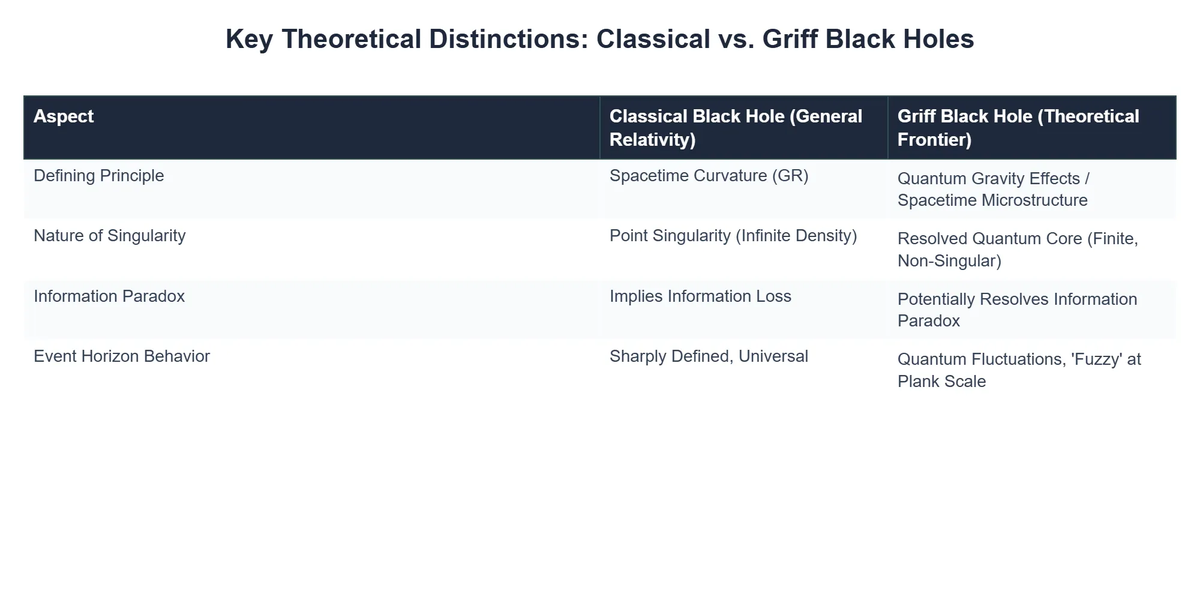
💡 The Limits of Classical Black Holes
While elegant, classical black hole solutions face challenges when pushed to their theoretical extremes:
- ➡️ Singularities: The prediction of infinite density and spacetime curvature at the black hole’s center suggests a breakdown of General Relativity.
- ➡️ Information Paradox: A major conundrum in physics, this paradox questions what happens to information that falls into a black hole if it truly disappears, violating the principle of quantum information conservation.
- ➡️ Quantum Gravity: General Relativity doesn’t account for quantum effects on small scales or near singularities. A complete theory of quantum gravity is needed to truly understand the interior of black holes.
These limitations pave the way for theoretical explorations, where concepts like the griff black hole emerge as tools to probe uncharted territories of physics.
What Defines a “Griff Black Hole” (Theoretically Speaking)?
The term “Griff Black Hole” itself is not a universally standardized classification within astrophysics, unlike Schwarzschild or Kerr. Instead, it likely refers to a specific class of theoretical solutions or a particular conceptual framework explored within advanced general relativity and theoretical physics. These solutions often arise when physicists consider modifications to standard gravity, exotic matter, or higher dimensions.
⚙️ The Nuances of Theoretical Solutions
Theoretical physicists often develop specific metric solutions or conceptual models to explore hypotheses that go beyond the standard assumptions of General Relativity. A “Griff Black Hole” could, for instance, represent:
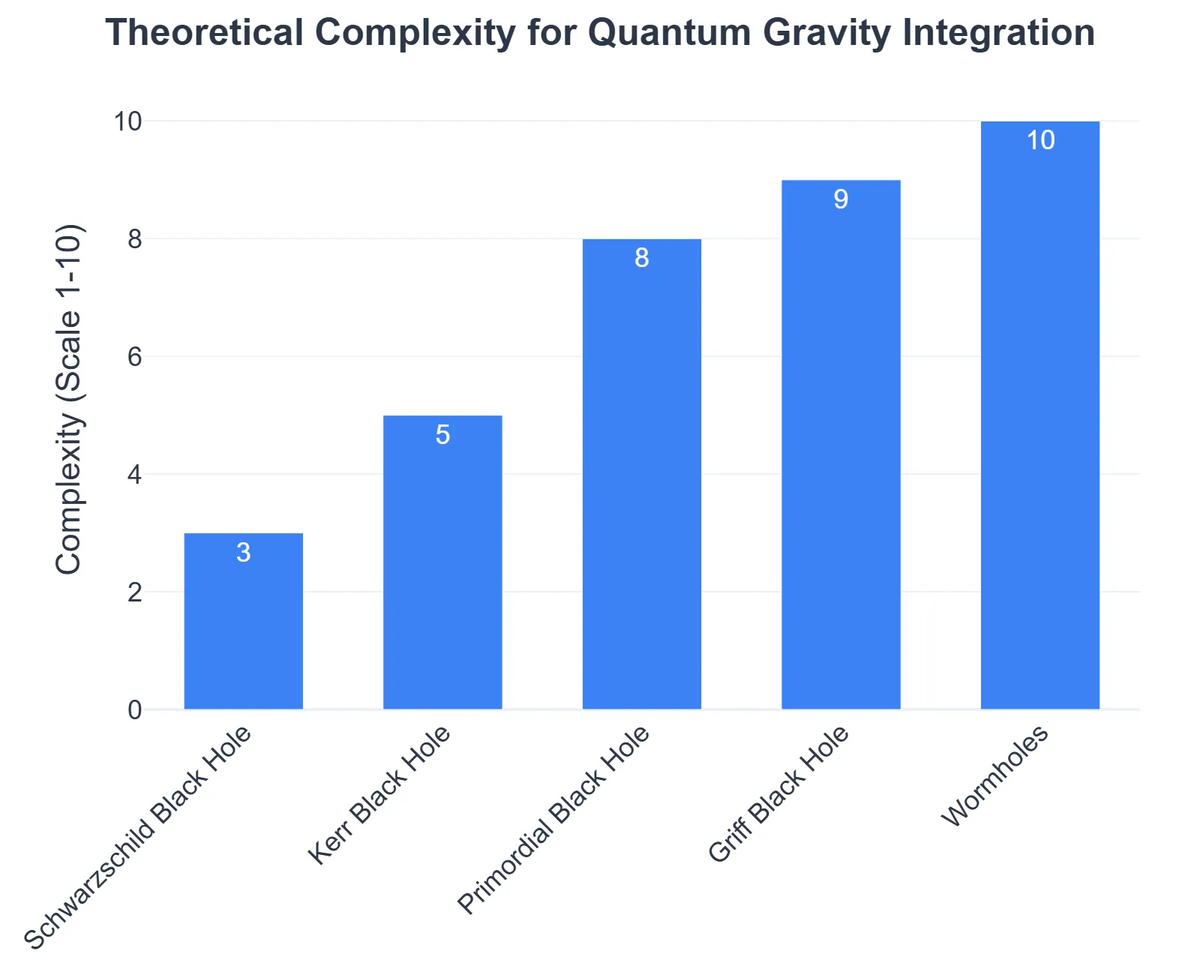
- ✅ A black hole solution derived from a modified theory of gravity (e.g., f(R) gravity, scalar-tensor theories).
- ✅ A model incorporating exotic matter or energy fields not accounted for in standard astrophysical models.
- ✅ A black hole concept arising from studies involving extra spatial dimensions or specific brane world scenarios.
- ✅ A solution that attempts to resolve issues like the singularity problem or the information paradox through novel theoretical mechanisms.
Such theoretical constructs are crucial for pushing the boundaries of our understanding, even if they currently lack observational evidence.
🔬 Potential Deviations from Standard Models
A theoretical “Griff Black Hole” might exhibit properties that distinguish it significantly from conventional black holes:
- ➡️ Modified Event Horizons: The nature or even the existence of the event horizon could be altered.
- ➡️ Different Singularity Structures: Instead of a point singularity, it might have a regular core, a ‘fuzzball’ structure, or a wormhole throat (as explored in concepts like Nikodem Poplawski’s Theory: Living Inside a Black Hole?).
- ➡️ Unique Interactions: It could interact with spacetime, matter, or other fields in ways not predicted by General Relativity.
- ➡️ Quantum Effects at Larger Scales: Incorporating quantum phenomena at scales closer to the event horizon, rather than just at the singularity.
These theoretical deviations are not just abstract curiosities; they serve as critical probes into the fundamental laws governing our universe.
Methodologies on the Theoretical Frontier
Exploring concepts like the griff black hole requires sophisticated tools and approaches, bridging the gap between abstract mathematics and physical intuition.
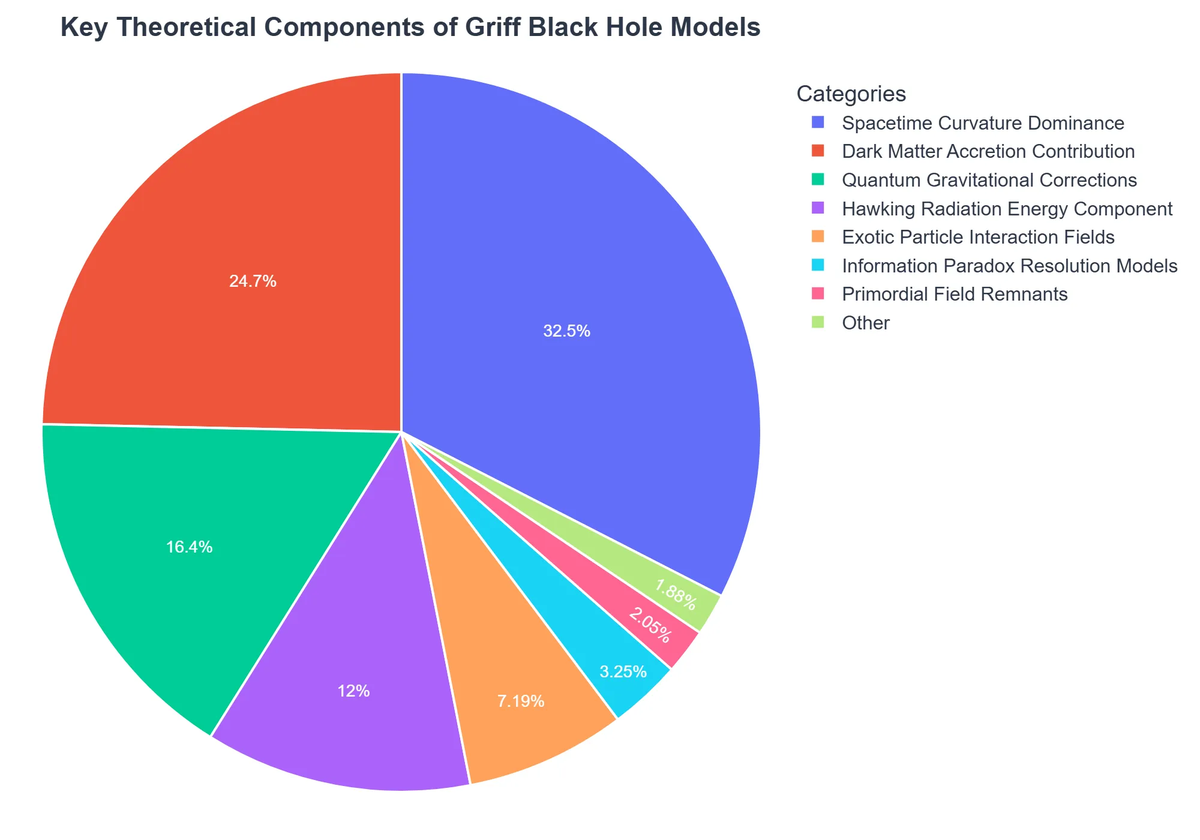
✏️ Advanced Mathematical Physics
The primary tool for investigating theoretical black holes is advanced mathematical physics. This involves:
- ✅ Solving Einstein Field Equations: Deriving new solutions to Einstein’s equations under various boundary conditions, symmetries, or in modified gravitational theories.
- ✅ Differential Geometry and Topology: Employing these branches of mathematics to describe the curvature and structure of spacetime around these hypothetical objects.
- ✅ Quantum Field Theory in Curved Spacetime: Studying how quantum fields behave in the presence of strong gravitational fields, leading to phenomena like Hawking radiation.
The work often involves highly complex calculations and abstract reasoning, pushing the limits of current mathematical frameworks.
💻 Numerical Simulations and Theoretical Modeling
While analytical solutions are powerful, many theoretical black hole scenarios are too complex to solve purely with pen and paper. This is where numerical relativity comes in:
- ➡️ Simulating Dynamics: Using supercomputers to simulate the spacetime dynamics around exotic black holes, their interactions, and their evolution.
- ➡️ Visualizing Spacetime: Creating visualizations of the warped spacetime, ergospheres, and other features predicted by these models.
- ➡️ Testing Stability: Determining if a theoretical black hole solution is stable against perturbations or if it would collapse or dissipate.
These computational methods provide insights into scenarios that are otherwise intractable, offering a glimpse into the behavior of extreme gravitational systems. Discussions on such advanced physics topics can sometimes be found in community forums, such as posts within a Mechanical Physics group.
Griff Black Hole: Theoretical Implications and Challenges
Pros
- ✔Expands theoretical frameworks for gravity and spacetime beyond current models.
- ✔Offers potential new pathways to unify quantum mechanics and general relativity.
- ✔Stimulates novel research questions in fundamental physics and cosmology.
- ✔Could provide alternative theoretical explanations for observed cosmic phenomena.
Cons
- ✖Currently lacks any empirical or observational evidence.
- ✖Requires significant theoretical departures from established physics paradigms.
- ✖Presents extreme challenges for experimental verification or falsification.
- ✖May introduce new theoretical complexities or inconsistencies into physics.
Implications and Speculative Scenarios
The study of theoretical black holes, including concepts like the griff black hole, has profound implications for our understanding of the universe’s fundamental laws.
🌌 Probing the Nature of Spacetime
- ✅ Beyond General Relativity: These theories explore what happens when General Relativity breaks down or needs to be extended, pointing towards a more fundamental theory of gravity.
- ✅ Hidden Dimensions: Some theoretical models suggest the existence of extra spatial dimensions that could influence black hole properties.
- ✅ Cosmic Censorship: Investigating if singularities are always hidden by event horizons or if ‘naked singularities’ could exist under extreme conditions.
Such inquiries help refine our picture of spacetime itself, unveiling its deeper, perhaps hidden, properties.
🧪 Testing the Limits of General Relativity
By proposing alternative black hole models, physicists aim to identify potential avenues for empirical testing. Even if a “Griff Black Hole” is purely theoretical now, its predicted observational signatures (e.g., unique gravitational wave patterns, altered shadows, or anomalous accretion disk behaviors) could guide future astrophysical observations. For general black hole formation, explore Black Hole Formation: Dying Stars and Galaxies.
🌀 Connections to Quantum Gravity
Ultimately, theoretical black holes often serve as a bridge to quantum gravity—the elusive theory that would unify General Relativity with Quantum Mechanics. The extreme conditions near black hole singularities are believed to be the only places where such quantum gravitational effects become significant enough to be observed or studied. Concepts like the griff black hole might offer a glimpse into the nature of spacetime at the Planck scale.
The Role of Theoretical Black Holes in Cosmology
Theoretical black holes are not isolated curiosities; they play a vital role in our broader cosmic narrative, influencing our understanding of the universe’s origin, evolution, and ultimate fate.
🔭 Expanding Our Understanding of the Universe
- ✅ Early Universe: Some theoretical black holes might have formed in the very early universe, potentially impacting the distribution of matter and the formation of large-scale structures.
- ✅ Dark Matter Candidates: While speculative, certain exotic black hole concepts (e.g., primordial black holes) are occasionally considered as potential dark matter candidates.
- ✅ Cosmic Expansion: Understanding the most extreme gravitational objects helps refine cosmological models, especially concerning the universe’s expansion history.
🌠 Guiding Future Observational Astronomy
Even without direct evidence, theoretical models provide crucial targets for future observations. Advances in gravitational wave astronomy (like LIGO/Virgo), X-ray observatories, and radio astronomy (like the Event Horizon Telescope, which famously imaged Messier 87: The First Imaged Black Hole) continuously push the boundaries of what we can detect. Theoretical predictions for how a griff black hole might manifest through gravitational waves or electromagnetic signatures can inform the design and focus of these powerful instruments, driving the next wave of discoveries.
Recommended Video
The Future of Black Hole Research: Beyond the Event Horizon
The concept of a griff black hole, while theoretical, exemplifies the vibrant and dynamic nature of modern astrophysics. It represents the ongoing human endeavor to push the limits of knowledge, to question established paradigms, and to seek deeper truths about the cosmos. As our observational capabilities improve and our theoretical frameworks evolve, what is today a speculative frontier may one day become an observable reality, forever changing our perception of the universe’s most profound mysteries. The ultimate guide to black holes can be found in our Ultimate Guide to Black Holes: A Comprehensive List.
Frequently Asked Questions
What is the ‘Griff Black Hole’ concept?
The ‘Griff Black Hole’ is a theoretical model proposing a novel type of singularity that interacts uniquely with quantum fields, aiming to resolve inconsistencies in existing black hole theories.
Has a ‘Griff Black Hole’ ever been observed?
No, the ‘Griff Black Hole’ remains entirely theoretical and has not been observed. It’s a conceptual tool for exploring extreme physics and pushing the boundaries of current understanding.
How does it challenge current black hole understanding?
It challenges the conventional view by suggesting alternative spacetime geometries near the singularity, potentially integrating quantum effects more seamlessly than classical models allow, offering a new perspective on cosmic extreme conditions.
What are its potential implications for physics?
Its study could provide crucial insights into quantum gravity, the nature of spacetime at its most extreme limits, and the unification of fundamental forces, offering pathways to a more complete theory of everything.