


The Cosmic Conundrum: Understanding Intermediate Black Holes
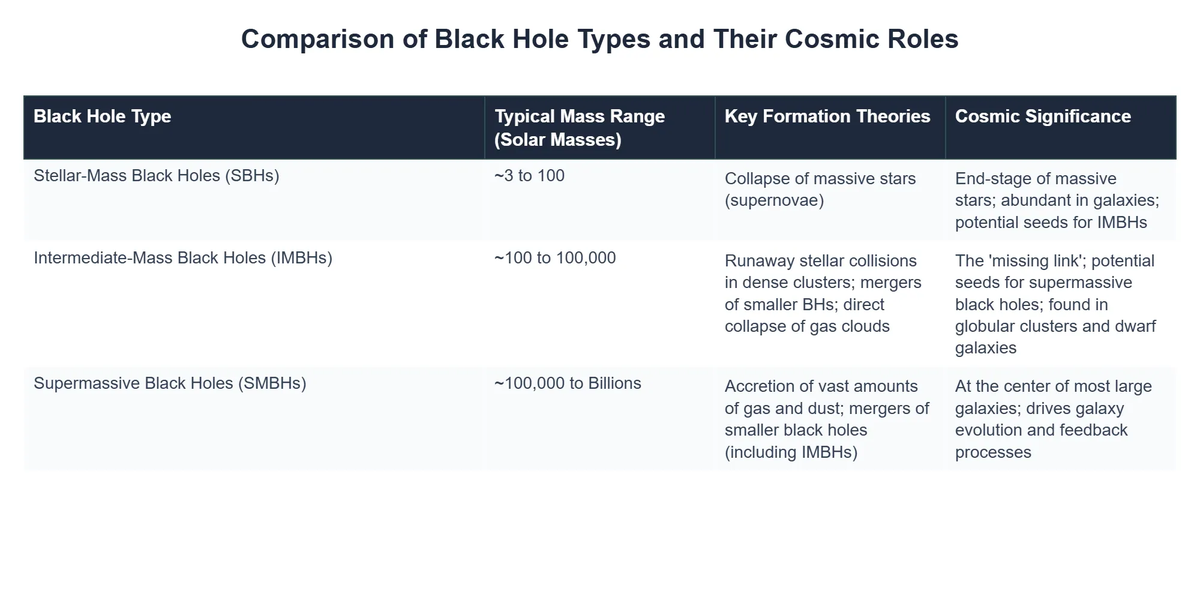
In the vast expanse of the cosmos, black holes exist in extremes. At one end, we have stellar-mass black holes, born from the collapse of massive stars, typically ranging from a few to tens of solar masses. At the other, we find the enigmatic supermassive black holes (SMBHs), residing at the hearts of most galaxies, boasting masses millions to billions of times that of our Sun. Yet, for decades, astronomers have grappled with a significant gap in this cosmic spectrum.
💡 Key Takeaways
- Intermediate-mass black holes (IMBHs) are theoretically predicted to exist, bridging the size gap between stellar-mass and supermassive black holes.
- Detecting IMBHs is challenging, but their existence is crucial for understanding how supermassive black holes grow and galaxies evolve.
- Various theories propose IMBHs form through runaway stellar collisions in dense clusters or mergers of smaller black holes.
- Future gravitational wave observatories and advanced telescopes are key to confirming the prevalence and properties of these ‘missing link’ black holes.
“Intermediate black holes are more than just a theoretical bridge; they are the Rosetta Stone of galactic dynamics, holding clues to how the universe’s most colossal structures came to be.”
— Astrid Bellweather, Astrophysicist & Science Communicator
This missing piece is the intermediate black hole (IMBH). These elusive objects are theorized to bridge the vast mass difference, occupying a range roughly between 100 and 100,000 solar masses. They are the cosmic ‘missing link,’ crucial for understanding how supermassive black holes grow and how galaxies evolve. Pinpointing their existence and understanding their properties is a central quest within modern astrophysics.
In This Article
- → The Cosmic Conundrum: Understanding Intermediate Black Holes
- — 💡 Key Takeaways
- — Why are Intermediate Black Holes so Important?
- → 🌌 The Elusive Quest for Evidence
- — Current Strategies for IMBH Detection:
- → Theories of Formation: Bridging the Gap
- — Paths to Intermediate Black Hole Formation:
- → 🔭 The Significance of IMBHs in Cosmic Evolution
- — Key Roles of Intermediate Black Holes:
- → Future Prospects and Ongoing Research
- — Next-Generation Observatories and Techniques:
Why are Intermediate Black Holes so Important?
- ✅ They represent a crucial step in the evolutionary pathway from stellar-mass black holes to the gargantuan supermassive ones.
- ➡️ Their existence would provide insights into the early universe and the conditions that allowed for rapid growth of SMBHs.
- 💡 They could be the gravitational anchors for globular clusters and ultra-luminous X-ray sources (ULXs).
🌌 The Elusive Quest for Evidence
Despite their theoretical importance, directly observing intermediate black holes has proven incredibly challenging. Unlike the energetic quasars powered by active supermassive black holes, IMBHs are not expected to be as luminous. And unlike stellar-mass black holes, they aren’t as numerous or easily detected through binary star systems.
Current Strategies for IMBH Detection:
Astronomers employ a range of indirect methods and search for specific cosmic signatures:
- ✅ X-ray Emissions: When matter falls into a black hole, it heats up to extreme temperatures, emitting powerful X-rays. Ultra-luminous X-ray sources (ULXs) in other galaxies are prime candidates, as their extreme brightness suggests an accretion rate too high for a stellar-mass black hole.
- ➡️ Dynamical Measurements: By observing the motion of stars, gas, or other objects orbiting a central, invisible mass within dense stellar systems like globular clusters, scientists can infer the presence and mass of an unseen black hole. A notable candidate identified through this method is found in the globular cluster Omega Centauri, suggesting an IMBH at its core.
- 💡 Gravitational Lensing: Although difficult to detect, the immense gravity of an IMBH could distort the light from background objects, creating a unique lensing signature.
- 🔭 Gravitational Waves: The merger of two black holes creates ripples in spacetime known as gravitational waves. While LIGO and Virgo have primarily detected stellar-mass black hole mergers, future detectors hold the promise of detecting mergers involving intermediate-mass black holes, providing definitive proof of their existence and probing their characteristics. For more on the detection of these cosmic events, explore our guide on Binary Black Holes: A Cosmic Dance.
Recent breakthroughs continue to provide new clues, though definitive confirmation remains a high priority for ongoing research.
Theories of Formation: Bridging the Gap
The existence of intermediate black holes presents a fascinating challenge for theoretical astrophysicists: how do these mid-range behemoths form? Their mass range places them beyond the typical stellar collapse scenario but below the conditions thought necessary for direct collapse into a supermassive black hole. Several compelling theories attempt to explain their genesis:
Paths to Intermediate Black Hole Formation:
- ✅ Runaway Stellar Collisions: In extremely dense star clusters, such as globular clusters, stars are packed incredibly close together. This environment could lead to a ‘runaway’ scenario where multiple massive stars collide and merge. The resulting super-massive star could then collapse directly to form an IMBH. This process would occur rapidly, potentially within the first few hundred million years of a cluster’s life.
- ➡️ Mergers of Smaller Black Holes: An alternative pathway involves the hierarchical merging of stellar-mass black holes. If a dense cluster forms, it might produce many stellar-mass black holes. These black holes could then sink to the center of the cluster due to dynamical friction, eventually merging with each other to form larger and larger black holes, ultimately creating an IMBH. This process is similar to how supermassive black holes are thought to grow over cosmic time by accreting gas and merging with other black holes.
- 💡 Direct Collapse of Primordial Gas Clouds: In the early universe, vast clouds of pristine hydrogen and helium might have existed without the heavy elements common today. Under specific conditions, these clouds could have collapsed directly, without forming stars first, to create massive “seed” black holes in the IMBH range. These seeds could then have grown into the supermassive black holes we observe today.
These theories are not mutually exclusive, and it’s possible that different intermediate black holes form through different mechanisms depending on their environment and the conditions of the early universe. Understanding these pathways is key to unlocking the full story of black hole evolution.

🔭 The Significance of IMBHs in Cosmic Evolution
The quest for intermediate black holes goes beyond merely filling a missing mass category. Their existence and formation mechanisms hold profound implications for our understanding of the universe’s grand narrative, particularly the evolution of galaxies and the growth of their central supermassive black holes.
Key Roles of Intermediate Black Holes:
- ✅ Seeds of Supermassive Black Holes: One of the most compelling reasons to find IMBHs is their potential role as the “seeds” from which supermassive black holes grew. If IMBHs formed early in the universe (e.g., through direct collapse), they could have quickly accrued vast amounts of gas and merged with other black holes to become the giants we see today. This concept is crucial for explaining the rapid emergence of active galactic nuclei (quasars) in the early universe. For an in-depth look at these cosmic giants, read our article on Massive Black Holes: Exploring the Giants of the Cosmos.
- ➡️ Probes of Globular Clusters and Dwarf Galaxies: Many IMBH candidates are found in globular clusters or dwarf galaxies. Studying these systems could reveal how IMBHs influence their host environments, for example, by shaping star formation or providing a gravitational anchor for the cluster.
- 💡 Unveiling Early Universe Conditions: The properties of IMBHs, particularly those formed through direct collapse, could provide unique insights into the physical conditions and gas dynamics in the very early universe, a period largely hidden from direct observation.
The detection and study of just a few definitive intermediate black holes could revolutionize our understanding of the universe’s early history and the fundamental processes that shaped it.
Future Prospects and Ongoing Research
The pursuit of intermediate black holes is a dynamic and rapidly evolving field. New observational facilities and advanced computational models are pushing the boundaries of what’s possible, bringing us closer to solving this cosmic mystery. This ongoing quest is a testament to the spirit of Cosmic Queries: Probing the Mysteries of the Universe.
Next-Generation Observatories and Techniques:
- ✅ James Webb Space Telescope (JWST): While not designed specifically for black hole detection, JWST’s unparalleled sensitivity in infrared wavelengths allows it to peer further back in time and observe the earliest galaxies. This capability could indirectly reveal more about the conditions conducive to IMBH formation and growth in the early universe. Learn more about its capabilities in James Webb Telescope: Unveiling the Universe’s Deepest Secrets.
- ➡️ Advanced Gravitational Wave Detectors: Next-generation gravitational wave observatories, both ground-based (like the Einstein Telescope or Cosmic Explorer) and future space-based missions (like LISA), are expected to significantly increase the detection rate of black hole mergers. These facilities will be sensitive to the gravitational waves produced by the inspiral and merger of IMBHs, offering a direct and unambiguous detection method.
- 💡 Improved X-ray Telescopes: Future X-ray missions with higher sensitivity and angular resolution will be crucial for identifying and characterizing more ULX sources, which remain strong candidates for actively accreting IMBHs.
The hunt for intermediate black holes continues to be a frontier of astronomical research. Each new candidate and every refined theoretical model brings us closer to painting a complete picture of black hole evolution, from stellar demise to galactic dominance.
Recommended Video
What are intermediate-mass black holes (IMBHs)?
IMBHs are a hypothetical class of black holes with masses between 100 and 100,000 times that of our Sun, bridging the gap between smaller stellar-mass black holes and supermassive black holes found at galaxy centers.
Why are IMBHs considered the ‘missing link’?
They are the ‘missing link’ because their existence would explain how stellar-mass black holes could grow into supermassive ones, providing a critical piece in the puzzle of cosmic evolution and galaxy formation.
How are scientists trying to find IMBHs?
Scientists search for IMBHs by looking for their gravitational effects on nearby stars, X-ray emissions from accreting matter, and gravitational wave signals from mergers. Future missions are designed for better detection.
What role do IMBHs play in galaxy formation?
IMBHs are thought to be the seeds from which supermassive black holes grow. Their formation and subsequent mergers could have played a crucial role in shaping the early universe and the development of galaxies as we know them.