


Unicorn Black Hole: A Mysterious Stellar-Mass Discovery
In the vast cosmic tapestry, black holes represent some of the most enigmatic objects, their immense gravity trapping even light. While we’ve long studied these cosmic behemoths, a recent discovery has challenged our understanding: the so-called unicorn black hole. This elusive object, formally known as V723 Mon, is pushing the boundaries of what we thought possible for stellar-mass black holes, prompting astronomers to rethink the formation and distribution of these gravitational singularities across the universe.
💡 Key Takeaways
- The ‘Unicorn’ is one of the smallest and closest stellar-mass black holes ever found.
- Its unusually low mass challenges current models of black hole formation and evolution.
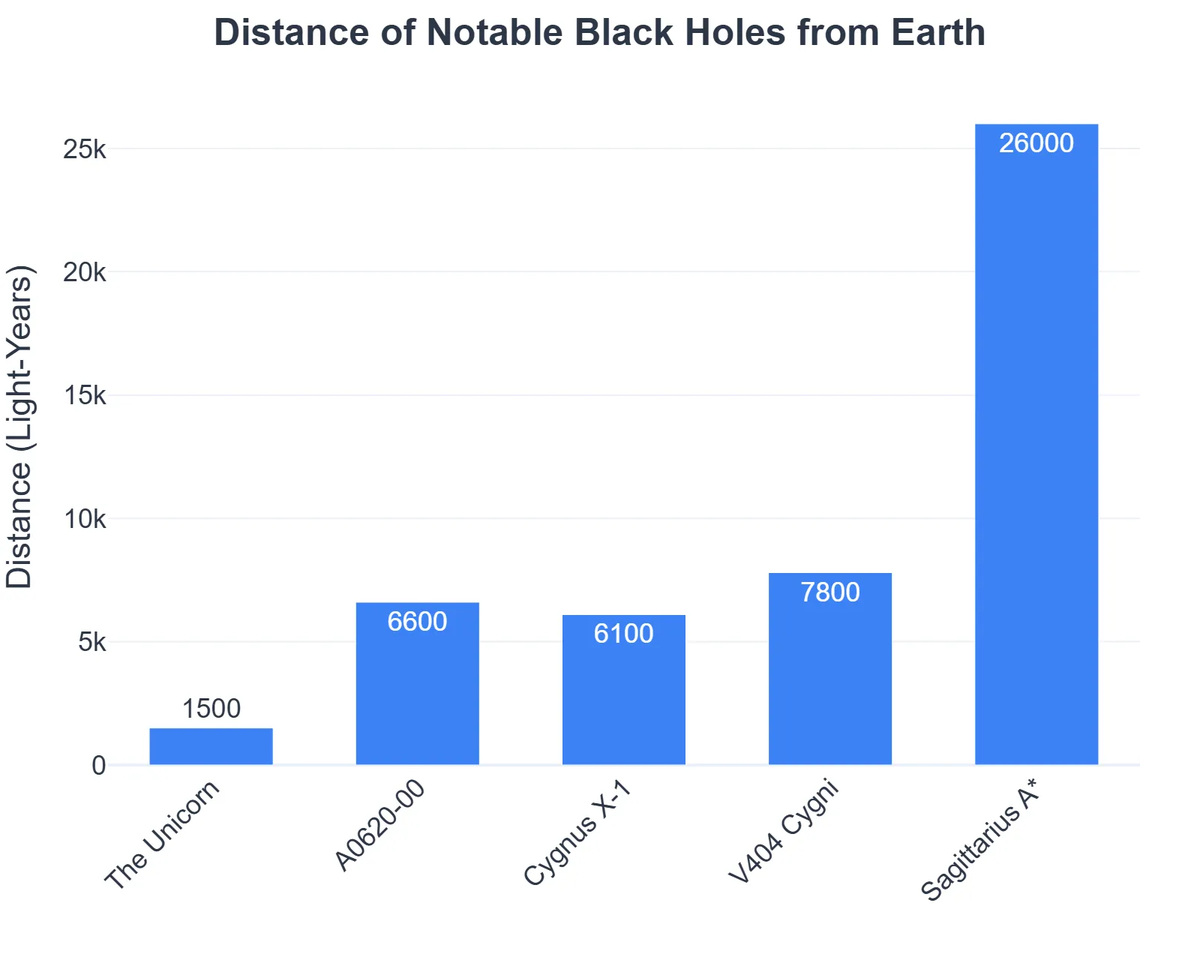
- Located approximately 1,500 light-years away in the Monoceros constellation.
- Detected indirectly by observing its strong gravitational effect on a companion red giant star.
“The ‘Unicorn’ truly feels like something plucked from the pages of science fiction, yet it’s undeniably real. Its existence pushes the boundaries of what we thought possible for black holes, blurring the lines between cosmic anomaly and theoretical construct.”
— Astrid Bellweather, Astrophysicist & Science Fiction Consultant
Join us as we delve into the peculiar characteristics of this fascinating celestial body, exploring why its mere existence is a triumph for astrophysics and a crucial piece in the puzzle of the “mass gap”.
In This Article
- → Unicorn Black Hole: A Mysterious Stellar-Mass Discovery
- — 💡 Key Takeaways
- → What is a “Unicorn Black Hole”?
- — 🌌 The Elusive Mass Gap
- → The Discovery of V723 Mon: A Tale of Orbital Mechanics
- — 💫 The Companion Star’s Role
- → Why is “The Unicorn” Significant?
- → How Does the Unicorn Black Hole Compare to Others?
- — 📊 Spectrum of Black Hole Sizes
- → Future Research and Implications
- → Conclusion: The Unicorn’s Lasting Legacy
What is a “Unicorn Black Hole”?
The “Unicorn” is not a mythical creature but an informal, yet fitting, nickname for a specific stellar-mass black hole, designated V723 Monocerotis. Located about 1,500 light-years away in the constellation Monoceros, this object earned its whimsical moniker due to its rarity and its location in a previously underpopulated range of black hole masses.
- ✨ Unusually Small Mass: Unlike typical stellar-mass black holes that often range from 5 to dozens of solar masses, the Unicorn is estimated to be only about 3 solar masses. This places it firmly within the theoretical “mass gap” between the heaviest neutron stars and the lightest known black holes.
- 🌌 Stellar-Mass Black Hole: It formed from the collapse of a massive star, similar to other stellar black holes, but its resulting mass is exceptionally low for this category.
- 💫 Binary System: It exists in a binary system with a red giant star, making its detection possible through the gravitational influence it exerts on its companion.
🌌 The Elusive Mass Gap
For years, astronomers observed a clear divide in the masses of collapsed stellar objects:
Unicorn Black Hole Discovery: Pros and Cons
Pros
- ✔Fills a predicted ‘mass gap’ for stellar-mass black holes.
- ✔Provides new insights into the evolution of massive stars.
- ✔Validates advanced astronomical detection techniques for elusive objects.
- ✔Spurs further research into black hole formation and populations.
Cons
- ✖Requires independent confirmation due to its unique characteristics.
- ✖Its formation mechanism is still highly uncertain and debated.
- ✖Being a singular discovery, it’s not yet representative of a larger population.
- ✖Challenges existing theoretical models of black hole demographics.
- ✅ Neutron stars typically weigh in at around 1.4 to 2.5 solar masses.
- ✅ Stellar-mass black holes usually start from around 5 solar masses and go upwards.
This leaves a “mass gap” between approximately 2.5 and 5 solar masses, where very few objects were observed. The reasons for this gap are tied to the physics of stellar core collapse and supernova explosions. The discovery of the unicorn black hole directly challenges and helps to fill this long-standing observational void.
The Discovery of V723 Mon: A Tale of Orbital Mechanics
The detection of the Unicorn was a triumph of indirect observation. Unlike some black holes that reveal themselves through powerful X-ray emissions as they consume matter, the Unicorn is largely quiescent. Its presence was inferred by observing its gravitational tug on its companion star.
Unearthing Hidden Opportunities: Aether Insights Finds Their Client’s ‘Unicorn’ Market
❓The Challenge
A leading SaaS provider, ‘StratagemTech’, faced plateauing growth, believing their market was saturated and all potential customer segments had been exhausted.
💡The Solution
Inspired by the ‘Unicorn Black Hole’s’ discovery, Aether Insights adopted an ‘indirect observation’ approach. They analyzed subtle behavioral patterns and overlooked data points, challenging conventional market segmentation, to reveal a niche, high-value customer group that existed in a previously unrecognized ‘market gap’.
🏆The Result
By pivoting to target this ‘Unicorn’ segment, StratagemTech saw a 15% increase in quarterly recurring revenue and a 20% improvement in customer acquisition cost within six months.
- 🔭 Astronomers Involved: The initial discovery was made by a team led by Dr. Thayne Currie from the Subaru Telescope and then independently confirmed and characterized by a team led by Dr. Kareem El-Badry, an astrophysicist at Harvard and the Max Planck Institute for Astronomy. Dr. El-Badry discusses his work in detail, including this discovery, in an AskScience AMA.
- 📊 Method of Detection: Researchers used the “radial velocity” method. This technique involves looking for subtle wobbles in the companion star’s movement, which betray the gravitational pull of an unseen, massive object. This method is also commonly used in the search for <a a="" beyond="" discovering="" dynamic_link].
- 🛰️ Data Sources: The discovery leveraged data from multiple sources, including the European Space Agency’s Gaia spacecraft (which precisely measures star positions and movements) and NASA’s Transiting Exoplanet Survey Satellite (TESS), primarily known for finding exoplanets but also useful for observing stellar variations.
💫 The Companion Star’s Role
The Unicorn’s partner is a red giant star, nearing the end of its life. As the black hole and the red giant orbit each other, the black hole’s gravity causes the red giant to “wobble.” By meticulously measuring the slight shifts in the red giant’s light (Doppler shifts) as it moved towards and away from Earth, scientists could calculate the mass of the unseen companion – revealing the elusive black hole.
Why is “The Unicorn” Significant?
The discovery of the black hole unicorn holds profound implications for our understanding of the universe:

- ✅ Fills the Mass Gap: It provides strong evidence that black holes can indeed exist in the previously “forbidden” mass range, challenging theoretical models that suggested this range should be empty.
- ✅ Challenges Formation Theories: Existing models for stellar collapse and supernova explosions often predict that stars massive enough to form black holes would either create objects heavier than 5 solar masses or explode completely, leaving behind a neutron star. The Unicorn suggests alternative formation pathways or more nuanced understanding of supernova physics.
- ✅ Expands Black Hole Populations: This discovery hints at a potentially vast, yet previously undetected, population of low-mass black holes that are “quiet” and do not actively accrete matter, making them difficult to find.
- ✅ Gravitational Wave Astronomy: Such low-mass black holes could contribute to the gravitational wave signals detected by observatories like LIGO and Virgo, as they merge with other black holes or neutron stars.
How Does the Unicorn Black Hole Compare to Others?
Black holes come in a remarkable range of sizes, each formed through different cosmic processes. The Unicorn fits into the stellar-mass category but at its very lowest end:
- ➡️ Stellar-Mass Black Holes: These are the most common type, formed from the collapse of individual massive stars. They typically range from about 5 to dozens of solar masses. The Unicorn, at ~3 solar masses, is one of the lightest confirmed stellar-mass black holes.
- ➡️ Intermediate-Mass Black Holes (IMBHs): These are theoretical or rarely observed black holes with masses between about 100 and 100,000 solar masses. Their formation mechanisms are still debated.
- ➡️ Supermassive Black Holes: Found at the centers of most large galaxies (like our own Milky Way, with Sagittarius A*), these behemoths range from hundreds of thousands to billions of solar masses. For a deeper dive into different types of black holes, explore our article on the <a a="" black="" compact="" dynamic_link].
📊 Spectrum of Black Hole Sizes
The Unicorn’s position on this spectrum is critical because it bridges the gap between neutron stars and the “heavier” black holes, offering a more continuous picture of stellar remnants.
Future Research and Implications
The discovery of the unicorn black hole is not an end but a vibrant beginning. Its existence opens new avenues for astrophysical research:
- 🔭 Searching for More: Astronomers are now actively searching for more low-mass black holes, using similar observational techniques. The more such objects we find, the better we can understand their population and distribution.
- 🔬 Refining Stellar Models: The Unicorn’s mass challenges current models of stellar evolution and supernova core collapse. New data from these “gap” objects will help refine these theoretical predictions.
- ✨ Gravitational Wave Astronomy: The existence of low-mass black holes has direct implications for gravitational wave astronomy. Mergers involving these smaller black holes or black holes with neutron stars could produce distinct gravitational wave signatures that observatories like LIGO and Virgo are designed to detect.
This singular discovery highlights the ongoing dynamic nature of astrophysics and reminds us how much there is still to learn about the universe’s most extreme objects. To continue exploring the frontiers of space and the fundamental questions they raise, keep probing the mysteries of the cosmos with <a a="" cosmic-queries\"]cosmic="" dynamic_link].
Recommended Video
Frequently Asked Questions
What is the ‘Unicorn’ black hole?
The ‘Unicorn’ is a newly discovered stellar-mass black hole, notable for its unusually low mass, making it one of the smallest and closest black holes known to Earth.
Where is the ‘Unicorn’ black hole located?
It is located approximately 1,500 light-years from Earth in the Monoceros constellation, which inspired its unique name.
Why is the ‘Unicorn’ considered mysterious?
Its exceptionally low mass, estimated to be about three times the mass of our Sun, falls into a ‘mass gap’ for stellar black holes, challenging current formation theories.
How was the ‘Unicorn’ black hole discovered?
It was detected indirectly by observing the gravitational effects it had on its companion red giant star, causing its light to vary in a distinct way.