


Our planet is a dynamic, living entity, constantly shaped by powerful, unseen forces beneath its surface. Among the most fundamental of these forces are the movements of Earth’s massive lithospheric plates, which interact at critical zones known as tectonic plate boundaries. These boundaries are not merely lines on a map; they are the epicenters of geological activity, responsible for everything from towering mountain ranges to devastating earthquakes and volcanic eruptions. Understanding them is key to grasping the hidden dynamics of our planet.
💡 Key Takeaways
- Understand the three primary types of tectonic plate boundaries: convergent, divergent, and transform.
- Learn how plate interactions cause significant geological phenomena like earthquakes, volcanoes, and mountain ranges.
- Discover the global impact of plate movements on Earth’s climate and landforms over geological time.
- Appreciate the dynamic, ever-changing nature of Earth’s crust driven by internal heat.
“Tectonic plate boundaries are Earth’s living seams, constantly reshaping our continents, driving seismic activity, and even influencing long-term climate patterns. Understanding them is key to deciphering our planet’s past, present, and future.”
— Marcus Sterling, Geophysical Explorer & Climate Dynamics Analyst
In this comprehensive guide, we’ll delve deep into the world of plate boundaries, exploring their types, the geological processes they unleash, and why they are so vital to the very fabric of our Earth. For a broader understanding of the underlying science, explore our insights into Earth’s Unseen Forces: The Hidden Dynamics of Our Planet.
In This Article
- — 💡 Key Takeaways
- → What Are Tectonic Plate Boundaries?
- → The Three Types of Plate Boundaries
- — 1. Convergent Plate Boundaries 💥
- — 2. Divergent Plate Boundaries ➡️
- — 3. Transform Plate Boundaries ↔️
- → Understanding World Plate Boundaries and Their Impact
- → Why Do Plate Boundaries Matter?
- → Conclusion
What Are Tectonic Plate Boundaries?
At its core, Earth’s outermost layer, the lithosphere, is broken into a series of rigid slabs called tectonic plates. These plates are in constant, albeit slow, motion, driven by convection currents within the Earth’s mantle. A tectonic plate boundary is simply the meeting point where two or more of these massive plates interact. It’s at these junctions that the vast majority of Earth’s geological activity occurs.
The concept of plate tectonics itself revolutionized our understanding of geology. To learn more about this foundational theory, consider reading our detailed guide on Plate Tectonics Explained: A Comprehensive Guide.

The Three Types of Plate Boundaries
The interactions between plates vary depending on the direction of their movement relative to each other. This gives rise to the three types of plate boundaries, each with distinct geological consequences.
1. Convergent Plate Boundaries 💥
Convergent boundaries occur where two plates move towards each other, resulting in a collision. The outcome of this collision depends on the type of crust involved (oceanic or continental). These are often areas of intense geological activity, including mountain building, volcanism, and deep earthquakes.
For a detailed breakdown of these complex interactions, refer to this comprehensive guide on Convergent Boundary dynamics.
- ✅ Oceanic-Oceanic Convergence: When two oceanic plates collide, one is typically forced beneath the other in a process called subduction. This leads to the formation of deep oceanic trenches and volcanic island arcs (e.g., Mariana Trench and the Japanese islands).
- ✅ Oceanic-Continental Convergence: Here, the denser oceanic plate subducts beneath the lighter continental plate. This process creates volcanic mountain ranges along the continental edge (e.g., the Andes Mountains) and deep ocean trenches offshore.
- ✅ Continental-Continental Convergence: When two continental plates collide, neither can subduct significantly due to their similar densities. Instead, the crust crumples, folds, and pushes upwards, forming vast mountain ranges (e.g., the Himalayas, formed by the collision of the Indian and Eurasian plates).
2. Divergent Plate Boundaries ➡️
Divergent boundaries are zones where plates move away from each other. This pulling apart of the crust creates new lithospheric material through volcanism and is primarily responsible for the expansion of ocean basins and the formation of rift valleys.
A prime example of a divergent boundary in action is Iceland, where the Mid-Atlantic Ridge surfaces, as explored by The Meeting of Tectonic Plates in Iceland.
- ✅ Mid-Ocean Ridges: In oceanic settings, divergence leads to the formation of underwater mountain ranges called mid-ocean ridges. Magma rises from the mantle to fill the gap, creating new oceanic crust in a process known as seafloor spreading (e.g., the Mid-Atlantic Ridge).
- ✅ Continental Rift Valleys: On continents, divergent forces can cause the continental crust to stretch and thin, forming rift valleys. If the rifting continues, it can eventually lead to the formation of a new ocean basin (e.g., the East African Rift Valley).
3. Transform Plate Boundaries ↔️
Transform boundaries occur where two plates slide horizontally past each other, without significant creation or destruction of crust. While they don’t produce volcanoes, these boundaries are notorious for generating powerful earthquakes due to the immense friction and stress that builds up as the plates grind against one another.
The dynamics of these side-by-side movements are crucial for understanding seismic activity. Learn more in this Transform Boundary guide.
- ✅ Fault Lines: Transform boundaries are characterized by large fault systems. The friction between the plates causes immense stress to accumulate, which is eventually released as earthquakes.
- ✅ Major Examples: The most famous example is the San Andreas Fault in California, where the Pacific Plate and the North American Plate slide past each other. Understanding Earth’s Fault Lines: Exploring Plate Boundaries and Movements is essential for comprehending earthquake risks.
Understanding World Plate Boundaries and Their Impact
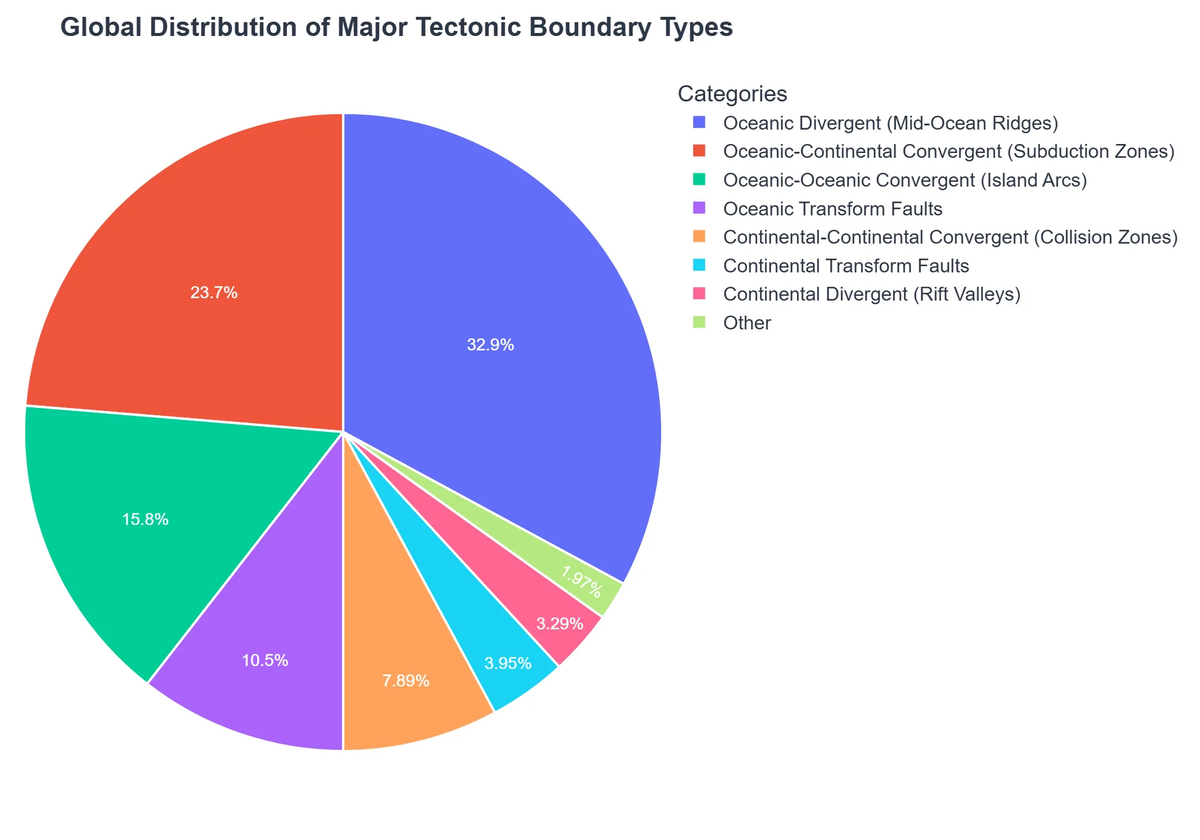
The distribution of world plate boundaries reveals a clear pattern, often correlating with zones of high seismic and volcanic activity. The “Ring of Fire” around the Pacific Ocean is a prime example, a direct consequence of numerous convergent and transform boundaries.
Tectonic Plate Boundaries: Benefits and Challenges of Understanding
Pros
- ✔Explains the causes of major natural phenomena like earthquakes and volcanoes.
- ✔Fundamental for understanding Earth’s dynamic geological processes and landforms.
- ✔Crucial for hazard assessment, mitigation, and land-use planning.
- ✔Informs resource exploration, such as geothermal energy and mineral deposits.
Cons
- ✖Requires a grasp of complex geological and geophysical concepts.
- ✖Can be challenging to visualize large-scale, long-term Earth processes.
- ✖Understanding evolves with new scientific discoveries, requiring continuous updates.
- ✖May be abstract without visual aids or practical examples of their effects.
- 💡 Earthquakes: All types of tectonic plate boundaries can generate earthquakes, but transform and convergent boundaries are particularly prone to large, destructive ones. The sudden release of accumulated stress along faults causes the ground to shake.
- 💡 Volcanoes: Most volcanoes form at convergent boundaries (subduction zones) and divergent boundaries (mid-ocean ridges and rift valleys) where magma rises to the surface.
- 💡 Mountain Building: Convergent boundaries, especially continental-continental collisions, are responsible for the formation of the world’s highest and most extensive mountain ranges.
- 💡 Tsunamis: Major earthquakes at oceanic convergent boundaries, particularly those causing significant vertical displacement of the seafloor, can displace massive amounts of water, leading to devastating tsunamis.
The slow but relentless forces driving these plate movements are fundamental to Earth’s geological processes. Dive deeper into the mechanisms by exploring Tectonic Plate Motion: Decoding Earth’s Engine.
Why Do Plate Boundaries Matter?
Understanding plate boundaries is not just an academic exercise; it has profound implications for human society and our planet’s future.
- ➡️ Natural Hazard Mitigation: By identifying active plate boundaries, scientists can better predict and prepare for earthquakes, volcanic eruptions, and tsunamis, potentially saving lives and mitigating damage.
- ➡️ Resource Exploration: Many valuable mineral deposits, oil and gas reserves, and geothermal energy sources are found in proximity to plate boundaries, formed by the geological processes occurring there.
- ➡️ Geographical Shaping: Plate movements continually reshape continents and ocean basins, influencing climate patterns, biodiversity, and the very distribution of land and water on Earth.
- ➡️ Scientific Discovery: Studying plate boundaries offers invaluable insights into Earth’s internal structure, its thermal engine, and the long-term evolution of our planet.

Recommended Video
Conclusion
Tectonic plate boundaries are the dynamic seams of our planet, constantly shaping its surface and driving the powerful geological events that define our world. From the majestic heights of the Himalayas to the destructive force of a tsunami, the evidence of their relentless activity is all around us.
By comprehending the intricate dance of these geological giants – the pushing, pulling, and grinding that occurs at each boundary – we gain a deeper appreciation for the ‘unseen forces’ that truly govern our planet. This knowledge empowers us to better understand, predict, and adapt to Earth’s powerful, ever-changing nature.
Frequently Asked Questions
What are the three main types of tectonic plate boundaries?
The three main types are convergent (plates move towards each other), divergent (plates move away from each other), and transform (plates slide past each other horizontally).
How do tectonic plate boundaries cause earthquakes?
Earthquakes occur when stress builds up along fault lines at plate boundaries due to friction, and then suddenly releases, causing the ground to shake.
Are volcanoes only found at plate boundaries?
While most volcanoes are found at convergent and divergent plate boundaries, some, known as “hot spot” volcanoes (like Hawaii), form in the middle of plates where magma plumes rise from the mantle.
What is subduction?
Subduction is a process occurring at convergent boundaries where one oceanic plate is forced to slide beneath another plate (either oceanic or continental) into the Earth’s mantle.