


GJ 1214 b: Exploring a Waterworld Exoplanet
In the vast cosmic ocean, discoveries of exoplanets continue to reshape our understanding of planetary formation and diversity. Among these distant worlds, one stands out for its enigmatic nature and the tantalizing possibility of being a true “waterworld”: GJ 1214 b. This fascinating exoplanet, located relatively close to our solar system, has been a focal point for astronomers eager to probe the mysteries of worlds vastly different from our own. Its unique characteristics challenge conventional classifications and offer unprecedented insights into the potential abundance of water-rich planets beyond Earth.
💡 Key Takeaways
- GJ 1214 b is a low-density super-Earth, suggesting a significant portion of its mass is water, potentially making it a ‘waterworld.’
- Its atmosphere is believed to be thick and steamy, making direct observation of a solid surface or liquid ocean challenging.
- The planet’s proximity to its star results in high temperatures, meaning any water would exist in exotic states like ‘hot ice’ or supercritical fluid.
- Studying GJ 1214 b provides crucial data for understanding the diversity of exoplanet compositions and atmospheres in our galaxy.
“GJ 1214 b truly blurs the lines between science and imagination. It’s not just a planet with water; it’s a testament to the incredible diversity of worlds out there, challenging our very definition of ‘Earth-like’ and fueling countless stories of what might exist beneath those alien oceans.”
— Astrid Bellweather, Astrophysicist & Science Fiction Consultant
This comprehensive guide delves into everything we know about GJ 1214 b, from its initial discovery to the cutting-edge observations made by powerful telescopes like Hubble and Webb, and what these findings imply for the future of exoplanet research. Prepare to journey to a world where water might exist in forms we can barely imagine.
In This Article
- → GJ 1214 b: Exploring a Waterworld Exoplanet
- — 💡 Key Takeaways
- → 🌌 Discovery and Location of GJ 1214 b
- → 💧 Characteristics: Is GJ 1214 b a True Waterworld?
- → 🔬 Unraveling Atmospheric Mysteries with Telescopes
- — Early Observations: The Hubble Haze
- — The Webb Revolution: Peering Through the Veil
- → ⚖️ GJ 1214 b: Super-Earth, Mini-Neptune, or Something Else?
- → 🔭 Implications for Exoplanet Research
- → ⏭️ Challenges and Future Prospects
- → Conclusion: A Glimpse into Alien Worlds
🌌 Discovery and Location of GJ 1214 b

GJ 1214 b was discovered in 2009 by the MEarth Project, a robotic observatory designed to search for exoplanets transiting small, red dwarf stars. Its detection marked a significant milestone, as it was one of the first super-Earths found to have its mass and radius precisely determined.
- ✅ Location: The exoplanet orbits GJ 1214, a red dwarf (M-dwarf) star located approximately 48 light-years away in the constellation Ophiuchus. Its relative proximity makes it an excellent target for detailed follow-up studies.
- ➡️ Discovery Method: It was discovered using the transit method, where astronomers observe a slight dimming of the host star’s light as the exoplanet passes in front of it. This method allows for the determination of the planet’s radius.
- 💡 Host Star Characteristics: GJ 1214 is a faint, cool star, significantly smaller and less luminous than our Sun. This characteristic is crucial, as it allows planets in close orbits to maintain relatively cooler temperatures, potentially suitable for liquid water under certain atmospheric conditions.
- 🗓️ Orbital Period: GJ 1214 b orbits its star incredibly closely, completing a full revolution in just 1.58 Earth days. This tight orbit means it receives a substantial amount of radiation from its star.
💧 Characteristics: Is GJ 1214 b a True Waterworld?
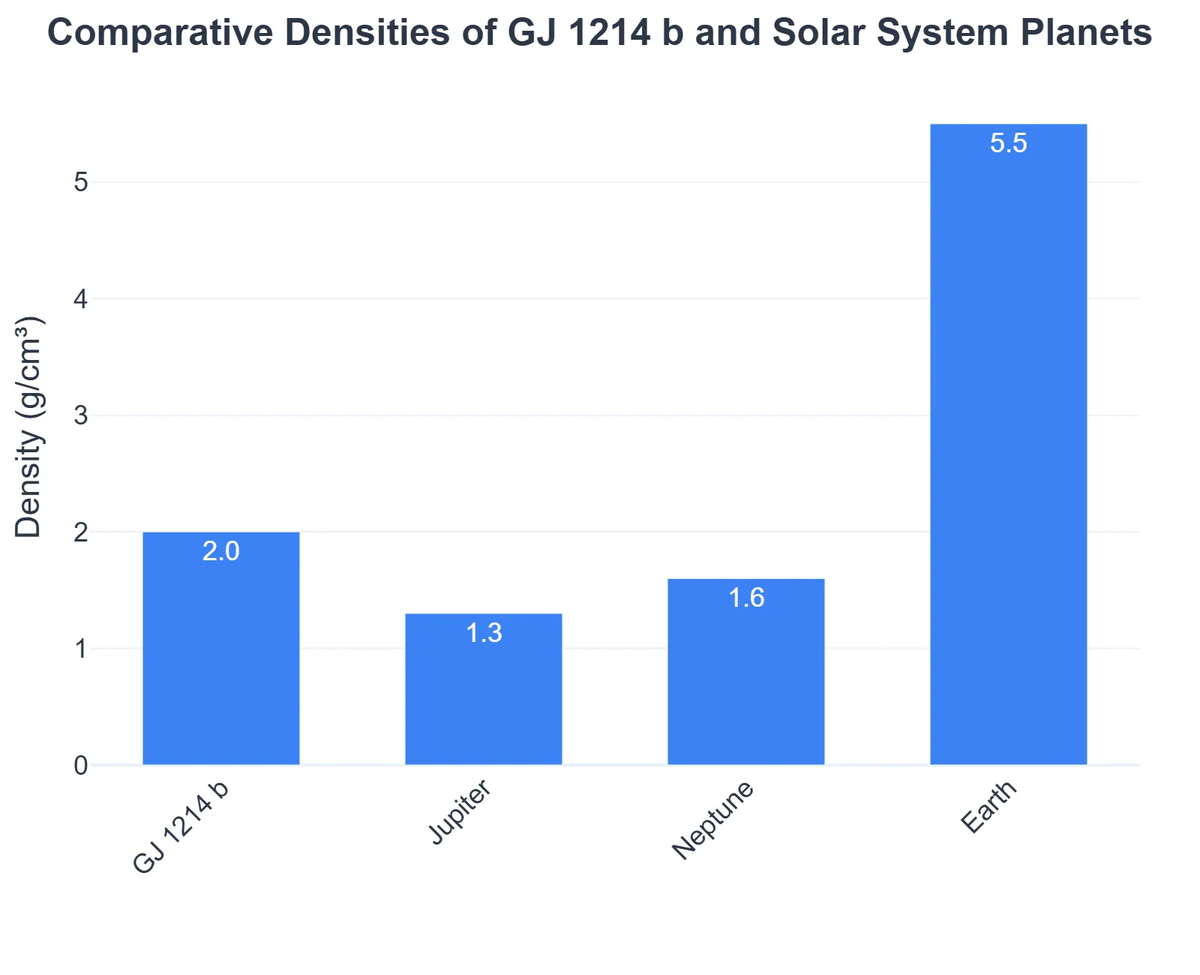
The most intriguing aspect of GJ 1214 b is its peculiar density, which strongly suggests a composition unlike any planet in our solar system. Its mass is about 6.5 times that of Earth, and its radius is approximately 2.7 times Earth’s. These figures lead to a calculated density that is significantly lower than that of rocky planets but higher than gas giants.
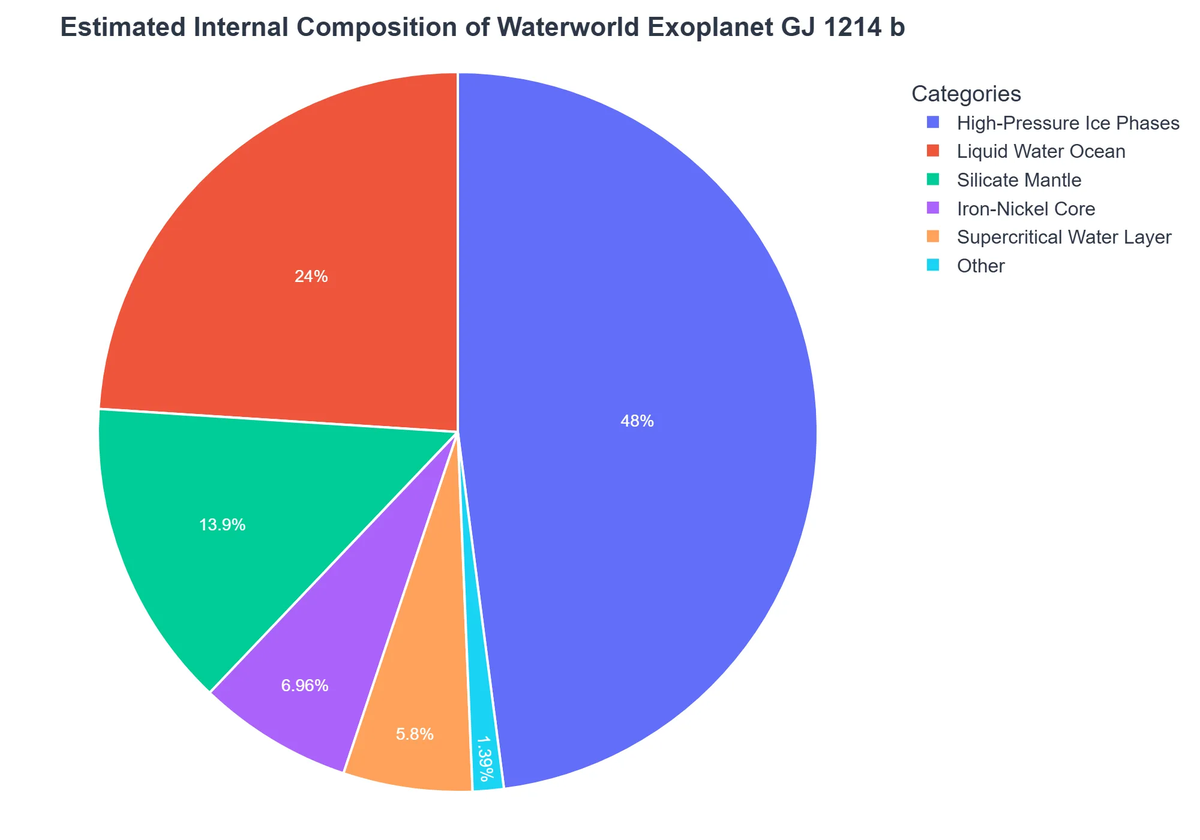
- ✅ Density Anomaly: This low density initially led scientists to hypothesize that GJ 1214 b could be a “waterworld” – a planet composed largely of water, possibly over 75% of its mass. For comparison, Earth’s water content is a mere fraction of its total mass.
- ➡️ Exotic Water States: Given the immense pressures and temperatures expected beneath its atmosphere, this water wouldn’t be in the familiar liquid or gaseous states. Instead, it could exist as exotic forms of ice, such as Ice VII, or even a supercritical fluid that blurs the line between liquid and gas.
- 💡 Surface Conditions: While often called a waterworld, the surface of GJ 1214 b is far from habitable in the Earth-like sense. The planet’s close orbit to its star results in equilibrium temperatures estimated to be around 282°C (540°F), far too hot for liquid water on the surface under typical pressures. Any water would likely be in a superheated, high-pressure state beneath a thick atmosphere.
- 🔬 Compositional Models: Models suggest its interior could consist of a small rocky core, a thick mantle of exotic ice/supercritical water, and an extensive hydrogen-helium atmosphere.
🔬 Unraveling Atmospheric Mysteries with Telescopes
Characterizing the atmosphere of GJ 1214 b has been a monumental challenge, but crucial for understanding its true nature. Early observations provided tantalizing clues, while newer telescopes are now offering unprecedented clarity.
Early Observations: The Hubble Haze
The Hubble Space Telescope was used to study GJ 1214 b’s atmosphere by observing how the star’s light changed as it passed through the planet’s atmospheric limb. However, the results were inconclusive.
Exploring GJ 1214 b: A Waterworld Exoplanet
Pros
- ✔Offers insights into the formation and evolution of water-rich exoplanets.
- ✔Potential for novel forms of life adapted to extreme, high-pressure aquatic environments.
- ✔Provides a unique case study for planetary diversity beyond rocky or gas giant worlds.
- ✔Relatively close proximity (48 light-years) makes it a feasible target for advanced observation.
Cons
- ✖Extreme temperatures and pressures likely preclude Earth-like surface habitability.
- ✖Thick, hazy atmosphere complicates direct observation of the surface and detailed atmospheric analysis.
- ✖Lack of a solid surface poses challenges for traditional exploration concepts.
- ✖Presence of exotic water phases (e.g., ‘hot ice’) makes understanding its internal structure complex.
- 🔭 Featureless Spectrum: Hubble’s observations revealed a remarkably flat, featureless spectrum, suggesting the presence of a thick, high-altitude haze or cloud layer that obscured lower atmospheric features. This haze made it difficult to determine the precise chemical composition of its atmosphere, leaving scientists to ponder whether it contained significant amounts of water vapor, methane, or other molecules.
- ☁️ Obscuring Clouds: This thick cloud cover prevented light from penetrating deeply into the atmosphere, making it impossible for Hubble to detect absorption lines from water, methane, or carbon dioxide.
The Webb Revolution: Peering Through the Veil
The James Webb Space Telescope (JWST), with its superior infrared capabilities, has proven to be a game-changer for atmospheric characterization, offering new insights into GJ 1214 b.
- 🚀 Deeper Penetration: Webb’s instruments can detect a wider range of infrared wavelengths, allowing light to penetrate deeper into the atmosphere, potentially below the obscuring haze layer.
- 💧 Water Vapor Detection: Recent observations by Webb have provided stronger evidence for the presence of water vapor in the atmosphere of GJ 1214 b, supporting the water-rich composition hypothesis. These findings are crucial for distinguishing between a truly water-dominated world and a mini-Neptune with a hydrogen-rich envelope.
- 🌡️ Temperature Mapping: Webb’s data has also enabled scientists to measure the light emitted by the planet itself, providing insights into its temperature profile and potential cloud structures. This helps refine models of its atmospheric circulation and composition. Researchers Measure the Light Emitted by a Sub-Neptune Planet’s Atmosphere for the First Time.
- 🔍 Mini-Neptune Hypothesis Revisited: While supporting the water-rich scenario, Webb’s observations also lean towards GJ 1214 b potentially being more akin to a “mini-Neptune” – a sub-Neptune class planet with a substantial hydrogen-helium envelope containing water vapor, rather than a solid surface beneath a massive water ocean. Webb Reveals Details About Exoplanet GJ 1214 b, A Mini-Neptune.
⚖️ GJ 1214 b: Super-Earth, Mini-Neptune, or Something Else?
The classification of GJ 1214 b has been a subject of ongoing debate among astronomers. It falls into a size category that doesn’t exist in our solar system, making it a prime example of exoplanet diversity.
Cosmic Learning Labs Boosts Engagement with Deep-Dive Exoplanet Content
❓The Challenge
‘Cosmic Learning Labs’ struggled with low engagement in their astronomy modules, as users found general exoplanet information too abstract and lacked a compelling hook.
💡The Solution
Inspired by the detailed and illustrative approach of ‘GJ 1214 b: Exploring a Waterworld Exoplanet,’ they revamped their content to feature specific, intriguing case studies. By focusing on the ‘waterworld’ narrative of GJ 1214 b, they made complex planetary science highly relatable and engaging.
🏆The Result
This content strategy led to a 40% increase in average session duration for astronomy modules and a 25% rise in module completion rates within six months.
- 🌎 Super-Earths: These are planets larger than Earth but smaller than Neptune, typically with masses between 1 to 10 Earth masses. Many super-Earths are thought to be rocky, like Earth, but GJ 1214 b’s low density sets it apart. For instance, Proxima Centauri b: Exploring Earth’s Nearest Exoplanet is a super-Earth with a higher density, suggesting a more rocky composition.
- 🪐 Mini-Neptunes: These are also larger than Earth but smaller than Neptune, characterized by a substantial hydrogen-helium atmosphere enveloping a core of rock and ice. Many exoplanets in this size range are now believed to be mini-Neptunes rather than true rocky super-Earths.
- 🔄 The Ambiguity: GJ 1214 b’s intermediate density and the evidence of a thick atmosphere with water vapor mean it could be described as a super-Earth with an unusually large volatile envelope, or a mini-Neptune with a very water-rich interior. This ambiguity highlights the incredible variety of planetary compositions possible beyond our solar system.
- 💡 Comparative Insights: Other similar-sized exoplanets like gj 1132 b (another super-Earth/mini-Neptune candidate) and gj 367b (an ultra-short period rocky planet) offer valuable comparisons for understanding the range of compositions and atmospheric properties in this intermediate planet class.
🔭 Implications for Exoplanet Research
The study of GJ 1214 b holds profound implications for the broader field of exoplanet research and our quest to understand the universe.
- 🚀 Planet Formation Models: This unique planet challenges existing models of planet formation and migration. How did a water-rich world form so close to its star? It suggests that planets can form far out in a protoplanetary disk where water ice is abundant and then migrate inwards, or that water-rich planetesimals were common in the inner disk.
- 🌍 Planetary Diversity: GJ 1214 b underscores the incredible diversity of planets that exist. It shows that not all super-Earths are rocky, and that there’s a spectrum of compositions between terrestrial worlds and gas giants. For a broader perspective on the variety of worlds being discovered, explore Exoplanet: Discovering Worlds Beyond Our Solar System.
- 💧 Abundance of Water: The potential for a planet composed largely of water hints at the vast reserves of water present in the cosmos, even on worlds where conditions are far from Earth-like. This is crucial for understanding the distribution of ingredients necessary for life.
- 🧪 Atmospheric Characterization Techniques: The challenges and successes in characterizing GJ 1214 b’s atmosphere push the boundaries of observational astronomy and atmospheric modeling. It highlights the indispensable role of next-generation telescopes like JWST in deciphering the composition of alien skies. More information can be found at GJ 1214 b – NASA Science.
⏭️ Challenges and Future Prospects
Despite significant progress, understanding GJ 1214 b fully presents ongoing challenges, yet also promises exciting future discoveries.
- 🔍 Pinpointing Composition: While Webb has provided clearer insights, definitively determining the precise ratio of water to rock to gas in GJ 1214 b’s interior remains a complex task. Further, refining the atmospheric composition requires even more detailed spectroscopic data.
- 💨 Atmospheric Dynamics: The superheated, high-pressure atmosphere is likely dynamic, with extreme winds and weather patterns. Modeling these conditions accurately is essential for a complete picture.
- 🛰️ Next-Generation Missions: Future space telescopes and ground-based observatories with even greater sensitivity and spectral resolution will continue to probe the secrets of GJ 1214 b. These advancements will help us move beyond hypotheses to more definitive conclusions about this “waterworld.” For instance, NASA continues to invest in missions that image and characterize exoplanets. NASA’s Webb Takes Closest Look Yet at Mysterious Planet.
Recommended Video
Conclusion: A Glimpse into Alien Worlds
GJ 1214 b stands as a testament to the incredible diversity of exoplanets awaiting discovery and study. What began as a mere dimming of a distant star has unfolded into the potential unveiling of a world fundamentally different from our own – a super-Earth or mini-Neptune dominated by exotic states of water, shrouded in a thick, steamy atmosphere. Its enigmatic nature serves as a powerful reminder that the universe holds surprises beyond our wildest imagination.
The journey to understand GJ 1214 b is far from over. As technology advances and our observational capabilities sharpen, we move ever closer to unraveling its full story, enriching our understanding of planetary formation, atmospheric science, and the very definition of a “world.” It is through such cosmic queries that we continue to probe the mysteries of the universe, one fascinating exoplanet at a time. Dive deeper into these astronomical wonders with Cosmic Queries: Probing the Mysteries of the Universe.
Frequently Asked Questions
What is GJ 1214 b?
GJ 1214 b is a super-Earth exoplanet located about 48 light-years away, known for its low density, suggesting it may be a ‘waterworld’ with a substantial amount of water in its composition.
Why is GJ 1214 b considered a ‘waterworld’?
Its measured mass and radius indicate a density significantly lower than rocky planets, consistent with a large fraction of its mass being water, possibly in exotic states like ‘hot ice’ or supercritical fluid due to extreme pressure and temperature.
Can life exist on GJ 1214 b?
While it contains water, GJ 1214 b is very hot (around 200°C/400°F) and has a thick, steamy atmosphere. These conditions make it unlikely to support life as we know it on its surface, but the potential for exotic chemistries remains a subject of scientific speculation.
How was GJ 1214 b discovered?
It was discovered in 2009 using the transit method by the MEarth Project, which observes the slight dimming of a star’s light as a planet passes in front of it.