
The human mind is a labyrinth of complex interactions, biases, and social influences. Understanding how we behave, especially in group settings, is a cornerstone of social psychology. Among the most illuminating areas of study are conformity studies, which delve into the powerful, often subtle, ways that group pressure can shape individual actions and beliefs. These groundbreaking experiments have not only unveiled the mechanisms of social influence but have also reshaped our understanding of free will, obedience, and the very fabric of society.
💡 Key Takeaways
- Classic experiments like Asch, Milgram, and Zimbardo reveal the powerful human tendency to conform under social pressure.
- Conformity is influenced by factors such as group size, unanimity, and the presence of authority.
- Understanding conformity helps explain phenomena ranging from everyday decisions to historical events.
- Ethical considerations in social psychology research highlight the need for participant welfare and informed consent.
“Conformity studies vividly illustrate the neural dance between individual autonomy and social embeddedness. Our brains are wired to navigate complex social cues, sometimes at the expense of independent judgment, offering profound insights into human decision-making.”
— Eleanor Vance, Neuroscience Communicator & Cognitive Psychologist
From the subtle pull of peer pressure in our daily lives to the profound impact of collective behavior in historical events, the dynamics of conformity are ever-present. This article will serve as your definitive guide to the classic social psychology experiments that laid bare these fundamental truths, offering practical insights into how these principles play out in our world. For a broader perspective on the intricate workings of the human psyche, explore our comprehensive resource on The Human Enigma: Unlocking the Secrets of Our Body and Mind.
In This Article
- — 💡 Key Takeaways
- → What is Conformity? Understanding the Basics
- — 💡 Types of Conformity
- — 🧠 Why Do We Conform?
- → The Groundbreaking Asch Conformity Experiments
- — 📋 The Setup: A Simple Line Test
- — 📊 Shocking Results and Key Findings
- — 🔑 Factors Influencing Asch Conformity
- → Beyond Asch: Other Influential Social Psychology Studies
- — ⚡ The Milgram Experiment: Obedience to Authority
- — ⛓️ The Stanford Prison Experiment: Roles and Situational Influence
- → The Mechanisms Behind Conformity
- — 🤝 Normative Social Influence
- — 🧐 Informational Social Influence
- → Real-World Applications and Ethical Considerations
- — 🌐 Conformity in Everyday Life
- — ⚖️ Ethical Dilemmas in Social Experimentation
- → Conclusion
What is Conformity? Understanding the Basics
At its core, conformity is a type of social influence involving a change in belief or behavior in order to fit in with a group or comply with social norms. It’s a pervasive aspect of human interaction, driven by our innate need for social connection and acceptance.
💡 Types of Conformity
- ✅ Compliance: Publicly conforming to group pressure while privately disagreeing. This is often temporary and specific to the situation.
- ✅ Identification: Conforming to the demands of a social role or group expectation, often because you value membership in that group. It’s a stronger form of conformity than compliance.
- ✅ Internalization: Publicly and privately conforming to the group’s beliefs or behaviors. This is the deepest level of conformity, where the new belief becomes integrated into your own value system.
🧠 Why Do We Conform?
Our reasons for conforming are multifaceted, stemming from both psychological and social needs:
- ➡️ Desire to Fit In: We want to be liked and accepted by others (normative influence).
- ➡️ Desire to Be Correct: We believe others might have more accurate information, especially in ambiguous situations (informational influence).
- ➡️ Role Expectations: Society assigns roles, and we often conform to the behaviors associated with those roles.
- ➡️ Fear of Rejection/Punishment: We may conform to avoid negative consequences or social ostracism.
The Groundbreaking Asch Conformity Experiments

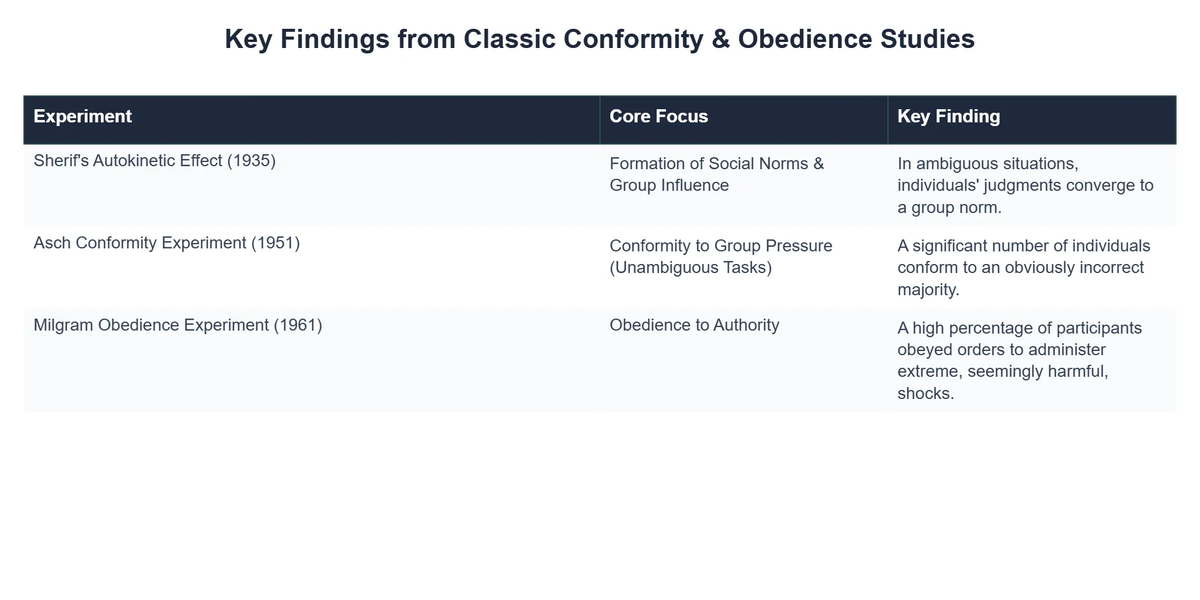
When discussing conformity studies, one name inevitably rises to the forefront: Solomon Asch. His seminal research in the 1950s provided compelling empirical evidence for the power of social influence on individual judgment. The Asch conformity studies became a benchmark for understanding how seemingly rational individuals could succumb to group pressure, even when the group’s judgment was clearly wrong.
📋 The Setup: A Simple Line Test
Asch designed an experiment that was deceptively simple. Participants were told they were taking part in a visual judgment task. They were shown a target line and then asked to identify which of three comparison lines matched its length. The catch? All but one participant in each group were confederates (actors) who were instructed to give incorrect answers on certain trials.
The true participant was usually seated towards the end, hearing several confederates give the wrong answer before it was their turn to respond. This setup created a clear conflict between their own perception and the unanimous (but incorrect) judgment of the group. For a detailed breakdown, see our article on the Asch Conformity Experiments: Understanding Social Influence.
📊 Shocking Results and Key Findings
The results were startling:
- 💡 Approximately 32% of participants conformed to the incorrect majority answer over the critical trials.
- 💡 A staggering 75% of participants conformed at least once.
- 💡 Only about 25% of participants consistently stuck to their own judgments throughout the experiment.
Asch later interviewed the participants who conformed. Many stated they knew the majority answer was wrong but conformed to avoid feeling awkward, ridiculed, or like an outcast. This highlights the immense power of normative social influence – the desire to be liked and accepted.
🔑 Factors Influencing Asch Conformity
- ✅ Group Size: Conformity increased with group size up to about 3-5 confederates, after which it plateaued.
- ✅ Unanimity: The presence of even one dissenter (another participant or confederate who gave the correct answer) drastically reduced conformity, often by 80%. This shows the power of having an ally.
- ✅ Task Difficulty: When the line judgment task became more ambiguous, conformity rates tended to increase, as participants were less sure of their own judgment (informational influence).
- ✅ Public vs. Private Response: When participants were allowed to write down their answers privately, conformity rates dropped significantly.
You can read more about the profound insights from Asch’s work at Verywell Mind’s article on The Asch Conformity Experiments.
Beyond Asch: Other Influential Social Psychology Studies
While Asch’s work is central to conformity psychology studies, other iconic experiments in social psychology have also shed light on related aspects of social influence, obedience, and the power of situations over individual disposition. These studies, though not purely about conformity, underscore the profound impact of social environments on human behavior.
⚡ The Milgram Experiment: Obedience to Authority
Stanley Milgram’s controversial experiments in the early 1960s explored the extent to which individuals would obey orders from an authority figure, even when those orders conflicted with their personal conscience. Participants (teachers) were instructed to administer what they believed were increasingly severe electric shocks to a “learner” (a confederate) for incorrect answers. The shocking finding was that a significant percentage of participants administered the maximum, seemingly dangerous, shock level simply because they were told to do so by an authoritative experimenter.
While often discussed alongside conformity, Milgram’s work is distinct in its focus on obedience to authority rather than conforming to peer pressure. However, both highlight how external social forces can override individual morality and judgment.
⛓️ The Stanford Prison Experiment: Roles and Situational Influence
Philip Zimbardo’s 1971 Stanford Prison Experiment (SPE) examined the psychological effects of perceived power, focusing on the dynamic between prisoners and guards. College students were randomly assigned roles, and the experiment quickly escalated, with guards exhibiting sadistic behavior and prisoners becoming submissive or rebellious. The experiment was terminated prematurely due to the extreme psychological distress experienced by participants.
FitFlow’s Social Surge: Boosting Engagement with Conformity Insights
❓The Challenge
FitFlow faced significant user churn and low engagement with its fitness programs, as users felt isolated in their solo health journeys, lacking a sense of shared purpose.
💡The Solution
Inspired by the principles of conformity, FitFlow revamped its app, introducing ‘Group Challenges’ with visible participant progress and ‘Community Leaderboards’ to foster identification and normative influence. They also prominently featured ‘Success Stories’ from peers, subtly encouraging users to conform to positive fitness behaviors.
🏆The Result
Within three months, FitFlow observed a 25% increase in user retention for challenge participants and a 40% growth in daily active engagement with community features.
The SPE, while heavily criticized for ethical reasons, illustrated the powerful influence of social roles and situations on behavior, demonstrating how individuals can readily adopt behaviors congruent with their assigned roles, even if those behaviors deviate from their normal personality. This relates to conformity in the sense that individuals conform to the expectations of their roles within a specific social structure. For more on these and other pivotal studies, consider exploring our guide to Iconic Social Experiments: Unveiling Human Behavior.
For a broader perspective on five famous social psychology experiments, including some mentioned here, you can consult Labvanced’s article on Classic Experiments in Social Psychology.
The Mechanisms Behind Conformity
The classic conformity studies revealed not just that people conform, but also provided crucial insights into why they conform. The two primary mechanisms are normative social influence and informational social influence.
🤝 Normative Social Influence
- ➡️ Definition: This occurs when people conform to avoid rejection or gain social acceptance. We adjust our behavior to match group norms because we desire to be liked and to fit in.
- ➡️ Example: In the Asch experiment, participants often conformed because they didn’t want to stand out or be seen as “different” from the rest of the group, even when they knew the group was wrong. It’s about meeting social expectations.
- ➡️ Outcome: Often leads to public compliance (changing behavior) without private acceptance (changing belief).
🧐 Informational Social Influence
- ➡️ Definition: This occurs when people conform because they believe others have more accurate information, especially in ambiguous or uncertain situations. We look to the group for guidance on what is correct.
- ➡️ Example: If you’re in a new city and don’t know which way to go, you might follow a crowd, assuming they know the correct path. In Asch’s task, if the lines were very similar, participants might question their own judgment and rely on the group’s answer.
- ➡️ Outcome: Often leads to private acceptance, where individuals actually change their beliefs as well as their behavior.
Understanding these two influences is critical to grasping the nuances of human interaction and social dynamics, a topic extensively covered in Social Behavioral Psychology: Understanding Human Interaction.
Real-World Applications and Ethical Considerations
The insights gleaned from classic conformity studies extend far beyond the laboratory. They offer a lens through which to understand various social phenomena, from fashion trends to political movements.
🌐 Conformity in Everyday Life
- ✅ Consumer Behavior: Marketing often leverages conformity, suggesting “everyone is buying this product.”
- ✅ Workplace Dynamics: Groupthink, where a desire for harmony results in irrational or dysfunctional decision-making, is a clear example of conformity’s negative impact.
- ✅ Public Health Campaigns: Campaigns often use social norms to encourage healthy behaviors (e.g., “most people recycle”).
- ✅ Social Movements: The rapid spread of ideas and actions in protests or online trends is often fueled by both normative and informational conformity.
⚖️ Ethical Dilemmas in Social Experimentation
While profoundly insightful, some of these classic studies, particularly Milgram’s and Zimbardo’s, raised significant ethical concerns regarding participant deception, psychological distress, and the lack of informed consent. These criticisms led to the development of strict ethical guidelines for psychological research, emphasizing participant well-being, debriefing, and the necessity of Institutional Review Boards (IRBs) to approve research proposals.
Recommended Video
Conclusion
The classic conformity studies have left an indelible mark on our understanding of human behavior. From Asch’s compelling demonstration of peer pressure to the more complex dynamics explored by Milgram and Zimbardo, these experiments underscore the profound influence of social contexts on individual actions. They serve as a powerful reminder that while we often perceive ourselves as independent thinkers, our decisions and beliefs are constantly shaped by the groups we belong to and the authorities we encounter.
By understanding the mechanisms of normative and informational influence, we gain critical insight into why people conform, helping us to critically evaluate our own decisions and the social pressures around us. These timeless studies continue to inform fields ranging from marketing and political science to education and law, proving that unlocking the secrets of our body and mind often begins with observing how we interact with one another.
Frequently Asked Questions
What is conformity in social psychology?
Conformity is the act of changing one’s behavior or beliefs to match those of others, typically due to real or imagined group pressure.
Which are the most famous conformity experiments?
Key experiments include Solomon Asch’s conformity experiments, Stanley Milgram’s obedience studies, and Philip Zimbardo’s Stanford Prison Experiment.
Why do people conform?
People conform for various reasons, including informational influence (believing others are correct) and normative influence (desire to fit in or avoid rejection).
What lessons do conformity studies offer today?
They highlight the importance of critical thinking, awareness of group dynamics, and the potential for both positive and negative impacts of social influence on behavior.