


Commercial Resupply Services: The Backbone of Space Exploration
In the vast expanse of space, where distances are measured in light-years and hostile environments prevail, one often overlooks the sheer logistical marvel required to sustain human presence beyond Earth. While the launch of astronauts and groundbreaking scientific discoveries capture headlines, the unsung heroes are the systems that reliably ferry essentials to orbit. This is where commercial resupply services step in, forming the indispensable backbone of ongoing space exploration, particularly for facilities like the International Space Station (ISS).
💡 Key Takeaways
- CRS is fundamental for sustaining long-duration human missions in space.
- Private companies have become critical partners in delivering essential cargo to orbit.
- These services enable continuous scientific research and maintenance aboard the ISS.
- CRS represents a cost-effective and innovative approach to space logistics, fostering industry growth.
“Commercial resupply isn’t merely about logistics; it’s the invisible tether sustaining our aspirations among the stars, proving that the mundane task of cargo delivery is, in fact, the cosmic linchpin of our off-world dreams.”
— Astrid Bellweather, Astrophysicist & Science Fiction Consultant
These services represent a pivotal shift in how space agencies operate, moving from solely government-led missions to a more collaborative and efficient model involving private industry. Without the steady flow of food, water, equipment, and scientific experiments delivered by commercial partners, long-duration missions in low Earth orbit (LEO) would be impossible. They are not just cargo haulers; they are vital lifelines, ensuring that humanity’s foothold in space remains firm and continues to expand.
In This Article
- → Commercial Resupply Services: The Backbone of Space Exploration
- — 💡 Key Takeaways
- → What Are Commercial Resupply Services (CRS)?
- — 📈 The Shift from Government-Led to Commercial
- — 📦 Core Mission: Delivering Vital Cargo
- → The Pioneers of CRS: SpaceX Dragon
- — 🐉 Capabilities and Design of Dragon
- — 🎯 Key Missions and Contributions
- → Northrop Grumman Cygnus: A Workhorse of LEO Logistics
- — 🛰️ Cygnus’ Unique Capabilities
- — 🚀 Resupply Missions and Legacy
- → The Critical Role of CRS in International Space Station Operations
- — 👨🚀 Supporting Crew and Scientific Research
- — 🔧 Maintenance and Upgrades
- → Beyond the ISS: The Future of Commercial Resupply
- — 🌕 Lunar Gateway and Deep Space Support
- — 🏢 Private Space Stations and New Frontiers
- → Challenges and Innovations in Space Logistics
- — 💰 Cost Efficiency and Reusability
- — ⬆️ Expanding Cargo Capacity
- → Conclusion
What Are Commercial Resupply Services (CRS)?

Commercial Resupply Services (CRS) refer to the contracts and missions undertaken by private aerospace companies to transport cargo, supplies, and scientific experiments to space stations, primarily the International Space Station. These services have revolutionized space logistics by introducing a commercial, competitive model to a sector traditionally dominated by government agencies.
📈 The Shift from Government-Led to Commercial
- ✅ Efficiency & Cost-Effectiveness: By leveraging private sector innovation and competition, governments like NASA can reduce the costs associated with developing and operating their own cargo vehicles.
- ➡️ Increased Reliability: A diversified portfolio of resupply providers reduces dependency on a single system, enhancing overall mission reliability and redundancy.
- 💡 Focus on Core Missions: Space agencies can reallocate resources and focus on deep-space exploration, research, and astronaut training, while commercial partners handle routine logistics.
📦 Core Mission: Delivering Vital Cargo
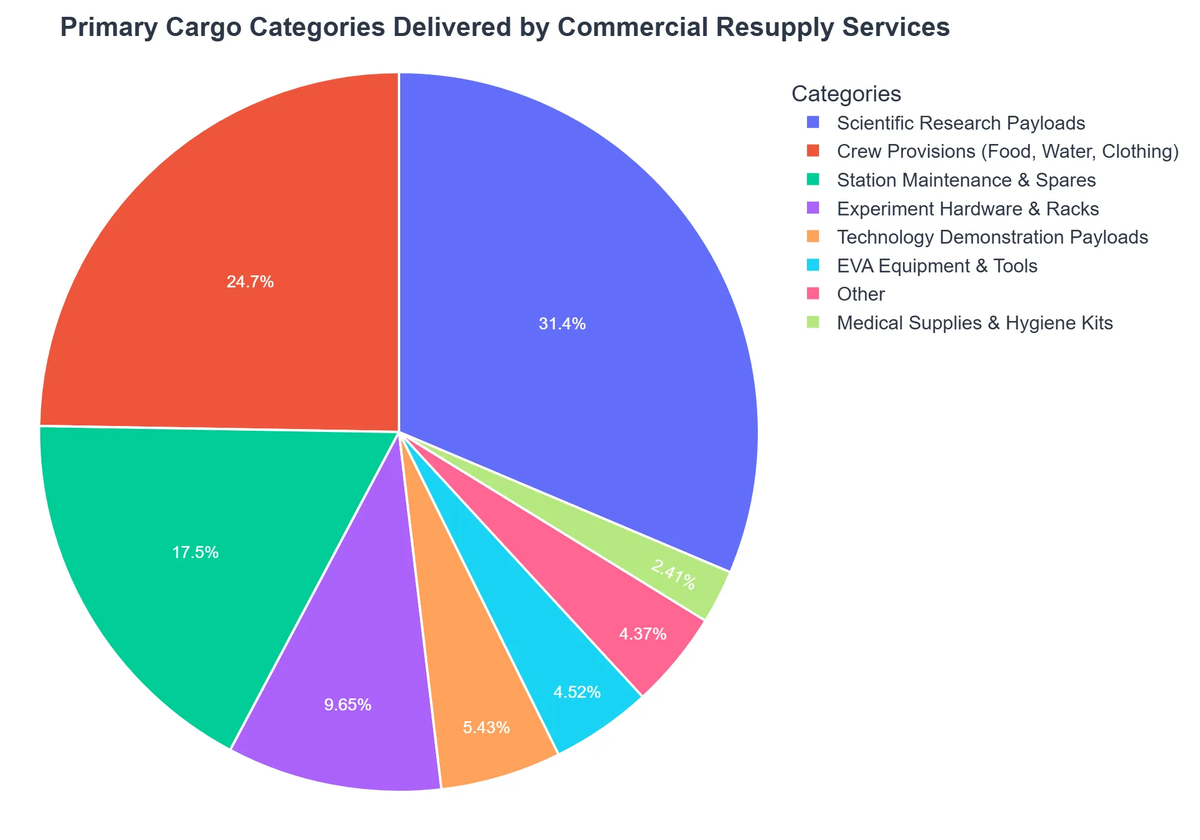
The primary function of CRS missions is to transport a diverse range of items critical for the survival and operation of space stations and their crews. This includes:
- 🍽️ Crew Supplies: Food, water, hygiene products, clothing.
- 🔬 Scientific Payloads: Equipment for experiments, samples for return to Earth.
- ⚙️ Spare Parts & Maintenance Equipment: Tools, components for repairs, and upgrades to station systems.
- 🗑️ Trash Disposal: Some vehicles are designed to dispose of waste by burning up during re-entry.
The Pioneers of CRS: SpaceX Dragon
One of the most prominent names in commercial spaceflight and a trailblazer in CRS is SpaceX, with its highly successful Dragon spacecraft. Developed under NASA’s Commercial Orbital Transportation Services (COTS) program, Dragon marked a new era of private logistics for the ISS.
🐉 Capabilities and Design of Dragon
The original Dragon cargo spacecraft, now succeeded by the Dragon 2 variant (both crew and cargo versions), revolutionized space cargo delivery. Its key features include:
- 🔄 Reusability: Unlike many previous cargo vehicles, the Dragon cargo capsule is designed to return to Earth, allowing for the retrieval of critical scientific samples and equipment. This capability is unique among the primary CRS vehicles.
- 📏 Pressurized and Unpressurized Cargo: Dragon can carry both sensitive equipment that requires a pressurized environment and larger, external components (like solar arrays or science instruments) in its unpressurized trunk.
- 🚀 Reliable Launch Vehicle: Launched atop SpaceX’s Falcon 9 rocket, Dragon benefits from a high-performance and increasingly reusable launch system.
🎯 Key Missions and Contributions
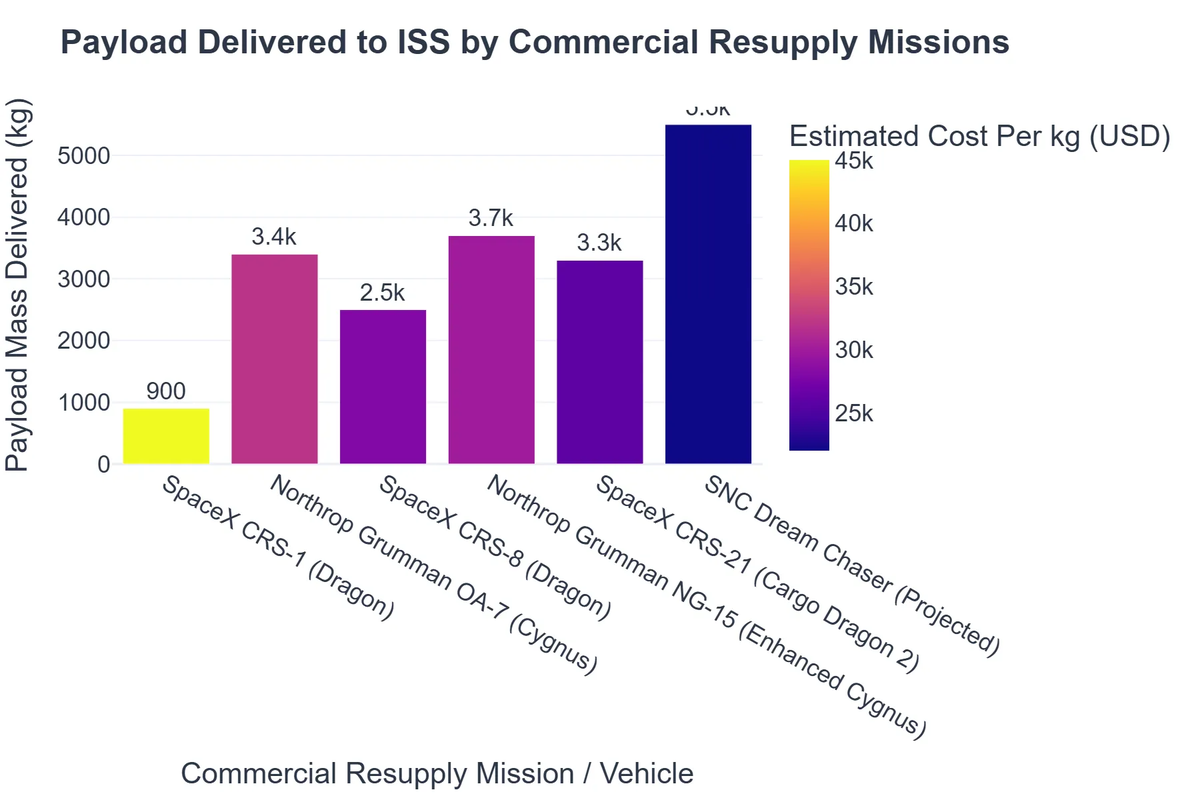
The SpaceX Dragon has completed numerous successful resupply missions to the ISS. For instance, the CRS-22 mission in 2021 delivered critical supplies, including new solar arrays to boost the station’s power capabilities. These missions are vital for ongoing research, supporting astronauts, and maintaining the station’s infrastructure (see ISS: SpaceX CRS-22 (International Space Station: SpaceX …)). The ability to bring back experiments provides an invaluable benefit to researchers on Earth, contributing to a deeper understanding of various scientific phenomena, including insights that might inform future discoveries related to Space Geology: Unearthing Planetary Body Secrets.
Northrop Grumman Cygnus: A Workhorse of LEO Logistics
Another cornerstone of NASA’s commercial resupply strategy is the Cygnus spacecraft, developed by Orbital Sciences (now part of Northrop Grumman). Cygnus complements Dragon by providing a reliable and robust means of transporting cargo to the ISS.
🛰️ Cygnus’ Unique Capabilities
While Cygnus is not designed for Earth return, it offers distinct advantages:
- ⬆️ Large Volume Capacity: Cygnus boasts a significant internal volume for pressurized cargo, making it ideal for delivering bulk supplies and equipment.
- 🔥 Waste Disposal: Upon completion of its mission, Cygnus is typically loaded with trash and discarded items from the ISS. It then deorbits and burns up harmlessly in Earth’s atmosphere, providing a crucial waste management service.
- 🛠️ Enhanced Capability: Newer versions of Cygnus, like those flown on missions such as Northrop Grumman’s 21st Commercial Resupply Mission, are continuously upgraded to carry more cargo and support more complex operations (learn more at Overview for NASA’s Northrop Grumman 21st Commercial Resupply …).
🚀 Resupply Missions and Legacy
Northrop Grumman Cygnus missions have been instrumental in keeping the ISS fully stocked and operational for years. From delivering food and water to crucial scientific instruments, Cygnus plays a critical role in sustaining long-duration human presence in space. Its reliable, one-way delivery system ensures that the station remains habitable and productive.
Commercial Resupply Services: A Balanced Review
Pros
- ✔Reduces operational costs for space station logistics.
- ✔Allows government agencies to focus on deep space exploration and research.
- ✔Fosters private sector innovation and competition.
- ✔Increases frequency and diversity of launch options.
Cons
- ✖Creates reliance on private company stability and performance.
- ✖Potential for commercial interests to influence mission priorities.
- ✖Less direct governmental control over design and operations.
- ✖Market consolidation could reduce future competitive options.
The Critical Role of CRS in International Space Station Operations
The International Space Station (ISS) is a testament to international collaboration and ingenuity, but its continued operation hinges on a robust supply chain. Commercial Resupply Services are absolutely vital for every aspect of the ISS mission.
👨🚀 Supporting Crew and Scientific Research
Astronauts aboard the ISS rely entirely on resupply missions for their daily necessities. Beyond sustenance, CRS missions are the primary means of sending up new scientific experiments and bringing back completed research for analysis on Earth. This continuous flow of materials enables groundbreaking studies in microgravity, medicine, materials science, and fundamental physics. The insights gained from these experiments contribute to our broader understanding, aligning with the core mission of Cosmic Queries: Probing the Mysteries of the Universe.
🔧 Maintenance and Upgrades
Like any complex facility, the ISS requires regular maintenance, spare parts, and upgrades to its systems. CRS vehicles deliver everything from air filters and water recycling components to major system upgrades. For example, recent Dragon missions have delivered large, new solar arrays to enhance the station’s power generation, ensuring its longevity and capability.
Beyond the ISS: The Future of Commercial Resupply
While the ISS has been the primary destination for CRS for decades, the future of space exploration demands an expansion of these services to new destinations and applications.
🌕 Lunar Gateway and Deep Space Support
As humanity eyes a return to the Moon and eventual missions to Mars, the concept of commercial resupply will extend beyond LEO. The Lunar Gateway, a planned outpost orbiting the Moon, will require regular resupply of crew provisions, scientific equipment, and possibly even propellants. Companies are already developing concepts for lunar cargo delivery, envisioning a future where routine supply lines stretch to cislunar space and beyond. This push into deeper space logistics is a crucial step for missions like BepiColombo, which while robotic, benefits from the underlying advancements in space transportation technologies, read more about it here: BepiColombo: Humanity’s Ambitious Mission to Mercury.
🏢 Private Space Stations and New Frontiers
With the ISS eventually set to be deorbited, commercial space stations are on the horizon. Companies are planning their own orbital habitats and research facilities, which will inherently require commercial resupply. This opens up new markets and opportunities for cargo delivery services, fostering competition and innovation in space logistics. The future of space is increasingly commercial, and resupply services are at its core (as discussed in The Future of Space, Part I: The Setup – by Max Olson).
Challenges and Innovations in Space Logistics
Despite the immense success of current CRS models, the industry continues to face challenges and pursue innovations to make space logistics even more efficient, reliable, and sustainable.
💰 Cost Efficiency and Reusability
- ✅ Full Reusability: The drive for fully reusable rockets and spacecraft (like SpaceX’s Falcon 9 and Starship) aims to drastically cut launch costs, making resupply more affordable.
- 💡 Standardized Interfaces: Developing universal docking mechanisms and cargo interfaces could streamline operations and allow for greater interoperability between different vehicles and stations.
⬆️ Expanding Cargo Capacity
- ➡️ Larger Vehicles: The development of larger cargo spacecraft and heavy-lift launch vehicles will enable the transport of more massive and voluminous payloads, essential for building larger deep-space habitats or transporting construction materials.
- ⚙️ In-Orbit Refueling: The ability to refuel spacecraft in orbit could extend mission durations and range, transforming how cargo is moved across vast distances.
Commercial Resupply Services are more than just a delivery service; they are the circulatory system of human spaceflight, constantly bringing life and possibility to orbital outposts. As we look towards a future of expanded human presence in space, these services will remain fundamental.
Recommended Video
Conclusion
The journey into space, once a monumental government undertaking, has been profoundly transformed by the advent and maturation of commercial resupply services. Companies like SpaceX with their Dragon capsules and Northrop Grumman with their Cygnus spacecraft have proven themselves indispensable partners, reliably delivering everything from scientific experiments to astronaut provisions to the International Space Station. They represent a paradigm shift, enabling cost-effective, regular access to low Earth orbit and freeing up governmental resources for ambitious new ventures beyond our immediate celestial neighborhood.
As we gaze towards a future encompassing lunar outposts, Martian missions, and even private orbital habitats, the role of commercial resupply will only grow in importance. These services are not merely a convenience; they are the literal lifeline, the logistical backbone that sustains our presence in the cosmos and fuels our ceaseless quest to probe the mysteries of the universe.
Frequently Asked Questions
What are Commercial Resupply Services (CRS)?
Commercial Resupply Services (CRS) are contracts awarded by NASA to private companies for delivering cargo, supplies, and scientific experiments to the International Space Station (ISS) and other orbital destinations.
Which companies currently provide CRS missions?
Currently, SpaceX (with its Dragon spacecraft) and Northrop Grumman (with its Cygnus spacecraft) are the primary commercial providers for resupply missions to the International Space Station under NASA’s CRS contracts.
What kind of cargo do CRS missions typically carry?
CRS missions transport a wide array of cargo, including food, water, crew supplies, spare parts, scientific research equipment, and materials for experiments, ensuring the continuous operation and habitation of the ISS.
How often do CRS missions occur?
The frequency of CRS missions varies but typically occurs several times a year, depending on the needs of the International Space Station and the schedules of the commercial providers.