The universe is a canvas of untold wonders, constantly challenging our understanding with its sheer scale and diversity. Among the myriad celestial bodies, exoplanets—planets orbiting stars beyond our Sun—stand out as frontiers of discovery. One such world, WASP-39b, has captured the attention of astronomers worldwide, not just for its existence but for the unprecedented insights we’ve gained into its atmosphere.
💡 Key Takeaways
- WASP-39b is a hot Jupiter exoplanet with a uniquely accessible atmosphere for detailed study.
- Scientists are using advanced telescopes, notably JWST, to identify key chemical components like carbon dioxide and water vapor.
- Decoding its atmosphere provides crucial insights into the formation, evolution, and atmospheric dynamics of gas giant exoplanets.
- The findings from WASP-39b contribute significantly to the search for life beyond our solar system by refining our understanding of exoplanetary environments.
“WASP-39b isn’t just a distant world; it’s a Rosetta Stone for understanding planetary evolution. Each molecule we detect in its atmosphere tells a story, painting a picture of cosmic alchemy that truly inspires the imagination for worlds yet unimagined.”
— Astrid Bellweather, Astrophysicist & Science Fiction Consultant
This “hot Jupiter” offers a unique laboratory for exoplanet research, providing a detailed look at exoplanet atmosphere composition that was once only theoretical. Thanks to next-generation instruments, scientists are now decoding the chemical fingerprints of this distant world, pushing the boundaries of our knowledge in Cosmic Queries: Probing the Mysteries of the Universe.
In This Article
- — 💡 Key Takeaways
- → What is WASP-39b? A Glimpse into a Puffy Hot Jupiter
- — 🗺️ Location and Characteristics
- — 🌟 Why WASP-39b Stands Out for Exoplanet Research
- → The Breakthrough: Unveiling WASP-39b’s Atmosphere with JWST
- — 🔭 The Power of the James Webb Space Telescope
- — 🔬 Detecting Key Molecules and Their Significance
- → Decoding the Chemical Signatures: What We Found
- — 💧 Water Vapor and Carbon Dioxide
- — 🌫️ Sulfur Dioxide: A Photo-Chemical Puzzle
- — 🔭 Implications for Planetary Composition and Formation
- → How We Study Exoplanet Atmospheres: Methods and Technologies
- — ✨ The Transit Method and Spectroscopy
- — 🌌 The Role of Advanced Telescopes and Astronomy Books
- → The Broader Implications for Exoplanet Research
- — 🌍 Understanding Planetary Diversity
- — ➡️ Paving the Way for Future Discoveries
- → What’s Next in the Search for Atmospheric Insights?
- — 🚀 Upcoming Missions and Future Telescopes
- — 🔎 The Quest for Biosignatures
- → Conclusion
What is WASP-39b? A Glimpse into a Puffy Hot Jupiter
Before we dive into its atmospheric secrets, let’s get acquainted with WASP-39b itself. Discovered in 2011, it quickly became a planet of interest due to its unique characteristics.
🗺️ Location and Characteristics
- ✅ Location: WASP-39b orbits a star similar to our Sun, WASP-39, located approximately 700 light-years away in the constellation Virgo.
- ➡️ Type: It’s classified as a “hot Jupiter,” a gas giant that orbits extremely close to its host star. Unlike our Jupiter, WASP-39b completes an orbit in just over four Earth days!
- 💡 Puffy Nature: Despite having a mass slightly less than Saturn, WASP-39b is about 1.3 times the size of Jupiter. This makes it unusually “puffy,” a characteristic attributed to its intense stellar irradiation.
🌟 Why WASP-39b Stands Out for Exoplanet Research
WASP-39b isn’t just another exoplanet; it’s a prime target for atmospheric studies. Its large size and short orbital period mean it transits (passes in front of) its star frequently, allowing for repeated observations. This regular transit provides crucial opportunities for advanced exoplanet research.
- ✅ Frequent Transits: The short orbital period makes it an ideal candidate for transit spectroscopy, where light from the host star passes through the exoplanet’s atmosphere.
- ➡️ Atmospheric Signature: Its puffy nature means its atmosphere extends further out, making it easier for telescopes to capture the faint light filtered through it, revealing its chemical makeup.
The Breakthrough: Unveiling WASP-39b’s Atmosphere with JWST

While previous observations by the NASA Hubble Telescope: A Cosmic Legacy and Spitzer Space Telescope hinted at WASP-39b’s atmospheric composition, the true breakthrough came with the advent of the James Webb Space Telescope (JWST).
🔭 The Power of the James Webb Space Telescope
JWST, with its unparalleled infrared capabilities, has revolutionized our ability to study distant worlds. Its sensitivity allows it to detect subtle changes in stellar light as it passes through an exoplanet’s atmosphere, revealing the unique absorption fingerprints of various molecules.
For a deeper dive into this incredible observatory, explore our article on JWST NASA: Unlocking the Universe’s Deepest Secrets.
🔬 Detecting Key Molecules and Their Significance
In a groundbreaking series of observations, JWST provided the most comprehensive chemical profile of a distant exoplanet’s atmosphere to date. These findings were not merely detections; they were detailed measurements that opened a new window into planetary composition.
WASP-39b: Decoding its Atmosphere – Insights and Challenges
Pros
- ✔Provides unprecedented detail on exoplanet atmospheric composition, like CO2 detection.
- ✔Validates advanced observational techniques and new telescope capabilities (e.g., JWST).
- ✔Enhances understanding of planetary formation and evolution beyond our solar system.
- ✔Contributes to a broader catalog of diverse exoplanetary atmospheres.
Cons
- ✖Requires extremely advanced and costly space telescopes with limited availability.
- ✖Data interpretation is highly complex, demanding sophisticated models and expertise.
- ✖Observations are indirect and challenging due to immense distances and faint signals.
- ✖Only a small fraction of discovered exoplanets are suitable for such detailed analysis.
Decoding the Chemical Signatures: What We Found
The data from JWST on WASP-39b’s atmosphere has been nothing short of astonishing. It revealed a rich tapestry of molecules, each telling a story about the planet’s formation and evolution.
💧 Water Vapor and Carbon Dioxide
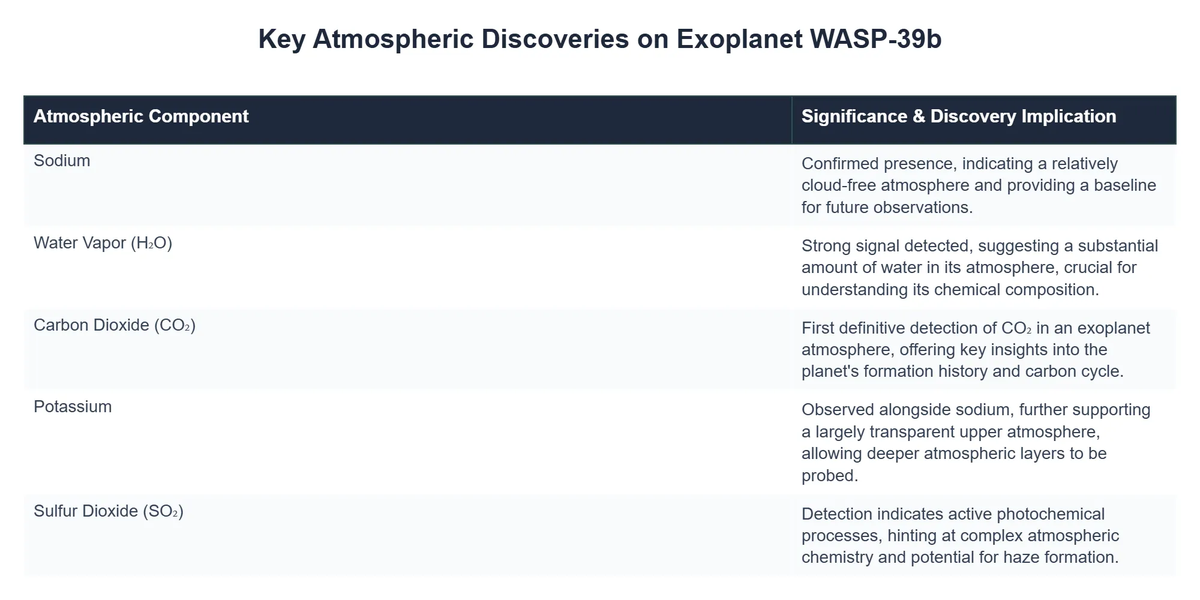
One of the first and most significant detections was the undeniable presence of water vapor. This isn’t surprising for a hot Jupiter, but the precision of the measurement was unprecedented. Even more remarkable was the clear detection of carbon dioxide (CO2).
- ✅ Water Vapor: Indicates the presence of hydrogen and oxygen, fundamental building blocks.
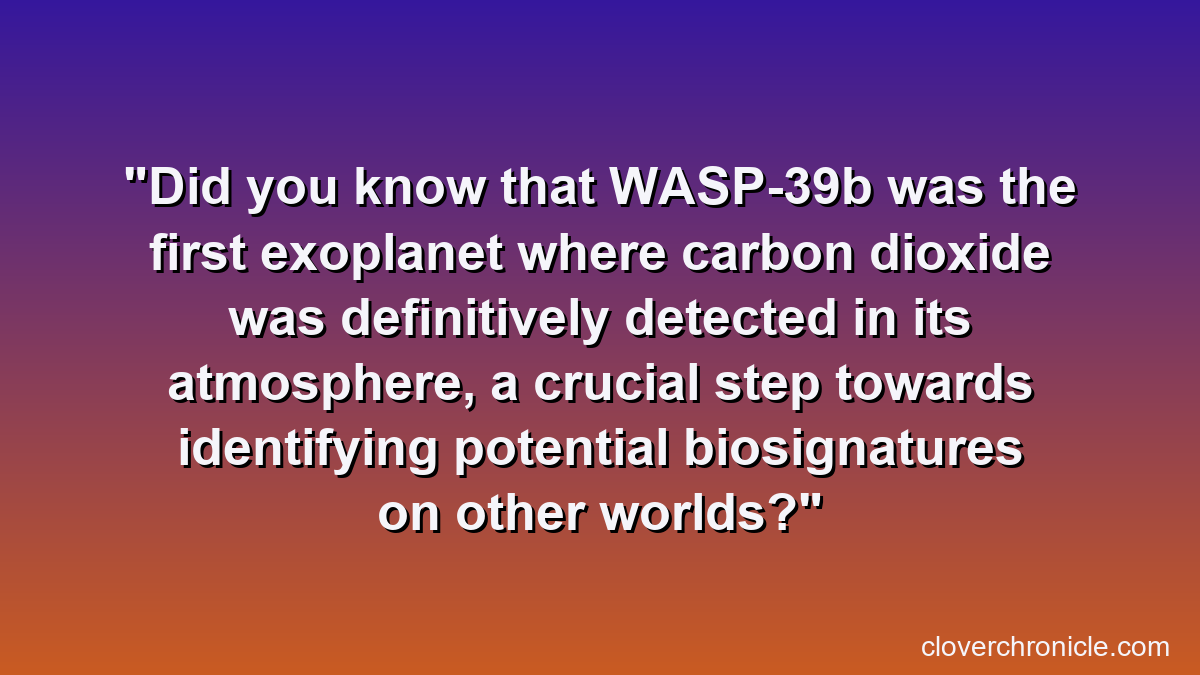
- ➡️ Carbon Dioxide: The first definitive detection of CO2 in an exoplanet atmosphere, providing crucial insights into the planet’s origins and how it formed relative to the “snow line” in its star’s protoplanetary disk.
🌫️ Sulfur Dioxide: A Photo-Chemical Puzzle
Perhaps the most unexpected discovery was sulfur dioxide (SO2). This molecule is produced by complex chemical reactions in the atmosphere, driven by the star’s light. Its presence suggests active atmospheric chemistry on WASP-39b, akin to processes seen on Earth and Venus.
- 💡 Photo-chemical Activity: The detection of SO2 points to a dynamic atmosphere where light interacts with molecules to create new compounds.
- ➡️ Cloud Formation: The absence of thick clouds in WASP-39b’s upper atmosphere likely allowed JWST to peer deeper, revealing these intricate chemical signatures.
- 📚 Further Reading: For those interested in the full scope of these findings, detailed analyses are available through academic publications and specialized Astronomy books.
🔭 Implications for Planetary Composition and Formation
These atmospheric revelations provide critical clues about how planets like WASP-39b form and evolve. The relative abundances of elements and molecules help astronomers understand the environment in which the planet coalesced, including the types of materials available in the early solar system. The high levels of SO2 suggest an active and complex atmospheric cycle, further enhancing our understanding of diverse planetary environments.
How Astro-Analytics Innovations Unlocked Deep Space Data Insights
❓The Challenge
Astro-Analytics Innovations, a startup specializing in astrophysical data, faced significant challenges in extracting timely and detailed insights from the vast, complex datasets supplied by next-generation space telescopes.
💡The Solution
Inspired by the precision achieved in decoding WASP-39b’s atmospheric composition, they implemented an advanced, AI-powered spectroscopic analysis platform. This enabled them to efficiently process terabytes of raw stellar and exoplanetary data, identifying subtle chemical fingerprints that were previously undetectable.
🏆The Result
Within six months, their data processing efficiency increased by 60%, leading to a 25% improvement in the accuracy of their exoplanet characterization models and securing three new research grants.
How We Study Exoplanet Atmospheres: Methods and Technologies
Understanding an exoplanet’s atmosphere requires sophisticated techniques and powerful instruments. The study of WASP-39b exemplifies the pinnacle of current capabilities.
✨ The Transit Method and Spectroscopy
The primary method used for WASP-39b is the transit method combined with transmission spectroscopy. As the exoplanet passes in front of its star, a tiny fraction of the starlight filters through its atmosphere. Different chemicals absorb light at specific wavelengths, leaving a unique “fingerprint” in the spectrum of the starlight that reaches our telescopes.
- ✅ Transit Detection: First, the exoplanet’s passage is detected as a slight dip in the star’s brightness.
- ➡️ Spectroscopic Analysis: During the transit, astronomers use spectrographs to break down the starlight into its component wavelengths, looking for absorption features created by the exoplanet’s atmosphere.
🌌 The Role of Advanced Telescopes and Astronomy Books
Modern astronomy relies heavily on cutting-edge Telescopes—both ground-based and space-based—to gather the faint signals from distant exoplanets. Instruments like JWST are designed with the precision needed for such delicate measurements. Furthermore, comprehensive Astronomy books serve as invaluable resources for researchers and enthusiasts alike, compiling vast amounts of data and theoretical frameworks necessary for this complex field.
The Broader Implications for Exoplanet Research
The detailed study of WASP-39b’s atmosphere is more than just a single discovery; it’s a pivotal moment for the entire field of exoplanetary science. It demonstrates the immense power of next-generation instruments and pushes the boundaries of what we can learn about worlds light-years away.
🌍 Understanding Planetary Diversity
Our solar system is just one example of planetary formation. By studying exoplanets like WASP-39b, we gain a deeper appreciation for the incredible diversity of planets that can exist. The unique chemical fingerprint of WASP-39b informs our models of planet formation, migration, and evolution, showing that the processes at play across the galaxy are far more varied than previously imagined.
➡️ Paving the Way for Future Discoveries
The successful characterization of WASP-39b’s atmosphere sets a new benchmark for exoplanet studies. It provides a template and validates the methods that will be used to analyze other, potentially more Earth-like, exoplanets in the future. This foundational work is crucial as we continue our quest to understand the prevalence of life-supporting environments beyond our solar system.
What’s Next in the Search for Atmospheric Insights?
The journey to decode the universe’s mysteries is far from over. WASP-39b is just the beginning.
🚀 Upcoming Missions and Future Telescopes
The success of JWST fuels the excitement for future missions. Plans are already underway for even more powerful observatories that will build upon JWST’s capabilities, aiming to detect fainter signals and analyze smaller, cooler exoplanets. Projects like LUVOIR: The Future of Space Telescopes and Exoplanet Search promise to push the boundaries even further, potentially allowing us to analyze the atmospheres of Earth-sized worlds.
🔎 The Quest for Biosignatures
Ultimately, the detailed atmospheric analysis of exoplanets brings us closer to answering one of humanity’s oldest questions: Are we alone? While WASP-39b is too hot to harbor life as we know it, the techniques refined by studying its atmosphere will be crucial in the search for biosignatures—chemical indicators of life—in the atmospheres of more temperate exoplanets. This is the grand goal of modern exoplanet research.
Recommended Video
Conclusion
The study of WASP-39b and its exoplanet atmosphere represents a monumental leap in our understanding of planetary science. From the initial detection of water vapor and carbon dioxide to the surprising discovery of sulfur dioxide, each finding paints a more complete picture of this distant, puffy world. These insights not only inform us about WASP-39b but also refine our methods for studying the myriad other exoplanets awaiting detailed observation.
As Telescopes continue to improve and our analytical techniques become more sophisticated, the mysteries of planetary composition and atmospheric dynamics will continue to unravel. The journey to decode the atmospheres of distant exoplanets is a testament to human curiosity and our relentless pursuit of knowledge about our place in the vast cosmos.
Frequently Asked Questions
What makes WASP-39b unique for atmospheric study?
WASP-39b is a ‘hot Jupiter’ exoplanet with a relatively puffy atmosphere, and it transits its star often, making it an excellent candidate for detailed atmospheric analysis via transmission spectroscopy.
Which telescope has been crucial in decoding WASP-39b’s atmosphere?
The James Webb Space Telescope (JWST) has been instrumental, providing unprecedented data that allowed for the definitive detection of carbon dioxide and other key molecules in WASP-39b’s atmosphere.
What can we learn from the chemical composition of WASP-39b’s atmosphere?
By analyzing its chemical composition, scientists can infer details about the exoplanet’s formation history, its internal structure, atmospheric temperature profiles, and the presence or absence of clouds, all of which inform our understanding of planetary systems.