

Community Biodiversity: Decoding Species Interactions in Ecosystems
Our planet teems with life, organized into intricate webs of relationships. At the heart of healthy ecosystems lies community biodiversity, which refers to the variety of life within a specific ecological community or habitat. It’s not just about how many different species exist, but also how these species interact with one another. These complex species interactions are the very pulse of an ecosystem, dictating its health, stability, and resilience.
💡 Key Takeaways
- Species interactions are fundamental drivers of community structure and function.
- Different interaction types, such as predation, competition, and mutualism, shape population dynamics and biodiversity.
- Understanding these relationships is crucial for ecosystem conservation and management.
- Ecosystem health and resilience are directly linked to the complexity and stability of species interactions.
“The intricate dance of coevolution sculpted by species interactions is the very engine of biodiversity. Every predator, every symbiont, every competitor, acts as a selective force, pushing life into novel forms and functions.”
— Julian Aris, Evolutionary Biologist & Geneticist
Understanding these interactions is fundamental to comprehending how life functions on Earth. From microscopic bacteria to towering trees and migratory animals, every organism plays a role, shaping its environment and being shaped by it in return. This intricate dance of life is a core tenet of The Code of Life: Decoding Genetics, Evolution, and Existence, revealing the biological blueprints that govern ecological communities.
In This Article
- → Community Biodiversity: Decoding Species Interactions in Ecosystems
- — 💡 Key Takeaways
- → Understanding Community Biodiversity
- — What is an Ecological Community?
- — Levels of Biodiversity
- → The Spectrum of Species Interactions
- — 🤝 Symbiotic Relationships
- — ⚔️ Competition
- — 🦁 Predation and Herbivory
- — Neutralism and Amensalism
- → Keystone Species and Trophic Cascades
- — What are Keystone Species?
- — Understanding Trophic Cascades
- → Factors Influencing Species Interactions
- — Climate and Environmental Conditions
- — Population Dynamics and Density
- — Evolutionary Adaptations and Co-evolution
- → Measuring and Monitoring Species Interactions
- — Ecological Field Studies
- — Modeling and Data Analysis
- — The Role of Citizen Science Projects
- → The Impact of Human Activities
- — Habitat Loss and Fragmentation
- — Climate Change
- — Pollution and Invasive Species
- → Protecting Community Biodiversity Through Action
- — Why Conservation Matters
- — Strategies for Preservation
- — How You Can Contribute
- → Conclusion: The Interconnected Web of Life
Understanding Community Biodiversity
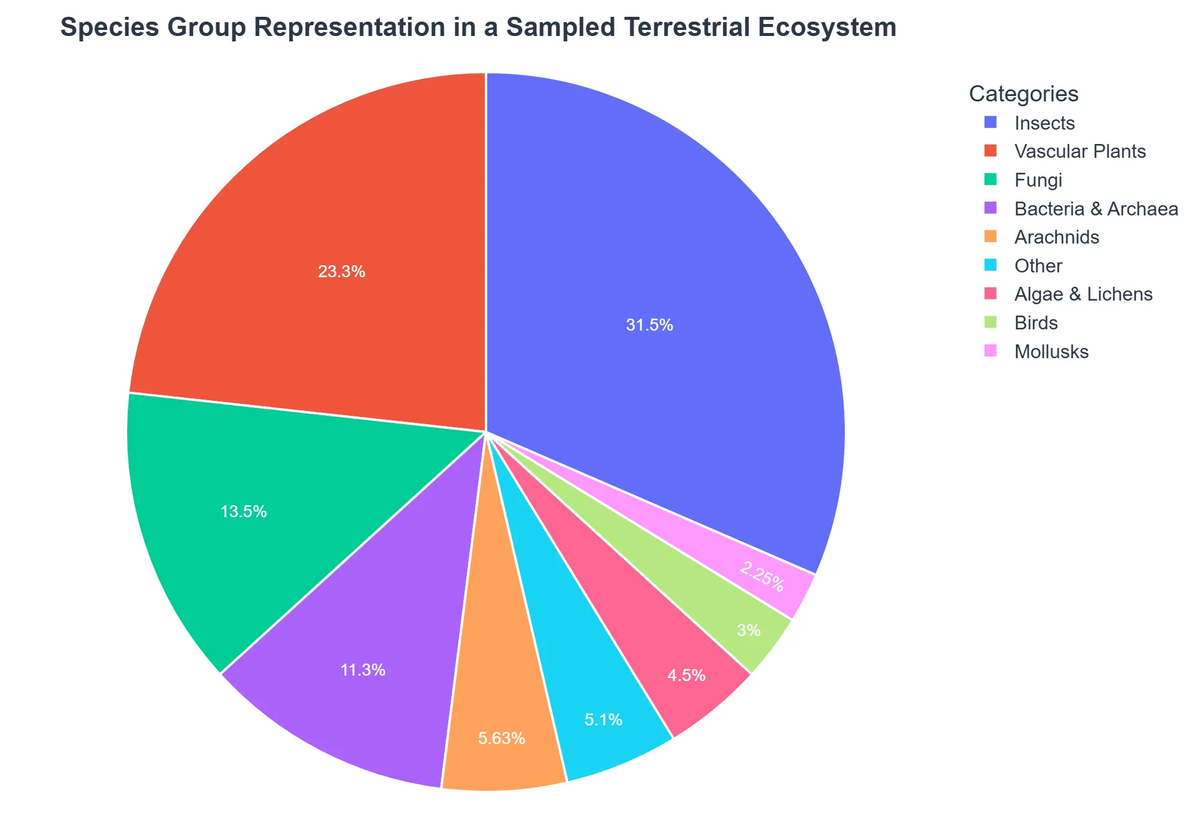
A biological community is more than just a collection of species; it’s a dynamic assembly of populations of different species living in the same area at the same time. The concept of community biodiversity extends beyond mere species richness (the number of different species) to include species evenness (the relative abundance of each species) and the functional roles species play.
What is an Ecological Community?
- ✅ Interacting Populations: A community comprises all the populations of different species that interact in a given area. For example, a forest community includes all the trees, fungi, insects, birds, and mammals living within it.
- ✅ Shared Environment: These species share a common physical environment, and their interactions often modify that environment.
- ✅ Dynamic Systems: Communities are not static; they change over time due to natural processes (like succession) and external disturbances (like climate change or human activities).
Levels of Biodiversity
While we focus on community biodiversity, it’s part of a larger picture:
- ➡️ Genetic Diversity: Variation within a single species, allowing adaptation to changing conditions.
- ➡️ Species Diversity: The variety of different species, encompassing both richness and evenness.
- ➡️ Ecosystem Diversity: The variety of habitats, communities, and ecological processes in the biosphere. Community biodiversity is a crucial component of ecosystem diversity.
The Spectrum of Species Interactions
Life in an ecosystem is characterized by an intricate web of relationships. These interactions can be beneficial, harmful, or neutral for the species involved, and they are critical drivers of evolution and ecosystem function. Understanding these relationships is key to appreciating the resilience of Biodiversity Habitats: Protecting Nature’s Homes.
🤝 Symbiotic Relationships
Symbiosis describes close, long-term interactions between different species. Not all symbiotic relationships are mutually beneficial.
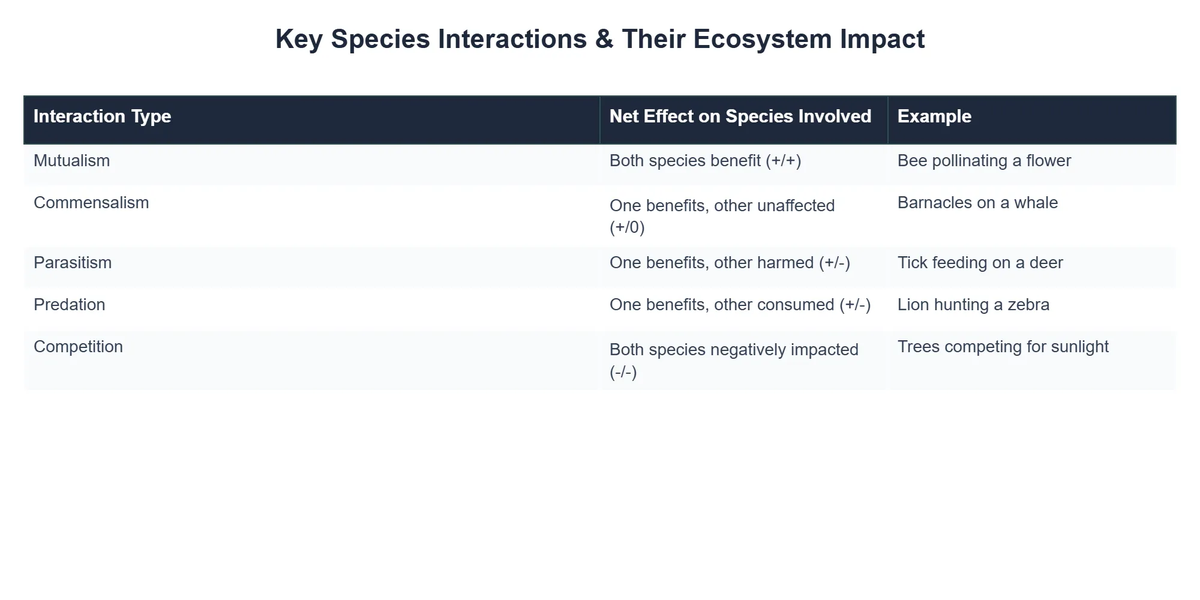
- 💡 Mutualism (+/+): Both species benefit from the interaction.
- Example: Bees pollinating flowers (bees get nectar, flowers get pollinated).
- Example: Mycorrhizal fungi and plant roots (fungi help plants absorb nutrients, plants provide sugars to fungi).
- 💡 Commensalism (+/0): One species benefits, while the other is neither harmed nor helped.
- Example: Barnacles on whales (barnacles get a place to live and filter feed, whales are unaffected).
- 💡 Parasitism (+/-): One species (the parasite) benefits at the expense of the other (the host), usually without immediately killing it.
- Example: Ticks feeding on mammals (ticks get blood, mammals can be weakened or transmit disease).
⚔️ Competition
Competition occurs when two or more species require the same limited resources.
- ➡️ Intraspecific Competition: Individuals of the same species compete (e.g., two male deer fighting for a mate).
- ➡️ Interspecific Competition: Individuals of different species compete (e.g., lions and hyenas competing for zebra carcasses).
- ➡️ Impact: Can lead to resource partitioning, character displacement, or competitive exclusion (one species outcompeting another).
🦁 Predation and Herbivory
These are consumer-resource interactions where one organism feeds on another.
- ➡️ Predation (+/-): One organism (the predator) kills and consumes another (the prey).
- Example: Wolves hunting deer.
- Impact: Drives evolution of both predator and prey, influencing population sizes.
- ➡️ Herbivory (+/-): An animal (herbivore) consumes parts of a plant.
- Example: Caterpillars eating leaves, deer browsing on shrubs.
- Impact: Can affect plant growth, distribution, and even lead to co-evolutionary defenses in plants.
Neutralism and Amensalism
- 💡 Neutralism (0/0): Two species interact, but neither affects the other. This is rare in truly interactive communities.
- 💡 Amensalism (-/0): One species is harmed, while the other is unaffected.
- Example: A large tree casting a shadow, inhibiting the growth of smaller plants below it, without the tree gaining or losing anything.
Keystone Species and Trophic Cascades
Not all species exert the same level of influence within a community. Some, despite their relatively low abundance, play disproportionately large roles in maintaining the structure and integrity of an ecosystem. This concept is closely tied to Biodiversity and Wildlife Conservation: An Intertwined Fate.
What are Keystone Species?
- 🌟 Disproportionate Impact: A keystone species is a species that has a unique and crucial role in the way an ecosystem functions. Without keystone species, the ecosystem would be dramatically different or cease to exist altogether.
- 🌟 Examples:
- Sea Otters: In kelp forests, sea otters prey on sea urchins. Without otters, urchin populations explode, overgraze kelp, and destroy the entire kelp forest ecosystem.
- Wolves (Yellowstone): Their reintroduction helped control elk populations, allowing riparian vegetation to recover, which in turn brought back birds and beaver, changing the very course of rivers.
Understanding Trophic Cascades
A trophic cascade is an ecological phenomenon triggered by the addition or removal of top predators and involving reciprocal changes in the relative populations of predator and prey through a food chain, which often results in dramatic changes in ecosystem structure and nutrient cycling.
- 📈 Top-Down Control: When predators limit the density or behavior of their prey, impacting the trophic levels below them. The reintroduction of wolves in Yellowstone is a classic example of a positive top-down cascade.
- 📉 Bottom-Up Control: When the productivity and abundance of organisms at lower trophic levels (e.g., plants) determine the population sizes of organisms at higher trophic levels.
- 💡 Significance: Trophic cascades highlight how fundamental species interactions are to ecosystem stability and reveal the far-reaching consequences of changes at any level of the food web.
Factors Influencing Species Interactions
The nature and intensity of species interactions are not static; they are shaped by a variety of environmental and biological factors, leading to a dynamic and ever-evolving ecological tapestry.
Climate and Environmental Conditions
- 🌡️ Temperature and Precipitation: Directly influence metabolic rates, growth, and reproduction, which in turn affect competitive abilities, predator-prey dynamics, and mutualistic exchanges.
- 💧 Resource Availability: The abundance of food, water, light, and nutrients dictates the intensity of competition and the viability of populations for predators and herbivores.
- 🗺️ Habitat Structure: Physical features of the environment (e.g., forest canopy layers, rock crevices) provide niches, refuges, and hunting grounds, influencing where and how species interact.
Population Dynamics and Density
- 👥 Population Size: The number of individuals in a population affects the frequency and outcome of interactions. Higher densities can intensify competition or increase encounters between predators and prey.
- 📈 Growth Rates: Different species have varying reproductive rates and capacities for population growth, which can shift competitive advantages or influence the stability of predator-prey cycles.
- 🌐 Dispersal: The movement of individuals into or out of a community can introduce new competitors, predators, or symbiotic partners, altering existing interaction networks.
Evolutionary Adaptations and Co-evolution
- 🧬 Co-evolution: A process where two or more species reciprocally affect each other’s evolution. This often results from strong, ongoing interactions.
- Example: Predator-prey arms races (e.g., faster gazelles and faster cheetahs).
- Example: Plant defenses (thorns, toxins) evolving in response to herbivory, and herbivores evolving ways to overcome these defenses.
- 🌿 Niche Partitioning: Through evolution, species can specialize to use different parts of a resource or habitat, reducing direct competition and allowing for greater species coexistence.
Measuring and Monitoring Species Interactions
To truly understand community biodiversity, ecologists employ a range of methods to observe, quantify, and model the intricate web of species interactions. This data is crucial for conservation efforts and predicting how ecosystems might respond to change.
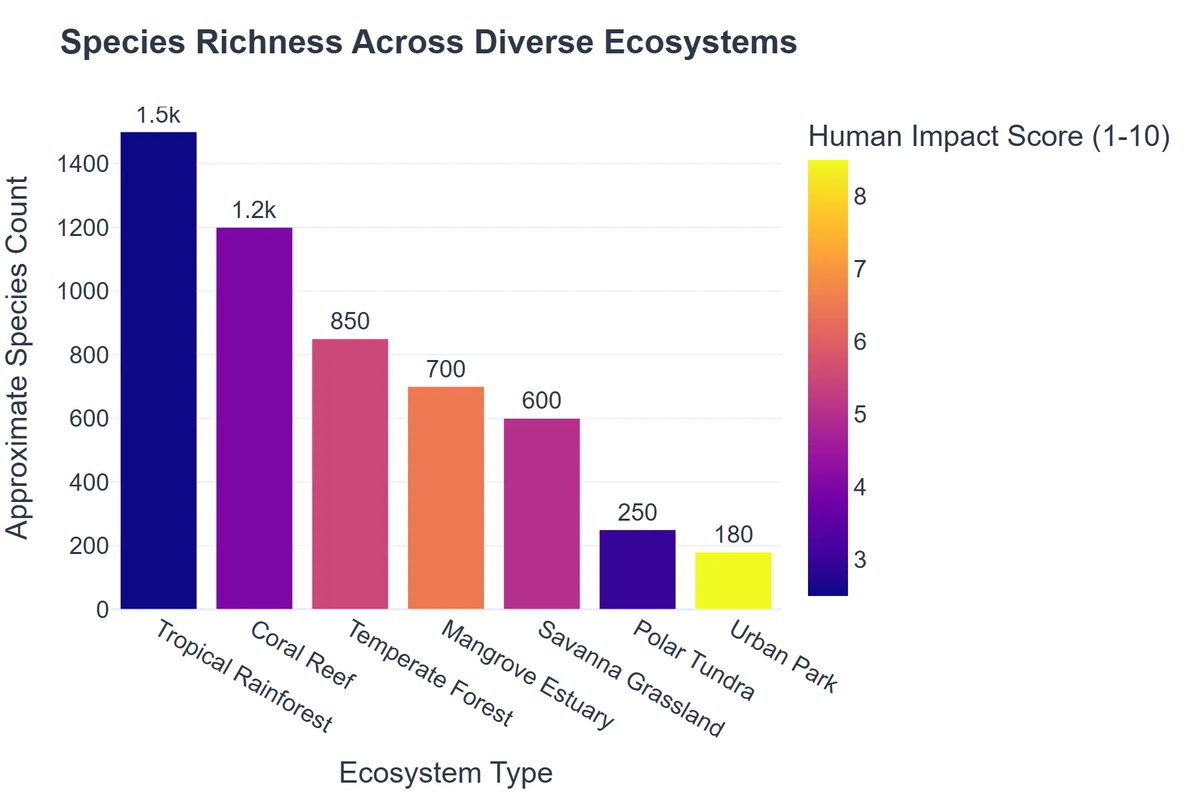
Ecological Field Studies
- 🔍 Direct Observation: Ecologists spend countless hours in the field observing behaviors like feeding, mating, territorial disputes, and symbiotic relationships.
- 🔬 Experimental Manipulation: Controlled experiments, such as adding or removing a species (like the Yellowstone wolf example), can reveal the causal effects of interactions on community structure.
- 📸 Camera Traps & Bioacoustics: Non-invasive technologies allow for long-term monitoring of elusive species and their interactions, providing data on prey selection, competitive exclusions, and more.
Modeling and Data Analysis
- 📊 Food Web Construction: Mapping out who eats whom within an ecosystem is a fundamental step.
- 📈 Population Dynamics Models: Mathematical models help predict how populations of interacting species will change over time, considering factors like birth rates, death rates, and interaction coefficients.
🕸️ Interaction Networks: Advanced ecological modeling uses network theory to visualize and analyze the complexity of all types of species interactions, not just trophic ones. Research on inferring species interactions in ecological communities helps scientists build these complex models.
The Role of Citizen Science Projects
In recent years, Citizen Science Projects have become invaluable tools for gathering large-scale data on biodiversity and interactions. These projects empower volunteers to contribute to scientific research, often through mobile apps or online platforms.
- 🗺️ Biodiversity Monitoring: Volunteers help map species distributions, identify invasive species, and track migratory patterns, providing crucial data on species presence and abundance.
- ✅ Benefit: Citizen science not only expands the reach of scientific data collection but also fosters public engagement and education about environmental issues.
🐦 Bird Counts & Insect Surveys: Projects like the Christmas Bird Count or various insect monitoring initiatives gather data that can reveal predator-prey dynamics or the impact of environmental changes on specific interactions. 🌱 Plant Phenology: Observing plant flowering and fruiting times provides insights into plant-pollinator or plant-herbivore interactions, especially in the context of climate change.
The Impact of Human Activities
Human actions, both direct and indirect, profoundly impact community biodiversity and the delicate balance of species interactions, often leading to detrimental consequences for ecosystem health and stability.
Habitat Loss and Fragmentation
- 💔 Reduced Space: Conversion of natural habitats for agriculture, urban development, and infrastructure destroys the physical spaces where species live and interact.
- ➡️ Edge Effects: The boundaries between natural and disturbed habitats create “edge effects” that can favor generalist species over specialists, further altering community structure.
🚧 Isolation: Fragmentation breaks up continuous habitats into smaller, isolated patches, preventing species movement, reducing genetic flow, and disrupting critical interactions (e.g., pollination, seed dispersal).
Climate Change
- 🌡️ Temperature Shifts: Rising global temperatures alter species distributions, phenology (timing of biological events), and metabolic rates, disrupting established interaction patterns.
🌊 Ocean Acidification: Increased CO2 absorption by oceans leads to acidification, which severely impacts marine organisms. Research shows that species interactions drive fish biodiversity loss in a high-CO2 world, highlighting a critical threat. 💨 Extreme Weather: More frequent and intense heatwaves, droughts, and floods can decimate populations, destabilize food webs, and alter competitive dynamics.
Pollution and Invasive Species
- 🧪 Pollution: Chemicals (pesticides, industrial waste), plastics, and nutrient runoff can directly harm species, alter habitat quality, and disrupt sensitive interactions, such as those between soil microbes and plants.
🌿 Invasive Species: Non-native species introduced to new environments can outcompete native species for resources, prey upon them, or introduce diseases, leading to cascading effects that unravel existing interaction networks. 📉 Disease Spread: Human activities often facilitate the spread of pathogens, impacting species populations and altering disease-host interactions within communities.
Protecting Community Biodiversity Through Action
The intricate web of species interactions is critical for healthy, resilient ecosystems that provide essential services to humanity. Protecting community biodiversity requires concerted effort from individuals, communities, and governments alike.
Why Conservation Matters
- 🌍 Ecosystem Services: Healthy communities provide vital services such as clean air and water, pollination of crops, soil formation, climate regulation, and disease control.
💪 Ecosystem Resilience: Diverse communities with robust interaction networks are more resilient to disturbances and can recover more effectively from environmental changes. 🧬 Genetic Resources: Protecting the full spectrum of biodiversity preserves genetic potential for future adaptations, medicine, and scientific discovery.
Strategies for Preservation
- 🌳 Habitat Protection and Restoration: Establishing protected areas, restoring degraded ecosystems, and creating wildlife corridors are fundamental to preserving the spaces where interactions occur.
⚖️ Sustainable Resource Management: Implementing sustainable practices in agriculture, forestry, and fisheries reduces pressure on wild populations and their habitats. 🚫 Invasive Species Control: Preventing new introductions and managing existing invasive species is crucial to safeguard native interactions. 🌱 Community-Based Conservation: Empowering local communities to manage and protect their natural resources often leads to more effective and sustainable outcomes.
How You Can Contribute
Every individual can play a role in promoting community biodiversity and safeguarding these vital interactions. For more ideas, see Promote Biodiversity: Actions for Individuals and Governments.
- 🌿 Support Local Conservation Groups: Get involved with or donate to Local Conservation Groups in your area. They often lead initiatives for habitat restoration, species monitoring, and public education. Your support helps them protect local ecosystems and the species interactions within them.
🔬 Participate in Citizen Science Projects: As highlighted earlier, joining Citizen Science Projects allows you to directly contribute to scientific understanding and monitoring of biodiversity, from bird counts to insect surveys. ♻️ Reduce Your Ecological Footprint: Adopt sustainable habits such as reducing consumption, recycling, conserving water and energy, and choosing eco-friendly products. 🗳️ Advocate for Policy: Support policies and elected officials who prioritize environmental protection, sustainable land use, and climate action. 📚 Educate Yourself and Others: Learn more about the biodiversity in your region and share that knowledge with friends and family.
Recommended Video
Frequently Asked Questions
What is community biodiversity?
Community biodiversity refers to the variety of life forms and their interactions within a specific ecological community or ecosystem, encompassing species richness and their relative abundances.
How do species interactions affect ecosystems?
Species interactions significantly influence population sizes, nutrient cycling, energy flow, and the overall stability and resilience of an ecosystem. They determine how resources are shared and utilized.
Can you give examples of different species interactions?
Common types include predation (predator-prey), competition (for resources), mutualism (both benefit), commensalism (one benefits, other unaffected), and parasitism (one benefits, other harmed).
Why is understanding species interactions important for conservation?
Understanding these interactions helps predict how changes in one species or its environment might impact the entire food web and ecosystem, informing effective conservation strategies and restoration efforts.