

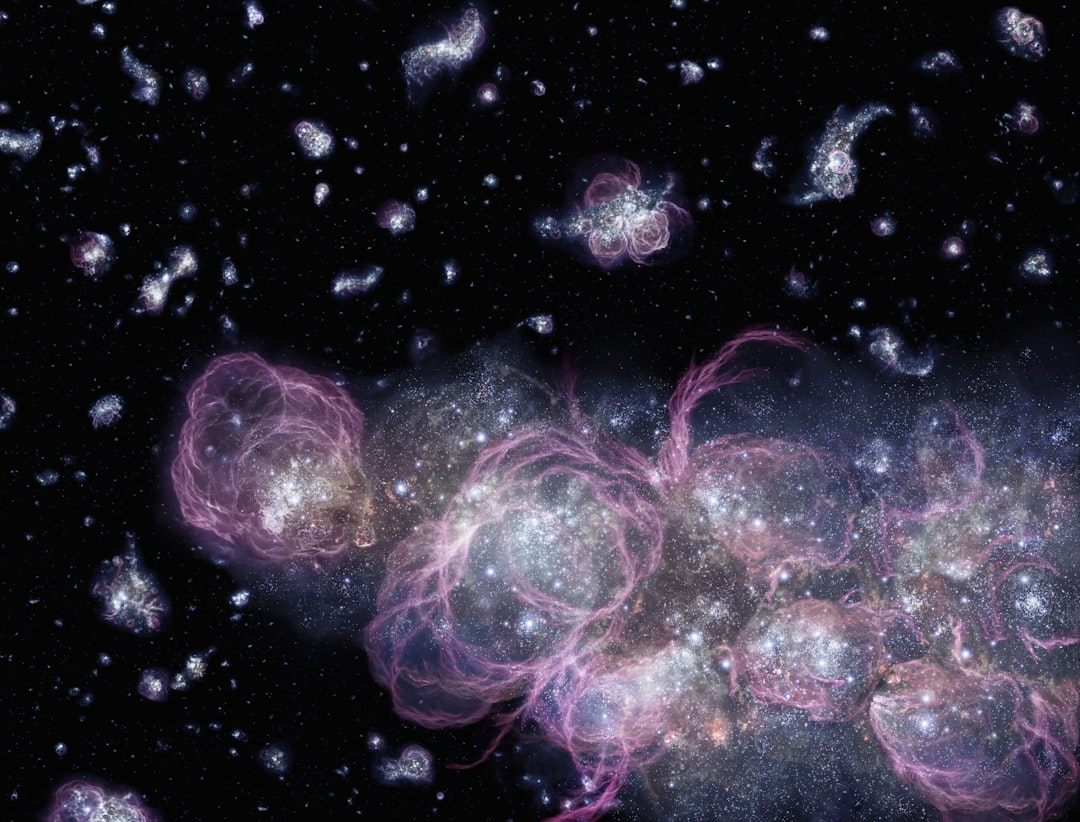
When we picture black holes, we often envision cosmic voids that passively consume everything in their path. While their gravitational pull is indeed immense, these enigmatic objects are far from dormant. In fact, some of the most spectacular and energetic phenomena in the universe are directly linked to them: black hole explosions. These aren’t conventional explosions in the sense of a star detonating, but rather incredible outbursts of energy and matter, driven by the intense gravitational and magnetic forces surrounding these cosmic behemoths.
💡 Key Takeaways
- Black hole outbursts are powerful energy releases caused by matter accreting onto the black hole.
- These events significantly influence the evolution and structure of host galaxies, sometimes suppressing or triggering star formation.
- Studying outbursts provides crucial insights into extreme gravity, plasma physics, and the fundamental processes governing energetic cosmic phenomena.
- Different types of black holes, from stellar-mass to supermassive, exhibit unique patterns and scales of outbursts.
“Black hole outbursts aren’t just cosmic fireworks; they’re the universe’s ultimate power generators, shaping galaxies and hinting at forces that could rewrite the very laws of physics, perhaps even inspiring future interstellar sagas.”
— Astrid Bellweather, Astrophysicist & Science Fiction Consultant
Understanding these powerful outbursts is crucial for comprehending galaxy evolution, the formation of cosmic structures, and the very fabric of our universe. From the dazzling intensity of `gamma-ray bursts` to the colossal outflows from `active galactic nuclei`, black holes are dynamic players on the cosmic stage.
For a deeper dive into the broader field of astrophysics, explore our Cosmic Queries: Probing the Mysteries of the Universe pillar page, where we unravel the grandest questions about space.
In This Article
- — 💡 Key Takeaways
- → Understanding Black Hole Outbursts: More Than Just Suction
- — 💡 Key Characteristics of Black Hole Outbursts:
- → The Engine Behind the Outbursts: Accretion Disks
- — 🌀 How Accretion Disks Power Outbursts:
- → Cosmic Cannons: Understanding Black Hole Jets
- — 🚀 Formation and Impact of Black Hole Jets:
- → Gamma-Ray Bursts: The Universe’s Most Powerful Explosions
- — 🌟 Types and Origin of Gamma-Ray Bursts:
- → Active Galactic Nuclei (AGNs): Supermassive Black Hole Outbursts
- — ⚡ The Activity of AGNs:
- → Detecting Outbursts: Observational Astronomy
- — 🛰️ Tools and Techniques for Detection:
- → Significance of Black Hole Outbursts in Cosmology
- — 🌍 Their Impact on the Cosmos:
- → Conclusion
Understanding Black Hole Outbursts: More Than Just Suction
The term “explosion” when applied to black holes refers to the immense energy released from the material around them, not from the black hole itself. Black holes are regions of spacetime where gravity is so strong that nothing, not even light, can escape. However, the process of matter falling into them (accretion) is incredibly violent and efficient, converting gravitational energy into light, heat, and powerful outflows.
💡 Key Characteristics of Black Hole Outbursts:
- ✅ Not the Black Hole Itself: The black hole is the engine, but the energy comes from the superheated matter swirling around it.
- ➡️ Extremely Energetic: These events can outshine entire galaxies.
- 🔭 Observable Across the Cosmos: Detected via X-rays, radio waves, gamma rays, and even gravitational waves.
- 🔬 Crucial for Astrophysics: Provides insights into extreme physics and galactic evolution.
The Engine Behind the Outbursts: Accretion Disks

The primary mechanism driving black hole outbursts is the `accretion disk`. As gas, dust, and even stars fall towards a black hole, they don’t plunge directly in. Instead, they are drawn into a swirling, flattened disk due to angular momentum.
🌀 How Accretion Disks Power Outbursts:
- 🔥 Friction and Heating: As particles in the disk rub against each other, they generate tremendous friction, heating the material to millions of degrees Celsius.
- ✨ Radiation Emission: This superheated plasma emits intense radiation across the electromagnetic spectrum, from radio waves to X-rays.
- 💥 Accretion Disk Flares: Instabilities within these disks can lead to sudden, dramatic increases in brightness, known as `accretion disk flares`, signaling a surge in matter falling towards the black hole.
- ⚡ Magnetic Field Interaction: The immense gravitational forces, coupled with the rotation of the black hole and the disk, can twist and amplify magnetic fields, channeling energy and matter into powerful jets.
Cosmic Cannons: Understanding Black Hole Jets
One of the most dramatic manifestations of black hole outbursts are `black hole jets`. These are incredibly powerful, highly collimated beams of plasma that are ejected at nearly the speed of light from the vicinity of the black hole’s poles, perpendicular to the accretion disk.
🚀 Formation and Impact of Black Hole Jets:
- 🌌 Collimation: Magnetic fields are believed to play a critical role in funneling the charged particles into narrow beams.
- 📏 Immense Scale: These jets can extend for hundreds of thousands, even millions, of light-years into intergalactic space.
- 🌡️ Heating Gas: As they blast through gas clouds, these jets can heat and push away surrounding gas, influencing star formation in galaxies.
- 🌠 Radio Lobes: When jets interact with the intergalactic medium, they often form vast “radio lobes” that glow brightly in radio wavelengths.
For more on these colossal structures, check out our article on Supermassive Black Holes: Colossal Engines of Galaxies.
Gamma-Ray Bursts: The Universe’s Most Powerful Explosions
When most people think of cosmic explosions, supernovae come to mind. But `gamma-ray bursts` (GRBs) are far more energetic, releasing more energy in a few seconds than the Sun will in its entire 10-billion-year lifetime. While their exact mechanisms are still debated, a significant class of long-duration GRBs is strongly linked to the formation of black holes.
🌟 Types and Origin of Gamma-Ray Bursts:
- ⏳ Long GRBs ( > 2 seconds): These are thought to originate from the collapse of rapidly rotating, massive stars (hypernovae) whose cores turn into black holes. The collapse drives powerful jets that punch through the star, producing the burst.
- ⏱️ Short GRBs ( < 2 seconds): These are typically attributed to the merger of two neutron stars, or a neutron star and a black hole, which also forms a new black hole.
These events are truly record-breaking in their energy output. As NASA highlights, the energy released can be immense. For more details, see the NASA article: Gamma-ray Bursts: Harvesting Knowledge From the Universe’s Most Powerful Explosions.
Active Galactic Nuclei (AGNs): Supermassive Black Hole Outbursts
At the heart of most galaxies, including our own Milky Way, reside `supermassive black holes`. When these colossal black holes are actively accreting matter, they become what are known as `active galactic nuclei` (AGNs). AGNs are not merely bright centers; they are sites of continuous, powerful outbursts.
⚡ The Activity of AGNs:
- ✨ Immense Luminosity: AGNs can outshine all the stars in their host galaxy combined, powered by the continuous infall of matter onto the central black hole.
- 🌬️ Galactic Winds: The intense radiation and jets from AGNs can drive powerful winds, pushing gas and dust out of the galaxy. This process, known as “feedback,” can regulate star formation and galaxy growth.
- 🔄 Variability: AGNs exhibit variability in their brightness, from rapid flickers to long-term changes, reflecting changes in the accretion rate onto the black hole.
Outbursts from these central black holes are key to understanding the evolution of galaxies themselves. Learn more about their influence in our guide to Galactic Black Holes: Understanding Galaxy Centers.
Detecting Outbursts: Observational Astronomy
Observing black hole outbursts requires sophisticated astronomical instruments that can detect a wide range of electromagnetic radiation, as well as other cosmic messengers.
🛰️ Tools and Techniques for Detection:
- X-ray Telescopes: Ideal for observing the superheated gas in accretion disks and the inner regions of jets.
- Gamma-Ray Observatories: Crucial for detecting the most energetic events, like GRBs.
- Radio Telescopes: Excellent for mapping the extended `black hole jets` and radio lobes, which are often remnants of past outburst activity.
- Optical and UV Telescopes: Used to study the broader impact of AGNs on their host galaxies and to observe the aftermath of GRBs.
- Gravitational Wave Detectors: While still nascent for black hole mergers, these offer a new window into the extreme dynamics of black hole formation and interaction, which can precede outbursts.
New discoveries are constantly reshaping our understanding, with breakthroughs like the record-breaking explosion spotted by NASA, as detailed in this NASA article on a record-breaking black hole explosion.
Significance of Black Hole Outbursts in Cosmology
Far from being mere cosmic spectacles, black hole outbursts play a fundamental role in shaping the universe we observe today.
🌍 Their Impact on the Cosmos:
- 🌱 Galaxy Evolution: The feedback from AGNs, through their jets and winds, can either stimulate or quench star formation, profoundly influencing how galaxies grow and evolve.
- 🌌 Intergalactic Medium: Outbursts inject vast amounts of energy and heavy elements into the intergalactic medium, enriching the cosmic web.
- 💡 Probes of Extreme Physics: They offer unique laboratories for studying physics under conditions impossible to replicate on Earth, testing theories of general relativity and electromagnetism.
- ⏰ Cosmic Distance Markers: Some types of GRBs might serve as “standard candles” to measure distances across the universe, helping us understand its expansion.
Recommended Video
Conclusion
The concept of “black hole explosions” reveals a universe far more dynamic and interconnected than a simple picture of cosmic vacuum cleaners might suggest. From the intricate dances within `accretion disks` to the colossal reach of `black hole jets` and the unparalleled power of `gamma-ray bursts`, these outbursts are fundamental engines of cosmic change. As our observational capabilities continue to advance, we are constantly unveiling new facets of these incredible phenomena, further solidifying the central role of black holes in the grand `cosmic queries` we continue to explore.
Frequently Asked Questions
What causes black hole explosions or outbursts?
Black hole outbursts are primarily caused by superheated gas and dust spiraling into a black hole’s accretion disk. As this matter approaches the event horizon, it releases immense gravitational energy, often ejecting powerful jets of plasma.
How often do black holes experience outbursts?
The frequency and intensity of black hole outbursts vary greatly. Stellar-mass black holes can have more frequent, shorter flares, while supermassive black holes experience less frequent but significantly more powerful outbursts that can last for millions of years.
Do black hole outbursts pose a threat to Earth?
No, known black holes capable of such outbursts are located at immense cosmic distances from Earth. The energy released dissipates over vast interstellar space, posing no direct threat to our planet.
What is the significance of studying black hole outbursts?
Studying black hole outbursts provides crucial insights into fundamental physics under extreme conditions, including the behavior of matter in intense gravitational fields, the mechanisms of jet formation, and the co-evolution of black holes and their host galaxies.