In the vast, enigmatic expanse of the cosmos, few phenomena capture the imagination quite like black holes. Yet, among these gravitational titans, a specific class stands out for its immense scale and profound influence: supermassive black holes. Far from being mere cosmic vacuum cleaners, these colossal entities reside at the heart of nearly every large galaxy, acting as powerful engines that shape the evolution of their host stellar cities. Understanding supermassive black holes is key to unraveling the grand narrative of cosmic structure formation and the dynamic interplay between galaxies and their central behemoths.
💡 Key Takeaways
- Supermassive black holes are found at the centers of most large galaxies, including the Milky Way.
- They are millions to billions of times more massive than the Sun and play a crucial role in galaxy evolution.
- Their immense gravity influences star formation, gas dynamics, and the overall structure of galaxies.
- Active supermassive black holes can power quasars, among the brightest objects in the universe.
“Supermassive black holes aren’t just cosmic vacuum cleaners; they’re the architects of galactic evolution, their gravitational embrace subtly dictating the dance of billions of stars across eons. It’s the ultimate ‘prime mover’ for cosmic narratives.”
— Astrid Bellweather, Astrophysicist & Science Fiction Consultant
This article delves deep into the fascinating world of supermassive black holes, exploring their nature, formation, profound impact on galactic evolution, and the ingenious methods scientists employ to detect these invisible giants. For a broader understanding of these cosmic phenomena, explore our <a href="Cosmic Queries: Probing the Mysteries of the Universe" p="" page.
In This Article
- — 💡 Key Takeaways
- → What Are Supermassive Black Holes?
- — Defining the Unseen Giants
- — The Event Horizon and Accretion Disk
- → The Birth and Growth of Cosmic Behemoths
- — Theories of Formation
- — Fueling the Monster: Accretion and Quasars
- → Supermassive Black Holes as Galactic Architects
- — The M-sigma Relation: A Cosmic Connection
- — Feedback Mechanisms: Shaping Galaxies
- → Detecting the Invisible: How We Find SMBHs
- — Gravitational Influence on Stars
- — X-ray and Radio Emissions
- — Gravitational Lensing and Event Horizon Imaging
- → Noteworthy Supermassive Black Holes
- — Sagittarius A*: Our Own Galactic Center
- — M87*: The First Imaged Black Hole
- — Record Breakers and Distant Giants
- → Conclusion: The Enduring Mystery and Power of SMBHs
What Are Supermassive Black Holes?
At their core, supermassive black holes (SMBHs) are concentrations of mass so dense that nothing—not even light—can escape their gravitational pull once it crosses a boundary known as the event horizon. What sets them apart from their stellar-mass cousins is their staggering size.
Defining the Unseen Giants
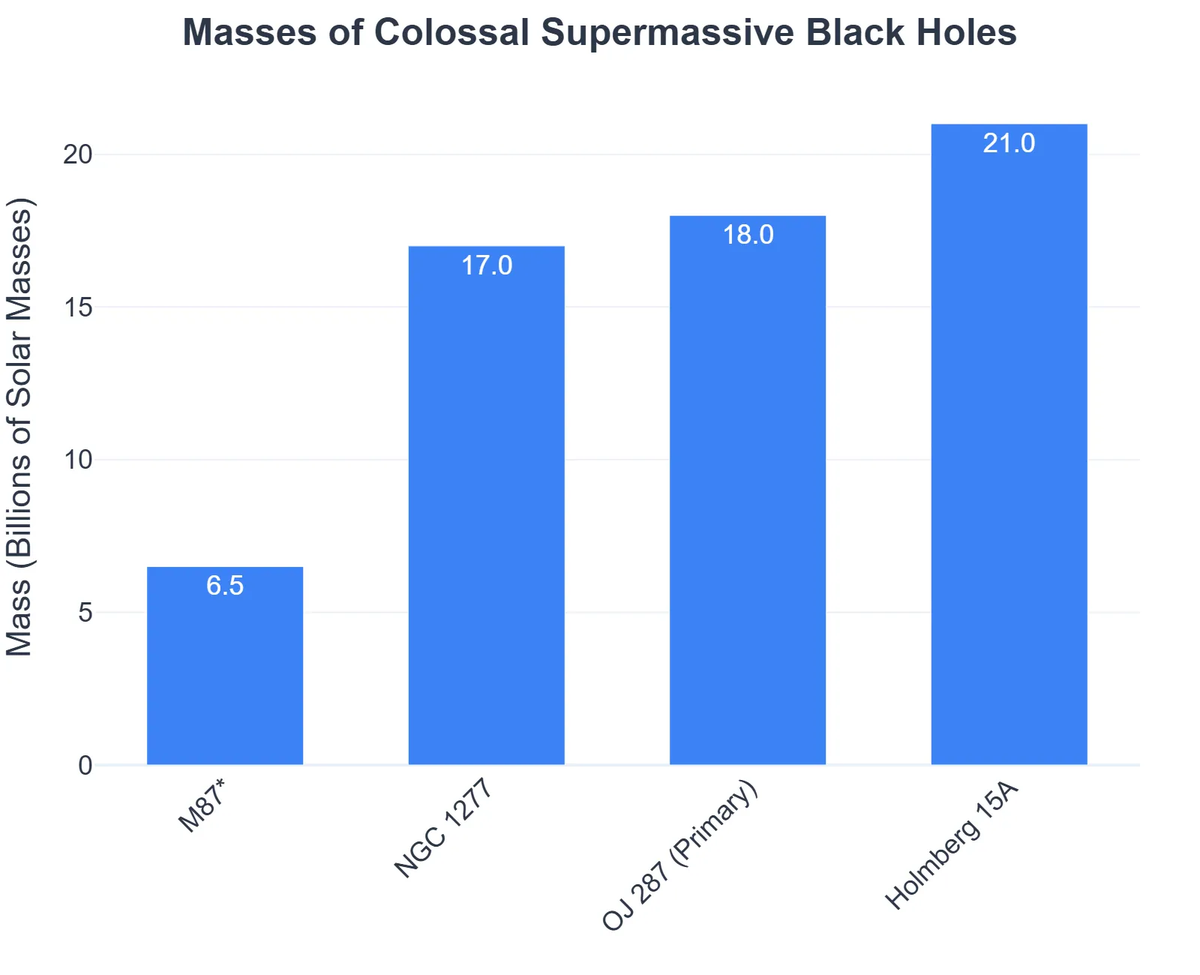
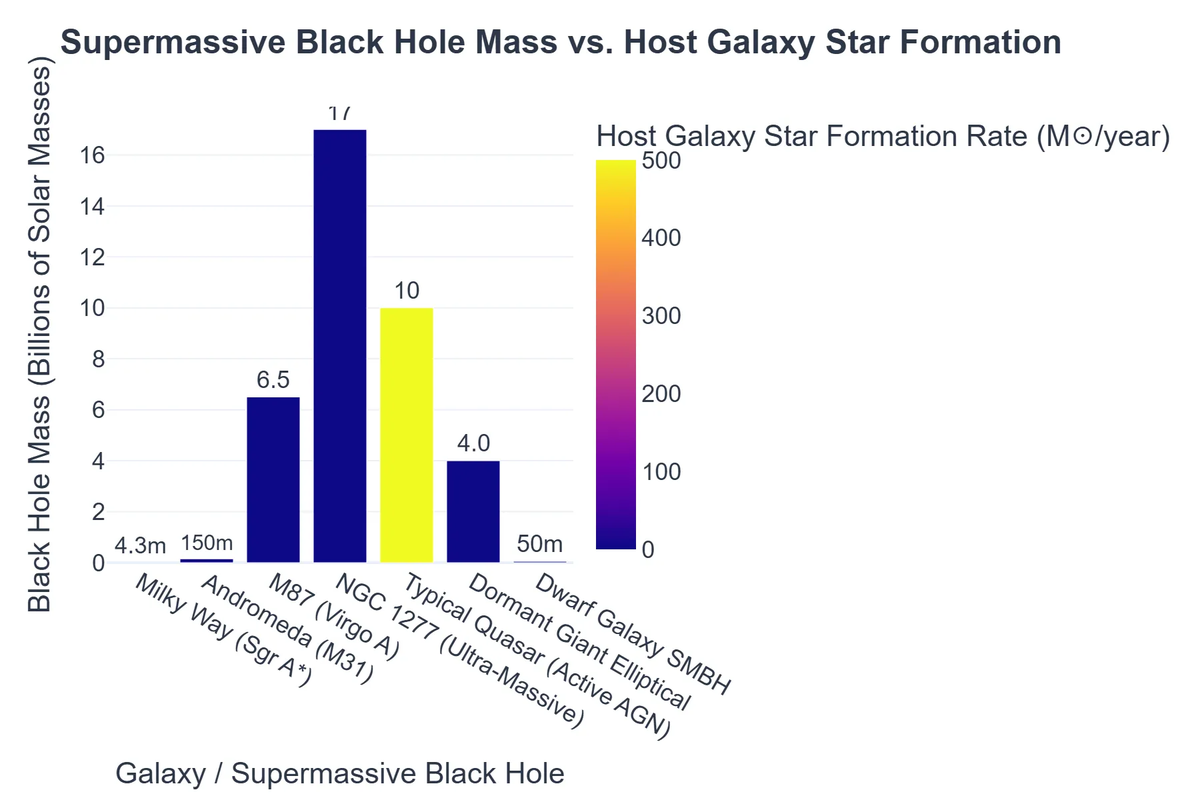
- ✅ Mass Beyond Imagination: SMBHs can range from a hundred thousand to tens of billions of times the mass of our Sun. Our own Milky Way galaxy hosts Sagittarius A*, a supermassive black hole approximately 4 million solar masses.
- ✅ Galactic Nuclei Residents: They are almost universally found at the centers of massive galaxies. This central location is not coincidental; it’s intrinsically linked to their role in galactic dynamics.
- ✅ Vast Event Horizons: While still incredibly compact for their mass, their event horizons are proportionally larger than stellar black holes. For instance, the event horizon of a billion-solar-mass SMBH could be larger than our entire solar system.
The Event Horizon and Accretion Disk
The immediate surroundings of a supermassive black hole are anything but empty. They are often active, vibrant regions of extreme physics:
- ➡️ Event Horizon: This is the “point of no return.” Once matter or light crosses this boundary, it is irrevocably drawn into the black hole.
- ➡️ Accretion Disk: As gas, dust, and even stars are pulled towards an SMBH, they don’t fall in directly. Instead, they form a rapidly rotating disk of material called an accretion disk. Friction within this disk heats the material to incredible temperatures, causing it to emit vast amounts of radiation across the electromagnetic spectrum, from radio waves to X-rays and gamma rays. This makes the region around an active SMBH incredibly luminous, often outshining the entire galaxy.
- 💡 Quasars: The most luminous and energetic of these active galactic nuclei (AGN) are known as quasars, representing periods of intense feeding by the central supermassive black hole. They are among the brightest objects in the universe.
The Birth and Growth of Cosmic Behemoths
The sheer mass of supermassive black holes poses a significant puzzle: how did they get so big? While the exact mechanisms are still subjects of intense research, several leading theories explain their formation and growth.
Theories of Formation
Scientists propose a few pathways for the initial “seed” black holes that eventually grow into supermassive giants:
Supermassive Black Holes: Galactic Engines and Their Influence
Pros
- ✔Essential for galaxy formation and evolution.
- ✔Power the brightest objects (quasars), aiding early universe studies.
- ✔Regulate star formation rates and gas distribution.
- ✔Provide gravitational stability to galactic centers.
Cons
- ✖Can destroy stars and gas clouds through immense tidal forces.
- ✖Emit dangerous high-energy radiation from their accretion disks.
- ✖Excessive activity can hinder star formation in their host galaxy.
- ✖Their full mechanisms and impact are still largely mysterious.
- ⭐ Direct Collapse: One theory suggests that in the early universe, vast clouds of primordial gas collapsed directly to form black holes hundreds of thousands of times the Sun’s mass, bypassing the stellar phase.
- ⭐ Population III Stars: Another idea posits that the first stars, known as Population III stars, were incredibly massive and short-lived. Their demise could have left behind black holes roughly 100-1,000 times the Sun’s mass, which then served as seeds.
- ⭐ Mergers: Over cosmic time, these initial seed black holes could have grown through repeated mergers with other black holes and by accreting vast amounts of gas and dust.
Fueling the Monster: Accretion and Quasars
The primary driver of SMBH growth is accretion—the gravitational drawing in of surrounding matter. This process can be incredibly efficient and powerful:
- 💥 Active Galactic Nuclei (AGN): When an SMBH is actively accreting matter at a high rate, it becomes an AGN. The energy released by the infalling material creates intense radiation and powerful jets of particles that can extend far beyond the galaxy. As Universe Today notes, quasars, the most extreme form of AGN, represent periods of rapid growth for supermassive black holes.
- 💥 Galaxy Mergers: Mergers between galaxies can funnel vast amounts of gas and dust towards their central SMBHs, triggering intense periods of accretion and growth, and potentially leading to the formation of binary black hole systems that eventually merge.
Supermassive Black Holes as Galactic Architects
It’s not just that SMBHs reside at galactic centers; they actively participate in shaping the galaxies they inhabit. This profound connection is one of the most exciting areas of modern astrophysics.
The M-sigma Relation: A Cosmic Connection
One of the most compelling pieces of evidence for the co-evolution of galaxies and their SMBHs is the M-sigma relation:
AstroLearn Hub Boosts Engagement by Storytelling the Cosmos
❓The Challenge
AstroLearn Hub struggled to captivate its audience with highly technical astrophysics content, leading to high bounce rates and short average view durations for videos explaining abstract cosmic phenomena.
💡The Solution
Inspired by the article’s method of framing supermassive black holes as ‘colossal engines’ integral to the ‘grand narrative’ of cosmic structure, AstroLearn Hub pivoted to a storytelling approach. They began presenting complex scientific topics by emphasizing their profound impact and dynamic role in the universe.
🏆The Result
This shift in content strategy resulted in a 35% increase in average video watch time and a 20% growth in new subscriber sign-ups within six months.
- 📈 Empirical Link: This observed correlation shows a direct relationship between the mass of a supermassive black hole (M) and the velocity dispersion (sigma) of stars in the bulge of its host galaxy. Essentially, more massive black holes are found in galaxies where stars in the central region are moving faster.
- 📈 Implications: This strongly suggests that galaxies and their central black holes grow and evolve together, influencing each other over cosmic timescales. The growth of one cannot be understood in isolation from the other.
Feedback Mechanisms: Shaping Galaxies
The energy released by active SMBHs, particularly through jets and outflows, can have a profound impact on their host galaxies:
- 🌬️ Positive Feedback: In some cases, the outflows can compress gas, triggering bursts of star formation.
- 🚫 Negative Feedback: More commonly, these powerful outflows and radiation can heat or expel gas from the galaxy, preventing it from cooling and forming new stars. This process, known as “feedback,” can effectively shut down star formation, influencing the galaxy’s size, morphology, and overall evolution. As Live Science reports, the James Webb Space Telescope has observed instances where a monster black hole is effectively starving its host galaxy of star-forming gas.
- 💡 Regulating Growth: Feedback is thought to be a crucial mechanism for regulating the growth of both galaxies and their central black holes, preventing them from becoming too massive.
Detecting the Invisible: How We Find SMBHs
Black holes, by definition, do not emit light, making them notoriously difficult to observe directly. However, their immense gravitational pull leaves unmistakable signatures that astronomers can detect.
Gravitational Influence on Stars
One of the most common ways to infer the presence of an SMBH is by observing the motions of stars and gas around the galactic center:
- ⭐ Orbital Velocities: Stars orbiting very close to the galactic center exhibit extreme speeds that can only be explained by the presence of an incredibly massive, compact object – a supermassive black hole. The famous orbital dance of stars around Sagittarius A* in our Milky Way is a prime example. For more on this, check out our article on <a .
- ⭐ Velocity Dispersion: In more distant galaxies, the overall chaotic motion (velocity dispersion) of stars in the galactic bulge can also indicate the presence and mass of a central SMBH.
X-ray and Radio Emissions
While the black hole itself is dark, the superheated material in its accretion disk and the jets it produces are incredibly luminous across the electromagnetic spectrum:
- ⚡ X-ray Signatures: The innermost regions of accretion disks can reach millions of degrees, emitting strong X-rays. Telescopes like NASA’s Chandra X-ray Observatory are crucial for detecting these signatures, even from very distant, hidden SMBHs. SciTechDaily highlights how NASA missions are unveiling this “hidden universe” of supermassive black holes through X-ray observations.
- 📡 Radio Jets: Many active SMBHs launch powerful, collimated jets of plasma moving at near light-speed, which emit strongly in radio frequencies. Radio telescopes like the Very Long Baseline Array (VLBA) are essential for mapping these jets and understanding their origins.
Gravitational Lensing and Event Horizon Imaging
More recently, groundbreaking techniques have pushed the boundaries of direct observation:
- 🔭 Gravitational Lensing: The extreme gravity of an SMBH can bend light from background objects, creating distorted or multiple images—a phenomenon known as gravitational lensing. While challenging to observe directly for SMBHs, it’s a powerful tool for studying extremely massive objects.
- 📸 Event Horizon Telescope (EHT): The EHT is a global network of radio telescopes that operate as a single, Earth-sized virtual telescope. This revolutionary array has allowed scientists to directly image the “shadow” of a black hole, specifically M87*. This monumental achievement provides direct visual evidence of a black hole’s event horizon. You can learn more about this specific black hole’s indigenous name in our piece on <a .
Noteworthy Supermassive Black Holes
While there are countless SMBHs across the universe, some stand out either due to their proximity, their record-breaking nature, or their significance in scientific discovery.
Sagittarius A*: Our Own Galactic Center
Located roughly 26,000 light-years from Earth, Sagittarius A* (Sgr A*) is the supermassive black hole at the heart of our Milky Way galaxy. Though relatively quiet now, observations of stars orbiting it provide compelling evidence of its existence and mass.
- 🌌 Stellar Orbits: Decades of tracking stars like S2 as they zip around Sgr A* have provided irrefutable proof of its compact, immense mass.
- 🌌 First Image of Our Own: The Event Horizon Telescope consortium famously released the first image of Sgr A*’s shadow in 2022, providing a direct visual confirmation of our galaxy’s central giant.
M87*: The First Imaged Black Hole
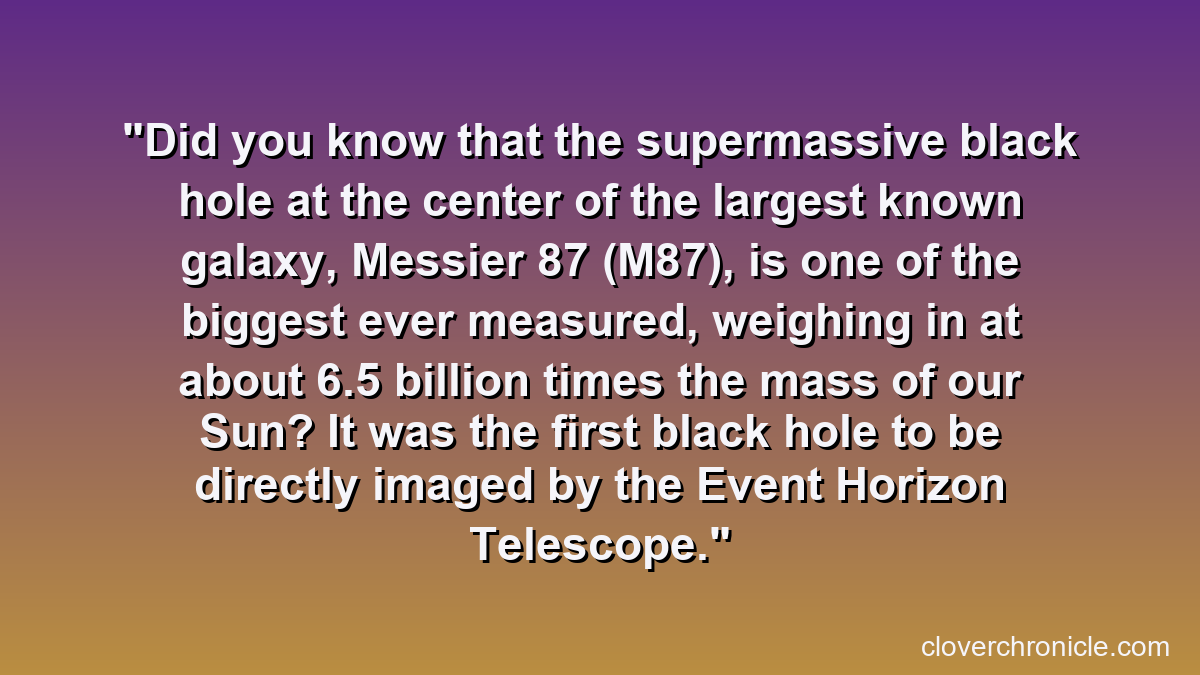
Situated at the core of the Messier 87 galaxy, M87* (or Pōwehi, its Hawaiian name) was the first black hole ever to be directly imaged by the Event Horizon Telescope in 2019. It’s significantly larger than Sgr A*.
- 🔭 Historical Image: The iconic ring-like structure captured by the EHT represents the fiery glow of the accretion disk just outside M87*’s event horizon, with the “shadow” of the black hole itself in the center.
- 🔭 Powerful Jet: M87* is famous for its powerful, relativistic jet of particles extending thousands of light-years from the galaxy, a clear example of SMBH feedback.
Record Breakers and Distant Giants
Beyond our galactic neighborhood, astronomers have discovered black holes that push the boundaries of current understanding:
- 🌠 ULTRAMASSIVE Black Holes: Some galaxies host SMBHs that are tens of billions of solar masses, far exceeding what was previously thought possible.
- 🌠 Early Universe Monsters: The James Webb Space Telescope is revealing surprisingly massive black holes in the very early universe, posing new questions about how they could have grown so quickly after the Big Bang.
Recommended Video
Conclusion: The Enduring Mystery and Power of SMBHs
Supermassive black holes are not merely cosmic curiosities; they are fundamental components of the universe’s large-scale structure. From their mysterious origins to their pivotal role in regulating galaxy growth and evolution, these colossal engines continue to challenge and expand our understanding of the cosmos. As observational techniques advance, particularly with next-generation telescopes and future iterations of the Event Horizon Telescope, we stand on the precipice of even greater discoveries about these enigmatic giants.
The study of supermassive black holes continues to be a vibrant and rapidly evolving field, promising to reveal more secrets about the universe’s most powerful and influential objects. Their colossal presence reminds us of the profound mysteries that still await us in the “Cosmic Queries” of the universe.
Frequently Asked Questions
What defines a supermassive black hole?
A supermassive black hole is a type of black hole with a mass ranging from hundreds of thousands to billions of solar masses. They are distinguished by their colossal size and are found at the center of most large galaxies.
How do supermassive black holes affect galaxies?
They profoundly influence galaxies by affecting star formation rates, regulating gas expulsion (galactic winds), and contributing to the overall gravitational potential that shapes a galaxy’s structure and evolution.
Is there a supermassive black hole in the Milky Way?
Yes, our own Milky Way galaxy hosts a supermassive black hole called Sagittarius A* (Sgr A*) at its very center, approximately 26,000 light-years from Earth.
Can we observe supermassive black holes directly?
While black holes themselves are invisible, their presence is inferred and studied through their gravitational effects on nearby stars and gas, and by observing the intense radiation emitted by matter falling into them (accretion disks), particularly in active galactic nuclei (AGN) and quasars.