

Welcome, fellow cosmic explorers, to an in-depth journey through one of the universe’s most enigmatic phenomena: black holes. In the realm of science fiction, few films have dared to tackle the complex physics of these gravitational behemoths with the same rigor and stunning visual fidelity as Christopher Nolan’s Interstellar movie. This article will dissect the intricate blend of cutting-edge theoretical physics and cinematic artistry that brought Gargantua, Interstellar‘s pivotal black hole, to life.
💡 Key Takeaways
- Interstellar’s depiction of Gargantua was based on real general relativity equations, making it one of the most scientifically accurate black hole portrayals.
- The film’s visual effects team worked directly with physicist Kip Thorne to simulate gravitational lensing and the accretion disk accurately.
- Concepts like time dilation and wormholes, central to the plot, are derived from Einstein’s theory of general relativity.
- Gargantua is an example of a rotating supermassive black hole, whose unique properties influence surrounding space-time.
“What makes Gargantua so compelling isn’t just its visual splendor, but the painstaking effort to root it in the most current understanding of general relativity. It’s a cinematic triumph that elevated the scientific portrayal of black holes for a generation.”
— Astrid Bellweather, Astrophysicist & Science Fiction Consultant
From the crushing realities of time dilation near an event horizon to the mind-bending possibilities of wormholes, we’ll explore how the scientific accuracy behind Interstellar not only captivated audiences but also pushed the boundaries of scientific visualization. Prepare to delve into the very fabric of spacetime as we unravel the mysteries that informed the creation of Gargantua and the profound implications for our understanding of the cosmos.
In This Article
- — 💡 Key Takeaways
- → 🌌 The Core Concepts of Black Hole Science
- — ➡️ What is a Black Hole?
- — 💡 Types of Black Holes
- — ⏱️ Spacetime Distortion and Time Dilation
- → 🪐 Interstellar’s Gargantua: A Scientific Blueprint
- — 🔬 Kip Thorne’s Scientific Guidance
- — ✨ Visualizing the Unseen: The Accretion Disk
- — ⏳ Time Dilation on Miller’s Planet
- → 💫 The Wormhole: Interstellar’s Cosmic Shortcut
- — 🔭 Theoretical Basis of Wormholes
- — 🧪 Traversable Wormholes and Exotic Matter
- → 🌠 Navigating the Event Horizon: Cooper’s Journey
- — 📏 Spaghettification vs. Gargantua’s Size
- — 🌌 The Tesseract and Higher Dimensions
- → 🔭 Black Holes in Reality: Beyond the Screen
- — Observing Black Holes: Indirect Evidence and Direct Imaging
- — Future Frontiers in Black Hole Research
- → ✨ The Enduring Legacy of Interstellar’s Physics
- — 💖 Inspiring Scientific Curiosity
- — 🤝 Bridging Science and Cinema
- → Conclusion
🌌 The Core Concepts of Black Hole Science
Before we journey to Gargantua, it’s essential to grasp the fundamental principles of black hole science. These cosmic titans are not “holes” in the traditional sense, but rather regions of spacetime where gravity is so intense that nothing—not even light—can escape.
➡️ What is a Black Hole?
- ✅ Singularity: At the heart of every black hole lies a singularity, a point of infinite density where the known laws of physics break down.
- ✅ Event Horizon: This is the boundary beyond which escape is impossible. Once an object crosses the event horizon, it is irrevocably pulled towards the singularity. It’s often referred to as the “point of no return.”
- ✅ Accretion Disk: Many black holes are surrounded by a swirling disk of gas and dust, heated to extreme temperatures by friction as it spirals inward. This disk glows brightly across the electromagnetic spectrum.
💡 Types of Black Holes
While all black holes share the same fundamental characteristics, they vary significantly in size:
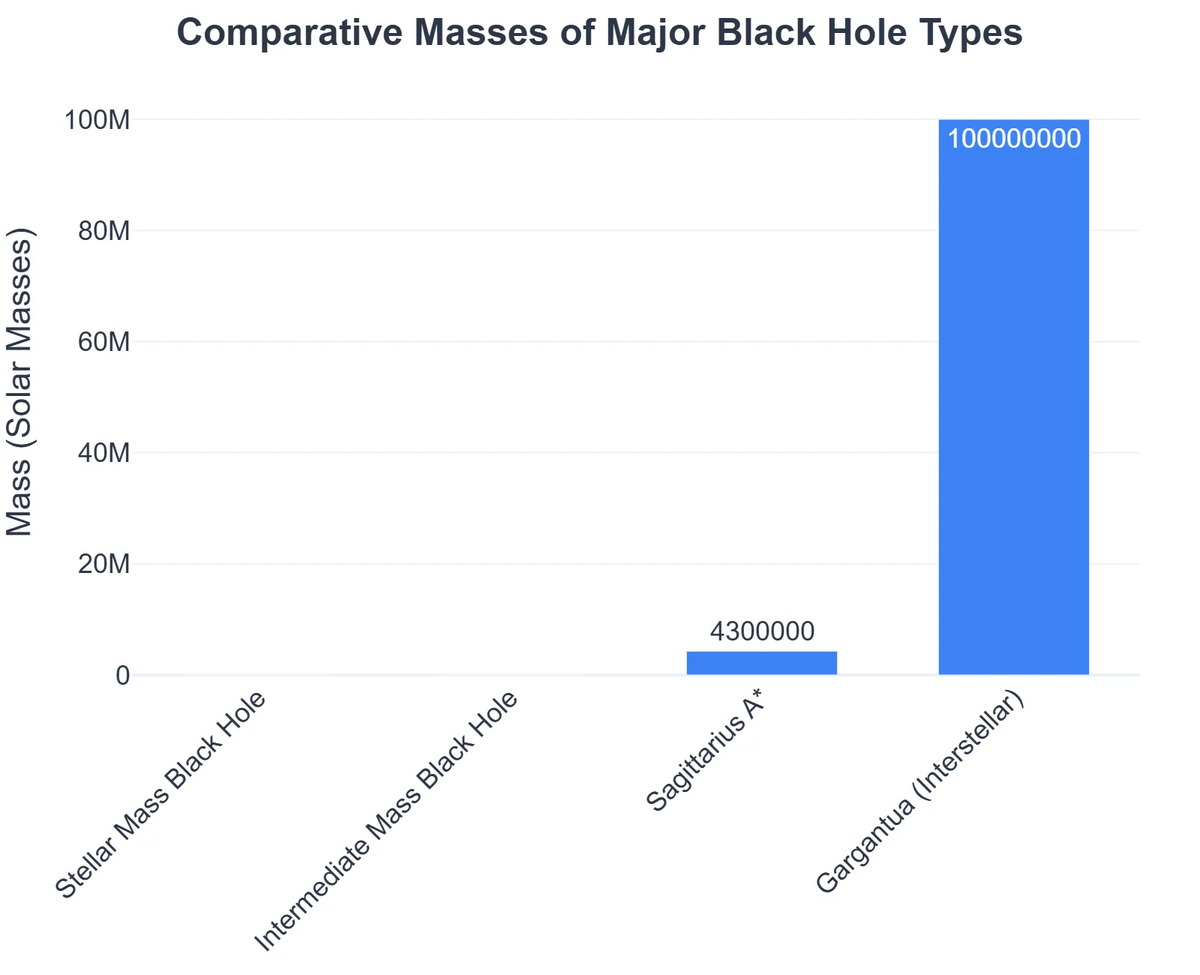
- ✅ Stellar Black Holes: Formed from the collapse of massive stars, typically 3 to 20 times the mass of our Sun.
- ✅ Supermassive Black Holes: Found at the centers of most galaxies, including our own Milky Way (Sagittarius A). These can range from millions to billions of solar masses. Gargantua, in *Interstellar, falls into this category.
⏱️ Spacetime Distortion and Time Dilation
One of the most mind-bending effects of a black hole’s immense gravity is its impact on spacetime. According to Einstein’s theory of general relativity, massive objects warp the fabric of spacetime around them. Near a black hole, this warping is extreme, leading to:
- ✅ Gravitational Lensing: Light from distant objects is bent and distorted by the black hole’s gravity, creating surreal visual effects, as brilliantly depicted in Interstellar.
- ✅ Time Dilation: Time itself passes more slowly for observers closer to a strong gravitational source than for those farther away. This phenomenon is central to the plot of Interstellar, particularly on Miller’s Planet. For a deeper dive into how time itself is affected by extreme gravity, explore our article on Temporal Physics: Unraveling the Science of Time.
🪐 Interstellar’s Gargantua: A Scientific Blueprint

The creation of Gargantua Interstellar was a monumental undertaking, blurring the lines between cinematic art and genuine scientific discovery. Led by executive producer and theoretical physicist Kip Thorne, Interstellar set a new benchmark for realistic depiction of cosmic phenomena.
🔬 Kip Thorne’s Scientific Guidance
Kip Thorne, a Nobel laureate in Physics, was integral to Interstellar‘s scientific accuracy. He provided the equations and theoretical framework that allowed the visual effects team to render Gargantua with unprecedented fidelity. His contributions ensured that the black hole wasn’t just a dramatic backdrop but a scientifically plausible entity, pushing the boundaries of what was previously visualized. Learn more about the specific challenges and triumphs in depicting this cosmic giant in Interstellar Black Holes: The Science of Gargantua.
✨ Visualizing the Unseen: The Accretion Disk
Perhaps the most visually stunning aspect of Gargantua is its accretion disk. Unlike previous Hollywood portrayals, Interstellar‘s black hole was rendered with a full, realistic accretion disk that orbited the black hole and was gravitationally lensed, appearing above and below the black hole’s silhouette due to the bending of light. This visualization was so accurate that it led to scientific publications by the film’s visual effects team.
⏳ Time Dilation on Miller’s Planet
Miller’s Planet, located incredibly close to Gargantua’s event horizon, serves as a dramatic demonstration of extreme time dilation. For every hour spent on Miller’s Planet, seven years passed on Earth. This profound effect highlighted the relativistic nature of time and gravity, forcing the characters—and the audience—to grapple with the true implications of living near a supermassive black hole. This concept is a cornerstone of Theoretical Physics: Charting the Universe.
💫 The Wormhole: Interstellar’s Cosmic Shortcut
Beyond the black hole, Interstellar introduced another fascinating element of theoretical physics: the wormhole. While still hypothetical, wormholes offer a tantalizing possibility for interstellar travel by creating shortcuts through spacetime.
🔭 Theoretical Basis of Wormholes
Wormholes, also known as Einstein-Rosen bridges, are theoretical tunnels that connect two distant points in spacetime, potentially allowing for faster-than-light travel. Although predicted by general relativity, stable, traversable wormholes require conditions that are currently unknown or impossible with known matter.
🧪 Traversable Wormholes and Exotic Matter
Kip Thorne proposed that to keep a wormhole open for passage, it would require “exotic matter” with negative energy density – something not observed in our universe. In Interstellar, the wormhole near Saturn is presented as a gift from an advanced civilization, implying that they possessed the knowledge or means to stabilize such a structure.
🌠 Navigating the Event Horizon: Cooper’s Journey
Cooper’s climactic journey into Gargantua is the film’s boldest speculative leap, venturing beyond the realm of confirmed science into the theoretical frontiers of higher dimensions and the nature of singularities. For a comprehensive look at the veracity of these depictions, read Gargantua Black Hole: Fact vs. Fiction in Interstellar.
📏 Spaghettification vs. Gargantua’s Size
For a stellar-mass black hole, crossing the event horizon would result in “spaghettification”—the immense tidal forces would stretch and tear an object apart. However, for a supermassive black hole like Gargantua, the event horizon is so vast that the tidal forces at the point of crossing would be much weaker, allowing an object (or a person) to pass through relatively intact, at least initially. The true danger lies closer to the singularity.

🌌 The Tesseract and Higher Dimensions
Cooper’s survival and subsequent experience within the Tesseract, a five-dimensional construct within Gargantua, represents the film’s most speculative element. This abstract space, designed by the future “Bulk Beings,” allowed Cooper to interact with past events in his daughter’s life by manipulating gravity across time. While the Tesseract is a fictional device, it’s rooted in the theoretical possibility of higher spatial dimensions, a concept explored in advanced black hole science and string theory.
🔭 Black Holes in Reality: Beyond the Screen
While Interstellar offers a compelling vision, the real study of black holes continues to yield astonishing discoveries, moving from theoretical prediction to observational evidence.
Observing Black Holes: Indirect Evidence and Direct Imaging
Black holes are, by definition, invisible. However, their presence is detected through their gravitational effects on surrounding matter and light:
- ✅ Gravitational Waves: The LIGO experiment has directly detected gravitational waves from colliding black holes, confirming a major prediction of general relativity.
- ✅ X-ray Emission: Matter falling into black holes heats up to extreme temperatures, emitting powerful X-rays detectable by telescopes.
- ✅ Event Horizon Telescope (EHT): In 2019, the EHT captured the first-ever image of a black hole’s shadow—that of M87—providing direct visual evidence of an event horizon, remarkably similar to *Interstellar‘s depictions. See how this aligns with the science on Space.com’s analysis of Interstellar black holes.
Future Frontiers in Black Hole Research
Current research continues to push the boundaries of our understanding, from exploring the nature of singularities to investigating the quantum properties of black holes and the information paradox. These are areas where black hole quantum physics seeks to bridge the gap between general relativity and quantum mechanics.
✨ The Enduring Legacy of Interstellar’s Physics
Interstellar‘s ambitious portrayal of black holes and wormholes has left an indelible mark, not just on cinema but also on public engagement with science.
💖 Inspiring Scientific Curiosity
The film, guided by Kip Thorne, successfully brought complex concepts like time dilation, gravitational lensing, and event horizons to a mainstream audience in an accessible and visually stunning way. It sparked countless discussions and inspired a new generation to look up at the stars with a deeper appreciation for the wonders of the universe.
🤝 Bridging Science and Cinema
The collaboration between theoretical physicists and Hollywood filmmakers set a precedent for scientific accuracy in speculative fiction. It demonstrated that hard science, even when venturing into the hypothetical, can enhance rather than detract from a compelling narrative.
Recommended Video
Conclusion
The science of black holes, as showcased through Gargantua and the wormhole in Interstellar, is a testament to the power of human curiosity and ingenuity. The film successfully merged cutting-edge scientific theory with cinematic storytelling, making concepts like gravitational time dilation and cosmic shortcuts tangible and dramatic. While Interstellar took speculative leaps, its foundation in verified black hole science and the meticulous guidance of experts like Kip Thorne ensured a portrayal that was both awe-inspiring and remarkably faithful to our current understanding of the cosmos. As we continue to probe the mysteries of the universe, films like Interstellar serve as a vital bridge, inspiring us all to ask more Cosmic Queries: Probing the Mysteries of the Universe.
Frequently Asked Questions
How accurate is Interstellar’s portrayal of Gargantua?
Interstellar’s depiction of Gargantua, particularly its gravitational lensing and accretion disk, is considered one of the most scientifically accurate in film history, thanks to the collaboration with physicist Kip Thorne.
What is time dilation in the context of Gargantua?
Time dilation near Gargantua means that time passes significantly slower for those close to the black hole compared to those far away, a key plot point illustrated by the planet Miller’s experience.
Did Kip Thorne contribute to Interstellar’s science?
Yes, Nobel laureate Kip Thorne served as a scientific consultant for ‘Interstellar,’ providing theoretical framework and equations for the black hole and wormhole visuals.
Are wormholes real, as shown in Interstellar?
While theoretically possible solutions to Einstein’s equations, traversable wormholes remain purely hypothetical and have not been observed or proven to exist in reality.