


For decades, humanity has gazed upon Mars, captivated by its crimson hue and the tantalizing possibility of life beyond Earth. At the forefront of this quest for knowledge stands the Jet Propulsion Laboratory (JPL), a federally funded research and development center managed by Caltech for NASA. From pioneering flybys to sophisticated robotic rovers, JPL Mars missions have systematically unveiled the Red Planet’s secrets, transforming our understanding of its past, present, and potential future.
💡 Key Takeaways
- JPL has been instrumental in nearly all successful US missions to Mars since the 1960s, leading humanity’s robotic exploration of the Red Planet.
- Their missions have dramatically advanced our understanding of Mars’ geology, climate history, atmospheric dynamics, and potential for habitability.
- Key technologies developed by JPL, like sophisticated rovers, enable on-site scientific discovery and sample collection in extreme Martian environments.
- Future JPL Mars missions aim to bring samples back to Earth for in-depth analysis and to prepare the groundwork for eventual human exploration.
“JPL’s relentless pursuit of Mars data has fundamentally reshaped our geophysical models of the planet. From ancient water flows to current seismic activity, their missions provide invaluable insights into planetary formation and dynamic processes, far beyond what ground-based observations could ever achieve.”
— Marcus Sterling, Geophysical Explorer & Climate Dynamics Analyst
This comprehensive guide delves into the storied history of JPL’s monumental contributions to Mars exploration, highlighting the groundbreaking missions that have pushed the boundaries of scientific discovery and engineering marvel. We’ll explore the evolution of technology, the profound insights gained, and the ambitious plans still on the horizon, all powered by the relentless pursuit of knowledge by NASA and its dedicated teams.
In This Article
- — 💡 Key Takeaways
- → The Dawn of Martian Exploration: Early Missions Paving the Way
- — 🌌 Mariner Program: First Glimpses of Mars
- — 🚀 Viking Program: The Search for Life
- → The Rover Revolution: Spirit, Opportunity, and Curiosity
- — 🪨 Mars Exploration Rovers (MER): Spirit and Opportunity
- — 🧪 Mars Science Laboratory (MSL): Curiosity
- → Modern Era of Mars Exploration: InSight and Perseverance
- — 🌍 InSight Lander: Listening to Mars’s Pulse
- — 🤖 Mars 2020 Perseverance Rover: Chasing Ancient Life
- → Pioneering Future Frontiers: Sample Return and Beyond
- — ↩️ Mars Sample Return (MSR): Bringing Martian Rocks to Earth
- — 🧑🚀 Preparing for Human Exploration
- → The Enduring Legacy of JPL and NASA in Mars Exploration
- — 💡 Scientific Breakthroughs and Unseen Forces
- — 🌟 Inspiring the Next Generation of Explorers
- → Conclusion
The Dawn of Martian Exploration: Early Missions Paving the Way
The journey to Mars began long before rovers trundled across its surface. Early missions, though rudimentary by today’s standards, laid the essential groundwork for everything that followed, proving that interplanetary travel was not just a dream but an achievable reality.
🌌 Mariner Program: First Glimpses of Mars
The Mariner program marked NASA’s initial forays into robotic planetary exploration. Managed by JPL, these missions provided the very first close-up images and scientific data of Mars, forever changing our perception of the Red Planet.
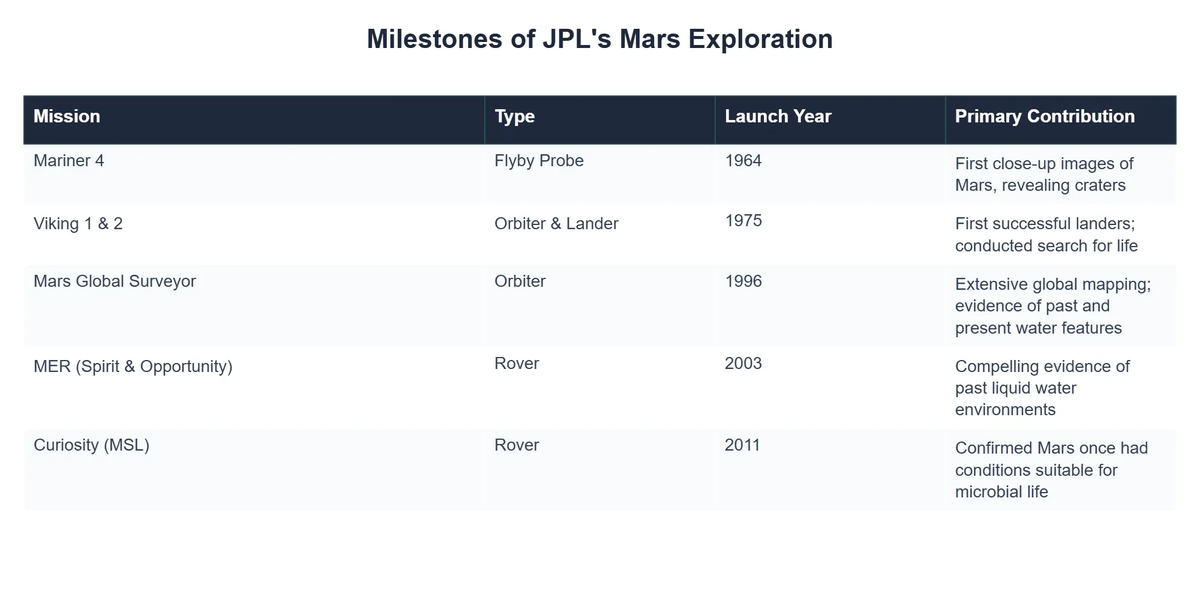
- ✅ Mariner 4 (1964): Achieved the first successful flyby of Mars, sending back 21 grainy but revelatory images. These pictures shattered the romanticized notions of Martian canals, revealing a cratered, moon-like landscape. As JPL itself noted, the Mariner 4 anniversary marked a pivotal moment in exploration. Learn more about the Mariner 4 legacy.
- ➡️ Mariner 6 and 7 (1969): These twin flybys provided more detailed atmospheric data and higher-resolution images, covering about 20% of the Martian surface.
- 💡 Mariner 9 (1971): Became the first spacecraft to successfully orbit another planet, providing unprecedented global mapping of Mars despite early dust storms. It observed the planet’s volcanoes, canyons, and polar caps, profoundly influencing future mission planning.
🚀 Viking Program: The Search for Life
The Viking missions represented a monumental leap in complexity and ambition. Consisting of two orbiters and two landers, Viking was the first mission to successfully land on Mars and conduct extensive scientific investigations on the surface, including an explicit search for biosignatures. While the landers were not developed by JPL, the mission laid crucial groundwork for future robotic surface operations.
- 🌍 Orbiter Contributions: Mapped the surface and atmosphere, identified potential landing sites for the landers, and relayed data back to Earth.
- 🔬 Lander Contributions: Performed sophisticated biological experiments to detect signs of microbial life in the Martian soil. Although results were inconclusive regarding life, they provided invaluable data on soil composition, meteorology, and seismic activity. For insights into lander technology, you might explore Lockheed Martin Mars Landers: From Viking to Phoenix.
The Rover Revolution: Spirit, Opportunity, and Curiosity

The turn of the millennium heralded a new era of Mars exploration: the age of the JPL rover. These mobile laboratories allowed scientists to explore diverse terrains, extending the reach of human curiosity far beyond static landers.
🪨 Mars Exploration Rovers (MER): Spirit and Opportunity
Launched in 2003, Spirit and Opportunity were designed for a 90-day mission but far exceeded expectations, operating for years and fundamentally changing our understanding of Mars’s watery past. These were iconic JPL rover missions.
- 💧 Evidence of Past Water: Both rovers found compelling geological evidence, such as hematite concretions (“blueberries”) and mineral deposits, indicating that liquid water was once abundant on Mars. You can read more about how these missions changed Mars science here: 20 Years After Landing: How NASA’s Twin Rovers Changed Mars Science.
- ⛰️ Diverse Geological Analysis: Spirit explored Gusev Crater, while Opportunity investigated Meridiani Planum, providing a rich dataset on Martian geology and mineralogy.
🧪 Mars Science Laboratory (MSL): Curiosity
The Curiosity rover, a technological marvel launched in 2011, took Martian exploration to an unprecedented level of sophistication. It landed in Gale Crater, a site chosen for its rich geological diversity, and has been exploring it ever since.
- 🔬 Habitability Assessment: Curiosity’s primary mission was to determine if Mars ever had conditions favorable for microbial life. It found evidence of a past freshwater lake system that could have supported life.
- 🌱 Organic Molecules: The rover detected organic molecules in Martian rocks, providing building blocks for life, though not direct evidence of life itself.
- ⚡ Advanced Instruments: Equipped with a suite of advanced scientific instruments, including a drill, a laser for rock vaporization (ChemCam), and sophisticated analytical laboratories, Curiosity continues to deliver groundbreaking data.
Modern Era of Mars Exploration: InSight and Perseverance
Recent decades have seen JPL push the boundaries even further, employing cutting-edge technology to probe deeper into Mars’s interior and prepare for the ultimate goal: bringing Martian samples back to Earth.
🌍 InSight Lander: Listening to Mars’s Pulse
Launched in 2018, the InSight lander (Interior Exploration using Seismic Investigations, Geodesy and Heat Transport) represented a unique shift, focusing on the deep interior of Mars rather than surface geology. It was another critical NASA mission managed by JPL.
How ‘Cosmic Canvas Collectibles’ Engaged Customers with Red Planet History
❓The Challenge
Their generic space merchandise descriptions failed to capture the deep passion of space enthusiasts, resulting in low customer engagement and stagnant conversion rates.
💡The Solution
By leveraging the rich historical detail and scientific narratives from guides like the JPL Mars Missions overview, they revamped product descriptions and created dedicated content highlighting the groundbreaking achievements of missions like Mariner 4 and Viking.
🏆The Result
This narrative-driven content strategy increased average session duration on product pages by 35% and boosted conversion rates for Mars exploration-themed merchandise by 25% within four months.
- Seismic Investigations: It conducted seismic investigations, heat flow measurements, and precision tracking to understand the planet’s formation and evolution. For a deeper dive into this mission, explore NASA InSight Mars Lander: Probing the Red Planet’s Interior.
- Internal Structure Analysis: InSight detected thousands of marsquakes and meteorite impacts, providing an unprecedented look into the Martian crust, mantle, and core.
🤖 Mars 2020 Perseverance Rover: Chasing Ancient Life
The Perseverance JPL rover, launched in 2020, is the most technologically advanced and ambitious rover sent to Mars to date. It embodies NASA’s next step in the journey towards human exploration and the search for ancient microbial life.
- 🏞️ Jezero Crater Exploration: Perseverance is exploring Jezero Crater, a former lakebed and river delta, identified as a prime location for preserving biosignatures. You can learn more about its discoveries here: Mars 2020 Perseverance Rover: Uncovering Red Planet Secrets.
- 📦 Sample Caching: A core part of its mission is to collect and cache Martian rock and regolith samples in sealed tubes, preparing them for future return to Earth.
- 🚁 Ingenuity Helicopter: As a technology demonstration, the Ingenuity helicopter, carried by Perseverance, achieved the first powered, controlled flight on another planet, opening a new dimension for planetary exploration.
Pioneering Future Frontiers: Sample Return and Beyond
The insights gathered by JPL’s past and current missions are not just ends in themselves; they are critical stepping stones towards even bolder endeavors, including bringing Mars to Earth and, eventually, humans to Mars.
↩️ Mars Sample Return (MSR): Bringing Martian Rocks to Earth
The Mars Sample Return campaign is an ambitious multi-mission effort, with Perseverance collecting samples as its first crucial step. Managed by JPL, MSR aims to bring these precious Martian materials to Earth for detailed analysis in terrestrial laboratories.
- 🔬 Unprecedented Analysis: Returning samples will allow scientists to use Earth-based instruments far more powerful than anything that can be sent to Mars, potentially confirming the presence of ancient life or revealing unknown geological processes. More details on this monumental endeavor can be found here: Mars Sample Return Mission: Bringing Martian Rocks to Earth.
- 🌐 International Collaboration: MSR is a collaborative effort between NASA and the European Space Agency (ESA), showcasing the power of international partnership in space exploration.
🧑🚀 Preparing for Human Exploration
Every JPL Mars mission, from the smallest atmospheric probe to the most complex rover, contributes vital data and technological advancements necessary for sending humans to Mars. Understanding radiation environments, atmospheric conditions, and resource availability are all direct outcomes of these robotic trailblazers.
- 🛠️ Technology Development: Rover operations test autonomous systems, power generation, and communication protocols essential for crewed missions.
- 🗺️ Site Selection: Detailed mapping and geological surveys inform potential landing sites and resource utilization strategies for future astronauts.
- 🧪 Life Support & Hazards: Environmental monitoring provides crucial data on Martian hazards and potential resources for life support.
NASA continues to outline its ambitious Mars exploration program for the coming decades, focusing on a sustainable human presence. Read more about NASA’s future Mars plans.

Recommended Video
The Enduring Legacy of JPL and NASA in Mars Exploration
The story of Mars exploration is inextricably linked with the ingenuity and perseverance of JPL and NASA. Their collaborative efforts have transformed Mars from a distant, mysterious orb into a scientifically accessible world, rich with potential for discovery.
💡 Scientific Breakthroughs and Unseen Forces
Through decades of meticulous planning, daring execution, and profound scientific analysis, JPL’s missions have uncovered critical insights into the Red Planet’s hidden dynamics:
- 💧 Water’s Past: Confirmed that Mars once harbored significant amounts of liquid water, making it potentially habitable in its early history.
- 🌬️ Atmospheric Evolution: Provided detailed data on Mars’s thin atmosphere, its escape into space, and the planet’s dramatic climate changes.
- 🌋 Geological Understanding: Mapped ancient volcanoes, vast canyon systems, and diverse geological terrains, unraveling the planet’s violent and active past.
- ⚛️ Elemental Composition: Identified key elements and minerals on the surface, guiding our understanding of Martian chemistry.
These discoveries not only deepen our understanding of Mars but also provide crucial context for comprehending Earth’s own geological history and the Earth’s Unseen Forces: The Hidden Dynamics of Our Planet that shape planetary bodies.
🌟 Inspiring the Next Generation of Explorers
Beyond the scientific papers and engineering achievements, JPL’s Mars missions have profoundly impacted public imagination. The stunning images, the narratives of rover endurance, and the tantalizing possibility of finding life have inspired countless individuals to pursue careers in science, technology, engineering, and mathematics (STEM). This continuous cycle of exploration and inspiration ensures that the quest to understand Mars, and indeed the cosmos, will continue for generations to come.
Conclusion
The journey to Mars, spearheaded by the remarkable efforts of JPL and NASA, represents one of humanity’s most ambitious and successful scientific endeavors. From the first fleeting images sent by Mariner 4 to the cutting-edge sample collection by the Perseverance JPL rover, each mission has built upon the last, progressively revealing more about our enigmatic planetary neighbor.
As we look to the future, with plans for sample return and eventually human missions, the legacy of these decades of Red Planet exploration continues to grow. JPL’s unwavering commitment to innovation and discovery ensures that the search for answers on Mars, and the pursuit of understanding our place in the universe, remains a vibrant and thrilling frontier.
Frequently Asked Questions
Which was JPL’s first successful Mars mission?
JPL’s first successful mission to Mars was Mariner 4 in 1965, which provided the first close-up images of the Red Planet and confirmed its heavily cratered, moon-like surface.
What are some of JPL’s most famous Mars rovers?
JPL is famous for designing and operating iconic Mars rovers including Sojourner (part of the Mars Pathfinder mission), Spirit, Opportunity, Curiosity, and the most recent, Perseverance. These rovers have vastly expanded our understanding of Mars.
What have JPL missions discovered about water on Mars?
JPL missions have found extensive evidence of ancient liquid water on Mars, including dried riverbeds, lakebeds, and minerals that only form in the presence of water. They’ve also detected subsurface ice and inferred the presence of transient briny water on the surface today.
How does JPL contribute to the search for life on Mars?
JPL missions like Perseverance are actively searching for signs of ancient microbial life by analyzing rock and soil samples on site and collecting core samples for potential return to Earth. Past missions also assessed Mars’s past habitability.