The quest to understand the formation and evolution of rocky planets like Earth often leads us to our celestial neighbor, Mars. While rovers traverse its surface, collecting invaluable geological data, a unique mission aimed deeper: the NASA InSight Mars Lander. Launched in 2018, InSight’s primary goal was to study the Red Planet’s deep interior, providing unprecedented insights into its hidden dynamics and the processes that shaped it over billions of years.
💡 Key Takeaways
- InSight’s primary mission was to study Mars’ deep interior using seismometers and heat flow probes.
- It successfully detected thousands of marsquakes, providing unprecedented data on Mars’ internal structure.
- The mission revealed key insights into the size and composition of Mars’ core, mantle, and crust.
- InSight’s findings are crucial for understanding the formation and evolution of rocky planets, including Earth.
“InSight revolutionized our understanding of Mars’ internal structure. By listening to its seismic whispers, we’ve gained an unprecedented view into the Red Planet’s deep geological processes, fundamentally reshaping our planetary models.”
— Dr. Marcus Sterling, PhD, Planetary Geoscientist & Climatologist
In This Article
- — 💡 Key Takeaways
- → Unveiling Mars’ Interior: The InSight Mission’s Core Purpose
- → ⚙️ Key Instruments of the InSight Lander
- — ➡️ The Seismic Experiment for Interior Structure (SEIS)
- — 🌡️ The Heat Flow and Physical Properties Package (HP3)
- — 🛰️ The Rotation and Interior Structure Experiment (RISE)
- → Groundbreaking Discoveries and Legacy of InSight
- → The End of a Mission: A Triumph of Science
Unveiling Mars’ Interior: The InSight Mission’s Core Purpose
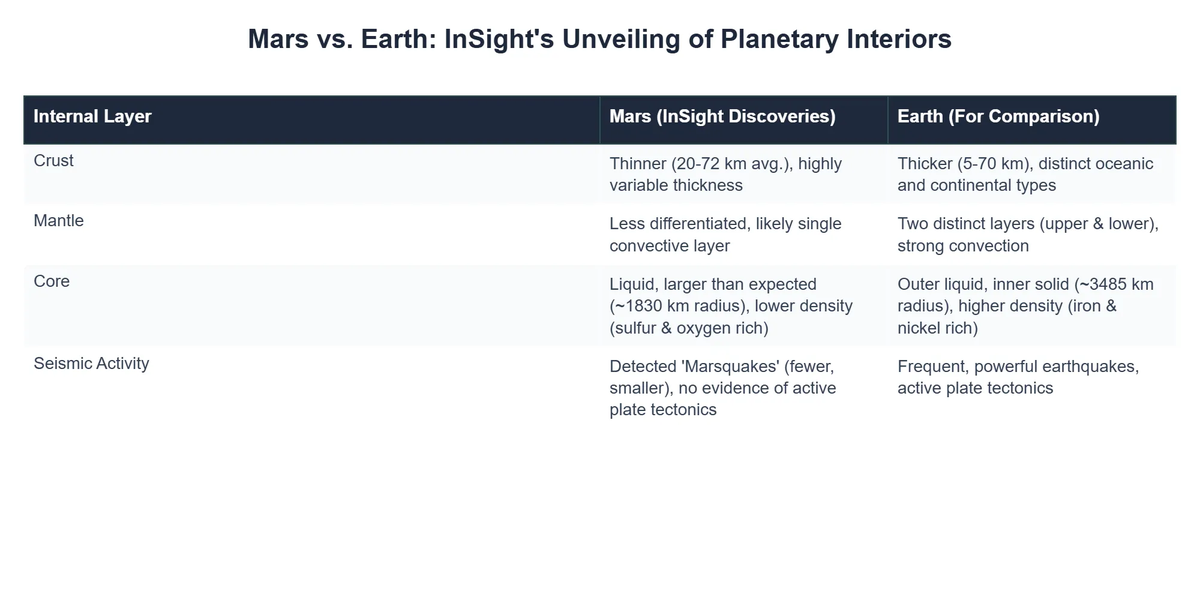
Unlike previous missions focused on surface geology or habitability, the InSight (Interior Exploration using Seismic Investigations, Geodesy, and Heat Transport) mission was designed as a stationary lander dedicated entirely to geophysics. Its primary objective was to understand the processes that formed and continue to shape rocky planets by examining the internal structure and thermal state of Mars.
- ✅ Seismology: Detecting and analyzing “Marsquakes” to map the planet’s internal layers (crust, mantle, core).
- ✅ Heat Flow: Measuring the heat escaping from Mars’ interior to understand its thermal evolution.
- ✅ Planetary Rotation: Precisely tracking Mars’ wobble (precession and nutation) to determine the size, state, and composition of its core.
By studying Mars, scientists gain a comparative planetology perspective, helping us better comprehend the complex processes that govern our own planet, Earth’s Unseen Forces: The Hidden Dynamics of Our Planet. The data collected by InSight Mars provided the first direct measurements of a planetary interior other than Earth’s Moon, making it a monumental step in planetary science.
⚙️ Key Instruments of the InSight Lander
The success of the InSight Mars Lander hinged on its sophisticated suite of scientific instruments, each meticulously designed to probe the planet’s depths. While many associate Martian exploration with the mobility of an `insight rover` like Mars 2020 Perseverance Rover, InSight’s strength lay in its stationary, precise measurements.
➡️ The Seismic Experiment for Interior Structure (SEIS)
SEIS was the mission’s centerpiece, a highly sensitive seismometer designed to detect the faint tremors of Marsquakes. It was carefully deployed onto the Martian surface by the lander’s robotic arm, then covered by a wind and thermal shield to protect it from environmental disturbances. This instrument was crucial for:
- 💡 Mapping Layers: By analyzing how seismic waves travel through the planet, scientists could determine the thickness of the Martian crust, the structure of its mantle, and the size and state (liquid or solid) of its core.
- 🌍 Detecting Marsquakes: SEIS recorded hundreds of seismic events, ranging from small tremors to larger quakes, providing unprecedented data on the planet’s internal activity.
🌡️ The Heat Flow and Physical Properties Package (HP3)
Nicknamed “the Mole,” HP3 was designed to burrow up to 5 meters (16 feet) below the Martian surface to measure the planet’s internal heat. This was critical for understanding Mars’ thermal evolution and how it lost its internal heat over geological time. However, the Mole faced significant challenges:
NASA InSight Mars Lander: Pros and Cons
Pros
- ✔Provided unprecedented data on Mars’ deep interior structure, including core insights.
- ✔Conducted the first successful seismic studies on another planet, detecting numerous marsquakes.
- ✔Advanced understanding of terrestrial planet formation and evolution.
- ✔Successfully deployed and operated sophisticated instruments on the Martian surface.
Cons
- ✖The HP3 heat probe (mole) failed to burrow into the Martian surface, limiting heat flow data.
- ✖Its stationary design restricted scientific observations to a single geological location.
- ✖Power degradation from dust accumulation on solar panels led to the mission’s eventual end.
- ✖Limited ability to relocate or adapt to unforeseen surface conditions.
- 🚧 Unexpected Soil Properties: The Martian regolith at the landing site did not provide enough friction for the Mole to hammer its way down effectively.
- 🛠️ Persistent Efforts: Mission engineers made heroic efforts to free the Mole, using the lander’s robotic arm to assist, but ultimately, it could not reach its target depth. Despite this, some valuable data was still gathered from its shallow penetration. You can learn more about its design and challenges at InSight Lander: Probing the Martian Interior | Space.
🛰️ The Rotation and Interior Structure Experiment (RISE)
RISE used the lander’s X-band radio system to precisely measure the tiny wobbles in Mars’ rotation. By tracking subtle shifts in the lander’s position from Earth, scientists could infer information about the planet’s deep interior, particularly its core. A more significant wobble would suggest a larger, less dense core, while a smaller wobble would point to a denser, possibly partially solid core. This technique provided independent verification of the seismic data.
For more on the extensive history of Martian exploration and the technologies involved, consider our article on JPL Mars Missions: Decades of Red Planet Exploration.
Groundbreaking Discoveries and Legacy of InSight
Despite the challenges faced by the HP3 instrument, the NASA InSight Mars Lander delivered a treasure trove of groundbreaking data, fundamentally changing our understanding of the Red Planet’s interior.
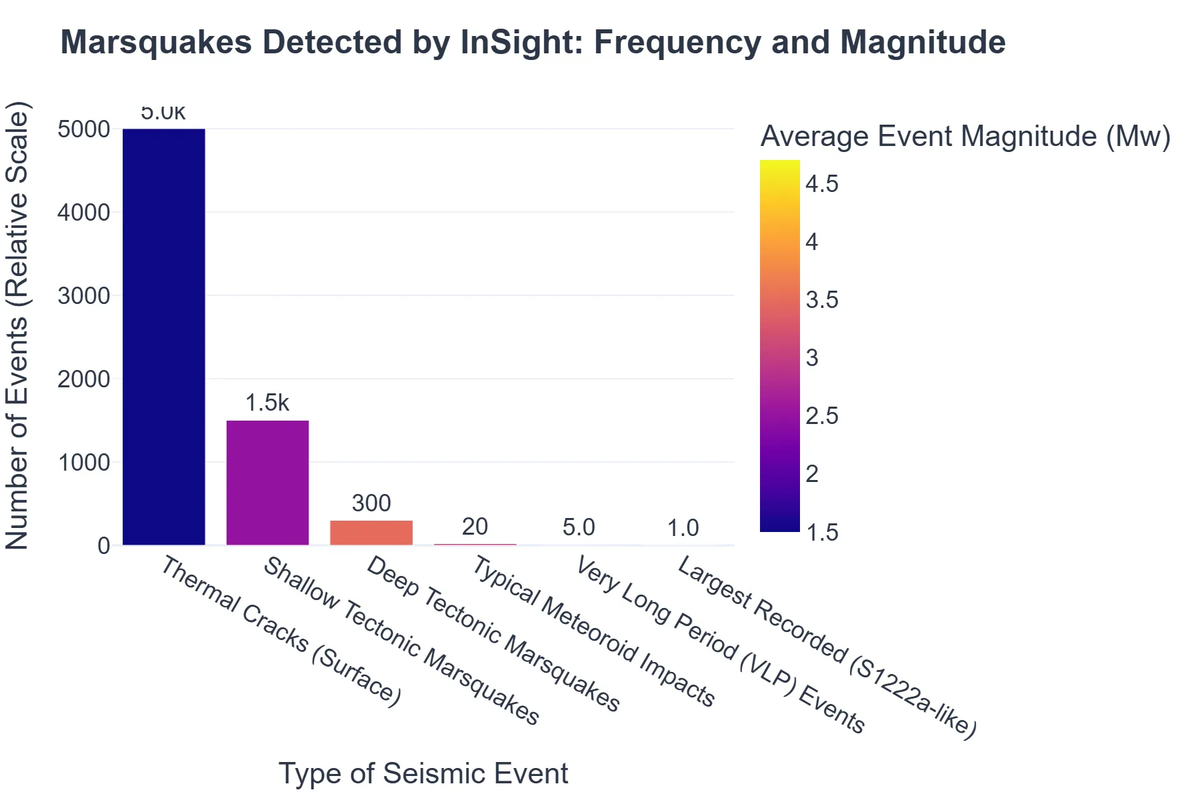
- ✅ First Direct Interior Map: InSight provided the first direct measurements of the Martian crust, mantle, and core, revealing that Mars’ crust is thinner than expected and its core is larger and less dense than previously modeled. It confirmed the core is molten liquid, similar to Earth’s outer core.
- ✅ Active Martian Seismicity: The SEIS instrument detected over 1,300 Marsquakes, proving that Mars is seismically active. This data allowed scientists to identify different types of quakes, including those associated with tectonic activity and even meteorite impacts.
- ✅ Weather Monitoring: Beyond its primary geophysical goals, InSight’s sensors also provided continuous weather data, including wind speed, temperature, and atmospheric pressure, contributing to a broader understanding of Mars’ environment.
- ✅ Core Insights: The RISE experiment confirmed that Mars has a liquid iron-sulfur core, a crucial finding for understanding the planet’s magnetic field history and its atmospheric evolution. This information is critical for comparative planetology and understanding the evolution of terrestrial planets, as detailed by NASA’s Jet Propulsion Laboratory How InSight Revealed the Heart of Mars – Teachable Moment.
These discoveries provide a critical dataset for planetary scientists, offering direct evidence that helps refine models of Mars’ formation and evolution. The insights gained from this mission will inform future robotic and human exploration of the Red Planet.
Recommended Video
The End of a Mission: A Triumph of Science
The mission of the insight mars lander officially concluded on December 21, 2022, after more than four years of operations. The end came as expected, due to dust accumulation on its solar panels, which gradually reduced its power output. Despite engineers’ best efforts to clear the panels, the diminishing power prevented the lander from performing its scientific duties.
- ✨ Extended Lifespan: InSight significantly outlasted its primary mission duration, providing valuable data for an extended period.
- 🚀 Future Exploration: The data from InSight is invaluable for planning future missions, helping engineers understand the Martian environment better for designing more resilient landers and future habitats. It also guides scientists in selecting prime landing sites for future geological studies.
- 🔧 Design Evolution: Lessons learned from InSight, particularly regarding dust mitigation and subsurface drilling, will undoubtedly influence the design of future planetary exploration vehicles, including those from manufacturers like Lockheed Martin Mars Landers: From Viking to Phoenix.
The InSight Mars Lander stands as a testament to human ingenuity and our unyielding curiosity about the cosmos. While it was a stationary platform, distinct from the mobile exploration capabilities of an `insight rover`, its unique scientific focus allowed it to peel back layers of Martian mystery, revealing the very heart of our enigmatic planetary neighbor. Its legacy will continue to resonate as scientists pore over its data for decades to come, helping us piece together the cosmic puzzle of planetary formation.
What was NASA InSight’s main goal?
InSight’s primary objective was to study the deep interior of Mars, including its core, mantle, and crust, using seismometers and a heat flow probe to understand the planet’s formation.
How did InSight study Mars’ interior?
It used a highly sensitive seismometer (SEIS) to detect ‘marsquakes’ and meteoroid impacts. By analyzing how seismic waves traveled through the planet, scientists could infer its internal layers.
What were some key discoveries made by InSight?
InSight determined the precise size and composition of Mars’ liquid core, measured the thickness of its crust and mantle, and identified ongoing seismic activity, revealing Mars is not geologically dead.
Is the InSight mission still active on Mars?
No, the InSight mission officially ended on December 21, 2022. It ceased operations after its solar panels accumulated too much dust, leading to insufficient power to continue its scientific work.