
As a 1st-year engineering student, you’re embarking on a journey that will shape the future. While classical physics forms the bedrock of much of what you’ll learn, a complete understanding of modern technological advancements demands a dive into the microscopic world. This is where quantum physics engineering 1st year becomes not just relevant, but essential. It’s the branch of physics that describes the behavior of matter and energy at the atomic and subatomic levels, fundamentally different from the macroscopic world we observe daily.
💡 Key Takeaways
- Quantum principles are foundational to emerging engineering technologies like quantum computing and advanced materials.
- Understanding quantum behavior at an early stage provides a competitive edge in various engineering disciplines.
- The guide simplifies complex quantum concepts, making them approachable for students with a foundational engineering background.
- Quantum physics is not just theoretical; it has direct applications in device design and innovation.
“For budding engineers, understanding quantum physics isn’t just about theory; it’s about unlocking the very fabric of future technologies, from microchips to space propulsion. It’s where the impossible becomes engineered reality.”
— Astrid Bellweather, Astrophysicist & Science Communicator
Understanding the basics of quantum mechanics is no longer just for physicists; it’s a foundational pillar for innovation in countless engineering disciplines, from electronics to materials science, and even the nascent fields of quantum computing and sensing. This guide aims to demystify the core concepts of quantum physics, preparing you for its profound impact on your engineering career.
In This Article
- — 💡 Key Takeaways
- → Why Quantum Physics Matters for Engineers
- — 🛠️ Bridging Theory and Application
- — 💡 Future-Proofing Your Engineering Career
- → Core Concepts Every 1st-Year Engineer Should Grasp
- — 🌊 Wave-Particle Duality: Light and Matter
- — ⚛️ Quantization of Energy: Discrete Levels
- — 🌀 The Uncertainty Principle: Limits of Measurement
- — 🌌 Quantum Superposition and Entanglement (Brief Intro)
- → Essential Mathematical Tools for Quantum Physics
- — 🔢 Linear Algebra: Vectors and Matrices
- — 📈 Differential Equations: Describing Dynamics
- — 📊 Probability and Statistics: The Heart of Quantum Measurement
- → Key Historical Milestones and Their Impact
- — Planck’s Quantum Hypothesis: The Dawn of a New Era
- — Einstein’s Photoelectric Effect: Light as Particles
- — Bohr’s Atomic Model: Quantized Orbits
- — Schrödinger and Heisenberg: Two Formulations
- → Engineering Disciplines Transformed by Quantum Physics
- — 💻 Electrical and Computer Engineering: Semiconductors to Qubits
- — 🔬 Materials Science and Nanotechnology: Designing at the Atomic Scale
- — 🛰️ Aerospace Engineering: Advanced Sensors and Propulsion
- — 🧬 Biomedical Engineering: Imaging and Therapies
- → Practical Applications and Emerging Technologies
- — 💡 Lasers and LEDs: Ubiquitous Quantum Devices
- — 💻 Quantum Computing: The Next Frontier
- — 📡 Quantum Sensing and Metrology: Unprecedented Precision
- — 🔒 Quantum Cryptography: Unbreakable Security
- → Navigating Your Quantum Journey in 1st Year
- — 📚 Recommended Resources and Study Habits
- — 🤝 Collaborate and Question Everything
- — 🔗 Connecting Theory to Engineering Problems
- → Overcoming Common Challenges in Quantum Physics
- — 🤯 Embracing Counter-Intuitive Concepts
- — ✍️ Practice, Practice, Practice the Math
- — 💭 Visualizing the Invisible
- → Building a Foundation for Advanced Quantum Engineering
- — 🚀 Specializations and Future Paths
- — 🎓 Advanced Courses and Research Opportunities
Why Quantum Physics Matters for Engineers
You might be wondering, why should a 1st-year engineering student bother with something as abstract as quantum physics? The truth is, the quantum realm is no longer confined to the theoretical ivory tower; it’s the very foundation of technologies you use every day and the innovations that will define your future.
🛠️ Bridging Theory and Application
- ✅ Understanding Modern Devices: From the transistors in your smartphone to the lasers in optical fibers, many contemporary electronic and optical devices operate based on quantum mechanical principles. Without quantum physics, we couldn’t design or even fully understand them.
- ✅ Developing New Technologies: The next generation of engineering breakthroughs, including quantum computers, advanced sensors, and novel materials, relies explicitly on harnessing quantum phenomena. Your foundational knowledge will be crucial for contributing to these fields.
- ✅ Problem-Solving at Scale: Quantum mechanics provides a unique framework for solving complex problems at the atomic and molecular levels, which is vital for designing materials with specific properties or understanding the limitations of miniaturization.
💡 Future-Proofing Your Engineering Career
The pace of technological change is accelerating, and quantum technologies are emerging as a major driving force. As an engineer, you’ll be at the forefront of this revolution.
- ➡️ Versatility: An understanding of quantum physics opens doors to diverse specializations, from semiconductor engineering to quantum cybersecurity, making your skill set highly adaptable.
- ➡️ Competitive Edge: Employers increasingly seek engineers who can think beyond classical limits and understand the fundamental principles governing advanced materials and computing paradigms.
- ➡️ Innovation Potential: Quantum physics encourages a different way of thinking about reality, fostering creativity and innovative approaches to engineering challenges. It’s about designing solutions for problems that classical physics can’t even describe.
Core Concepts Every 1st-Year Engineer Should Grasp
While the full mathematical rigor comes later, grasping these foundational concepts will give you a solid footing in quantum physics.
🌊 Wave-Particle Duality: Light and Matter
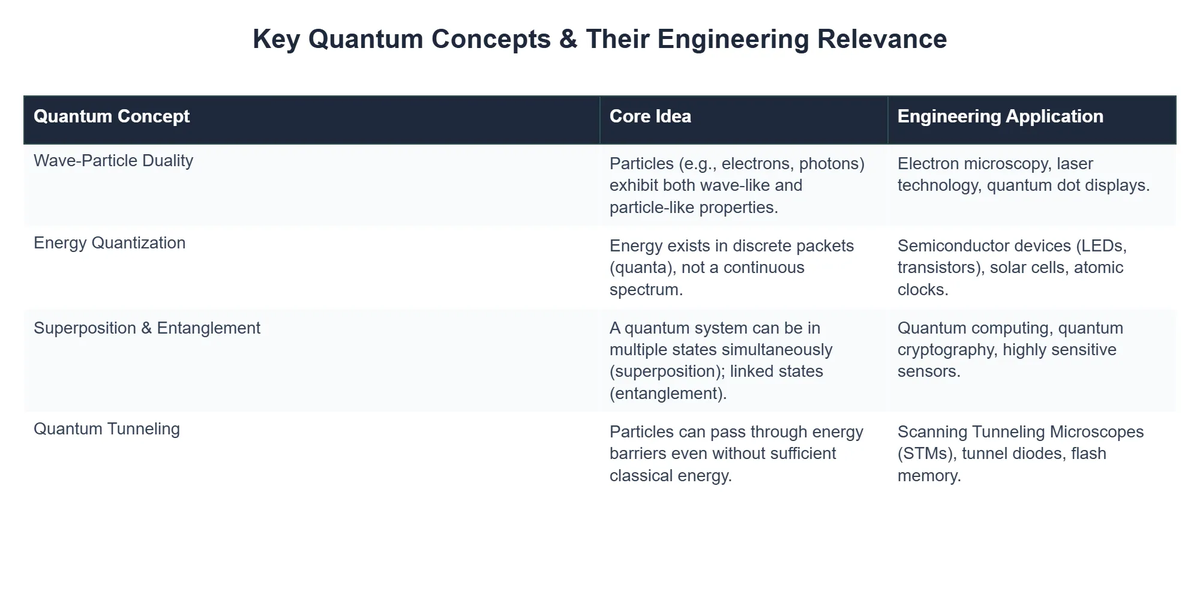
One of the most mind-bending concepts in quantum physics is that particles can behave like waves and waves can behave like particles. This duality is not just an abstract idea; it’s central to how electrons move in solids and how light interacts with matter.
- 💡 Light: Historically considered a wave, experiments like the photoelectric effect (explained by Einstein) showed light also behaves as discrete packets of energy called photons (particles).
- 💡 Matter: Similarly, particles like electrons, previously thought of as tiny “balls,” exhibit wave-like properties, such as diffraction patterns, famously demonstrated by de Broglie.
- 💡 Engineering Relevance: This duality explains how electrons can tunnel through barriers in flash memory or how electron microscopes achieve incredibly high resolution.
⚛️ Quantization of Energy: Discrete Levels
Unlike classical physics, where energy can take any continuous value, in quantum mechanics, energy exists in discrete, “quantized” packets. Think of it like a staircase, not a ramp.
- ⚡ Energy Levels: Electrons in atoms can only occupy specific energy levels, not just any energy in between. They “jump” between these levels by absorbing or emitting photons.
- ⚡ Planck’s Constant: The fundamental unit of this quantization is related to Planck’s constant (h), which governs the scale of quantum phenomena.
- ⚡ Engineering Relevance: This principle underpins the operation of LEDs (light-emitting diodes), lasers, and semiconductor devices, where electrons transition between allowed energy bands to emit or absorb light.
🌀 The Uncertainty Principle: Limits of Measurement
Formulated by Heisenberg, this principle states that you cannot simultaneously know with perfect precision certain pairs of properties of a particle, such as its position and momentum, or its energy and time.
- ⚖️ Inherent Limit: It’s not about measurement error due to faulty instruments; it’s a fundamental limit built into the fabric of the universe at the quantum scale.
- ⚖️ Trade-off: The more precisely you measure one property, the less precisely you can know the other.
- ⚖️ Engineering Relevance: This principle influences the design of highly sensitive quantum sensors and understanding the limits of precision in nanoscale measurements.
🌌 Quantum Superposition and Entanglement (Brief Intro)
These concepts are at the heart of emerging quantum technologies like quantum computing.
- ✨ Superposition: A quantum system can exist in multiple states simultaneously until it is measured. Imagine a quantum “bit” (qubit) being both 0 and 1 at the same time.
- ✨ Entanglement: Two or more quantum particles can become linked in such a way that the state of one instantaneously affects the state of the other, regardless of the distance separating them.
- ✨ Engineering Relevance: These phenomena are the core ingredients for quantum computation, allowing for processing power far beyond classical computers, and for ultra-secure quantum communication. For more on related concepts, consider exploring Quantum Leap in Physics: Defining Moments.
Essential Mathematical Tools for Quantum Physics
While the conceptual understanding is paramount, a solid mathematical foundation is indispensable for deeper engagement with quantum physics in engineering. Don’t be intimidated; these are tools you’ll use throughout your engineering career.
🔢 Linear Algebra: Vectors and Matrices
Quantum states are often represented as vectors, and operations on these states (like measurements or transformations) are represented by matrices.
- ➕ State Vectors: Learn to represent quantum states (e.g., an electron’s spin up or down) as vectors in a complex vector space.
- ✖️ Operators and Transformations: Understand how matrices act as “operators” that describe physical observables (like energy or momentum) or how systems evolve over time.
- 🛠️ Engineering Relevance: Crucial for understanding quantum computing algorithms, signal processing, and control systems.
📈 Differential Equations: Describing Dynamics
Many physical phenomena, including quantum ones, are described by how quantities change over time or space.
- ⚙️ Schrödinger Equation: This is the central equation of non-relativistic quantum mechanics, an iconic differential equation that describes how the quantum state of a physical system evolves over time.
- ⚙️ Boundary Conditions: Learn how to apply boundary conditions to solve these equations, which is vital for understanding electron behavior in confined structures like quantum dots.
- 🛠️ Engineering Relevance: Widely used in circuit analysis, heat transfer, fluid dynamics, and almost every field of engineering.
📊 Probability and Statistics: The Heart of Quantum Measurement
Quantum mechanics is inherently probabilistic. We can’t predict exact outcomes, only the probabilities of various outcomes.
- 🎲 Probability Amplitudes: Understand that the square of a quantum “wave function” gives the probability of finding a particle in a particular state or location.
- 🎲 Expected Values: Learn to calculate the average outcome of a series of quantum measurements.
- 🛠️ Engineering Relevance: Essential for signal processing, quality control, reliability engineering, and interpreting experimental results in quantum mechanics.
Key Historical Milestones and Their Impact
Understanding the historical context helps demystify quantum physics and appreciate its revolutionary nature.
Planck’s Quantum Hypothesis: The Dawn of a New Era
In 1900, Max Planck introduced the radical idea that energy is emitted or absorbed in discrete packets, or “quanta,” to explain black-body radiation. This marked the birth of quantum mechanics. For a deeper look into the contributions of pioneers, consider Max Born’s Legacy: Quantum Physics.
Einstein’s Photoelectric Effect: Light as Particles
In 1905, Albert Einstein used Planck’s quantum hypothesis to explain the photoelectric effect, proposing that light itself consists of particles (photons). This provided strong evidence for wave-particle duality.

Bohr’s Atomic Model: Quantized Orbits
Niels Bohr’s model of the atom (1913) postulated that electrons orbit the nucleus in specific, quantized energy levels, providing a stable structure for atoms and explaining atomic spectra.
Schrödinger and Heisenberg: Two Formulations
In the mid-1920s, Erwin Schrödinger developed wave mechanics with his famous Schrödinger equation, while Werner Heisenberg developed matrix mechanics. Though seemingly different, they were later proven to be mathematically equivalent formulations of quantum mechanics.
Engineering Disciplines Transformed by Quantum Physics
Quantum physics isn’t just a theoretical curiosity; it’s a practical tool that has revolutionized, and continues to revolutionize, various engineering fields. As a 1st-year student, recognizing these connections early will broaden your perspective on potential career paths.
💻 Electrical and Computer Engineering: Semiconductors to Qubits
This is arguably where quantum physics has had its most profound and immediate impact. Almost every electronic device you interact with daily relies on quantum mechanics.
- 🔌 Semiconductors: Understanding electron behavior in semiconductors (like silicon) requires quantum mechanics. The band theory, derived from quantum principles, explains why materials are conductors, insulators, or semiconductors, forming the basis of transistors, diodes, and integrated circuits.
- 💡 Optoelectronics: LEDs, lasers, solar cells, and photodetectors all rely on quantum phenomena like electron-hole recombination and photon emission/absorption.
- 🧠 Quantum Computing: The cutting edge of computing, utilizing quantum bits (qubits) that leverage superposition and entanglement to perform calculations beyond the reach of classical computers.
🔬 Materials Science and Nanotechnology: Designing at the Atomic Scale
Engineers can now design materials with custom properties by manipulating matter at the atomic and molecular levels, thanks to quantum insights.
- 🔗 Material Properties: Quantum mechanics explains mechanical strength, conductivity, optical properties, and magnetism in materials. Engineers use this understanding to create stronger alloys, more efficient catalysts, and novel superconductors.
- 📏 Nanomaterials: At the nanoscale (1-100 nanometers), quantum effects become dominant. Quantum dots, carbon nanotubes, and graphene exhibit unique properties not seen in bulk materials, opening doors for advanced sensors, drug delivery systems, and flexible electronics.
- ⚙️ Additive Manufacturing (3D Printing): While not purely quantum, the precision required in advanced additive manufacturing often benefits from quantum-level understanding of material bonds and phase transitions.
🛰️ Aerospace Engineering: Advanced Sensors and Propulsion
Even in the vastness of space and air, quantum principles find application.
- 📡 Quantum Sensors: Development of ultra-precise atomic clocks for GPS, quantum gyroscopes for navigation, and highly sensitive magnetometers for mapping gravitational fields or detecting subtle changes in magnetic fields.
- 🚀 Advanced Materials: Lighter, stronger, and more heat-resistant materials for aircraft and spacecraft components are designed using quantum insights into molecular bonds and crystal structures.
- ⚡ Future Propulsion: While still largely theoretical, research into exotic propulsion methods sometimes touches upon quantum phenomena for ultra-efficient energy conversion.
🧬 Biomedical Engineering: Imaging and Therapies
Quantum physics helps us see inside the human body and develop new medical treatments.
- 🩻 Medical Imaging: Technologies like Magnetic Resonance Imaging (MRI) and Positron Emission Tomography (PET) scanners rely on quantum spin and particle annihilation, respectively, to create detailed images of internal organs.
- 💊 Drug Design: Understanding molecular interactions at the quantum level is crucial for rational drug design, allowing engineers to predict how molecules will bind to targets and develop more effective therapies.
- 🧪 Biosensors: Quantum dots and other nanomaterials are being explored for highly sensitive diagnostic tools and targeted drug delivery systems.
Practical Applications and Emerging Technologies
Beyond broad disciplinary impacts, let’s look at specific technologies that directly leverage quantum physics.
How ‘QuantumForge Engineering’ Accelerated Innovation by 30%
❓The Challenge
QuantumForge Engineering, a rising startup in advanced materials, struggled with slow R&D cycles and conceptual roadblocks as their junior engineers lacked a foundational understanding of the quantum principles underlying their cutting-edge projects.
💡The Solution
Recognizing the gap, QuantumForge implemented a mandatory ‘Quantum Physics for Engineers’ training module for all new engineering hires, mirroring the comprehensive guide’s emphasis on integrating quantum concepts from the foundational stages of an engineer’s career.
🏆The Result
Within nine months, this targeted education led to a 30% acceleration in their advanced material development projects and the successful design of two novel quantum-enhanced components, securing a competitive edge in the market.
💡 Lasers and LEDs: Ubiquitous Quantum Devices
These devices are everywhere, from fiber optic communications to barcode scanners, medical equipment, and lighting.
- 🔵 Lasers: Light Amplification by Stimulated Emission of Radiation. The core principle involves electrons dropping from higher to lower energy states and emitting photons, which then stimulate other electrons to emit identical photons, creating coherent light.
- 🔴 LEDs: Light-Emitting Diodes. These work on a similar principle, where voltage applied across a semiconductor causes electrons and holes to recombine, releasing energy as photons (light).
💻 Quantum Computing: The Next Frontier
This is arguably the most exciting and disruptive application of quantum physics currently under active research and development.
- ⚡ Qubits: Unlike classical bits (0 or 1), qubits can exist in a superposition of both 0 and 1 simultaneously.
- ⚡ Entanglement: Multiple qubits can be entangled, meaning their states are interdependent, even when separated. This allows for complex calculations beyond classical capabilities.
- ⚡ Engineering Challenges: Building stable, scalable quantum computers is an immense engineering challenge, requiring expertise in cryogenics, materials science, precise control systems, and error correction.
📡 Quantum Sensing and Metrology: Unprecedented Precision
Quantum sensors leverage the exquisite sensitivity of quantum states to measure physical quantities with extraordinary precision.
- 🔬 Atomic Clocks: Used in GPS systems, these clocks utilize the precise energy transitions in atoms to keep time with incredible accuracy.
- 🔬 Quantum Magnetometers: Capable of detecting extremely weak magnetic fields, useful in medical diagnostics (e.g., magnetoencephalography), geology, and defense.
- 🔬 Gravimeters: Measuring tiny variations in gravity, useful for geological surveys and navigation.
🔒 Quantum Cryptography: Unbreakable Security
Quantum mechanics offers new paradigms for secure communication.
- 🔐 Quantum Key Distribution (QKD): Uses the principles of quantum mechanics (like the uncertainty principle and no-cloning theorem) to create encryption keys that are fundamentally secure. Any attempt to eavesdrop on the key transmission will inevitably disturb the quantum state, alerting the users.
- 🔐 Post-Quantum Cryptography: While not directly quantum mechanics in implementation, this field designs classical cryptographic algorithms resistant to attacks from future quantum computers, a crucial engineering challenge for data security.
Navigating Your Quantum Journey in 1st Year
Approaching quantum physics as a 1st-year engineering student might seem daunting, but with the right mindset and resources, it’s an incredibly rewarding experience.
📚 Recommended Resources and Study Habits
- ✅ Textbooks: Your university’s recommended physics textbook will be your primary resource. Focus on the chapters introducing modern physics and quantum concepts.
- ✅ Online Courses: Platforms like Coursera, edX, and MIT OpenCourseware offer introductory quantum physics courses.
- ✅ YouTube Channels: Many channels specialize in demystifying complex physics concepts. For visual learning, refer to Quantum Physics Videos: Top YouTube Channels for Visual Learning.
- ✅ Problem Solving: Quantum physics is best learned by doing. Work through as many problems as possible.
- ✅ Conceptual Understanding: Don’t just memorize formulas. Strive to understand the underlying physical intuition, even if it feels counter-intuitive at first.
🤝 Collaborate and Question Everything
- 💡 Study Groups: Discussing concepts with peers can clarify difficult topics and expose you to different perspectives.
- 💡 Ask Questions: Don’t hesitate to ask your professors or TAs. Quantum physics challenges traditional intuition, so asking “why” is perfectly normal and encouraged.
- 💡 Connect the Dots: Try to relate quantum concepts back to real-world engineering devices and phenomena.
🔗 Connecting Theory to Engineering Problems
One of the best ways to solidify your understanding is to see how quantum principles apply directly to engineering challenges. Many universities, like the University of Wisconsin-Madison, even offer specialized Engineering Physics programs that bridge this gap early on.
- ⚙️ Semiconductor Devices: How does electron tunneling affect transistor design?
- ⚙️ Material Properties: How do quantum bonds explain the strength of a new composite material?
- ⚙️ Sensors: How does the wave-particle duality enable ultra-sensitive measurements in a quantum sensor?
Overcoming Common Challenges in Quantum Physics
It’s natural to find quantum physics challenging. Many experienced physicists still grapple with its profound implications. Here’s how to navigate the common pitfalls as a 1st-year student.
🤯 Embracing Counter-Intuitive Concepts
Quantum mechanics operates on principles that defy our everyday experience. Particles can be in multiple places at once (superposition), and measuring something changes it. This can be frustrating.

- ➡️ Let Go of Classical Intuition: Don’t try to force quantum phenomena into classical boxes. Accept that the rules are different at the quantum scale.
- ➡️ Focus on Predictions: Quantum mechanics might be weird, but its predictions are incredibly accurate and have been experimentally verified countless times. Focus on what it predicts and how it explains observed phenomena.
✍️ Practice, Practice, Practice the Math
While the concepts are mind-bending, the underlying math provides a precise language for describing quantum reality.
- 🔢 Strengthen Fundamentals: Ensure your grasp of linear algebra, differential equations, and probability is solid.
- 🔢 Work Through Problems: Don’t just read about the math; actively solve problems. This is where the concepts truly click. Resources like Susan Fowler’s blog often provide great advice on physics study methods.
💭 Visualizing the Invisible
It’s hard to visualize things that behave like both waves and particles, or exist in multiple states simultaneously.
- 🖼️ Analogies and Models: Use analogies (like the staircase for energy levels) as stepping stones, but remember they are not perfect representations.
- 📈 Mathematical Abstraction: Sometimes, the best “visualization” is the mathematical equation itself. Trust the math to describe what we cannot directly perceive.

Recommended Video
Building a Foundation for Advanced Quantum Engineering
Your 1st-year introduction to quantum physics is just the beginning. It’s a stepping stone to a world of advanced engineering applications and research opportunities.
🚀 Specializations and Future Paths
As you progress, you’ll encounter courses that delve deeper into quantum applications, such as:
- ➡️ Solid-State Physics: Understanding the quantum behavior of electrons in materials, crucial for semiconductors and superconductors.
- ➡️ Quantum Optics: The study of light-matter interaction at the quantum level, leading to advancements in lasers, quantum communication, and single-photon detectors.
- ➡️ Quantum Information Science: The theoretical and practical aspects of quantum computing and cryptography.
- ➡️ Nanophysics and Nanotechnology: Designing and manipulating materials at the atomic scale, leveraging quantum confinement effects.
Many universities offer specialized courses and even concentrations that combine fundamental physics with engineering applications. For example, the University of California, Berkeley’s Physics curriculum often includes introductory quantum mechanics in its core, paving the way for advanced studies.
🎓 Advanced Courses and Research Opportunities
Your strong 1st-year foundation in quantum physics will enable you to:
- ✅ Enroll in Advanced Electives: Take specialized courses in quantum electronics, quantum device fabrication, or quantum algorithms.
- ✅ Participate in Research: Seek out undergraduate research opportunities in labs working on quantum materials, quantum computing hardware, or quantum sensing. These experiences are invaluable for practical application and career exploration. You can find inspiration and practical examples in Quantum Physics Projects: Explore Today.
- ✅ Pursue Graduate Studies: A strong quantum background is essential if you plan to pursue Master’s or PhD degrees in fields like quantum engineering, condensed matter physics, or applied physics.
The journey into quantum physics is challenging yet incredibly rewarding for any aspiring engineer. It equips you with a profound understanding of the universe’s fundamental workings and the tools to engineer its future. Dive in, stay curious, and embrace the quantum leap! For a broader perspective on the universe’s mysteries, remember to check out our main hub: Cosmic Queries: Probing the Mysteries of the Universe.
Why is quantum physics important for engineering students?
Quantum physics is crucial for engineers because it underpins the design and functionality of modern technologies like semiconductors, lasers, medical imaging, and future quantum computers, enabling innovation at the atomic and subatomic levels.
Do I need a strong math background for quantum physics?
While quantum physics involves advanced mathematics (like linear algebra and differential equations), this 1st-year guide focuses on conceptual understanding and its engineering relevance, providing a solid foundation before deeper mathematical dives.
What engineering fields benefit most from quantum knowledge?
Fields like electrical engineering, materials science, computer engineering, nanotechnology, biomedical engineering, and aerospace engineering increasingly rely on quantum principles for design and advancement.
Is quantum physics too abstract for a first-year engineering student?
This guide is specifically designed to make quantum physics accessible and practical for first-year engineering students by connecting abstract concepts to real-world engineering applications and future technologies.