


The universe, in all its majestic complexity, presents humanity with its most profound questions. Among them, none looms larger than: how did it all begin? The quest to understand the cosmic dawn has driven scientific inquiry for centuries, leading to a rich tapestry of scientific theories of the origin of the universe. While some concepts have gained widespread acceptance backed by empirical evidence, others remain fascinating hypotheses, pushing the boundaries of our understanding.
💡 Key Takeaways
- The Big Bang Theory is the prevailing scientific model explaining the universe’s expansion from an extremely hot, dense state.
- Alternative theories like the Multiverse and Cyclic Universe offer different frameworks for understanding cosmic beginnings.
- Scientists utilize cosmic microwave background radiation, gravitational wave detection, and particle physics to research the early universe.
- Our understanding of the universe’s origin is constantly evolving with new discoveries and technological advancements.
“Understanding the universe’s origin isn’t just about tracing matter and energy; it’s about comprehending the very fabric of reality and our place within its grand, evolving story.”
— Astrid Bellweather, Astrophysicist & Science Communicator
Delving into these cosmological models allows us to piece together the incredible narrative of existence, from the first moments of spacetime to the formation of stars, galaxies, and ultimately, ourselves. This exploration isn’t just about ancient history; it shapes our perception of reality and hints at the future of the cosmos itself. For a broader perspective on these grand questions, consider exploring Cosmic Queries: Probing the Mysteries of the Universe.
In This Article
- — 💡 Key Takeaways
- → Understanding the Prevailing Model: The Big Bang Theory
- — The Core Principles of the Big Bang
- — Evidences Supporting the Big Bang
- → Beyond the Big Bang: Alternative and Complementary Cosmological Models
- — Inflationary Cosmology
- — Steady-State Theory
- — Oscillating/Cyclic Universe Theory
- — Multiple Universe Theories (The Multiverse)
- → The Role of Quantum Physics in Cosmic Beginnings
- — Quantum Fluctuations and the Early Universe
- — String Theory and M-Theory’s Contributions
- → The Origin of the Solar System: A Smaller Scale Cosmic Beginning
- — The Nebular Hypothesis
- — Planetary Formation Processes
Understanding the Prevailing Model: The Big Bang Theory
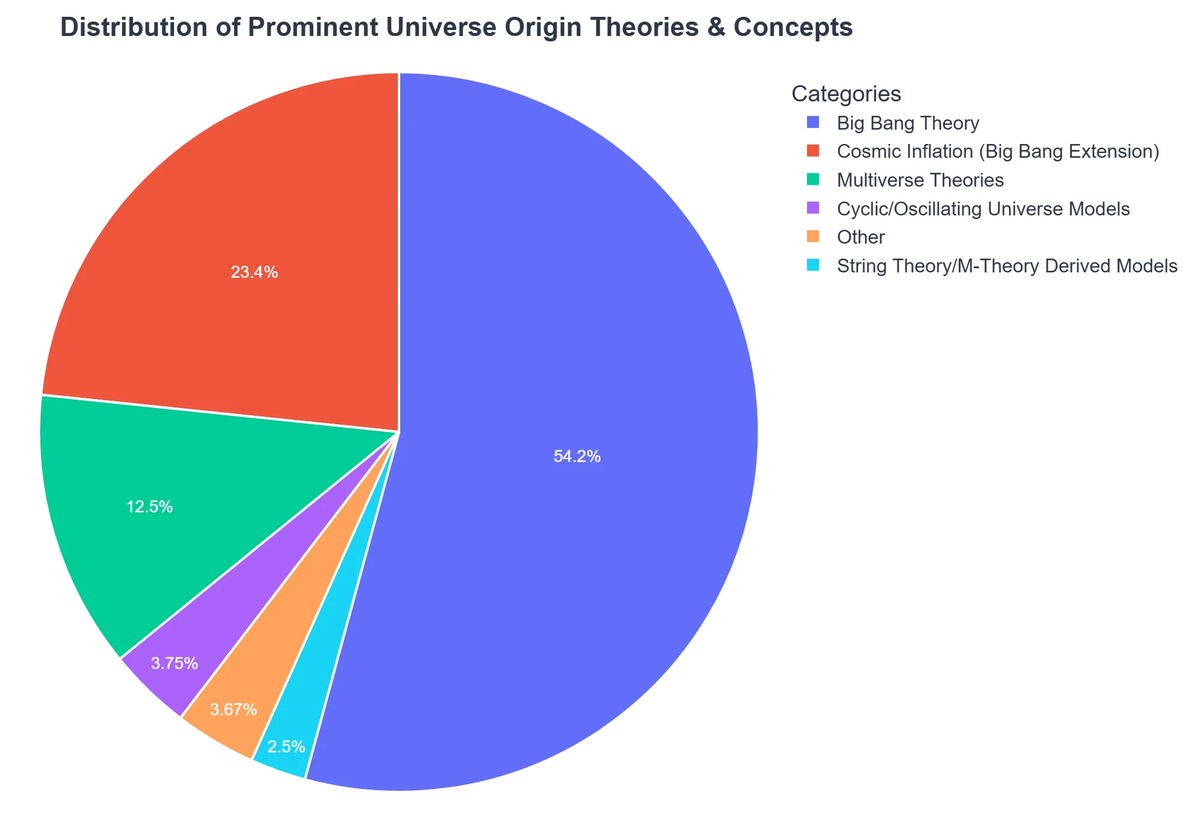
When discussing the origin of the cosmos, the Big Bang theory stands as the overwhelmingly dominant scientific explanation. It describes how the universe expanded from an extremely hot, dense state, gradually cooling and forming the structures we observe today. It is not an explosion in existing space, but rather the expansion of space itself.
The Core Principles of the Big Bang
- ✅ Cosmic Expansion: The universe is continually expanding, a phenomenon observed through the redshift of distant galaxies. This implies that in the past, everything was much closer together.
- ✅ Hot, Dense Beginning: The theory posits an initial state of incredibly high temperature and density, from which all matter and energy emerged.
- ✅ Cooling and Formation: As the universe expanded, it cooled, allowing fundamental particles to form, then atoms, and eventually stars and galaxies.
Evidences Supporting the Big Bang
The Big Bang theory’s strength lies in its ability to explain several key observations:
- ➡️ Hubble’s Law and Redshift: Edwin Hubble’s observations in the 1920s showed that galaxies are moving away from us, and the farther they are, the faster they recede. This universal expansion is a cornerstone of the Big Bang. You can learn more about this in our article on Big Bang Expansion: Understanding the Universe’s Growth.
- ➡️ Cosmic Microwave Background (CMB) Radiation: Discovered in 1964 by Arno Penzias and Robert Wilson, the CMB is the faint echo of the universe’s hot, early state – a uniform glow of microwave radiation coming from all directions. It’s essentially the “afterglow” of the Big Bang.
- ➡️ Abundance of Light Elements: The Big Bang nucleosynthesis model accurately predicts the observed cosmic abundances of light elements like hydrogen, helium, and lithium, which were formed in the first few minutes after the Big Bang.
According to NASA’s Cosmic History overview, the Big Bang model successfully describes the universe from the earliest moments we can observe, offering a robust framework for understanding cosmic evolution. You can read more about this model here: Cosmic History (NASA).
Beyond the Big Bang: Alternative and Complementary Cosmological Models
While the Big Bang theory remains the scientific consensus for explaining the early universe, scientists continue to explore various cosmological models that either refine, extend, or offer alternatives to it. These different hypotheses explaining the origin of the universe push the boundaries of our knowledge, addressing questions the Big Bang alone doesn’t fully answer or exploring entirely different cosmic narratives.
Inflationary Cosmology
Proposed by Alan Guth in the early 1980s, inflationary cosmology is an extension of the Big Bang theory, not a replacement. It suggests that the universe underwent an extremely rapid, exponential expansion just a tiny fraction of a second after its birth. Inflation elegantly solves several problems left open by the standard Big Bang model, such as:
- 💡 The Horizon Problem: Why the universe is so remarkably uniform in temperature across vast distances.
- 💡 The Flatness Problem: Why the universe’s geometry appears to be perfectly flat.
- 💡 The Monopole Problem: Why we don’t observe certain exotic particles (magnetic monopoles) predicted by some grand unified theories.
Steady-State Theory
Historically, the Steady-State theory was the main competitor to the Big Bang. Proposed in the late 1940s by Hermann Bondi, Thomas Gold, and Fred Hoyle, it posited that the universe, while expanding, maintained a constant average density through the continuous creation of new matter. This meant the universe had no beginning and no end. However, the discovery of the Cosmic Microwave Background (CMB) radiation and other evidence definitively disproved the Steady-State theory, solidifying the Big Bang as the leading model.
Origin of the Universe Theories: Pros and Cons
Pros
- ✔Provide a scientific framework for understanding cosmic beginnings.
- ✔Offer testable predictions and explain observed cosmological phenomena.
- ✔Drive ongoing research, technological advancements, and new discoveries.
- ✔Integrate diverse fields of physics and astronomy.
Cons
- ✖Contain elements that are currently untestable or highly speculative.
- ✖Do not fully explain all cosmic mysteries (e.g., dark matter/energy, initial singularity).
- ✖Face challenges in reconciling with quantum gravity at extreme scales.
- ✖Multiple competing theories exist, leading to ongoing debates and revisions.
Oscillating/Cyclic Universe Theory
The Oscillating or Cyclic Universe theory suggests that the universe undergoes an infinite series of expansions (Big Bangs) and contractions (Big Crunches). In this model, our current universe is just one cycle in an eternal succession. While intriguing, the discovery of dark energy, which appears to be accelerating the universe’s expansion, makes a future “Big Crunch” seem unlikely under current conditions. However, variations of cyclic models continue to be explored, sometimes involving collisions of branes in higher dimensions.
Multiple Universe Theories (The Multiverse)
Perhaps one of the most mind-bending of the different hypotheses explaining the origin of the universe is the concept of a multiverse. There are several versions, including:
- 🌌 Level I: Infinite Universes: If space is infinite, then any cosmic region with the same laws of physics and initial conditions must eventually repeat.
- 🌌 Level II: Bubble Universes (Eternal Inflation): A consequence of eternal inflation, where different patches of space expand at different rates, potentially giving rise to separate “bubble” universes with varying physical constants.
- 🌌 Level III: Many-Worlds Interpretation of Quantum Mechanics: Every quantum measurement causes the universe to split into multiple copies, each representing a different outcome.
- 🌌 Level IV: Mathematical Universes: The idea that all possible mathematical structures correspond to actual universes.
These theories explore the possibility that our universe is just one of many. For more on this captivating topic, check out Multiple Universe Theories: Unpacking the Multiverse.
The Role of Quantum Physics in Cosmic Beginnings
While the Big Bang describes the universe from a very early moment, it doesn’t fully explain what triggered the initial expansion or what existed “before” it. This is where quantum physics, the study of matter and energy at the most fundamental levels, enters the picture, attempting to explain the very earliest moments of cosmic creation.

Quantum Fluctuations and the Early Universe
At the incredibly tiny scales of the very early universe, the laws of quantum mechanics dominate. Quantum physics dictates that even empty space is not truly empty but is filled with fleeting pairs of particles and antiparticles that constantly pop into and out of existence – these are known as quantum fluctuations. Many theoretical models suggest that the universe itself might have originated from such a fluctuation, or that these fluctuations provided the seeds for the large-scale structure we observe today, even before inflation.
String Theory and M-Theory’s Contributions
String theory and its more comprehensive successor, M-theory, are theoretical frameworks attempting to unify all fundamental forces of nature, including gravity, by positing that the most basic constituents of the universe are not point-like particles but tiny, vibrating strings or membranes (branes). These theories naturally exist in higher dimensions (e.g., 10 or 11 dimensions). Some M-theory models suggest that our universe could be a “brane” existing within a larger “bulk” and that the Big Bang itself could have been the result of the collision of two such branes. These represent some of the most ambitious attempts at explaining the origin of the universe from a purely theoretical physics perspective. To understand more about the conceptual leaps involved, see Universe Creation Theories: From Nothingness to Cosmos.
The Origin of the Solar System: A Smaller Scale Cosmic Beginning
While the Big Bang explains the universe’s grand origin, the question of the origin of the solar system theories focuses on a more localized, yet equally intricate, cosmic beginning. Our Sun, Earth, and all other planets and celestial bodies in our solar system did not form during the Big Bang itself but billions of years later, from the remnants of older stars.
The Nebular Hypothesis
The prevailing scientific model for the formation of our solar system is the Nebular Hypothesis. This theory suggests that the solar system formed approximately 4.6 billion years ago from a giant, rotating cloud of gas and dust called a solar nebula. This nebula was composed primarily of hydrogen and helium, along with trace amounts of heavier elements created in previous stellar generations.
- ✨ Gravitational Collapse: A disturbance (perhaps a nearby supernova) caused a portion of the nebula to collapse under its own gravity.
- ✨ Rotation and Flattening: As the nebula collapsed, it began to spin faster and flatten into a disc, much like a spinning ice skater pulls their arms in.
- ✨ Protosun Formation: Most of the material collected at the center, forming a dense, hot protosun.
Planetary Formation Processes
Within the swirling disc of gas and dust surrounding the protosun, planets began to form through a process called accretion. Microscopic dust grains collided and stuck together, gradually building up into larger and larger clumps. These clumps, known as planetesimals, continued to grow by sweeping up more material, eventually forming the planets, moons, and other bodies we see today. Inner planets (like Earth) formed where it was hotter, leading to rocky compositions, while outer planets (like Jupiter) formed in colder regions, allowing them to accumulate vast amounts of gas and ice.
Understanding these processes is crucial not just for our own solar system but also for predicting the likelihood of other planetary systems and even life elsewhere. This is directly relevant to discussions around Exoplanets: Discovering Worlds Beyond Our Solar System. More on the general theories regarding the universe’s origins can be found here: Origin of the Universe: How Did It Begin and How Will It End (APU).

Recommended Video
What is the primary theory for the universe’s origin?
The Big Bang Theory is the most widely accepted scientific model, positing that the universe began as an extremely hot, dense point and has been expanding and cooling ever since.
Are there any alternative theories to the Big Bang?
Yes, while less supported by current evidence, theories such as the Multiverse concept, the Cyclic Universe theory, and theories involving String Theory offer alternative explanations for cosmic origins.
How do scientists study the early universe?
Scientists study the early universe by observing the Cosmic Microwave Background (CMB) radiation, analyzing the distribution of galaxies, and conducting experiments in particle accelerators that simulate early universe conditions.
What is the age of the universe according to current theories?
Based on measurements of the Cosmic Microwave Background and the expansion rate of the universe, the current scientific consensus estimates the age of the universe to be approximately 13.8 billion years.