
What is Quantum Mechanics? Unraveling the Mysteries of the Subatomic World
Delving into the fabric of reality often leads us to its most fundamental level: the subatomic. Here, the rules of our everyday world crumble, giving way to the peculiar and mind-bending principles of quantum mechanics. This revolutionary framework in `physics quantum mechanics` isn’t just an abstract theory; it’s the bedrock of modern technology and our deepest understanding of the universe.
💡 Key Takeaways
- Quantum mechanics describes the fundamental nature of matter and energy at the smallest scales.
- Key concepts include wave-particle duality, superposition, and quantum entanglement, which defy classical intuition.
- QM is crucial for modern technologies like lasers, transistors, and MRI machines.
- Despite its successes, quantum mechanics presents profound philosophical questions about reality and observation.
“Quantum mechanics isn’t just about tiny particles; it’s the fundamental language of the universe, revealing a reality far more intricate and interconnected than we ever imagined. It truly redefines our cosmic perspective.”
— Astrid Bellweather, Astrophysicist & Science Communicator
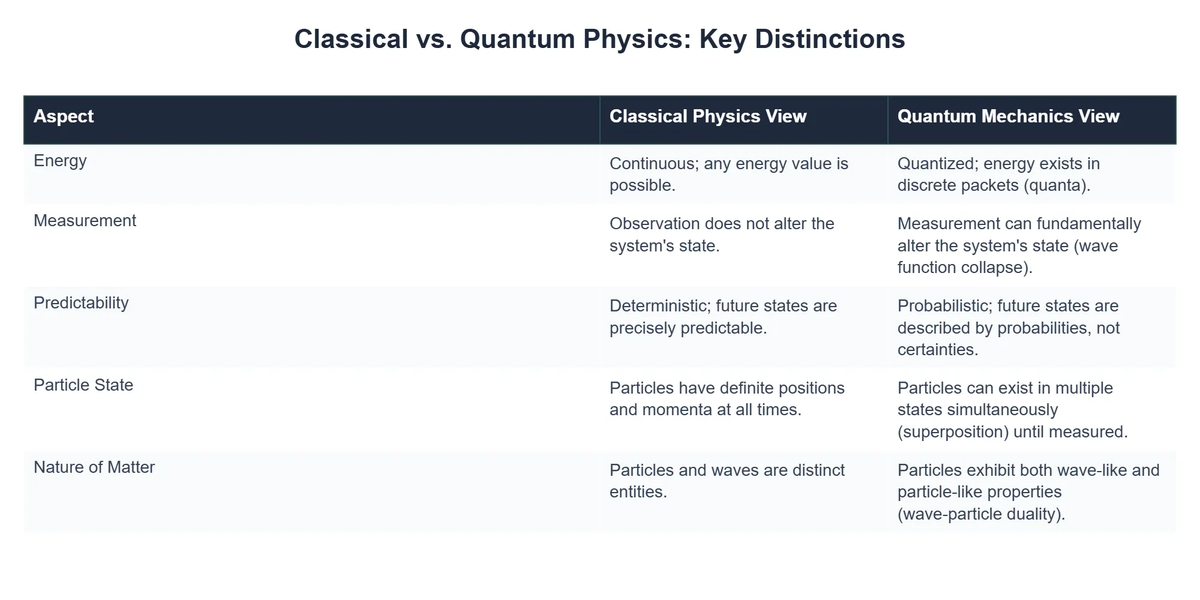
At its core, the `quantum mechanics meaning` revolves around the behavior of matter and energy at the atomic and subatomic scales. Unlike classical physics, which provides a deterministic view of the universe, quantum mechanics introduces probability, uncertainty, and a level of weirdness that continues to challenge our intuition. It explains why atoms are stable, how light interacts with matter, and the very nature of chemical bonds.
In This Article
- → What is Quantum Mechanics? Unraveling the Mysteries of the Subatomic World
- — 💡 Key Takeaways
- → The Fundamental Laws of Quantum Mechanics: A Bizarre Reality
- → Entanglement and Nonlocality in Quantum Mechanics: Spooky Action
- → Quantum Mechanics Examples and Their Impact on Technology
- → Exploring the Types of Quantum Mechanics: Beyond the Basics
The Fundamental Laws of Quantum Mechanics: A Bizarre Reality
The universe at its smallest scales operates under a set of `laws of quantum mechanics` that defy common sense. These principles are not merely theoretical curiosities; they are experimentally verified phenomena that have profoundly reshaped our understanding of what is real.
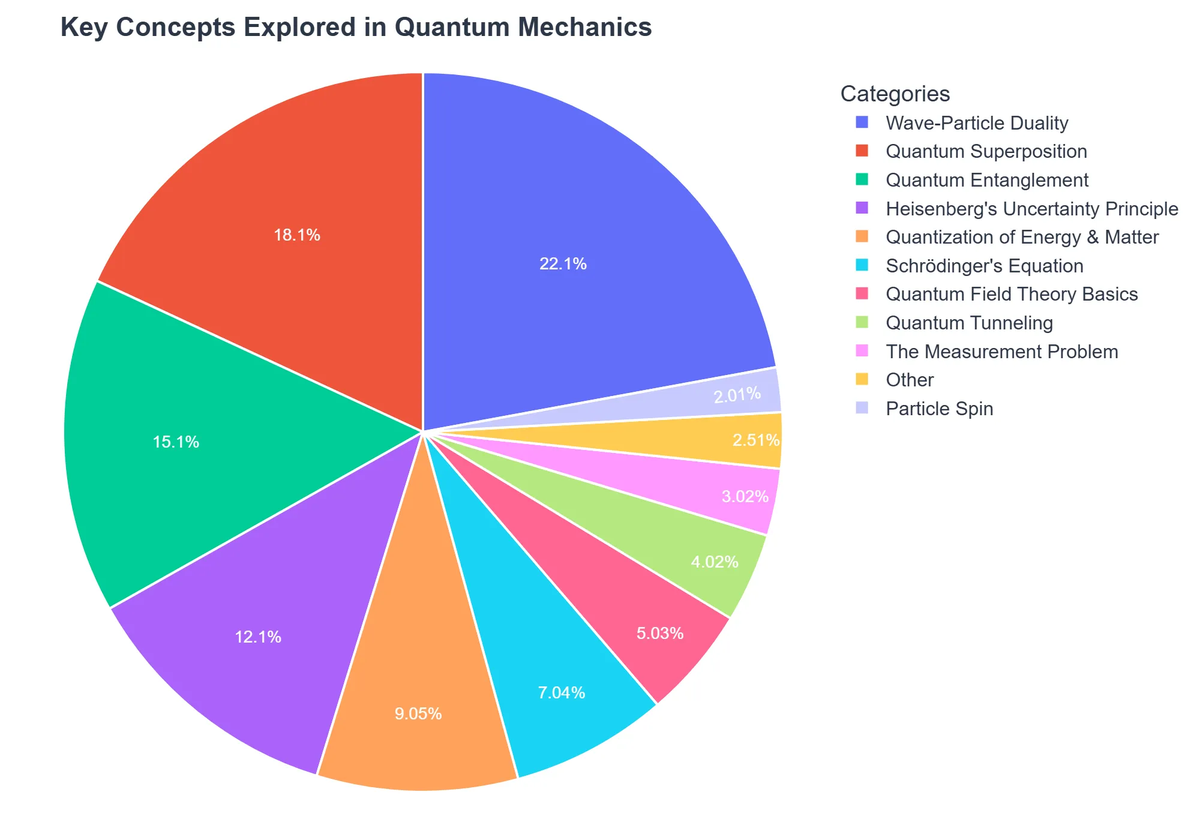
- ✅ Superposition: Imagine a coin spinning in the air. Before it lands, it’s neither heads nor tails; it’s both simultaneously. In quantum mechanics, particles can exist in multiple states (like different locations, energy levels, or spins) at the same time. This is called a superposition. Only upon measurement does the particle “collapse” into a single, definite state.
- ➡️ Wave-Particle Duality: Light sometimes behaves like a wave (think of ripples in a pond) and sometimes like a particle (a tiny, indivisible packet of energy called a photon). Remarkably, particles like electrons, protons, and even atoms also exhibit this duality. They can act as waves, diffracting and interfering, or as particles, localized and countable.
- 💡 Quantum Tunneling: Picture a ball rolling up a hill. If it doesn’t have enough energy to reach the top, it rolls back down. Not so in the quantum world! A particle can “tunnel” through an energy barrier, even if it doesn’t have enough energy to classically overcome it. This phenomenon is crucial for nuclear fusion in the sun and is utilized in scanning tunneling microscopes.
- ⚛️ Quantization: Energy, momentum, and other properties of particles are not continuous but come in discrete packets, or “quanta.” For instance, an electron orbiting an atom can only occupy specific energy levels, not any level in between. This explains the stability of `quantum mechanics of atoms` and the distinct spectral lines observed when atoms emit or absorb light.
Entanglement and Nonlocality in Quantum Mechanics: Spooky Action
Perhaps the most mind-bending aspect of `quantum mechanics explained` is the phenomenon of `entanglement in quantum mechanics` and its implication: `nonlocality in quantum mechanics`. Albert Einstein famously dubbed it “spooky action at a distance” because it seemed to violate the principle that nothing can travel faster than the speed of light.
When two particles become entangled, they become intrinsically linked, regardless of the distance separating them. If you measure a property of one entangled particle (e.g., its spin), you instantly know the corresponding property of the other particle, even if it’s light-years away. There’s no detectable signal traveling between them; the correlation is instantaneous.
This isn’t just a theoretical concept; experiments have repeatedly confirmed entanglement. It suggests a deeply interconnected universe where local measurements can have non-local effects, challenging our classical notions of reality and causality. For a deeper dive into this fascinating concept, explore our article on Quantum Physics: Unraveling Its Meaning and Entanglement.
As noted by renowned physicist George Musser in his book, “Sneaking a Look at God’s Cards: Unraveling the Mysteries of the Universe,” nonlocality is a fundamental feature of quantum mechanics that continues to inspire debate and discovery.
From Deterministic to Dynamic: How Algorithmic Ascent Revolutionized Predictive Analytics
❓The Challenge
Traditional, deterministic predictive models struggled to accurately forecast complex, non-linear customer behaviors, resulting in suboptimal campaign performance.
💡The Solution
Inspired by quantum mechanics’ embrace of probability, superposition, and the non-deterministic nature of reality, Algorithmic Ascent developed a new analytical framework. This approach recognized that customer states are often multi-faceted and non-intuitive, leading to a more nuanced understanding of digital journeys.
🏆The Result
This paradigm shift led to a 25% increase in predictive accuracy for key customer segments and a 15% rise in overall campaign conversion rates within six months.
Quantum Mechanics Examples and Their Impact on Technology
While the theoretical aspects of quantum mechanics can feel abstract, its practical `quantum mechanics examples` and applications are deeply embedded in our daily lives and drive cutting-edge technologies. The principles derived from understanding the `quantum mechanics of atoms` have led to innovations that were once considered science fiction.
- 📡 Lasers: From barcode scanners to fiber-optic communications and medical surgeries, lasers rely on the quantum principle of stimulated emission, where electrons drop to lower energy states and emit photons.
- 💡 Transistors & Semiconductors: The very foundation of modern electronics – from your smartphone to supercomputers – is built on understanding how electrons behave in semiconductor materials, a purely quantum phenomenon.
- 🔬 Magnetic Resonance Imaging (MRI): MRI machines use the quantum property of nuclear spin to produce detailed images of organs and tissues inside the human body, revolutionizing medical diagnostics.
- ⏰ Atomic Clocks: These incredibly precise timekeepers, essential for GPS systems and global communication networks, operate based on the precise quantum energy transitions of atoms.
- 💻 Quantum Computing: This emerging field leverages quantum phenomena like superposition and entanglement to perform computations far beyond the reach of classical computers, with potential to revolutionize drug discovery, material science, and cryptography. The World Economic Forum highlights how quantum physics could explain natural mysteries and drive new technologies.
Exploring the Types of Quantum Mechanics: Beyond the Basics
The field of quantum mechanics isn’t a monolithic entity; it branches into various specialized areas that tackle specific problems or incorporate new theoretical frameworks. Understanding these `types of quantum mechanics` provides a more complete picture of this vast scientific domain.
- ⚙️ Quantum Electrodynamics (QED): Often called “the jewel of physics,” QED is a quantum field theory that describes how light and matter interact. It’s incredibly successful at predicting phenomena with unprecedented precision, like the magnetic moment of the electron.
- 🌌 Quantum Chromodynamics (QCD): This theory describes the strong nuclear force, which binds quarks together to form protons and neutrons, and holds the atomic nucleus together.
- 🔬 Quantum Field Theory (QFT): A more general framework that combines special relativity with quantum mechanics. It views particles not as fundamental objects, but as excited states of underlying quantum fields that permeate all of space. Both QED and QCD are specific examples of QFT.
- 🧠 Quantum Information Theory: This interdisciplinary field applies quantum mechanics to information science and computing. It explores how quantum phenomena can be used to process, store, and transmit information more efficiently and securely.
For a deeper dive into the specific rules governing this bizarre reality, consider exploring our comprehensive guide on the Quantum Laws of Physics: Unraveling Reality’s Rules. And to understand the broader context of how these principles fit into our exploration of the cosmos, visit our pillar content on Cosmic Queries: Probing the Mysteries of the Universe.
Recommended Video
What is quantum mechanics?
Quantum mechanics is a fundamental theory in physics that describes the behavior of matter and light at the atomic and subatomic levels, where classical physics breaks down.
What are some core principles of quantum mechanics?
Key principles include wave-particle duality (particles can behave as waves and vice-versa), superposition (a particle can exist in multiple states simultaneously), and entanglement (two or more particles become linked, sharing the same fate).
How does quantum mechanics impact technology?
Quantum mechanics is the foundation for numerous modern technologies, including lasers, semiconductors (used in computers), transistors, LED lights, and advanced medical imaging like MRI.