


The Allure of Interstellar Travel: A Human Imperative
For centuries, humanity has gazed at the stars, wondering what lies beyond our familiar solar system. The concept of interstellar travel – journeys between stars – represents the ultimate frontier in space exploration. It’s a dream fueled by curiosity, the scientific quest for exoplanetary life, the potential for new resources, and perhaps, the long-term survival of our species.
💡 Key Takeaways
- Interstellar travel faces colossal engineering, biological, and temporal challenges.
- Current propulsion technologies are insufficient; revolutionary advancements are needed.
- Theoretical concepts like warp drives and generational ships offer potential, but remain highly speculative.
- The feasibility of interstellar travel hinges on breakthroughs in physics, materials science, and human adaptation.
“While the challenges of interstellar travel are daunting, the fundamental laws of physics don’t forbid it. It’s a testament to our ingenuity that we’re even contemplating such monumental leaps.”
— Astrid Bellweather, Astrophysicist & Science Communicator
While robotic probes like NASA’s Voyagers have technically entered interstellar space (as detailed in our guide on NASA Voyager Mission: Exploring the Interstellar Frontier), sending humans, or even large, complex spacecraft, to another star system remains an monumental undertaking. This ambition pushes the boundaries of engineering, physics, and human endurance, compelling us to consider whether such voyages are truly possible and what it would take to achieve them.

This quest for knowledge and expansion is deeply rooted in our desire to understand the universe around us, a fundamental drive explored further in Cosmic Queries: Probing the Mysteries of the Universe.
In This Article
- → The Allure of Interstellar Travel: A Human Imperative
- — 💡 Key Takeaways
- → The Grand Challenges of Interstellar Travel
- — 📏 Immense Distances and Travel Times
- — ⚡ Energy Requirements: Powering the Journey
- — 🛡️ Radiation and Micrometeoroids: Protecting the Crew and Craft
- — ⏳ Human Physiology and Psychology
- → Current Technologies and Concepts: Are We Close?
- — ⚙️ Existing Propulsion and Their Limits
- — 💡 Future Concepts on the Horizon
- → Future Pathways and Speculative Solutions
- — 🪐 Generational Ships and Ark Missions
- — 😴 Suspended Animation and Cryosleep
- — 🌌 Warp Drives and Wormholes: Theoretical Faster-Than-Light Travel
- → The Long Road Ahead: When Could Interstellar Travel Be Possible?
The Grand Challenges of Interstellar Travel
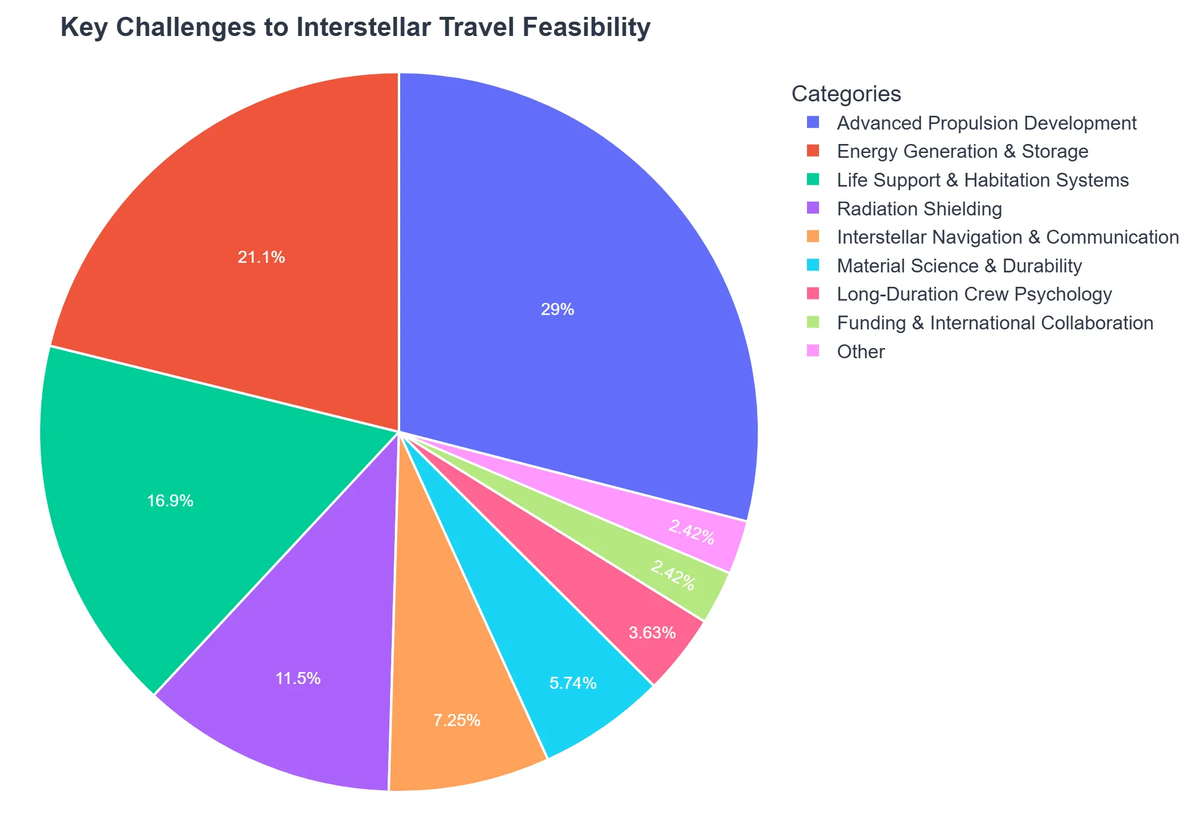
Venturing to another star presents an array of challenges so profound they often feel insurmountable with current technology. These aren’t just minor hurdles; they are fundamental barriers that require revolutionary breakthroughs.
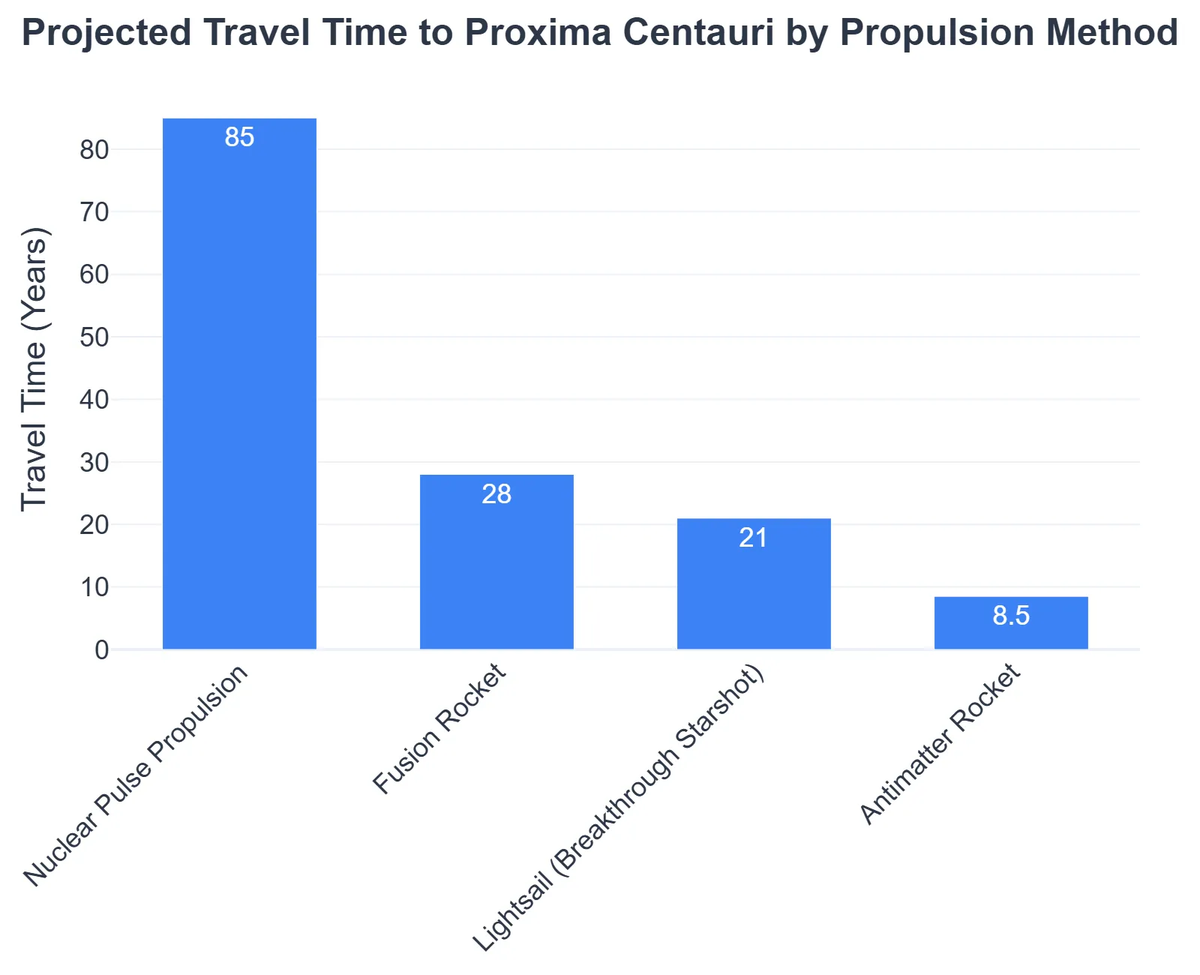
📏 Immense Distances and Travel Times
The sheer scale of interstellar distances is difficult to comprehend. The nearest star system, Alpha Centauri, is approximately 4.37 light-years away. A light-year, the distance light travels in one year, is about 9.46 trillion kilometers (5.88 trillion miles).
- ✅ Even traveling at the speed of light, it would take over four years to reach Alpha Centauri.
- ✅ Our fastest spacecraft, like the Parker Solar Probe, travels at speeds of roughly 690,000 km/h (430,000 mph). At this speed, reaching Alpha Centauri would take thousands of years.
- ✅ This means any current propulsion method would result in journeys spanning lifetimes, generations, or even millennia.
⚡ Energy Requirements: Powering the Journey
Propelling a spacecraft, especially one carrying humans or substantial payload, to even a fraction of the speed of light requires an unimaginable amount of energy. The energy needed increases exponentially with velocity.
- ➡️ Current chemical rockets are woefully inadequate for interstellar speeds.
- ➡️ Even advanced concepts like nuclear fusion or antimatter propulsion demand energy densities far beyond our current capabilities.
- ➡️ Storing and safely controlling such vast amounts of energy for sustained acceleration remains a formidable engineering challenge.
🛡️ Radiation and Micrometeoroids: Protecting the Crew and Craft
Space is not empty; it’s filled with hazards that pose severe threats to interstellar missions:
- 💡 Cosmic Radiation: Galactic cosmic rays and solar energetic particles can cause severe health effects for astronauts (cancer, organ damage) and damage sensitive electronics. Effective shielding adds immense mass to a spacecraft.
- 💡 Micrometeoroids and Space Debris: Even tiny particles traveling at hyper-velocities can cause catastrophic damage to a spacecraft’s hull, systems, and life support.
⏳ Human Physiology and Psychology
Long-duration spaceflight takes a heavy toll on the human body and mind:
Interstellar Travel: Possibilities and Challenges
Pros
- ✔Potential for discovering new life, resources, and habitable planets.
- ✔Ensures the long-term survival and redundancy of human civilization.
- ✔Drives radical advancements in physics, engineering, and life support systems.
- ✔Expands humanity’s presence and understanding of the universe.
Cons
- ✖Overwhelming distances requiring travel times spanning centuries or millennia.
- ✖Requires technological breakthroughs far beyond current capabilities (e.g., FTL propulsion).
- ✖Prohibitive energy and resource costs associated with launch and sustainment.
- ✖Significant risks from cosmic radiation, micrometeoroids, and unknown hazards.
- 🧠 Physical Deterioration: Bone density loss, muscle atrophy, cardiovascular issues, and vision problems are significant concerns in microgravity.
- 🧠 Psychological Impact: Confinement, isolation, lack of sensory input, and separation from Earth can lead to severe psychological stress, depression, and conflict among crew members.
- 🧠 Life Support: Maintaining a closed, self-sustaining ecosystem for decades or centuries is an unprecedented challenge.
Current Technologies and Concepts: Are We Close?
While the challenges are immense, humanity is not idle. Research into advanced propulsion and mission concepts continues, pushing the boundaries of what’s considered feasible. When considering if `interstellar travel possible by 2100`, it’s generally accepted that manned interstellar travel is highly unlikely within that timeframe, but robotic probes and theoretical advancements could make significant strides.
⚙️ Existing Propulsion and Their Limits
Today’s workhorse rockets, based on chemical propulsion, are effective for Earth orbit and even interplanetary missions, but they are far too slow for interstellar distances. Ion thrusters, while more fuel-efficient, provide extremely low thrust, making them suitable only for slow, long-duration missions within our solar system.
Future Horizons Institute: Embracing the Multi-Generational Challenge
❓The Challenge
The institute struggled to secure consistent funding and public buy-in for its ambitious, multi-generational research initiatives focused on global societal challenges, as most stakeholders prioritized short-to-medium term solutions.
💡The Solution
Inspired by the article’s candid portrayal of interstellar travel’s ‘grand challenges’—highlighting the necessity of ‘revolutionary breakthroughs’ and commitment spanning ‘lifetimes or millennia’—the institute reframed its proposals. They transparently articulated that their goals, much like stellar voyages, inherently demand a multi-generational investment and fundamental paradigm shifts.
🏆The Result
This strategic pivot enabled them to secure a landmark $75 million endowment from a major philanthropic foundation specifically for ‘transformative long-term impact,’ increasing their research capacity by over 120% for these grand challenges.
- 🚀 Chemical Rockets: High thrust, but very low exhaust velocity, meaning they burn through propellant quickly.
- 🚀 Ion Thrusters: High exhaust velocity, but extremely low thrust, taking years to accelerate a probe to moderate speeds.
💡 Future Concepts on the Horizon
Scientists and engineers are exploring a multitude of theoretical and early-stage concepts that could one day enable faster, more efficient travel:
- 🌟 Nuclear Propulsion:
- ✅ Nuclear Thermal Rockets (NTR): Use a nuclear reactor to heat a propellant (e.g., hydrogen) to extremely high temperatures, expelling it as thrust. Offers significantly higher efficiency than chemical rockets.
- ✅ Nuclear Pulse Propulsion (Orion Project): Hypothesized to use successive nuclear detonations to propel a spacecraft. Highly controversial and complex.
- 🌟 Solar Sails: Propelled by the pressure of photons from the Sun or powerful lasers. Concepts like Breakthrough Starshot envision tiny probes propelled to relativistic speeds by ground-based lasers, potentially reaching Alpha Centauri in decades. This is one of the most promising avenues for achieving `interstellar space travel` for small probes within the coming century. Learn more about the quest for faster travel in Light Speed Spacecraft: The Quest for Interstellar Travel.
- 🌟 Fusion Propulsion: Harnessing controlled nuclear fusion to generate thrust. Offers incredibly high energy density but is still decades away from practical application even for power generation on Earth.
- 🌟 Antimatter Propulsion: The most energy-dense reaction known, annihilating matter and antimatter to produce pure energy for thrust. The challenge lies in producing, storing, and safely handling antimatter.
Future Pathways and Speculative Solutions
Beyond propulsion, other concepts address the immense travel times and human factors involved in interstellar journeys.

🪐 Generational Ships and Ark Missions
If speeds remain limited, the concept of a “generational ship” emerges. These massive spacecraft would be self-sustaining colonies, carrying entire populations for centuries or millennia, with descendants arriving at the destination. This requires:
- ✅ Robust, closed-loop ecosystems for food, water, and air recycling.
- ✅ Social and governmental structures to maintain order and purpose across generations.
- ✅ Genetic diversity and psychological resilience for long-term isolation.
😴 Suspended Animation and Cryosleep
Another approach to managing long travel times is to place the crew in some form of suspended animation or cryosleep, significantly slowing down their metabolic processes. While common in science fiction, the technology to safely induce and reverse long-term human hibernation without cellular damage is currently non-existent.
🌌 Warp Drives and Wormholes: Theoretical Faster-Than-Light Travel
Perhaps the most captivating solution is bypassing the speed of light entirely. Concepts like the Alcubierre Warp Drive propose manipulating spacetime itself to allow faster-than-light travel without violating the laws of physics locally. However, these remain purely theoretical, requiring exotic matter with negative energy density – something we have no evidence of existing. Dive deeper into this fascinating concept with Alcubierre Warp Drive: Faster-Than-Light Travel?.
Recommended Video
The Long Road Ahead: When Could Interstellar Travel Be Possible?
Given the immense challenges, the consensus among scientists is that routine, manned `interstellar space travel` is likely centuries away, if not longer. While Breakthrough Starshot hints at robotic probes reaching nearby stars within decades, transporting humans is an entirely different magnitude of problem.
The journey to the stars will require breakthroughs not just in propulsion, but in materials science, life support, artificial intelligence, and our understanding of fundamental physics. It demands sustained international collaboration, massive investment, and a truly generational commitment.
Ultimately, the question of “Is interstellar travel possible?” has a nuanced answer: Yes, for robotic probes, it’s already a reality in a very limited sense, and faster probes are plausible. For humans, the physical and engineering hurdles are so profound that it remains firmly in the realm of long-term scientific aspiration rather than near-term feasibility. However, the pursuit of this dream drives innovation that benefits us even here on Earth, pushing the boundaries of what humanity believes it can achieve. As eloquently summarized by NASA, “The journey to interstellar space takes a lot of time. And it needs a lot of power. And a lot of patience.” (Source: NASA).
How long would interstellar travel take?
Even at speeds approaching light, journeys to the nearest star systems would take years, requiring solutions for human longevity, resource management, and social cohesion over extended periods.
What are the biggest challenges to achieving interstellar travel?
Key challenges include developing ultra-fast propulsion, protecting against cosmic radiation, ensuring human survival over vast timespans, and acquiring the immense energy and resources required.
Is a ‘warp drive’ a real possibility?
A warp drive is a theoretical concept, like the Alcubierre drive, based on general relativity that could allow faster-than-light travel by distorting spacetime. However, it requires exotic matter and immense energy, making it purely speculative for now.
Could we use generational ships for interstellar journeys?
Yes, generational ships are a plausible concept where multiple generations would live and die aboard a vessel during a centuries-long journey. This approach addresses the time challenge but introduces complex social, biological, and engineering hurdles.