What is Plasma Cosmology? An Alternative View of the Universe
In the vast expanse of cosmological theories, the plasma cosmology theory presents a compelling alternative to the widely accepted Big Bang model. Unlike the conventional view that emphasizes gravity as the dominant force shaping the universe, plasma cosmology posits that electromagnetic forces, acting on cosmic plasma, play an equally, if not more, significant role in the universe’s structure and evolution.
💡 Key Takeaways
- Plasma Cosmology proposes electromagnetic forces, not just gravity, are primary in shaping the universe.
- It offers alternative explanations for phenomena like galactic formation and cosmic background radiation.
- Unlike the Big Bang, Plasma Cosmology suggests an eternal and evolving universe without a singular beginning.
- It challenges mainstream cosmological models, advocating for a plasma-dominated cosmos.
“Plasma Cosmology reminds us that science thrives on challenging assumptions. While mainstream models prevail, exploring alternative theories like this fuels vital curiosity and pushes the boundaries of our cosmic understanding.”
— Astrid Bellweather, Astrophysicist & Science Communicator
At its core, this theory suggests that the universe is largely filled with plasma – an ionized gas consisting of a roughly equal number of positive and negative charges. Given that over 99% of the visible matter in the universe is in the plasma state, proponents argue that its electromagnetic properties cannot be overlooked. This perspective challenges several fundamental assumptions of standard cosmology, offering different explanations for phenomena ranging from the cosmic microwave background to the formation of galaxies.
For a broader understanding of various cosmic theories, delve into our comprehensive guide on Cosmology Explained: Major Theories of the Universe.

In This Article
- → What is Plasma Cosmology? An Alternative View of the Universe
- — 💡 Key Takeaways
- → The Foundational Principles of Plasma Cosmology Theory
- → Plasma Cosmology vs. The Standard Big Bang Model
- — 💡 Origin of the Universe
- — 🌌 Cosmic Microwave Background (CMB)
- — 🔭 Large-Scale Structure
- — ⚫ Dark Matter and Dark Energy
- → Key Predictions and Explanations by Plasma Cosmology
- → Challenges and Criticisms of Plasma Cosmology
- → Notable Proponents and the History of the Theory
- → The Current Standing and Future of Plasma Cosmology
The Foundational Principles of Plasma Cosmology Theory
The roots of plasma cosmology can be traced back to the work of Nobel laureate Hannes Alfvén, a Swedish electrical engineer and plasma physicist. Alfvén, often considered the father of modern plasma physics, proposed that electromagnetic fields and currents, not just gravity, dictate the dynamics of celestial bodies and the large-scale structure of the universe.
Key tenets of the plasma cosmology theory include:
- ✅ Dominance of Electromagnetic Forces: While gravity is undeniably present, plasma cosmology argues that electromagnetism is far stronger and more influential over vast cosmic distances where plasma exists. This is especially true when considering the long-range forces that govern charged particles.
- ✅ Birkeland Currents: These are electric currents that flow along geomagnetic field lines, observed both in Earth’s magnetosphere and hypothesized to exist on galactic and intergalactic scales. In plasma cosmology, these currents, often in helical filaments, are thought to be responsible for structuring matter and forming galaxies.
- ✅ Cellular Structure: The universe, according to this theory, might be organized into a cellular structure, with plasma regions separated by thin, current-carrying double layers that act as boundaries.
- ✅ No Beginning or End: Unlike the Big Bang, which posits a definite origin for the universe, plasma cosmology often suggests a universe that is infinite in both time and space, evolving through continuous, gradual processes driven by plasma dynamics rather than a singular explosive event. This concept echoes elements of Steady-State Cosmology: The Universe’s Enduring Debate.
To explore more about the role of electromagnetic forces in space, check out Electromagnetic Universe: Exploring Plasma Cosmology.
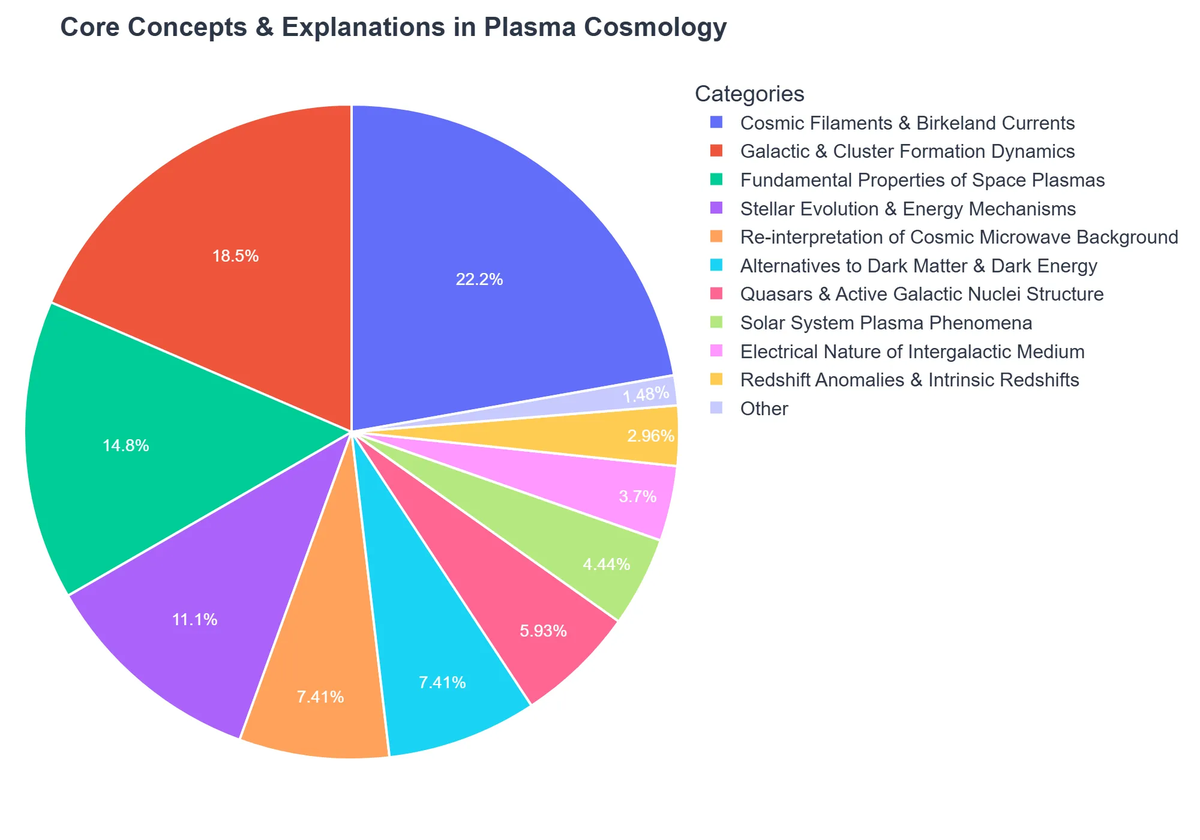
Plasma Cosmology vs. The Standard Big Bang Model
The divergence between plasma cosmology and the standard Lambda-CDM (Big Bang) model is profound, offering fundamentally different explanations for several cosmic observations:
💡 Origin of the Universe
- ➡️ Big Bang: Proposes the universe began from an extremely hot, dense singularity approximately 13.8 billion years ago, expanding ever since.
- ➡️ Plasma Cosmology: Generally suggests an eternally existing universe, or one that has undergone cycles of expansion and contraction, without a singular “beginning” event. Energy and matter are continually recycled or restructured through plasma processes.
🌌 Cosmic Microwave Background (CMB)
- ➡️ Big Bang: Interprets the CMB as the residual heat from the early universe’s hot, dense phase, a definitive “afterglow.”
- ➡️ Plasma Cosmology: Offers alternative explanations for the CMB, viewing it as a phenomenon arising from absorption and re-emission of radiation by cosmic plasma or from local thermalization processes within plasma structures over vast distances. Critics of plasma cosmology often point to its less precise explanation of CMB anisotropies compared to the Big Bang model.
🔭 Large-Scale Structure
- ➡️ Big Bang: Galaxies and clusters form through gravitational collapse of matter, influenced by initial quantum fluctuations and dark matter halos.
- ➡️ Plasma Cosmology: Proposes that electromagnetic forces, specifically Birkeland currents, play a primary role in organizing matter into filaments, sheets, and galaxies. These currents can pinch plasma into dense regions, fostering star and galaxy formation.
⚫ Dark Matter and Dark Energy
- ➡️ Big Bang: Requires the existence of hypothetical dark matter to explain galaxy rotation curves and large-scale structure formation, and dark energy to account for the accelerating expansion of the universe.
- ➡️ Plasma Cosmology: Claims that the effects attributed to dark matter and dark energy can be explained by the long-range electromagnetic forces and the dynamics of charged plasma. For instance, magnetic fields could exert pressures or forces that mimic dark matter’s gravitational effects on galactic scales. This remains a highly debated point, and mainstream science has not found a compelling alternative to dark matter and dark energy yet.
Key Predictions and Explanations by Plasma Cosmology
While often outside mainstream consensus, plasma cosmology offers distinct interpretations and predictions for various astronomical observations:
- ✅ Galaxy Formation: Instead of gravitational instability alone, plasma cosmology suggests that galaxies form along the pinch points and intersections of massive Birkeland currents. These currents are thought to concentrate plasma, leading to the accretion of matter and subsequent star formation.
- ✅ Cosmic Filaments and Voids: The observed large-scale structure of the universe, characterized by galaxies arranged in vast filaments and sheets surrounding immense voids, is naturally explained by the geometry of interconnected cosmic current systems.
- ✅ Quasars and Active Galactic Nuclei: These highly energetic objects are sometimes viewed as manifestations of intense electrical discharges or instabilities within galactic plasma structures.
- ✅ Redshift Anomaly Explanations: Some proponents argue that certain redshift anomalies, which are difficult to explain solely by cosmological expansion, might be understood through interactions of light with cosmic plasma over vast distances.
The theory suggests that cosmic magnetic fields, which are pervasive throughout the universe, are not merely passive remnants but active participants in shaping cosmic phenomena, unlike in the standard model where they are often considered secondary.
Plasma Cosmology: Pros and Cons of an Alternative Universe Theory
Pros
- ✔Offers alternative explanations for cosmic structures without invoking dark matter or dark energy.
- ✔Rooted in observable plasma physics and electromagnetic forces, which are well-understood in laboratories.
- ✔Proposes a universe that is potentially infinite and ageless, avoiding a singular beginning.
- ✔Predicts some observed phenomena, such as cosmic microwave background anisotropies, without inflation.
Cons
- ✖Lacks a comprehensive theoretical framework and detailed mathematical models compared to standard cosmology.
- ✖Struggles to explain the observed Big Bang Nucleosynthesis and the abundance of light elements.
- ✖Faces significant challenges in explaining the uniformity of the Cosmic Microwave Background (CMB).
- ✖Not widely accepted within the mainstream scientific community due to insufficient observational support and predictive power.
Challenges and Criticisms of Plasma Cosmology
Despite its proponents’ arguments, plasma cosmology faces significant challenges and is not widely accepted within the mainstream scientific community. The primary reasons include:
- ➡️ Lack of Quantitative Predictions: Critics argue that plasma cosmology often provides qualitative explanations rather than precise quantitative predictions that can be rigorously tested against observational data, especially concerning the Cosmic Microwave Background. The CMB’s anisotropy patterns are particularly well-explained by Big Bang inflationary models.
- ➡️ Inconsistencies with General Relativity: The theory’s emphasis on electromagnetic forces over gravity sometimes leads to frameworks that are difficult to reconcile with the established successes of Einstein’s theory of General Relativity on large scales.
- ➡️ Experimental Verification: The scale and complexity of proposed cosmic plasma phenomena make direct experimental verification extremely challenging, unlike many aspects of plasma physics applicable in laboratory settings.
- ➡️ Occam’s Razor: Mainstream cosmology often finds its models, despite requiring concepts like dark matter and dark energy, to be simpler and more consistent with a broader range of observations (e.g., nucleosynthesis, galaxy evolution, large-scale structure) than alternative models.
For a critical perspective on similar alternative theories, you might find our article on Debunking the Electric Universe Theory: Exploring Alternative Cosmologies insightful.
Notable Proponents and the History of the Theory
While Hannes Alfvén laid much of the groundwork, other scientists have contributed to or advocated for various aspects of plasma cosmology. Key figures include:
- 💡 Hannes Alfvén: His pioneering work in magnetohydrodynamics and plasma physics in the mid-20th century provided the theoretical and observational basis for extending plasma behavior to cosmic scales.
- 💡 Anthony Peratt: A plasma physicist who has published on aspects of the Electric Universe model, often intersecting with plasma cosmology’s ideas, particularly concerning galaxy formation and quasars.
- 💡 Eric Lerner: Author of “The Big Bang Never Happened,” a prominent popularizer and advocate for plasma cosmology, often emphasizing its arguments against the Big Bang model.
The theory gained some traction in the late 20th century, particularly among a subset of plasma physicists who felt that cosmology had become too reliant on gravitational physics without adequately accounting for the dominant plasma state of matter in the universe. However, as the Big Bang model continued to accumulate strong observational evidence (CMB, Type Ia supernovae, Big Bang Nucleosynthesis), plasma cosmology remained a niche area of research, largely outside the mainstream.
You can learn more about the generally accepted model by reading about Georges Lemaître: The Father of the Big Bang Theory.
Recommended Video
The Current Standing and Future of Plasma Cosmology
Today, plasma cosmology exists primarily as an alternative or “heterodox” theory within the broader field of cosmology. It is not part of the standard curriculum in most university physics departments, and the vast majority of cosmological research and funding is directed towards refining and testing the Big Bang Lambda-CDM model.

Mainstream astronomy and astrophysics have found compelling evidence supporting the Big Bang, including the precise measurements of the CMB by satellites like COBE, WMAP, and Planck, the observed expansion of the universe (Hubble’s Law), and the abundance of light elements (hydrogen, helium, lithium) in the universe. These observations are robustly explained by the Big Bang model but pose significant challenges for plasma cosmology to explain quantitatively without ad hoc assumptions.
Despite its marginalization, a small community of researchers continues to explore plasma cosmology, primarily focusing on its potential to offer solutions to perceived problems in the standard model, such as the need for dark matter and dark energy, or the flatness problem Flatness Problem: Why Our Universe is So Precisely Flat. While it remains a fringe theory, its persistence highlights the ongoing human quest for understanding and the importance of scientific debate, even if alternative ideas eventually prove inconsistent with overwhelming evidence.
For additional perspective, explore this discussion on the topic: What is plasma cosmology? : r/askscience.
For further reading, the Wikipedia entry provides a comprehensive overview: Plasma cosmology – Wikipedia.
What is Plasma Cosmology?
Plasma Cosmology is an alternative cosmological model proposing that electromagnetic forces, acting on cosmic plasma, are more significant than gravity in shaping the universe’s large-scale structure.
How does it differ from the Big Bang theory?
Unlike the Big Bang’s singular origin, Plasma Cosmology suggests an eternal, evolving universe without a specific beginning, focusing on continuous plasma interactions rather than initial expansion.
Is Plasma Cosmology accepted by mainstream science?
No, Plasma Cosmology is generally considered a fringe theory by mainstream astrophysicists, who largely support the Lambda-CDM (Big Bang) model due to extensive observational evidence.