In the vast tapestry of cosmic theories, certain threads stand out for their unconventional weave, challenging the established scientific consensus. One such thread is the Electric Universe Theory, a fascinating yet highly controversial cosmological model that posits electromagnetic forces, rather than gravity, as the dominant shaper of cosmic structures. While mainstream astrophysics largely operates on the foundational principles of general relativity and quantum mechanics, alternative cosmologies, like the Electric Universe, propose radically different explanations for the universe’s origin, evolution, and observed phenomena.
💡 Key Takeaways
- The Electric Universe Theory posits electromagnetic forces dominate cosmology, but lacks consistent observational and experimental evidence.
- Mainstream cosmological models, like the Big Bang and Lambda-CDM, are supported by a vast array of empirical data and predictive power.
- Understanding scientific consensus requires distinguishing robust, testable theories from alternative models that often challenge established physics.
- Critical thinking and reliance on peer-reviewed evidence are essential when evaluating cosmological claims.
“While alternative theories can spark curiosity, the strength of modern cosmology lies in its consistent agreement with observational data, from cosmic microwave background to galaxy distribution. That’s why we must differentiate testable science from intriguing, yet unverified, ideas.”
— Astrid Bellweather, Astrophysicist & Science Communicator
This article aims to provide a comprehensive look at the Electric Universe Theory, dissect its core claims, and critically evaluate them against the overwhelming evidence supporting the mainstream scientific model. We will also explore other notable alternative cosmologies, distinguishing between those with varying degrees of scientific acceptance and those considered fringe.
In This Article
- — 💡 Key Takeaways
- → What is the Electric Universe Theory?
- → The Mainstream Scientific Consensus: Gravity’s Reign
- → Key Claims of the Electric Universe Theory and Their Debunking
- — ⚡ Plasma Dominance vs. Gravity’s Strength
- — ⭐ Stellar and Galactic Formation
- — 💥 Rejection of the Big Bang and Dark Matter/Energy
- → Why Mainstream Science Rejects the Electric Universe
- → Exploring Other Alternative Cosmologies (and Their Scientific Standing)
- — 🌀 The Steady State Theory
- — 🌌 Inflation Theory of the Universe
- — 🧠 The Brain Theory Universe (Multiverse/M-Theory Concepts)
- — 🧪 Plasma Cosmology (Distinct from EU)
- → The Importance of Scientific Rigor and Evidence
What is the Electric Universe Theory?
The Electric Universe (EU) Theory is a multidisciplinary hypothesis that suggests electromagnetic forces play the primary role in shaping the universe, from stars and galaxies down to planetary systems. Unlike the standard cosmological model, which posits gravity as the fundamental long-range force, the EU theory emphasizes the pervasive influence of plasma and electric currents.
- ⚡ Plasma Dominance: Proponents argue that since over 99% of the visible universe is composed of plasma (ionized gas), its electromagnetic properties must be paramount. They suggest that Birkeland currents (electric currents flowing along magnetic field lines) and plasma discharges are responsible for phenomena typically attributed to gravity, such as galactic rotation, star formation, and even the existence of black holes.
- 🌌 Challenging Gravity’s Primacy: In the EU model, gravity is considered a secondary, localized effect, rather than the universal organizing force. This directly contradicts the established understanding derived from Albert Einstein’s general theory of relativity, which describes gravity as the curvature of spacetime.
- 💡 Cosmic Electrical Circuits: The theory envisions the universe as an interconnected network of electrical circuits, where cosmic rays, solar flares, and even galactic arms are manifestations of electrical discharge phenomena. This perspective often draws on the work of plasma physicists like Hannes Alfvén, though his work is often extrapolated far beyond its original scientific context by EU proponents.
The Mainstream Scientific Consensus: Gravity’s Reign
The prevailing scientific understanding of the cosmos is encapsulated by the Standard Model of Cosmology, often referred to as the Big Bang Model. This model, rigorously tested and supported by decades of observational evidence, describes a universe that originated from an extremely hot, dense state approximately 13.8 billion years ago and has been expanding and cooling ever since.
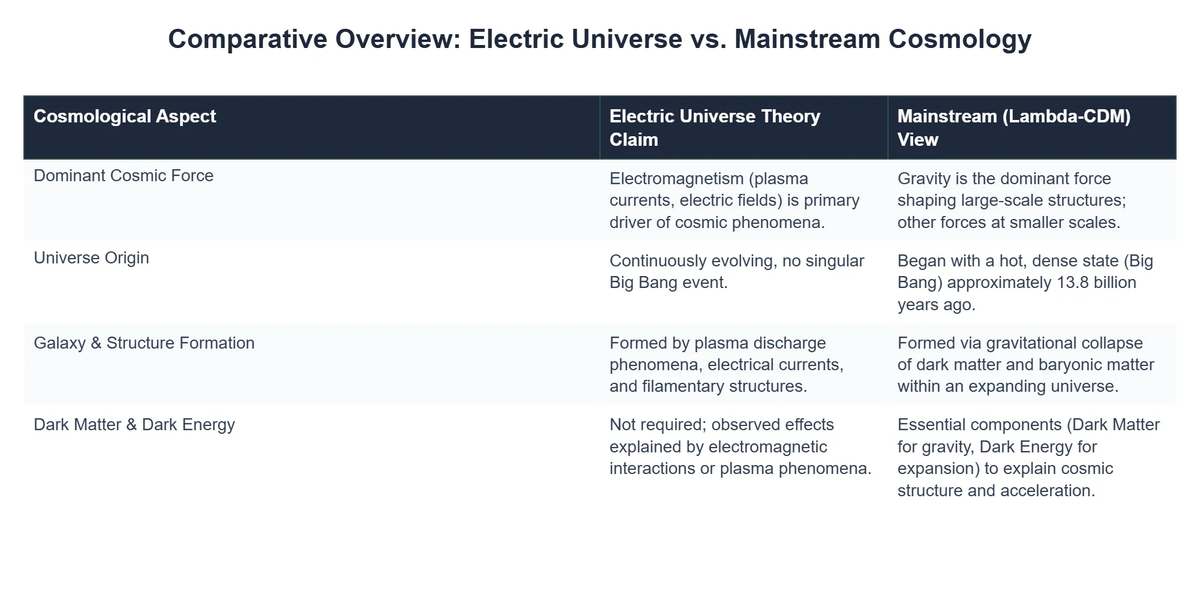
- ✅ General Relativity as Foundation: At its core, mainstream cosmology relies on Einstein’s General Theory of Relativity, which accurately describes gravity as a curvature in spacetime caused by mass and energy. This framework successfully predicts phenomena like the bending of light by massive objects (gravitational lensing) and the orbit of planets.
- 🔭 Key Observational Pillars: The Big Bang Model is supported by several pillars of evidence:
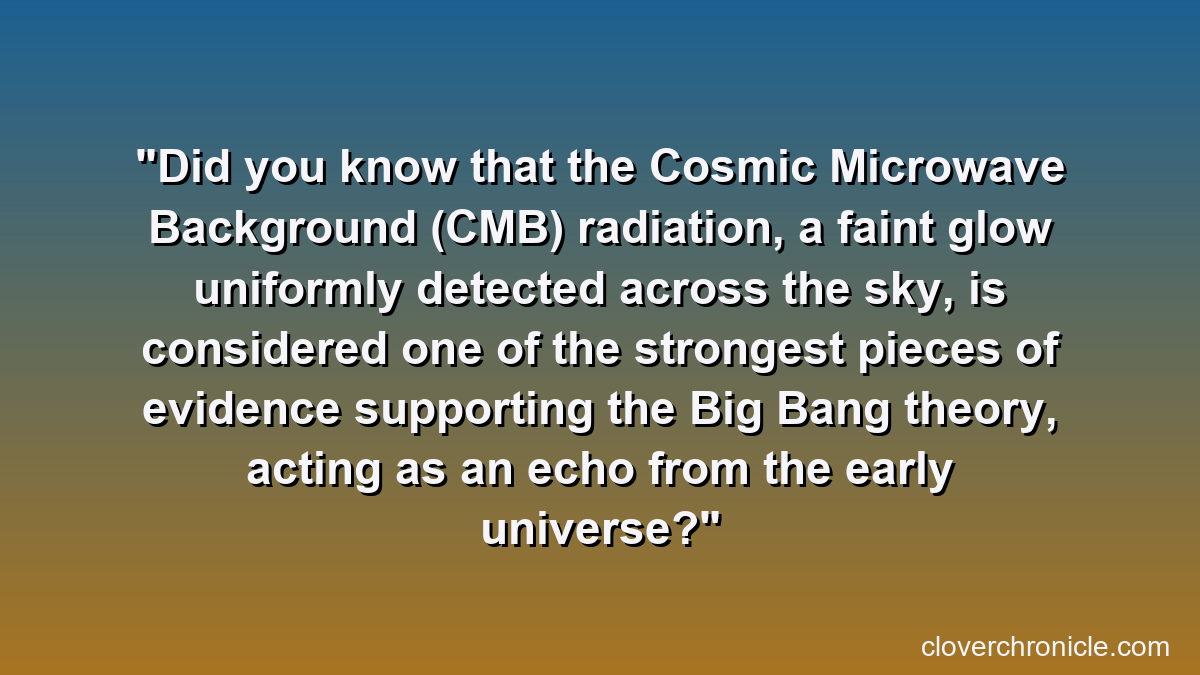
- ➡️ Cosmic Microwave Background (CMB): The faint afterglow radiation from the Big Bang, uniformly distributed across the sky.
- ➡️ Hubble’s Law (Redshift): The observation that galaxies are receding from us, and the farther away they are, the faster they are moving, indicating an expanding universe.
- ➡️ Big Bang Nucleosynthesis: The observed abundance of light elements (hydrogen, helium, lithium) in the universe matches predictions from the Big Bang’s early, hot phase.
- ➡️ Large-Scale Structure: The observed distribution of galaxies and galaxy clusters, consistent with gravitational self-organization from initial quantum fluctuations.
- 🌌 Dark Matter and Dark Energy: While not directly observed, these mysterious components are inferred from their gravitational effects. Dark matter is needed to explain galaxy rotation curves and gravitational lensing without enough visible mass, and dark energy is required to account for the accelerating expansion of the universe. For more on this, see [EXTERNAL_LINK URL=”https://en.wikipedia.org/wiki/Dark_energy” title=”Dark energy – Wikipedia”].
For a deeper dive into the fundamental questions facing modern astrophysics, explore Cosmic Queries: Probing the Mysteries of the Universe.
Key Claims of the Electric Universe Theory and Their Debunking
The Electric Universe Theory makes several bold claims that directly contradict well-established physics and astronomical observations. Here, we address some of the most prominent.
⚡ Plasma Dominance vs. Gravity’s Strength
EU Claim: Electromagnetic forces in plasma are vastly stronger than gravity and therefore must dominate cosmic dynamics.
Debunking: While electromagnetic forces are indeed much stronger than gravity at the atomic or even laboratory scale, their influence diminishes rapidly with distance and is often canceled out over large scales. Cosmic plasma, being quasi-neutral (equal numbers of positive and negative charges), tends to screen out electric fields. Magnetic fields can persist, but their energy density over truly vast cosmic distances (intergalactic voids, superclusters) is far too low to compete with the cumulative gravitational pull of trillions of stars and galaxies. Gravity, though weaker per particle, is always attractive and has an infinite range, allowing it to dominate on cosmic scales. As explained on Physics StackExchange, the universe is mostly charge-neutral, making large-scale electric fields negligible. [EXTERNAL_LINK URL=”https://physics.stackexchange.com/questions/18950/how-to-debunk-the-electric-universe” title=”electromagnetism – How to debunk ‘The Electric Universe’? – Physics …”]
⭐ Stellar and Galactic Formation
EU Claim: Stars are formed by cosmic plasma pinch effects, and galaxies are shaped by immense Birkeland currents.
Debunking: Mainstream astrophysics explains star formation as the gravitational collapse of dense pockets within giant molecular clouds. This process is directly observed in stellar nurseries like the Orion Nebula. Galactic structures, such as spiral arms, are understood as density waves propagating through a disk of stars and gas, shaped primarily by gravitational interactions. The observed rotation curves of galaxies, which require the presence of dark matter to be explained by gravity, remain a significant challenge for the EU, as electromagnetism alone cannot account for them without violating fundamental physical laws or requiring an unobserved, immense cosmic current infrastructure.
💥 Rejection of the Big Bang and Dark Matter/Energy
EU Claim: The Big Bang never happened; the universe is eternal or in a steady state. Consequently, there’s no need for dark matter or dark energy.
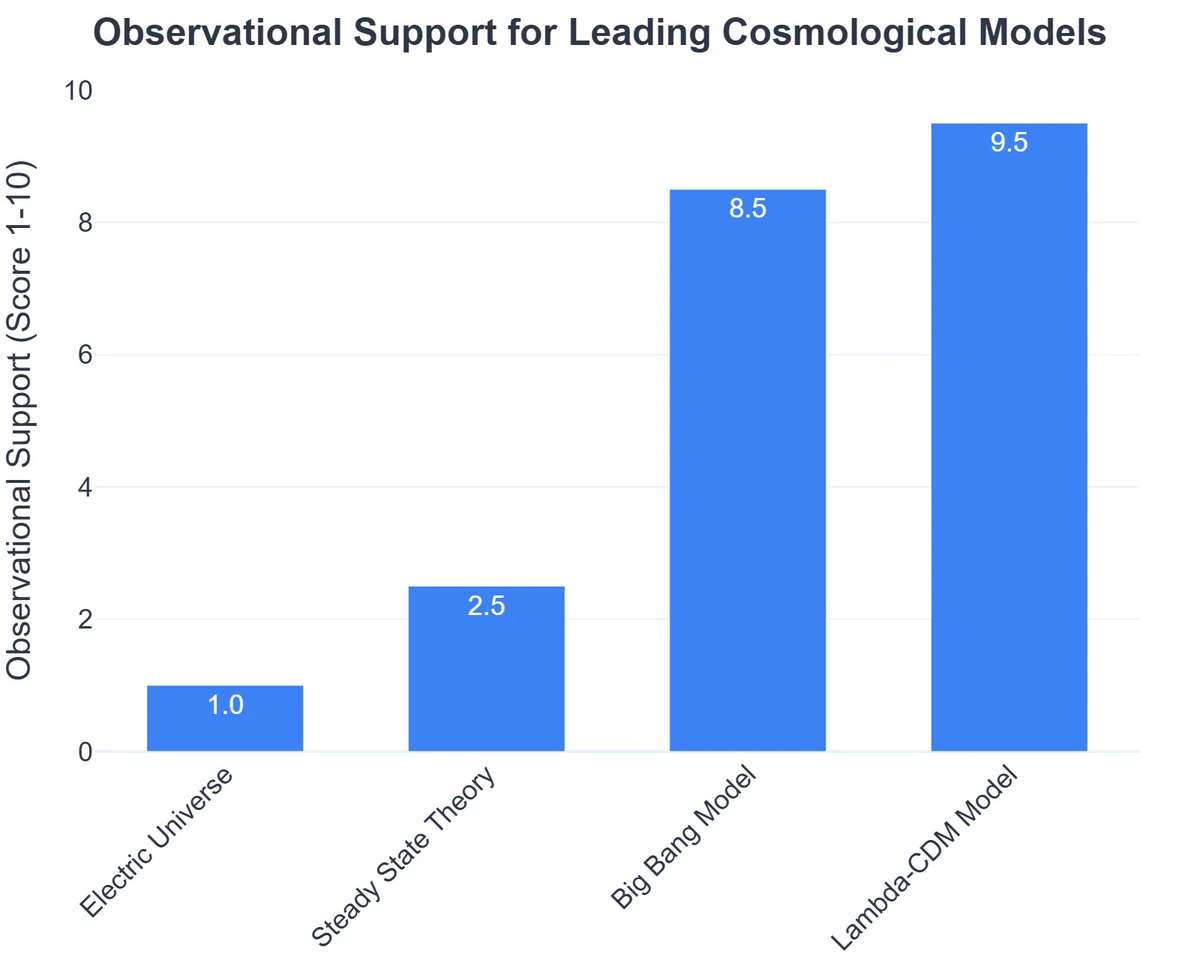
Debunking: This is perhaps the most significant divergence. The evidence for the Big Bang is overwhelming and multifaceted, as outlined earlier (CMB, redshift, light element abundances). The Electric Universe has no coherent explanation for these phenomena. While some alternative cosmologies like the Steady State Theory were once scientific competitors to the Big Bang, they were largely abandoned due to the mounting evidence. The concepts of dark matter and dark energy, while still poorly understood, arise from direct observational anomalies within the gravitational framework that electromagnetism, as described by the EU, cannot resolve. Mainstream science embraces these as open questions to be investigated, not as reasons to discard the entire framework.
Why Mainstream Science Rejects the Electric Universe
The scientific community’s rejection of the Electric Universe Theory is rooted in its failure to meet the rigorous standards of scientific inquiry and its inconsistencies with established observations and physics.
- ❌ Lack of Predictive Power: A cornerstone of any scientific theory is its ability to make testable predictions. The EU theory has largely failed to make novel, quantitative predictions that have been subsequently verified by observation. Instead, it often attempts to reinterpret existing observations within its framework.
- ❌ Inconsistent with Tested Physics: The EU requires significant revisions or outright abandonment of fundamental laws of physics that have been repeatedly validated in laboratories and through astronomical observations, including Maxwell’s equations (in their cosmic application) and Einstein’s General Relativity.
- ❌ Absence of Peer-Reviewed Evidence: The vast majority of Electric Universe literature is published outside of mainstream, peer-reviewed scientific journals. This means it has not undergone the critical scrutiny by experts in the field, which is essential for validating scientific claims. The scientific method relies on falsifiability and consensus built upon verifiable data, neither of which are robustly present in the EU’s claims. For a detailed discussion on why the astrophysics community doesn’t incorporate the Electric Universe model, you can refer to discussions like those on [EXTERNAL_LINK URL=”https://www.quora.com/Why-does-common-astrophysics-refuse-to-incorporate-an-electric-universe-model-as-part-of-their-theory” title=”Why does common astrophysics refuse to incorporate an electric …”].
- ❌ Explanatory Gaps: Even if one were to entertain the EU’s claims, it struggles to provide comprehensive, quantitative explanations for many observed phenomena that the Big Bang model explains well, such as the detailed structure of the Cosmic Microwave Background, the precise abundances of light elements, or the gravitational effects explained by the presence of a Largest Black Hole in the Universe: Cosmic Leviathans Revealed which are fundamentally gravitational rather than electromagnetic.
Exploring Other Alternative Cosmologies (and Their Scientific Standing)
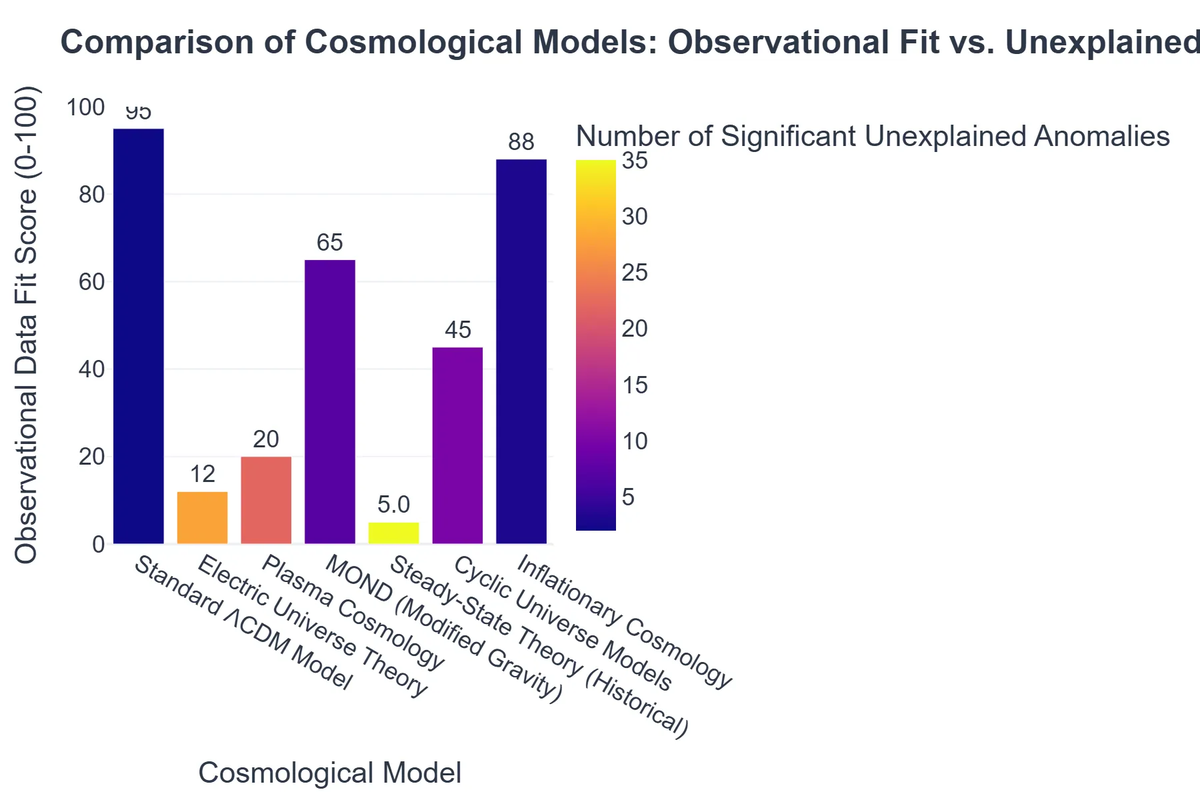
While the Electric Universe Theory occupies a fringe position, it’s important to recognize that the field of cosmology has always explored and continues to explore various alternative or complementary ideas to the dominant paradigm. These can range from historical competitors to active areas of modern theoretical research.
🌀 The Steady State Theory
Historically, the Steady State Theory was the primary competitor to the Big Bang in the mid-20th century. Proposed by Bondi, Gold, and Hoyle, it suggested the universe was eternal, infinite, and unchanging on average, with new matter continuously being created to maintain a constant density as the universe expanded. While elegant, it was largely disproven by the discovery of the Cosmic Microwave Background radiation in 1964, which provided irrefutable evidence of a hotter, denser past, fundamentally contradicting the Steady State’s core tenet. Learn more about this historical debate in Big Bang vs. Steady State: The Debate on the Universe’s Origin.
🌌 Inflation Theory of the Universe
Not an alternative to the Big Bang, but rather an extension, the inflation theory of the universe proposes a period of extremely rapid, exponential expansion in the first tiny fraction of a second after the Big Bang. Inflation solves several problems within the standard Big Bang model, such as the horizon problem (why the CMB is so uniform), the flatness problem (why the universe appears spatially flat), and the magnetic monopole problem. While still theoretical, it is widely accepted as a highly plausible component of early universe cosmology due to its explanatory power and testable predictions.
🧠 The Brain Theory Universe (Multiverse/M-Theory Concepts)
The phrase “brain theory universe” isn’t a standard scientific term, but it might refer to highly theoretical concepts like brane cosmology, which arises from string theory or M-theory. These theories suggest our universe might be just one “brane” (a higher-dimensional membrane) floating in a larger, higher-dimensional space, potentially colliding with other branes to trigger events like the Big Bang. Concepts like the multiverse, where countless universes exist, also fall into this realm. These are speculative, highly mathematical, and currently untestable ideas, existing at the cutting edge of theoretical physics rather than as direct cosmological models.
🧪 Plasma Cosmology (Distinct from EU)
It’s crucial to distinguish the fringe Electric Universe Theory from the legitimate scientific field of plasma cosmology. The latter is a branch of astrophysics that studies the behavior of plasma in space, recognizing its importance in phenomena like solar flares, the solar wind, and some aspects of active galactic nuclei. However, this scientific field works within the established gravitational framework and does not propose electromagnetism as the dominant force shaping the universe on large scales. For more on this, see Electromagnetic Universe: Exploring Plasma Cosmology. Other concepts like the “fractal theory of the universe” or “bubble theory universe” also exist, often as highly theoretical or conceptual models, but generally remain within a framework compatible with fundamental physics, unlike the EU.
Recommended Video
The Importance of Scientific Rigor and Evidence
The journey of understanding the universe is one of continuous inquiry, observation, and refinement. Scientific progress hinges on a commitment to the scientific method: formulating hypotheses, making testable predictions, gathering empirical evidence, and submitting findings to rigorous peer review. Theories that withstand this scrutiny, like the Big Bang model, gain widespread acceptance because they provide the most consistent and comprehensive explanations for observed phenomena.
While challenging established paradigms can be a catalyst for discovery, genuine scientific advancement requires that new ideas be supported by verifiable data and adhere to the fundamental laws of physics. The debate around the Electric Universe Theory serves as a powerful example of the critical distinction between alternative ideas that stimulate scientific progress and those that deviate from the evidence-based approach that defines modern cosmology. The universe is a complex and wondrous place, and our understanding of it continues to evolve, but this evolution is driven by evidence and logical consistency, not by wishful thinking or unproven assertions.
What is the Electric Universe Theory?
The Electric Universe Theory is an alternative cosmology proposing that electromagnetic forces, not gravity, are the primary drivers of cosmic structures and phenomena, from stars to galaxies.
Why is the Electric Universe Theory considered fringe?
It is considered fringe because it lacks consistent empirical support, contradicts established physics (like general relativity and quantum mechanics), and cannot explain observed phenomena as comprehensively as mainstream cosmological models.
What are the mainstream cosmological models?
The leading mainstream cosmological models include the Big Bang theory and the Lambda-CDM model, which are strongly supported by extensive observational evidence such as the expansion of the universe, cosmic microwave background radiation, and the abundance of light elements.
How can one evaluate cosmological claims?
When evaluating cosmological claims, look for theories supported by empirical evidence, testable predictions, peer-reviewed research, and a broad consensus within the scientific community.