


The human mind, a marvel of complexity and efficiency, often navigates the world using mental shortcuts. While these shortcuts, known as heuristics, are incredibly useful for rapid decision-making, they also open the door to systematic patterns of deviation from rationality. These deviations are known as biases. Understanding the various types of bias in psychology is crucial for anyone seeking to gain a deeper insight into human thought, behavior, and the often-unseen forces that shape our perceptions.
💡 Key Takeaways
- Psychological biases are systemic errors in thinking that affect judgments and decisions.
- Biases can be cognitive (individual processing) or research-related (methodological flaws).
- Recognizing common biases like confirmation bias or anchoring helps improve critical thinking.
- Mitigating bias requires self-awareness, diverse perspectives, and rigorous methodology.
“Understanding the subtle interplay of biases isn’t just about identifying flaws; it’s about revealing the intricate architecture of human cognition and guiding us toward more robust inquiry.”
— Dr. Eleanor Vance, PhD, Cognitive Neuroscientist & Human Potential Researcher
From the subtle ways we interpret information to the profound impact on our social interactions and global policies, biases are an integral part of the human experience. They are not merely errors but inherent features of our cognitive architecture, evolved to help us process vast amounts of information quickly. However, recognizing their influence is the first step toward mitigating their potential pitfalls and fostering more objective reasoning. For a broader understanding of how these mental processes shape our reality, explore Brain Bias: How Biases Shape Our Reality.
In This Article
- — 💡 Key Takeaways
- → 🧠 Understanding Bias: The Foundation of Distorted Thinking
- — 💡 Why Do We Have Biases?
- → 🔍 Cognitive Biases: The Brain’s Mental Shortcuts
- — ➡️ Heuristics vs. Biases: A Crucial Distinction
- → 🎯 Common Cognitive Biases Explained
- — 🤝 Confirmation Bias
- — 🗓️ Availability Heuristic
- — ⚓ Anchoring Bias
- — 🖼️ Framing Effect
- — 💸 Sunk Cost Fallacy
- — retrospective Hindsight Bias
- — ⛰️ Dunning-Kruger Effect
- — 🌟 Halo Effect
- → 🤝 Social Biases: Shaping Our Interactions
- — 👥 In-Group/Out-Group Bias
- — stereotype Stereotyping
- — 🚫 Prejudice
- — ⚖️ Discrimination
- — 👻 Implicit Bias
- → 🕰️ Memory Biases: How Our Past is Rewritten
- — ❌ Misinformation Effect
- — beginning-end Recency/Primacy Effect
- — ❓ Source Amnesia
- — 🚫 False Memory
- → ⚖️ Decision-Making Biases: Flaws in Judgment
- — 📉 Loss Aversion
- — ☀️ Optimism Bias
- — 🌧️ Pessimism Bias
- — stay-same Status Quo Bias
- — 🚶♀️ Bandwagon Effect
- → 🔬 Research Biases: Ensuring Scientific Rigor
- — selection Selection Bias
- — 🕵️♂️ Observer Bias
- — 📰 Publication Bias
- — 💬 Response Bias
- → ❤️ Emotional Biases: When Feelings Take Over
- — Feeling Affect Heuristic
- — Possession Endowment Effect
- — Me Self-Serving Bias
- → 🌍 The Pervasive Impact of Bias on Daily Life
- → 🚧 Strategies for Mitigating Bias: Towards Clearer Thinking
- — 意識 Self-Awareness and Reflection
- — logic Critical Thinking
- — 🌍 Seeking Diverse Perspectives
- — slow System 2 Thinking
- — 🛠️ Debiasing Techniques
🧠 Understanding Bias: The Foundation of Distorted Thinking
In psychology, a bias refers to a systematic tendency to think in certain ways that can lead to deviations from sound judgment. Unlike random errors, biases are predictable patterns of irrationality that affect our perceptions, memories, decisions, and social interactions.
💡 Why Do We Have Biases?
Biases aren’t inherently “bad”; they serve several purposes, primarily stemming from our evolutionary need for efficiency:
- ✅ Cognitive Load Reduction: Our brains are constantly bombarded with information. Biases act as mental shortcuts, allowing us to process data quickly without expending excessive cognitive energy.
- ✅ Survival Instincts: In ancestral environments, quick judgments, even if imperfect, often meant the difference between survival and peril.
- ✅ Emotional Regulation: Some biases help protect our self-esteem or maintain a coherent worldview, contributing to psychological well-being.
- ✅ Social Cohesion: Biases like in-group preference can foster group loyalty and cooperation, which were crucial for community survival.
However, in modern, complex environments, these shortcuts can lead to significant errors in judgment, miscommunication, and perpetuate harmful stereotypes.
🔍 Cognitive Biases: The Brain’s Mental Shortcuts
At the heart of psychological bias are cognitive bias, which are systematic errors in thinking that occur when people are processing and interpreting information in the world around them. They result from our brain’s attempts to simplify information processing, leading to consistent deviations from logic and rationality. For a comprehensive overview, delve into Types of Cognitive Bias: Understanding Distortions in Thinking.
➡️ Heuristics vs. Biases: A Crucial Distinction
- ✅ Heuristics: These are the “rules of thumb” or mental shortcuts our brains use to make quick judgments and decisions, especially under conditions of uncertainty or limited information. They are efficient and often lead to correct or acceptable outcomes.
- ✅ Biases: These are the predictable errors or systematic deviations that can arise from the application of heuristics, leading to conclusions that are not always rational or accurate. They are the “byproducts” of our efficient mental processing.
Understanding these brain’s mental shortcuts is key to recognizing why we often deviate from purely rational thought, as explored in Cognitive Bias: Understanding Our Brain’s Mental Shortcuts.
🎯 Common Cognitive Biases Explained
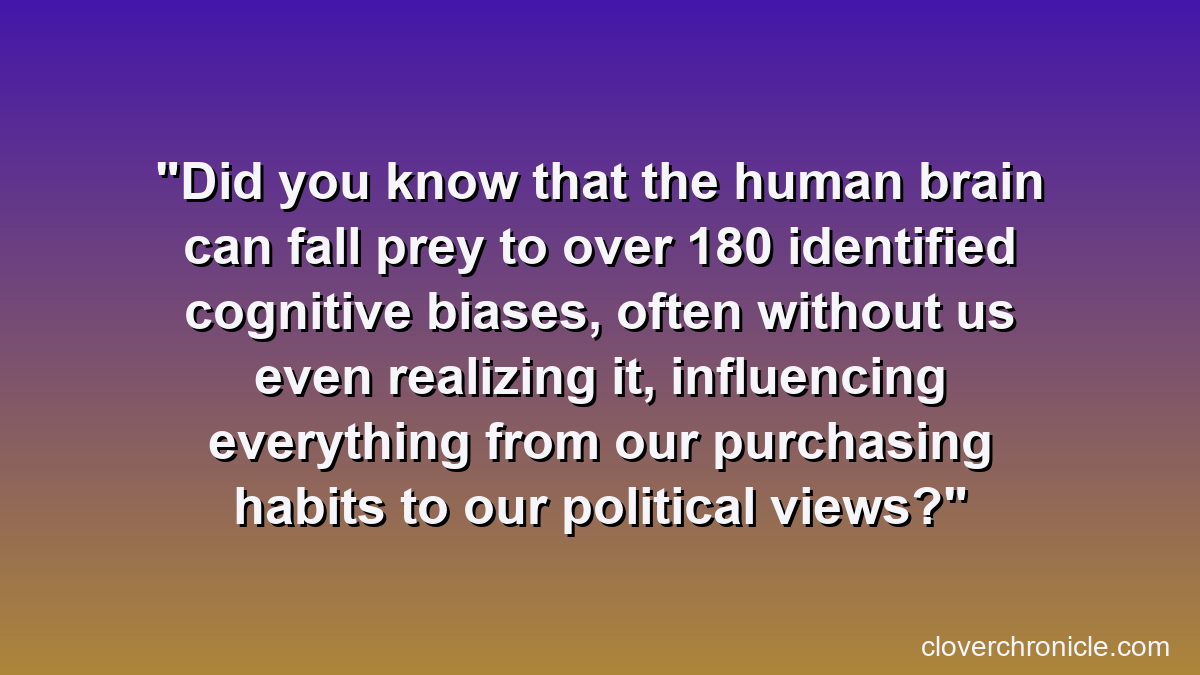
There are over 100 known cognitive biases, but some are more prevalent and impactful than others. Here are some of the most common different types of bias in psychology:
🤝 Confirmation Bias
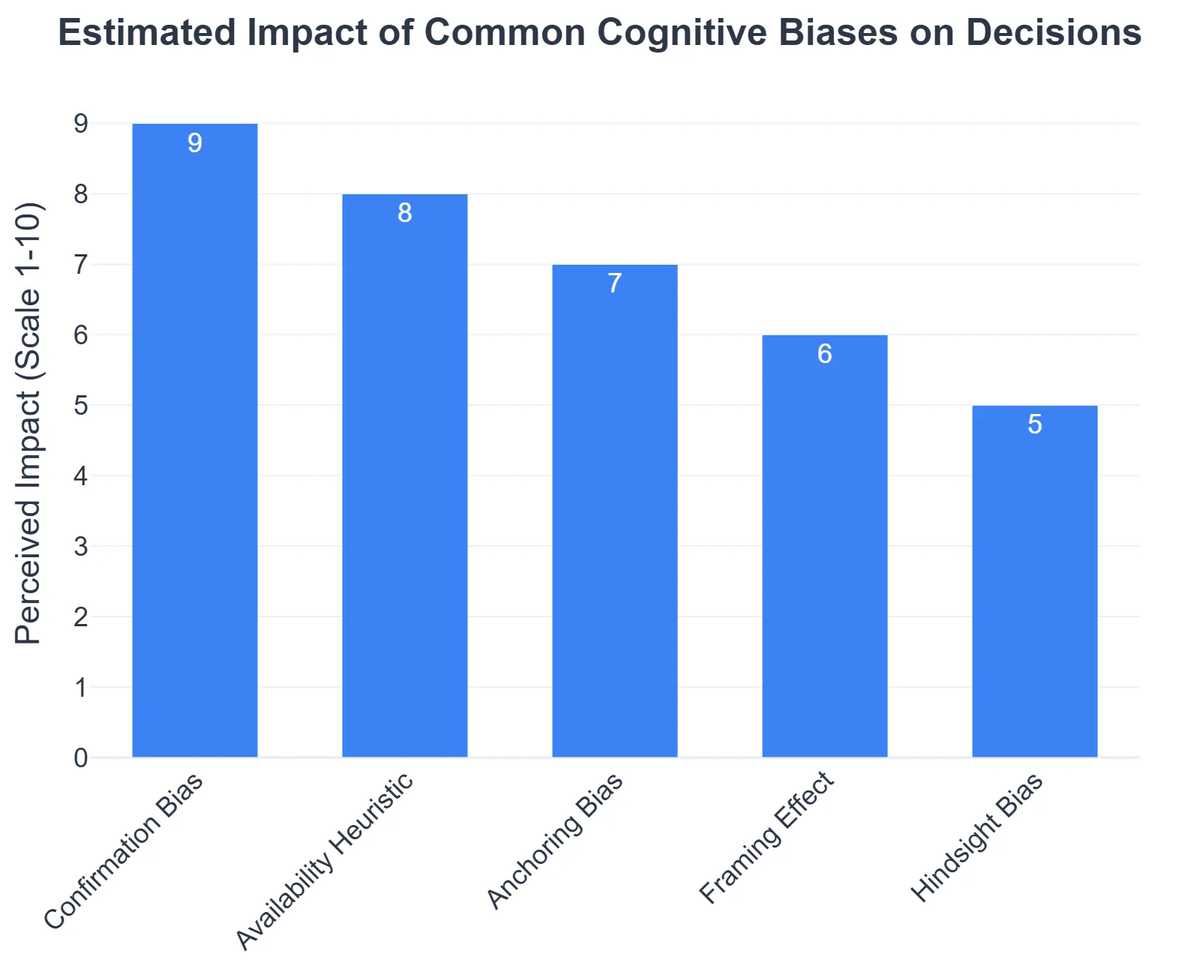
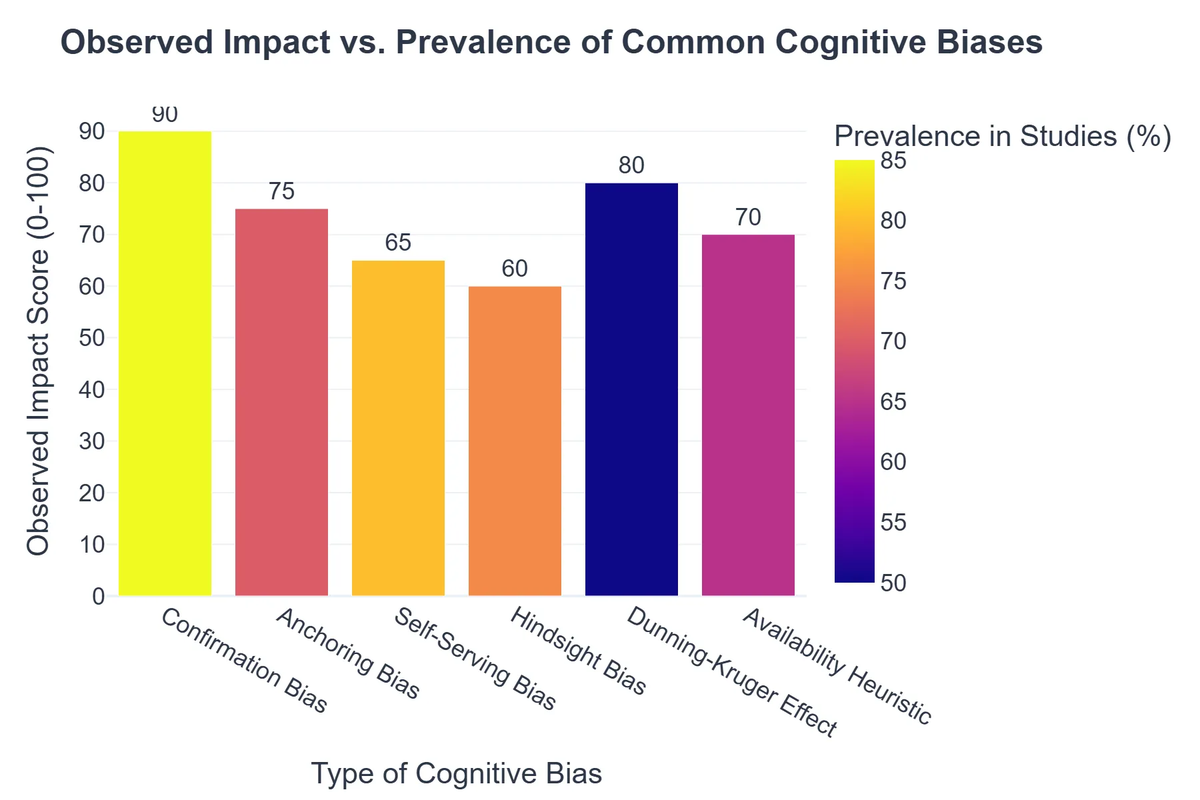
One of the most pervasive types of confirmation bias, this is the tendency to search for, interpret, favor, and recall information in a way that confirms one’s pre-existing beliefs or hypotheses. It makes us less likely to consider evidence that contradicts our views. For more details, see Confirmation Bias: Meaning, Examples, & Impact.
- ✅ Example: Someone who believes a certain politician is corrupt will primarily seek out news articles and social media posts that support this view, while dismissing or ignoring any information that suggests otherwise.
🗓️ Availability Heuristic
This bias causes us to overestimate the likelihood or frequency of events based on how easily examples come to mind. If something is easily recalled (e.g., vivid, recent, or emotionally charged), we tend to believe it’s more common or probable.
- ✅ Example: After seeing several news reports about plane crashes, a person might overestimate the risk of flying, even though statistically, air travel is very safe.
⚓ Anchoring Bias
Anchoring bias describes our tendency to rely too heavily on the first piece of information offered (the “anchor”) when making decisions. Subsequent judgments are then made by adjusting from this anchor, even if it’s arbitrary.
- ✅ Example: In a negotiation, the first price offered often sets the range for all subsequent discussions, even if it’s an extreme figure.
🖼️ Framing Effect
The framing effect illustrates that our decisions are often influenced by the way information is presented, rather than by the information itself. A choice can be presented in a way that emphasizes positive or negative connotations, altering our perception.
- ✅ Example: People are more likely to choose a medical treatment if told it has a “90% success rate” than if told it has a “10% failure rate,” even though the outcomes are identical.
💸 Sunk Cost Fallacy
This bias occurs when individuals continue a behavior or endeavor as a result of previously invested resources (time, money, effort) that cannot be recovered, rather than considering the future costs and benefits. It’s the reluctance to “cut your losses.”
- ✅ Example: Continuing to pour money into a failing business or relationship because of how much time and effort has already been invested.
retrospective Hindsight Bias
Hindsight bias, sometimes called the “I-knew-it-all-along” phenomenon, is the tendency to perceive past events as more predictable than they actually were. After an event has occurred, people often believe they “knew” it would happen.
- ✅ Example: After a sports team wins a championship, fans might claim they always knew that team would win, despite earlier doubts or predictions to the contrary.
⛰️ Dunning-Kruger Effect
This cognitive bias describes the phenomenon where people with low ability at a task overestimate their own ability, and people with high ability tend to underestimate their own ability. The less competent often lack the metacognitive ability to recognize their incompetence.
- ✅ Example: An amateur musician might genuinely believe they are exceptionally talented and ready for a major concert, while a seasoned professional might constantly feel they need to improve.
🌟 Halo Effect
The halo effect is a cognitive bias where our overall impression of a person influences how we feel and think about their character. Specifically, one positive trait (e.g., attractiveness, kindness) can lead us to infer other positive traits (e.g., intelligence, competence), even without evidence.
- ✅ Example: An attractive person might be perceived as more trustworthy or intelligent in a job interview, purely based on their appearance.
🤝 Social Biases: Shaping Our Interactions
Social biases are deeply ingrained tendencies that influence how we perceive, judge, and interact with others, particularly those who belong to different social groups. These biases often operate unconsciously and can lead to prejudice and discrimination.
👥 In-Group/Out-Group Bias
This fundamental social bias involves favoring members of one’s own group (the “in-group”) over those who are not part of it (the “out-group”). It stems from our innate need for belonging and can lead to competition or animosity between groups.
- ✅ Example: Loyalty to a sports team often leads fans to view their own team’s players more favorably and opposing players more critically, regardless of objective performance.
stereotype Stereotyping
Stereotyping is the oversimplified and often negative generalization about a group of people. It involves attributing certain characteristics to individuals based solely on their membership in a particular group, without considering individual differences.
- ✅ Example: Assuming all members of a certain profession or nationality share particular personality traits.
🚫 Prejudice
Prejudice is a preconceived opinion or feeling, either favorable or unfavorable, usually formed without knowledge, thought, or reason. It is often a negative attitude towards an entire group of people, based on stereotypes.
Understanding Psychological Biases: Advantages and Disadvantages
Pros
- ✔Enhances critical thinking and reasoning skills.
- ✔Improves the objectivity and validity of psychological research.
- ✔Facilitates better personal and professional decision-making.
- ✔Aids in identifying and mitigating systemic inequalities.
Cons
- ✖Complexity makes biases challenging to fully identify and categorize.
- ✖Risk of over-attributing all disagreements or errors to bias.
- ✖Requires significant training and expertise for effective application.
- ✖Can lead to increased self-consciousness or analytical paralysis.
- ✅ Example: Having a negative opinion about individuals from a specific ethnic group, without having any personal experience or factual basis for that opinion.
⚖️ Discrimination
Discrimination is the behavioral manifestation of prejudice, involving the unjust or prejudicial treatment of different categories of people or things, especially on the grounds of ethnicity, age, sex, or disability. It is the act of treating someone differently based on bias.
- ✅ Example: Denying someone a job, housing, or opportunity purely because of their gender, race, or sexual orientation.
👻 Implicit Bias
Implicit bias refers to the attitudes or stereotypes that affect our understanding, actions, and decisions in an unconscious manner. These biases are activated involuntarily and without an individual’s awareness or intentional control. They are often learned over time from societal cues.
- ✅ Example: A hiring manager unconsciously favoring candidates from a certain demographic background, even if they explicitly state they are committed to diversity.
🕰️ Memory Biases: How Our Past is Rewritten
Our memories are not perfect recordings of the past; they are constantly being reconstructed and are susceptible to various biases. These memory biases can alter how we recall events, leading to inaccurate or distorted recollections.
❌ Misinformation Effect
The misinformation effect occurs when a person’s recall of episodic memories becomes less accurate because of post-event information. This can happen when leading questions or new information introduced after an event alters the memory of the original event.
- ✅ Example: In eyewitness testimony, if a lawyer asks, “How fast was the car going when it smashed into the other car?” instead of “How fast was the car going when it hit the other car?”, the eyewitness might report a higher speed, even if their original memory was different.
beginning-end Recency/Primacy Effect
These effects describe how items at the beginning (primacy) and end (recency) of a list or sequence are more easily remembered than those in the middle.
- ✅ Primacy Example: Remembering the first few items on a grocery list better than the middle ones.
- ✅ Recency Example: Remembering the last few things someone said in a conversation more clearly.
❓ Source Amnesia
Source amnesia is the inability to remember where, when, or how previously learned information has been acquired, while retaining the factual knowledge. You remember the information, but forget its context or origin.
- ✅ Example: Believing a piece of information is general knowledge, but not recalling that you actually learned it from a specific movie or a dubious online source.
🚫 False Memory
A false memory is a recollection of an event, or details of an event, that did not actually occur. These memories can feel as real and vivid as true memories, and individuals can be genuinely convinced they are accurate.
- ✅ Example: Believing you witnessed a specific event at a family gathering when you were a child, based on repeated storytelling from relatives, even though you were not actually present or old enough to remember it.
⚖️ Decision-Making Biases: Flaws in Judgment
These biases specifically impact our ability to make rational choices, often leading us to outcomes that are not in our best interest. They highlight how our emotions and shortcuts can override logical assessment.
📉 Loss Aversion
Loss aversion is the psychological phenomenon where the pain of losing something is psychologically more powerful than the pleasure of gaining the equivalent thing. People are generally more motivated to avoid losses than to acquire equivalent gains.
- ✅ Example: An investor might hold onto a losing stock for too long, hoping it will recover, because the pain of realizing the loss is greater than the potential gain from selling and reinvesting.
☀️ Optimism Bias
Optimism bias, or unrealistic optimism, is the tendency for individuals to believe that they are less likely to experience negative events and more likely to experience positive events than others. It’s an irrational positive belief about one’s future.
- ✅ Example: A smoker believing they are less likely to get lung cancer than other smokers, or someone starting a new business believing their venture is guaranteed to succeed where others have failed.
🌧️ Pessimism Bias
Conversely, pessimism bias is the tendency to overestimate the likelihood of negative outcomes and underestimate positive ones. It involves having an overly negative expectation about future events.
- ✅ Example: A student anticipating they will fail an exam despite having studied diligently, or someone assuming the worst outcome in a new situation.
stay-same Status Quo Bias
The status quo bias is a preference for things to stay the same. People tend to stick with their current situation or choice, even when there are potential benefits to changing. Change involves effort and perceived risk, which we tend to avoid.
- ✅ Example: Sticking with a particular brand of coffee or car, even if new, better, or cheaper alternatives become available, simply because it’s what you’ve always used.
🚶♀️ Bandwagon Effect
The bandwagon effect is a cognitive bias whereby people do something primarily because others are doing it, regardless of their own beliefs, which they may ignore or override. It’s a form of collective conformity.
- ✅ Example: Buying a product because it’s a bestseller, supporting a political candidate because they are leading in the polls, or joining a trend because “everyone else is doing it.”
🔬 Research Biases: Ensuring Scientific Rigor
In the realm of scientific inquiry and data collection, biases can subtly creep into methodologies, data analysis, and interpretation, potentially skewing results and leading to inaccurate conclusions. Recognizing these is vital for valid research. For a detailed guide on various research biases, consult Understanding Different Types of Research Bias.
selection Selection Bias
Selection bias occurs when the method for selecting participants or data for a study is not random or representative of the larger population, leading to a sample that systematically differs from the target population.
- ✅ Example: A survey about public opinion on healthcare that only includes responses from wealthy individuals, thus not accurately reflecting the views of the entire population.
🕵️♂️ Observer Bias
Observer bias (also known as experimenter bias or expectancy bias) occurs when a researcher’s expectations, beliefs, or past experiences influence the outcome of the study. This can happen consciously or unconsciously, affecting how data is collected, interpreted, or reported.
- ✅ Example: A scientist subtly influencing the behavior of study participants or misinterpreting ambiguous results to align with their hypothesis.
📰 Publication Bias
Publication bias is the tendency for studies with positive or statistically significant results to be more likely to be published than those with negative or null results. This can lead to a skewed perception of the evidence base, making certain effects appear stronger or more consistent than they actually are.
- ✅ Example: A pharmaceutical company only publishing studies where their drug showed positive effects, while suppressing studies where it showed no effect or adverse effects.
💬 Response Bias
Response bias refers to a wide range of tendencies for participants to respond inaccurately or untruthfully to questions, often due to social desirability, acquiescence, or extremeness. It affects the validity of self-reported data.
- ✅ Example: In a survey, respondents over-reporting positive behaviors (like charitable giving) or under-reporting negative behaviors (like smoking) to present themselves in a favorable light.
❤️ Emotional Biases: When Feelings Take Over
Beyond the purely cognitive realm, our emotions play a significant role in shaping our judgments and decisions. Emotional biases are systematic errors that arise from our feelings and affective states, often leading us away from rational choices.
Feeling Affect Heuristic
The affect heuristic is a mental shortcut in which people make decisions based on their current emotions or “gut feelings” rather than on a more thorough, logical analysis of risks and benefits. If a decision feels good, it’s perceived as low risk; if it feels bad, it’s high risk.
- ✅ Example: An investor avoiding a potentially lucrative stock simply because the company’s name or industry evokes a negative feeling, despite strong financial indicators.
Possession Endowment Effect
The endowment effect is the tendency for individuals to ascribe more value to something merely because they own it. Once something is “endowed” to us, we perceive its value to be higher than if we did not own it, making us less willing to part with it.
- ✅ Example: People often demand a much higher price for an item they own (e.g., a mug, a concert ticket) than they would be willing to pay to acquire the exact same item if they didn’t own it.
Me Self-Serving Bias
The self-serving bias is the common tendency to attribute positive events to one’s own character or actions (internal factors) and negative events to external factors beyond one’s control. It protects self-esteem.
- ✅ Example: A student who passes an exam attributes their success to their intelligence and hard work, but if they fail, they blame the difficult questions or the unfair grading system.
🌍 The Pervasive Impact of Bias on Daily Life
The various bias psychology types are not confined to academic discussions; they profoundly influence every facet of our daily lives, often without our conscious awareness. Their impact spans personal, professional, and societal realms:
- ➡️ Personal Relationships: Biases can fuel misunderstandings, perpetuate conflicts, and hinder empathy. For instance, confirmation bias can lead us to only see flaws in a partner if we’re already upset, while fundamental attribution error might make us blame their character for a mistake rather than external circumstances.
- ➡️ Professional Decisions: From hiring and promotions to strategic planning and market analysis, biases can lead to suboptimal outcomes. Implicit bias can result in non-diverse teams, while sunk cost fallacy might keep a company invested in a failing project.
- ➡️ Consumer Behavior: Marketing heavily leverages biases like the framing effect or the bandwagon effect to influence purchasing decisions, often leading us to buy things we don’t truly need.
- ➡️ Societal Issues: Social biases underpin prejudice, discrimination, and systemic inequalities. They affect justice systems, healthcare access, educational opportunities, and political polarization.
- ➡️ Health & Well-being: Optimism bias can lead people to neglect preventive health measures, while anchoring bias might affect how doctors diagnose based on initial symptoms.
Recognizing the breadth of this influence is the first step in fostering more rational decisions and equitable interactions. Understanding these deep-seated aspects of human cognition is central to The Human Enigma: Unlocking the Secrets of Our Body and Mind.
Recommended Video
🚧 Strategies for Mitigating Bias: Towards Clearer Thinking
While biases are inherent to human cognition, they are not immutable. Through awareness and deliberate strategies, we can mitigate their negative effects and foster more objective decision-making. As outlined by The Decision Lab, active engagement with these biases is key. Learn more at List of Cognitive Biases and Heuristics – The Decision Lab.
意識 Self-Awareness and Reflection
The most crucial step is acknowledging that everyone, including ourselves, is susceptible to biases. Regularly pause and reflect on your thoughts, assumptions, and decisions.
- ✅ Question Your Assumptions: Why do I believe this? What evidence supports it?
- ✅ Consider the Opposite: Actively try to argue against your initial viewpoint.
- ✅ Practice Mindfulness: Be present and observe your thoughts without immediate judgment.
logic Critical Thinking
Engage in systematic, logical thinking rather than relying on intuitive shortcuts. This involves analyzing information, evaluating arguments, and identifying logical fallacies.
- ✅ Seek Out Disconfirming Evidence: Actively look for information that challenges your existing beliefs, rather than just confirming them.
- ✅ Break Down Complex Problems: Divide large decisions into smaller, manageable parts to reduce cognitive load and allow for more detailed analysis.
- ✅ Apply Probabilistic Thinking: Instead of binary thinking, consider the spectrum of probabilities for outcomes.
🌍 Seeking Diverse Perspectives
Surrounding yourself with people who hold different viewpoints, backgrounds, and experiences can help expose your own blind spots.
- ✅ Cultivate Diverse Networks: Engage with individuals from varied cultural, professional, and social backgrounds.
- ✅ Solicit Feedback: Actively ask others for their opinions, especially those who might disagree with you.
- ✅ Deliberate Devil’s Advocate: Assign someone (or play the role yourself) to challenge assumptions within a group discussion.
slow System 2 Thinking
In psychology, “System 1” thinking is fast, intuitive, and emotional (prone to biases), while “System 2” thinking is slower, more deliberate, and logical. When important decisions are at stake, engage System 2.
- ✅ Take Your Time: Avoid rushed decisions, especially under pressure.
- ✅ Use Structured Decision-Making Tools: Employ pros and cons lists, decision matrices, or cost-benefit analyses.
- ✅ Pre-Mortem Analysis: Before a project starts, imagine it has failed and brainstorm all possible reasons why. This helps uncover potential risks and biases.
🛠️ Debiasing Techniques
Specific strategies can be employed to directly counter known biases:
- ✅ Considering Alternatives: For anchoring bias, generate multiple options or price points before accepting the first one.
- ✅ Accountability: Knowing you’ll have to justify your decision to others can encourage more thorough thinking.
- ✅ Double-Blinding (in research): To counter observer bias, ensure neither researchers nor participants know who is in the control or experimental group.
- ✅ Empathy Building: For social biases, actively try to understand and share the feelings of others, especially those from different groups.
While completely eliminating bias is impossible, continuous effort in these areas can significantly improve the quality of our thinking, decisions, and interactions.
What is a cognitive bias?
A cognitive bias is a systematic error in thinking that occurs when people process and interpret information in the world around them, affecting decisions and judgments.
How do research biases affect studies?
Research biases can skew results, leading to inaccurate conclusions by influencing study design, data collection, or interpretation, undermining the validity and reliability of findings.
Can biases be completely eliminated?
While inherent to human cognition, biases cannot be fully eliminated. However, awareness, critical thinking, and structured methodologies can significantly mitigate their negative impacts.
What is the most common type of bias?
Confirmation bias is often considered one of the most pervasive, as it describes our tendency to favor information that confirms our existing beliefs and dismiss contradictory evidence.