

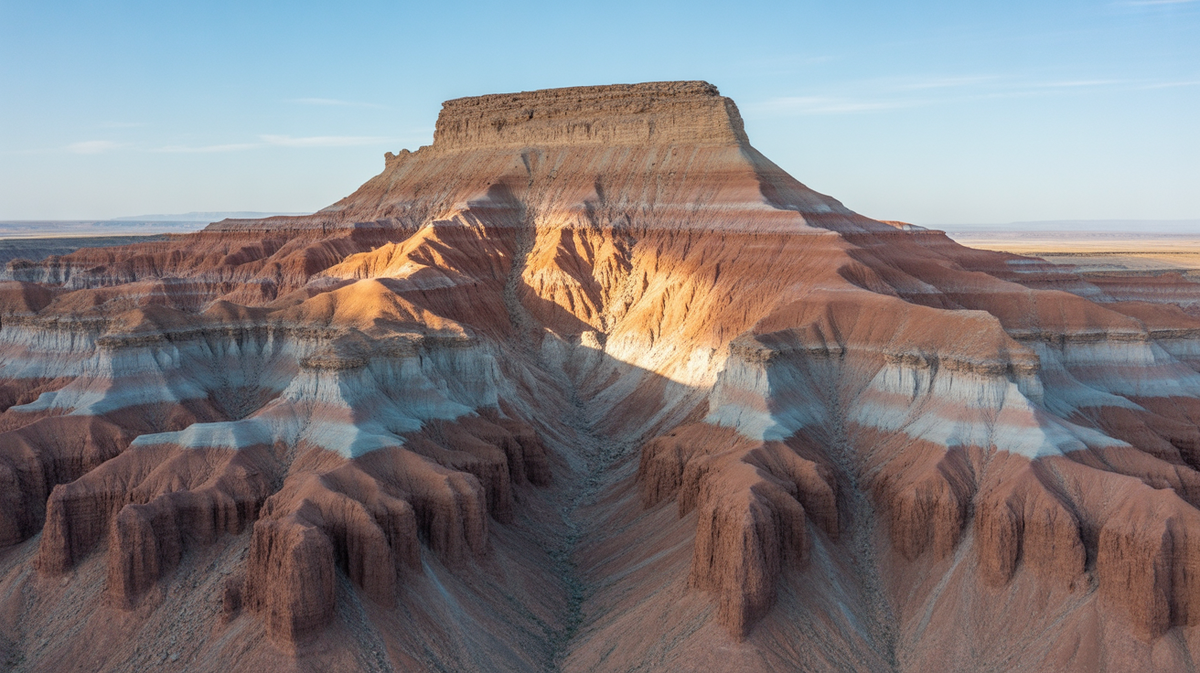
The Earth’s surface is a canvas of incredible geological artistry, sculpted over eons by powerful, often unseen, forces. Among the most iconic and visually striking landforms are mesas – vast, flat-topped mountains that stand as silent sentinels of deep geological time. Understanding mesa geology unveils a captivating story of erosion, resilience, and the relentless work of natural processes.
💡 Key Takeaways
- Mesas are distinct flat-topped landforms created by differential erosion of layered rock.
- Their formation often involves a durable ‘caprock’ protecting softer, underlying geological layers.
- Mesa features provide critical insights into past geological activity, climate, and ancient environments.
- Understanding mesas helps differentiate them from similar landforms like buttes and plateaus.
“Mesas aren’t just Earth’s majestic sentinels; their sculpted forms on Mars, for instance, echo similar erosional forces, offering planetary geoscientists vital clues to past water and climate cycles across diverse worlds.”
— Dr. Marcus Sterling, PhD, Planetary Geoscientist & Climatologist
In This Article
- — 💡 Key Takeaways
- → Understanding Mesas: What Defines These Iconic Landforms?
- — Distinguishing Mesas from Similar Landforms
- → The Geological Genesis: How Mesas Are Formed
- — Step-by-Step Formation Process:
- → Key Geological Features and Regional Variations of Mesas
- — Common Geological Features:
- — Regional Variations:
- → Significance of Mesas in Earth’s Geological Record and Human History
- — Geological and Scientific Importance:
- — Ecological and Cultural Significance:
Understanding Mesas: What Defines These Iconic Landforms?
A mesa is a distinctive flat-topped hill or mountain, often with steep, cliff-like sides. The term “mesa” comes from the Spanish word for “table,” aptly describing its characteristic shape. While often used interchangeably with other terms, mesas possess specific geological attributes that set them apart:

- ✅ Broad, Flat Top: The most defining feature is the extensive, level surface at its summit. This top can span many square kilometers.
- ✅ Steep, Erosional Cliffs: Mesas are typically bordered by precipitous slopes or cliffs that drop sharply to the surrounding lower terrain.
- ✅ Resistant Caprock: Crucially, the flat top is preserved by a layer of highly resistant rock, known as a “caprock,” which protects the softer layers beneath from erosion.
- ✅ Isolation: Mesas are isolated landforms, detached from larger plateaus by extensive erosion of the surrounding weaker rock.
Distinguishing Mesas from Similar Landforms
While mesas are part of a continuum of erosional remnants, it’s important to differentiate them from their relatives:
- ➡️ Plateaus: A plateau is a much larger, extensive flat-topped area of high elevation, often spanning hundreds of kilometers, from which mesas and buttes are eventually carved. Think of a plateau as the parent landmass.
- ➡️ Buttes: A butte is essentially a smaller, more isolated version of a mesa. As a mesa continues to erode, its flat top shrinks until it becomes an isolated, steep-sided pillar. The distinction is primarily one of size, with buttes typically having a top surface area smaller than their height.
- ➡️ Teardowns/Pinnacles: Further erosion of buttes can lead to even smaller, slender spires or pinnacles.
The Geological Genesis: How Mesas Are Formed
The formation of mesas is a testament to the power of differential erosion and the enduring strength of certain rock types. This process typically unfolds over millions of years and involves several key stages:

Step-by-Step Formation Process:
- 1️⃣ Initial Uplift: The story often begins with regional uplift, which elevates a large, flat-lying area composed of horizontally layered sedimentary rocks. This creates a high-altitude plateau.
- 2️⃣ Layered Stratigraphy: These rocks are not uniform. They consist of alternating layers of soft, easily erodible rocks (like shale, sandstone, or mudstone) and harder, more resistant rocks (such as basalt, limestone, or a well-cemented conglomerate). The resistant layer at the top is the future caprock.
- 3️⃣ Erosion Begins: Once elevated, the plateau becomes exposed to powerful erosional forces. Water (from rivers and rain), wind, and ice begin to wear away the softer rock layers, particularly along joints, cracks, and fault lines.
- 4️⃣ Differential Erosion: This is the critical mechanism. The softer underlying rocks erode much faster than the hard caprock above. As the softer material is removed, the resistant caprock is undercut, leading to the formation of steep cliffs. This process creates a distinct break in slope between the resistant top layer and the weaker slopes below. For instance, the geological history of regions like the Uinta Mountains illustrates the large-scale erosional processes that sculpt such features.
- 5️⃣ Headward Erosion and Isolation: Rivers and streams continue to cut deeper and wider valleys, eating away at the plateau. Over time, these valleys isolate sections of the plateau, leaving behind separate flat-topped landforms – the mesas. This continuous back-wearing (or headward erosion) eventually detaches them entirely.
- 6️⃣ Weathering and Mass Wasting: Freeze-thaw cycles, chemical weathering, and the action of gravity (mass wasting, like rockfalls and landslides) further shape the mesa’s sides, maintaining the steep cliffs as the softer material at the base is removed.
The precise balance between uplift, the type and sequence of rock layers, and the prevailing climate dictates the size, shape, and longevity of a mesa.
Key Geological Features and Regional Variations of Mesas
Mesas are not monolithic; their appearance and internal structure can vary significantly depending on the local geology and climate. From the iconic red rock landscapes of the American Southwest to the verdant Tepuis of South America, mesas showcase Earth’s diverse geological palette.
Common Geological Features:
- 💡 Caprock Composition: The type of caprock is crucial. Basaltic lava flows create particularly durable mesas, as seen in many parts of the Columbia River Basalt Group. Sandstones and limestones also form strong caprocks, especially if they are well-cemented or resistant to dissolution.
- 💡 Layered Sediments: Below the caprock, mesas reveal a stratigraphy of various sedimentary rocks, often laid down in ancient seas, lakes, or river systems. These layers can hold valuable paleontological data.
- 💡 Talus Slopes: At the base of the steep cliffs, you’ll often find piles of broken rock fragments, known as talus or scree slopes. These are formed by the continual weathering and collapse of material from the cliff face above.
- 💡 Joint Systems: Natural fractures or joint systems within the rock layers often provide pathways for water to penetrate and initiate erosion, influencing where valleys form and how mesas become isolated.
Regional Variations:
- 🌎 American Southwest: Perhaps the most famous examples of mesas are found in the Colorado Plateau region (e.g., Monument Valley, Grand Mesa). Here, the caprock is typically sandstone or basalt, and the arid climate accentuates the erosional forms. The vibrant red colors often come from iron oxides in the sandstone.
- 🌎 South America (Tepuis): Venezuela and Guyana are home to “Tepuis” – isolated table-top mountains, often shrouded in cloud forests, that are among the oldest exposed rock formations on Earth. These are unique ecosystems with high endemism. Tepuis are prime examples of the dramatic isolation achieved through extensive erosion.
- 🌎 India (Deccan Traps): The Deccan Traps feature extensive basaltic lava flows that have been eroded into numerous flat-topped hills and plateaus, showcasing basalt as a robust caprock.
For more insights into how varied geological structures can be, explore our article on Mélange Geology: Unraveling Chaotic Accretionary Wedges, which discusses entirely different, often chaotic, geological formations.
Recommended Video
Significance of Mesas in Earth’s Geological Record and Human History
Beyond their striking beauty, mesas hold immense scientific, ecological, and cultural value, offering windows into both Earth’s past and present.
Geological and Scientific Importance:
- 🔬 Paleontological Goldmines: The layered sedimentary rocks within mesas often preserve fossils of ancient life, providing critical clues about past environments, climates, and evolutionary pathways. Their isolated nature can also protect fossil sites from extensive disturbance.
- 🔬 Stratigraphic Records: Each rock layer within a mesa tells a story of deposition and environmental change. Geologists study these exposed strata to reconstruct the geological history of a region over millions of years.
- 🔬 Erosion and Landscape Evolution Studies: Mesas serve as natural laboratories for studying the processes of weathering and erosion, offering insights into how landscapes evolve over geological timescales. Research, such as on asymmetric topography, often relies on such landforms.
- 🔬 Resource Exploration: Certain sedimentary layers within mesas may contain valuable mineral resources, including coal, uranium, or oil and natural gas deposits. Understanding the geology of these formations is crucial for Resource Geology: Unearthing Earth’s Natural Assets.
Ecological and Cultural Significance:
- 🌿 Unique Ecosystems: The isolated, high-altitude environments of many mesas foster unique ecosystems, often with endemic plant and animal species found nowhere else on Earth. The Tepuis are a prime example of this biodiversity.
- 🏛️ Cultural Heritage: Many indigenous cultures hold mesas sacred, using them for ceremonial purposes, dwelling sites, or as defensive strongholds. Their imposing stature often features prominently in local myths and legends.
- 🏞️ Tourism and Recreation: Mesas are major tourist attractions, drawing visitors for hiking, photography, and experiencing dramatic landscapes. They are vital to the economies of regions like the American Southwest.
Mesa geology, therefore, is not just about understanding rocks and erosion; it’s about appreciating the dynamic interplay of forces that shape our world, leaving behind silent monuments that speak volumes about Earth’s enduring power. To further grasp the vast scale of geological processes, consider exploring Earth’s Unseen Forces: The Hidden Dynamics of Our Planet, our comprehensive guide to the planet’s fundamental dynamics. Understanding these landforms contributes to our broader knowledge of geological evolution and the planet’s history.
What is a mesa in geology?
A mesa is a flat-topped hill or mountain with steep sides, typically found in arid and semi-arid regions. The name ‘mesa’ is Spanish for ‘table’, referring to its characteristic shape.
How do mesas form?
Mesas form through the differential erosion of horizontally layered rock. A resistant layer of rock (the caprock) at the top protects softer layers beneath it from erosion, creating the flat top and steep sides.
What is the difference between a mesa and a butte?
Both mesas and buttes are isolated, flat-topped hills with steep sides. The distinction lies in their size: a mesa is typically wider than it is tall, while a butte is taller than it is wide, representing a more eroded, smaller remnant.
Are there mesas on other planets?
Yes, similar flat-topped landforms resembling mesas and buttes have been observed on Mars, suggesting that similar geological processes, particularly erosion by wind and possibly water, have shaped its surface.