

In the vast tapestry of the cosmos, where galaxies spiral and black holes loom, the universe’s most profound secrets often hide in its smallest corners. For centuries, scientists sought the ultimate building blocks of matter, progressively peeling back layers from atoms to electrons, protons, and neutrons. Yet, the journey didn’t stop there. Deep within the heart of protons and neutrons lies an even more fundamental particle: the quark. These enigmatic entities are the true irreducible constituents of matter as we know it, governed by the principles of quantum physics and the incredibly powerful strong nuclear force.
💡 Key Takeaways
- Quarks are elementary particles that are the fundamental constituents of matter, forming protons and neutrons.
- There are six distinct types, or ‘flavors,’ of quarks: up, down, charm, strange, top, and bottom.
- Quarks carry fractional electric charges and are bound together by the strong nuclear force, mediated by gluons.
- Their properties and interactions are precisely described by the Standard Model of particle physics.
“Quarks are not just abstract concepts; they are the very threads weaving the fabric of reality at its most basic level, challenging our perceptions of what matter truly is.”
— Astrid Bellweather, Astrophysicist & Science Communicator
Understanding quarks is central to deciphering the Standard Model of particle physics, our most successful theory describing the fundamental forces and particles that make up everything around us. They are not found in isolation but are perpetually bound together, a testament to the universe’s intricate and often counter-intuitive design. Let’s embark on a journey to unveil these extraordinary particles and their pivotal role in shaping the fabric of reality.
In This Article
- — 💡 Key Takeaways
- → ⚛️ What Are Quarks? The Fundamental Building Blocks of Hadrons
- — The Six Flavors of Quarks
- — Antiquarks: The Mirror Images
- → ⚛️ How Do Quarks Interact? The Strong Force and Color Charge
- — Understanding Color Charge
- — Quark Confinement and Asymptotic Freedom
- → ⚛️ Quarks in Action: Forming Hadrons
- — Protons and Neutrons: The Nucleon Family
- — Exotic Hadrons: Beyond the Trios and Pairs
- → ✨ The Discovery and Ongoing Research into Quarks
⚛️ What Are Quarks? The Fundamental Building Blocks of Hadrons
Quarks are elementary particles, meaning they are not known to be composed of smaller, more fundamental constituents. They are unique in that they are the only fundamental particles in the Standard Model that experience all four fundamental forces: the strong nuclear force, the weak nuclear force, the electromagnetic force, and gravity. Their most distinctive feature, however, is their fractional electric charge, a property unlike any other known particle.
The Six Flavors of Quarks
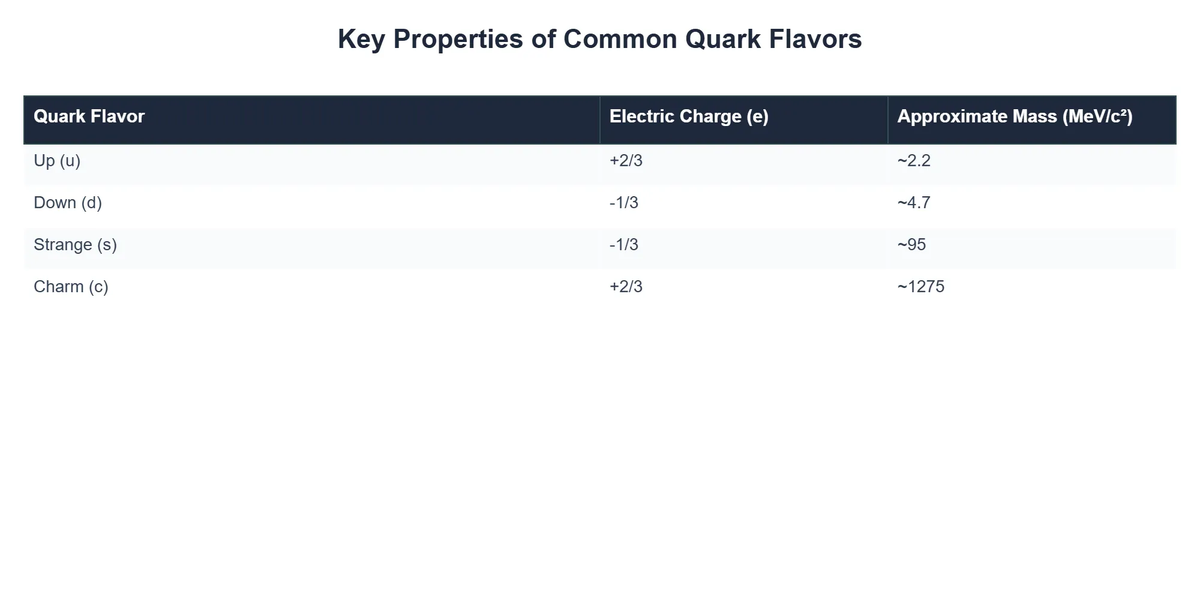
Scientists have identified six different types, or “flavors,” of quarks. These flavors are grouped into three generations, each with a pair of quarks:
- ✅ First Generation:
- Up (u) Quark: Carries a charge of +2/3e (where ‘e’ is the elementary charge).
- Down (d) Quark: Carries a charge of -1/3e.
These are the lightest and most common quarks, forming the protons and neutrons that make up ordinary matter.
Key Properties of Common Quark Flavors - ✅ Second Generation:
- Charm (c) Quark: Heavier than up and down, with a charge of +2/3e.
- Strange (s) Quark: Heavier than down, with a charge of -1/3e.
These quarks are typically found in exotic particles created in high-energy collisions, such as those at particle accelerators. NOVA Quantum Physics: Exploring the Universe’s Mysteries often delves into the experimental aspects of these discoveries.
- ✅ Third Generation:
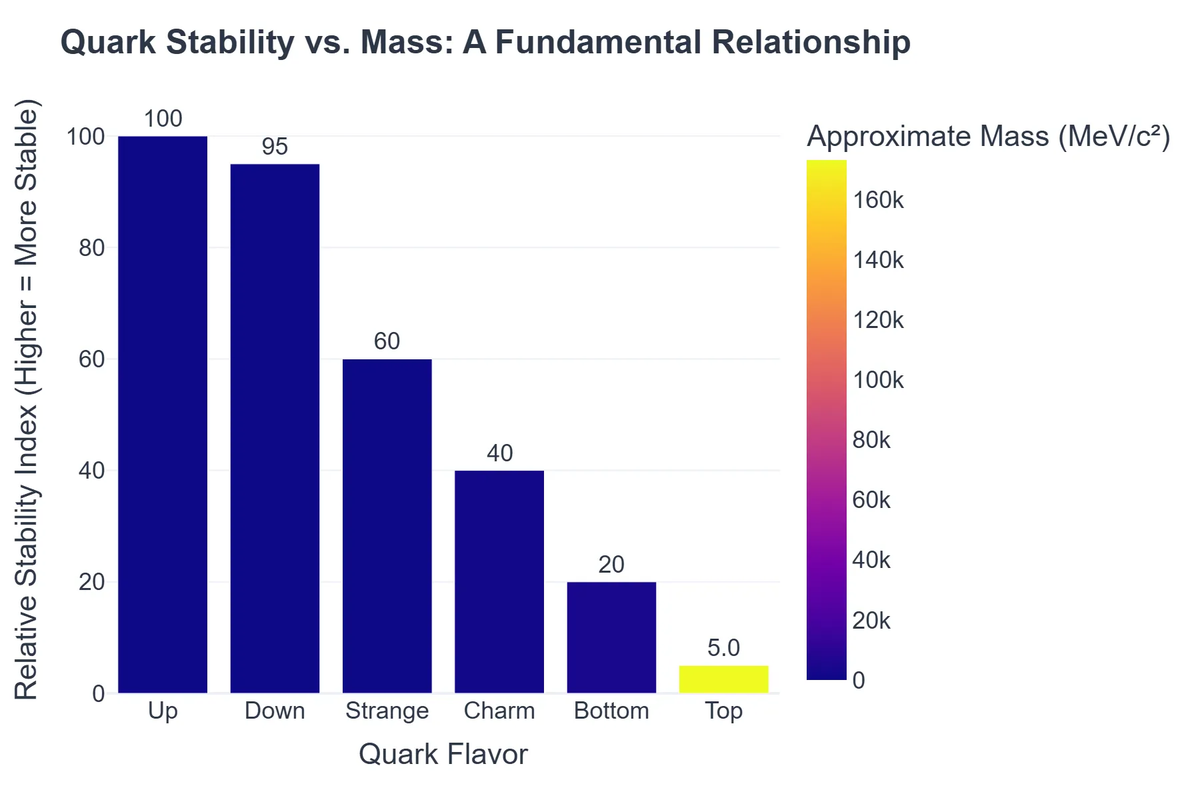
- Top (t) Quark: The most massive of all elementary particles, with a charge of +2/3e.
- Bottom (b) Quark: Also very massive, with a charge of -1/3e.
The top quark is exceptionally heavy – roughly as massive as a gold atom – and has an incredibly short lifespan, decaying almost instantaneously. Research into these heavy quarks, especially the top quark, continues to yield fascinating insights into the fundamental nature of matter. Scientists are even looking for clues to the early universe by spotting top quarks at mega-detectors. Learn more about top quark research in this Nature article.
Antiquarks: The Mirror Images
Just as every particle has an antiparticle, each quark flavor has a corresponding antiquark. Antiquarks have the same mass as their quark counterparts but possess opposite electric charges and other quantum numbers. For example, an anti-up quark ($\overline{u}$) has a charge of -2/3e, and an anti-down quark ($\overline{d}$) has a charge of +1/3e.
⚛️ How Do Quarks Interact? The Strong Force and Color Charge
Quarks are unique not only in their fractional charge but also in how they interact via the strong nuclear force. This force, mediated by particles called gluons, is incredibly powerful and governs the binding of quarks within composite particles. Unlike the electromagnetic force, which weakens with distance, the strong force actually gets stronger as quarks are pulled apart.
Understanding Color Charge
To explain how quarks bind together, physicists introduced a property called “color charge” (not related to visual color). Each quark can have one of three color charges: “red,” “green,” or “blue.” Antiquarks carry corresponding “anti-red,” “anti-green,” or “anti-blue” charges. The fundamental rule of the strong force is that all observable particles must be “color-neutral” or “white.” This means:
- ➡️ A particle composed of three quarks (like a proton) must contain one red, one green, and one blue quark, combining to form white.
- ➡️ A particle composed of a quark and an antiquark (like a pion) must contain a color and its anti-color (e.g., red and anti-red), which also combine to form white.
This concept of color charge is fundamental to Yang-Mills Theory: Unraveling Fundamental Forces of the Universe, which describes the strong force and other gauge theories.
Quark Confinement and Asymptotic Freedom
The strong force exhibits two remarkable properties:
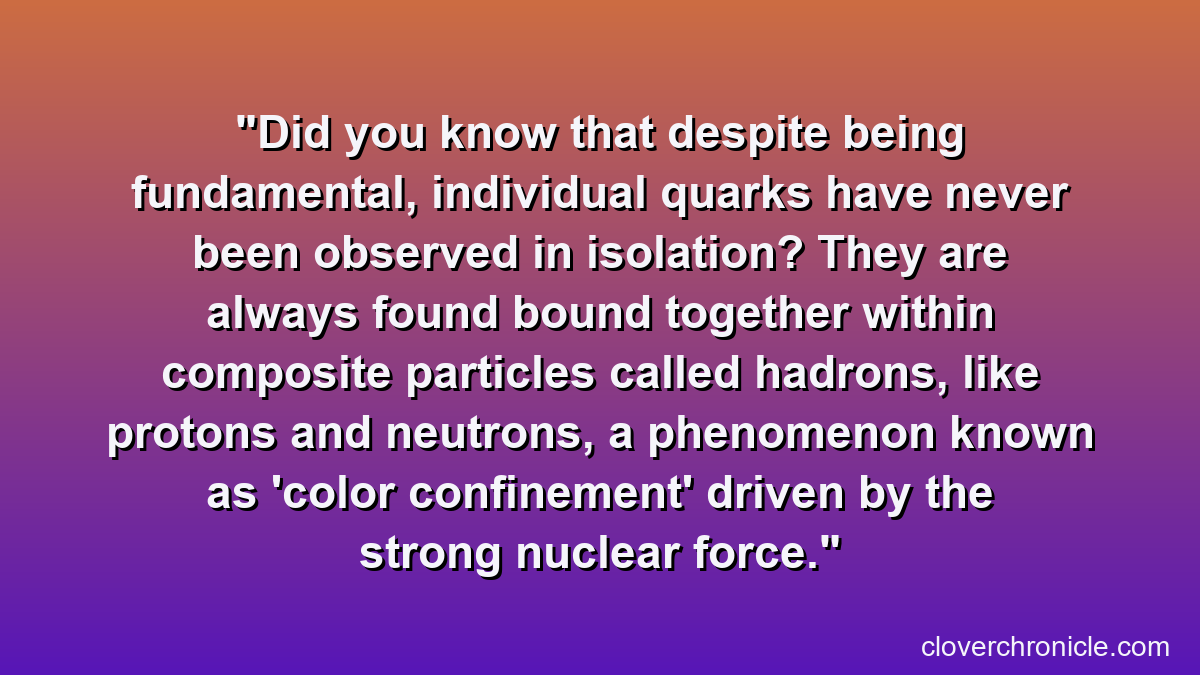
- 💡 Quark Confinement: Quarks are never found in isolation. The strong force binding them together grows so intense with distance that it becomes energetically impossible to pull them apart. Any attempt to separate quarks creates new quark-antiquark pairs from the vacuum, which then combine to form new hadrons. This is why we can only observe quarks within composite particles like protons and neutrons.
- 💡 Asymptotic Freedom: Paradoxically, when quarks are extremely close to each other (at very short distances, or high energies), the strong force between them becomes very weak, almost negligible. This allows quarks to move almost freely within a hadron. This concept was a groundbreaking discovery that earned a Nobel Prize in Physics.
⚛️ Quarks in Action: Forming Hadrons
Composite particles made of quarks are called hadrons. There are two main types of hadrons:
- ✅ Baryons: Composed of three quarks. Protons and neutrons are the most famous examples.
- ✅ Mesons: Composed of a quark and an antiquark. Pions and kaons are common examples.
Protons and Neutrons: The Nucleon Family
These are the building blocks of atomic nuclei, and thus, all ordinary matter:
- ➡️ A Proton consists of two up quarks and one down quark (uud). Its total charge is (+2/3e) + (+2/3e) + (-1/3e) = +1e.
- ➡️ A Neutron consists of one up quark and two down quarks (udd). Its total charge is (+2/3e) + (-1/3e) + (-1/3e) = 0e.
The interactions between these quarks, mediated by gluons, are what give protons and neutrons their mass and stability. Understanding these subatomic interactions is a key focus of Quantum Mechanics Explained: Unraveling the Mysteries of the Subatomic World.
Exotic Hadrons: Beyond the Trios and Pairs
While most hadrons are baryons or mesons, modern particle physics experiments have confirmed the existence of more complex quark configurations:
- ✅ Tetraquarks: Particles made of four quarks (two quarks and two antiquarks).
- ✅ Pentaquarks: Particles made of five quarks (four quarks and one antiquark).
The discovery of these exotic hadrons, often at facilities like the Large Hadron Collider (LHC), continues to refine our understanding of the strong force and the intricate ways quarks can combine. For instance, the discovery of a charm new particle at the LHC highlighted ongoing advances. Read more in Scientific American.
✨ The Discovery and Ongoing Research into Quarks
The concept of quarks was independently proposed in 1964 by American physicist Murray Gell-Mann and, less formally, by George Zweig. Initially, they were mathematical constructs to explain the observed patterns in the properties of hundreds of known hadrons. Experimental evidence for their existence began to emerge in the late 1960s with “deep inelastic scattering” experiments at the Stanford Linear Accelerator Center (SLAC), which showed that protons and neutrons had internal, point-like constituents. This revolutionized particle physics, solidifying the idea of fundamental particles within previously thought-to-be-elementary ones.
Today, research into quarks continues to be at the forefront of fundamental physics. Experiments at powerful particle accelerators like the LHC at CERN constantly probe the properties of quarks, searching for new phenomena that might hint at physics beyond the Standard Model. This relentless pursuit of knowledge is at the heart of Cosmic Queries: Probing the Mysteries of the Universe. Current research includes:
- ➡️ Precision measurements of quark masses and decay properties.
- ➡️ Searching for new exotic hadrons or particles that interact with quarks in unexpected ways.
- ➡️ Investigating the behavior of quarks under extreme conditions, such as in the early universe or inside neutron stars, where they might form a “quark-gluon plasma.”
Recommended Video
What exactly are quarks?
Quarks are fundamental particles, meaning they are not made up of smaller components. They combine to form composite particles called hadrons, such as protons and neutrons, which constitute the nuclei of atoms.
How many types of quarks exist?
There are six ‘flavors’ of quarks: up (u), down (d), charm (c), strange (s), top (t), and bottom (b). Each also has a corresponding antiparticle.
What force holds quarks together?
Quarks are bound together by the strong nuclear force, the strongest of the four fundamental forces. This force is mediated by particles called gluons, which act as the ‘glue’ between quarks.
Can quarks be found in isolation?
No, individual quarks cannot be observed in isolation due to a phenomenon called ‘color confinement.’ They are always found bound together within hadrons, like a proton which contains two up quarks and one down quark.