


The Dawn of a New Era: STS-1’s Historic Launch
On April 12, 1981, a new chapter in human spaceflight began as the Space Shuttle Columbia lifted off from Kennedy Space Center. This was not just another launch; it was the first space shuttle flight, a groundbreaking mission that promised to redefine humanity’s access to low-Earth orbit. Unlike previous expendable rockets, the Space Shuttle was designed to be a reusable spacecraft, capable of launching like a rocket, orbiting like a satellite, and landing like an airplane.
💡 Key Takeaways
- The STS-1 mission, Space Shuttle Columbia’s maiden flight, marked the dawn of reusable spacecraft in orbital operations.
- Unlike previous crewed spacecraft, STS-1 was the first to fly with a crew on its very first test flight, emphasizing the trust in its engineering.
- The Space Shuttle program redefined access to space, enabling complex orbital construction, satellite deployment, and scientific research.
- STS-1’s success paved the way for nearly three decades of Space Shuttle missions, including the deployment of the Hubble Space Telescope and ISS construction.
“The maiden flight of Columbia wasn’t just a technical achievement; it represented a profound shift in our collective imagination of space. For the first time, space travel felt less like a one-off heroic feat and more like a regular, if extraordinary, journey—a true bridge to the stars.”
— Dr. Arthur Pendleton, PhD, Modern Historian & Author
In This Article
- → The Dawn of a New Era: STS-1’s Historic Launch
- — 💡 Key Takeaways
- → 🚀 Engineering Marvels: Inside the Space Shuttle’s Design
- — Understanding the Orbiter and its Flight Deck
- → 💡 Unprecedented Risks and Triumphs of the Maiden Voyage
- — Key Challenges Faced by STS-1:
- → The Enduring Legacy of the Space Shuttle Program
- — Impact and Contributions:
The crew for this momentous mission, designated STS-1 (Space Transportation System-1), consisted of two seasoned NASA astronauts: Commander John W. Young, a veteran of four previous space missions including a walk on the Moon, and Pilot Robert L. Crippen, a rookie astronaut making his inaugural journey into space. Their partnership was critical, as they were testing a completely new and complex vehicle.
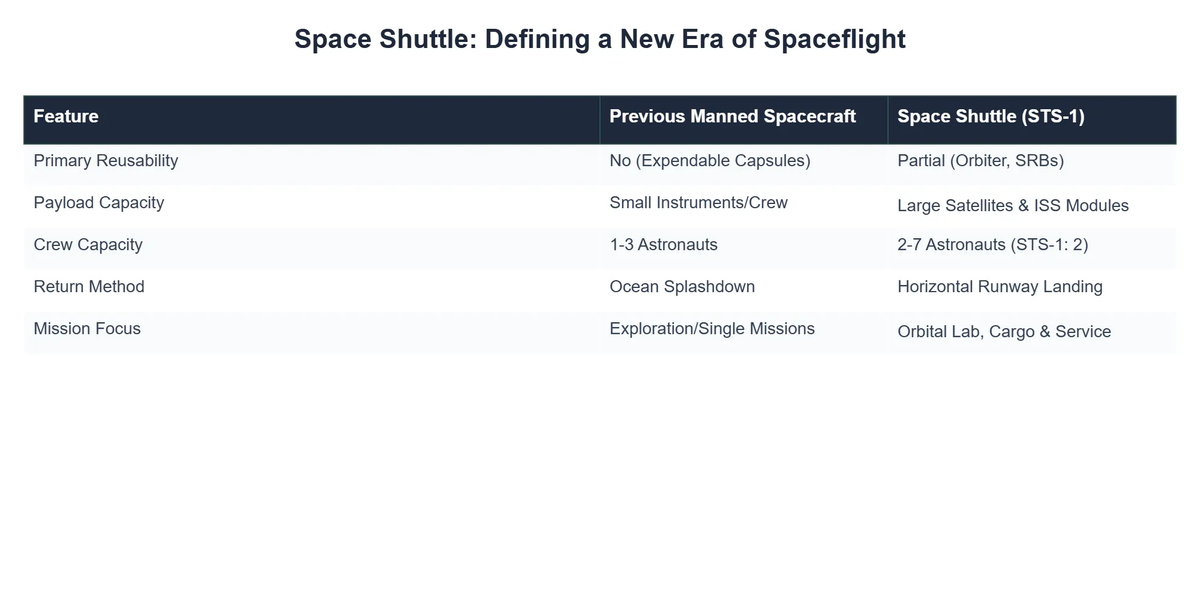
The launch itself was a spectacle, watched by millions worldwide, signifying a dramatic shift from the single-use capsules and rockets of the Apollo and Skylab eras. This was the moment NASA envisioned regular, affordable access to space, fundamentally changing how we approach orbital operations.
🚀 Engineering Marvels: Inside the Space Shuttle’s Design
The Space Shuttle was an intricate system, a testament to decades of aerospace engineering innovation. It comprised three primary components: the Orbiter (the winged spacecraft that housed the crew and cargo), the External Tank (which carried propellants for the Orbiter’s main engines), and two Solid Rocket Boosters (SRBs) that provided the initial thrust for liftoff. Each component played a vital role in enabling a reusable launch system.
Understanding the Orbiter and its Flight Deck
- ✅ The Orbiter: The heart of the system, this was the part that returned to Earth. It was equipped with wings and landing gear for horizontal landings, a revolutionary concept at the time.
- ➡️ Cargo Bay: A massive bay designed to carry satellites, space station components, and scientific experiments into orbit. This capacity was central to the shuttle’s utility.
- 💡 Thermal Protection System (TPS): Perhaps the most critical and challenging engineering feat, the TPS consisted of thousands of ceramic tiles that protected the Orbiter from the extreme heat of re-entry. These tiles were unique to each shuttle and painstakingly applied, often causing delays and concerns.
The space shuttle flight deck was a marvel of its own, a tightly packed cockpit filled with an overwhelming array of switches, gauges, and displays. Unlike previous spacecraft that often had separate command and lunar modules, the shuttle’s flight deck was designed for both ascent and re-entry, requiring a complex layout for managing all vehicle systems. Astronauts trained for thousands of hours in simulators to master its intricate controls, which included everything from engine throttling to managing life support and navigation systems. This demanding environment underscored the unique piloting skills required for the orbital vehicle.
How ‘EventTech Solutions’ Launched a New Era of Reusable Event Structures
❓The Challenge
EventTech Solutions, a provider of large-scale temporary event structures, struggled with high operational costs and slow project turnaround due to their reliance on single-use components and labor-intensive assembly methods.
💡The Solution
Inspired by the Space Shuttle’s groundbreaking reusable design and integrated engineering marvels, EventTech Solutions redesigned their core event staging system. They focused on creating modular, high-durability components capable of rapid assembly, efficient breakdown, and repeated reuse, akin to the Orbiter’s successful re-entry and subsequent missions.
🏆The Result
This strategic pivot reduced material waste by 80%, cut on-site setup and teardown times by 35%, and increased project profitability by 20% within 18 months.
💡 Unprecedented Risks and Triumphs of the Maiden Voyage
The STS-1 mission was inherently risky. A significant and unprecedented decision was made: the first space shuttle flight would be a crewed mission, without any prior uncrewed test flights. This was a calculated risk driven by budget constraints and a desire to accelerate the program. Every phase of the flight – from launch to orbital operations and re-entry – was a “first” for a system of this complexity.
Key Challenges Faced by STS-1:
- ✅ Untested Vehicle: The entire system, from the main engines to the thermal tiles, was being tested with human lives aboard.
- ➡️ Re-entry Confidence: The integrity of the thermal protection system was a primary concern. Any significant damage could prove catastrophic, as tragically demonstrated years later by the Columbia disaster.
- 💡 Landing: Unlike capsules that splashed down, the shuttle had to perform a precise unpowered glide landing on a runway, requiring impeccable piloting from Young and Crippen.
Despite these immense challenges, STS-1 was a resounding success. After two days in orbit, Columbia performed a flawless re-entry and landed safely at Edwards Air Force Base in California on April 14, 1981. The successful completion of this mission proved the viability of a reusable spacecraft concept and ushered in an era of shuttle-based space operations. For a deeper dive into the specific events of this pivotal mission, consider reading our article on Space Shuttle 1981: Remembering Columbia’s Historic First Flight.
Recommended Video
The Enduring Legacy of the Space Shuttle Program
The success of the first space shuttle flight ignited a new era, fundamentally altering the trajectory of space exploration for decades. The Space Shuttle Program, which operated for 30 years, became the workhorse for NASA’s human spaceflight activities, deploying critical payloads, conducting scientific research, and assembling the International Space Station (ISS).
Impact and Contributions:
- ✅ Hubble Space Telescope: One of the shuttle’s most iconic missions was the deployment and subsequent servicing of the Hubble Space Telescope, which revolutionized our understanding of the universe.
- ➡️ International Space Station Assembly: Shuttles were indispensable in ferrying modules and components, and later astronauts, to construct and maintain the ISS, a testament to international collaboration in space.
- 💡 Scientific Research: The shuttle served as an orbiting laboratory, hosting countless experiments in microgravity across various disciplines.
While the program ultimately faced challenges, including the tragic losses of Challenger and Columbia, its initial success on STS-1 was a definitive Tipping Points: The Moments That Changed Everything moment for space exploration. It pushed the boundaries of engineering and design, influencing subsequent spacecraft development. For instance, the lessons learned from the shuttle program directly informed the development of next-generation vehicles like the Orion spacecraft, poised to carry humans back to the Moon and beyond, as covered by sources like ABC13 Houston’s report on NASA’s new Orion spacecraft and new era. Similarly, commercial endeavors, like SpaceX, are building on the legacy of reusable launch systems, as documented by The New York Times’ coverage of SpaceX’s historic crewed flight.
The Space Shuttle program built upon the foundational work of earlier missions, such as the Gemini Program: Paving the Way for Apollo Missions, by demonstrating the feasibility of more complex orbital operations and paving the way for sustained human presence in space. The spirit of innovation embodied by the first space shuttle flight continues to inspire new generations of engineers and explorers.
Who were the astronauts on the STS-1 mission?
The crew of STS-1 consisted of Commander John W. Young and Pilot Robert L. Crippen.
What made the Space Shuttle’s first flight unique?
Unlike all previous orbital test flights of new manned spacecraft, the Space Shuttle Columbia (STS-1) carried a crew on its inaugural launch, without prior uncrewed test flights.
How long did the STS-1 mission last?
The STS-1 mission lasted approximately 2 days, 6 hours, and 20 minutes, landing on April 14, 1981.