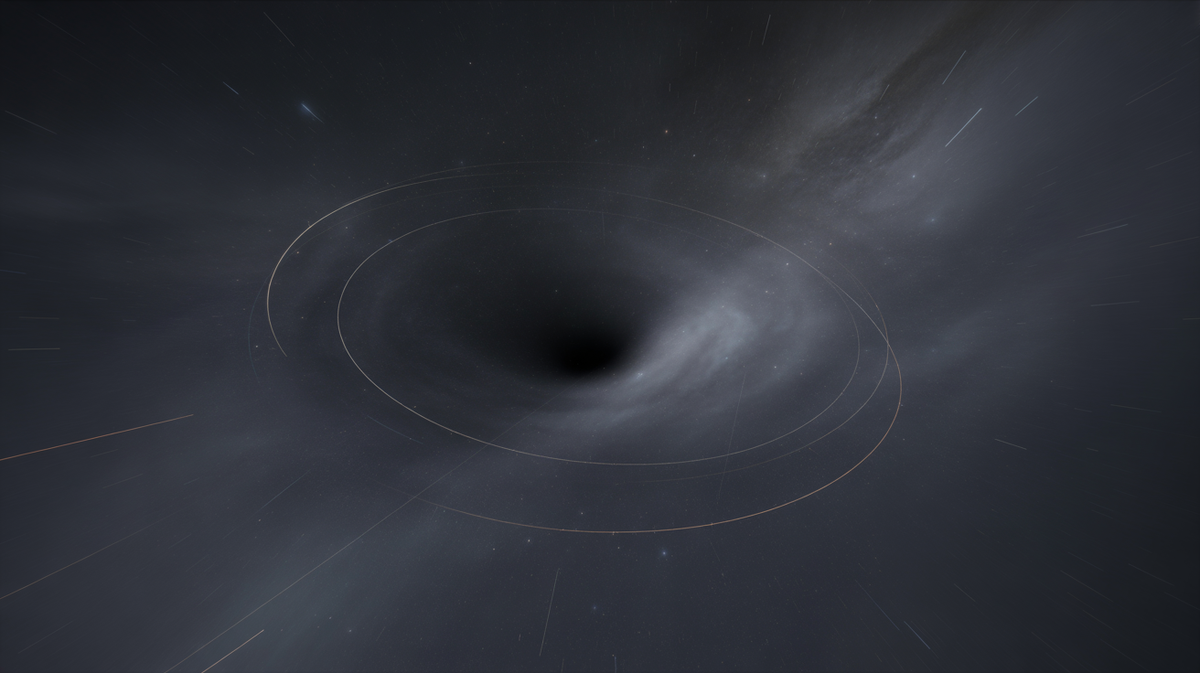
The universe is a cosmic ballet of visible and invisible forces, and among its most enigmatic players are black holes. While many conjure images of active quasars devouring matter and spewing out powerful jets, a significant portion of these gravitational behemoths operate in silence. These are the dormant black holes, celestial bodies that, despite their immense gravitational pull, offer no immediate signs of their presence.
💡 Key Takeaways
- Dormant black holes are incredibly difficult to detect due to their lack of active accretion.
- Gravitational lensing and the motion of nearby stars are key methods for identifying these elusive objects.
- Their presence can profoundly influence the structure and evolution of galaxies, even when inactive.
- Unveiling dormant black holes provides crucial insights into the life cycles of stars and the universe.
“Dormant black holes are the quiet giants of the cosmos, holding immense power while offering subtle clues to their existence. Unlocking their secrets is like finding missing pieces in the universe’s grand puzzle.”
— Astrid Bellweather, Astrophysicist & Science Communicator
Unlike their more dramatic counterparts, these quiescent giants do not actively pull in large amounts of gas and dust, meaning they don’t produce the characteristic X-rays or radio emissions that make active black holes detectable. Unveiling the secrets of these cosmic recluses is a monumental challenge for astronomers, yet understanding them is crucial for completing our census of the universe’s most extreme objects and comprehending galactic evolution. For a comprehensive overview of the field, explore Cosmic Queries: Probing the Mysteries of the Universe.
In This Article
- — 💡 Key Takeaways
- → What Exactly Are Dormant Black Holes?
- → The Elusive Nature: Why Are They So Hard to Detect?
- → Methods for Black Hole Detection
- — ⚙️ Gravitational Influence on Companion Stars
- — 🔭 Microlensing
- — 🌟 Searching for Isolated Dormant Black Holes
- → The Significance of Finding Dormant Black Holes
What Exactly Are Dormant Black Holes?
At their core, a dormant black hole is a black hole that is not currently accreting matter at a significant rate. This lack of active feeding is what renders them “quiescent” or “dormant.”
- ✅ Defining Quiescence: An active black hole, often a supermassive one at the center of a galaxy, is surrounded by an accretion disk of superheated gas and dust. This material spirals inward, emitting intense radiation across the electromagnetic spectrum, from X-rays to radio waves. A dormant black hole, conversely, lacks this vibrant accretion disk or possesses one that is extremely dim.
- ➡️ Stellar Mass vs. Supermassive: While supermassive black holes can also be dormant (like Sagittarius A* at the center of our Milky Way, which is relatively quiet), the term often refers to stellar mass black holes. These are formed from the gravitational collapse of massive stars, typically 3 to 100 times the mass of our Sun.
- 💡 The “Invisible” Nature: Without the luminous glow of an accretion disk, a dormant black hole emits no light of its own, making it inherently invisible to traditional telescopes. They are, in essence, perfect cosmic voids, detectable only by their gravitational influence on nearby objects.
The Elusive Nature: Why Are They So Hard to Detect?
The primary reason dormant black hole detection is so challenging lies in their very definition: they don’t radiate energy. Active black holes are readily observed due to the intense light and radiation emitted by the matter falling into them. Dormant ones, however, are essentially cosmic ghosts.
- ⭐ No Emitted Light: A black hole’s gravity is so immense that nothing, not even light, can escape once it crosses the event horizon. Without infalling matter to heat up and glow, there’s no direct emission to detect.
- 🔭 Lack of Accretion Signatures: Active galactic nuclei (AGN) and quasars are the cosmic lighthouses of the universe, powered by actively feeding supermassive black holes. Dormant black holes, without these feeding frenzies, lack these tell-tale energetic signatures.
- 🌌 Vastness of Space: Even if a dormant black hole is nearby, finding it amidst billions of stars and galaxies is like finding a needle in an astronomical haystack. It’s a fundamental challenge that pushes the boundaries of observational astronomy. To delve deeper into the nature of these hidden objects, read our guide on Mysterious Black Holes: Decoding the Universe’s Enigmas.
Methods for Black Hole Detection
Despite their invisible nature, scientists have devised ingenious ways to infer the presence of quiescent black holes by observing their profound gravitational effects on their surroundings. These methods rely on indirect evidence and meticulous observation.
⚙️ Gravitational Influence on Companion Stars
The most common method for detecting stellar mass black holes involves observing a binary star system. If a star is orbiting an invisible companion, and that companion is too massive to be a neutron star (the next densest stellar remnant), it is highly likely to be a black hole.
- ➡️ Wobbling Stars: Astronomers look for stars that “wobble” or exhibit unusual orbital patterns, indicating they are gravitationally bound to an unseen, massive object. By measuring the star’s orbital speed and period, they can estimate the mass of the invisible companion.
- ✅ X-ray Binaries: Sometimes, even in a “dormant” system, if the black hole is close enough to its companion star, it can strip away some of the star’s outer layers. This material, as it falls towards the black hole, heats up to extreme temperatures and emits bursts of X-rays, providing a crucial, albeit transient, detection signature. This is how many of the first black hole candidates were discovered, though these are technically not completely dormant during such episodes. Insights into such discoveries are often published by institutions like NuSTAR.
🔭 Microlensing
Gravitational microlensing is a powerful technique that capitalizes on Einstein’s theory of general relativity. When a massive object, like a dormant black hole, passes directly in front of a more distant star from our vantage point, its immense gravity acts like a lens.
- 📈 Brightness Magnification: The black hole bends the light from the background star, temporarily magnifying its brightness. This unique brightening pattern, and how it changes over time, can reveal the mass of the lensing object, even if it’s completely dark.
- 💡 Rare Alignment: Microlensing events are rare and require precise alignment, but they offer a unique way to detect free-floating, isolated black holes that are not part of binary systems. This method has even been used to search for dark companions of sun-like stars, as detailed by Earth.com.
🌟 Searching for Isolated Dormant Black Holes
Detecting isolated dormant black holes, which are not in binary systems, is significantly harder but not impossible. Researchers use data from vast sky surveys, looking for minute gravitational distortions or subtle effects. Understanding both the smallest and largest black holes helps refine these searches; for more, see Small Black Holes: Exploring Primordial to Miniature Cosmic Giants or Biggest Black Holes in the Universe: Unveiling the Giants.
Recommended Video
The Significance of Finding Dormant Black Holes
The effort to detect and study quiescent black holes is not just an academic exercise; it has profound implications for our understanding of the universe.
- 📊 Completing the Black Hole Census: It’s estimated that there could be millions, or even billions, of stellar-mass black holes in the Milky Way galaxy alone. The vast majority of these are expected to be dormant. Finding them allows astronomers to get a more accurate count of these cosmic objects, refining our models of stellar evolution and the final fates of massive stars.
- 💫 Understanding Galactic Evolution: While supermassive black holes (which can also be dormant) play a key role in galaxy formation and evolution, the population of stellar-mass black holes also contributes to the overall gravitational dynamics of galaxies. Discovering dormant ones helps us understand how they are distributed and how they might influence star formation and galactic structure over cosmic timescales.
- 🌌 Dark Matter Contribution: While not the primary form of dark matter, large populations of isolated dormant black holes could potentially contribute to the universe’s overall dark matter budget. Their detection, or lack thereof, helps constrain models of what dark matter is composed of.
- 🔍 Probing Extreme Physics: Every black hole discovery, whether active or dormant, provides a laboratory for testing Einstein’s theory of general relativity in the most extreme gravitational environments imaginable.
What defines a dormant black hole?
A dormant black hole is one that is not actively accreting matter from its surroundings, making it invisible to most conventional detection methods like X-ray emission.
How are dormant black holes detected?
Scientists primarily detect dormant black holes through their gravitational influence on nearby stars or gas, looking for gravitational lensing effects or unusual stellar orbits.
Are dormant black holes dangerous to Earth?
No, dormant black holes, particularly those in distant galaxies or even stellar-mass ones within the Milky Way, pose no direct threat to Earth. Their gravitational effects are localized.
Can a dormant black hole become active again?
Yes, if a dormant black hole encounters a sufficient supply of gas, dust, or even a star, it can ‘switch on’ and begin actively accreting, becoming an active galactic nucleus or a microquasar.