Prepare to be mesmerized. Few natural phenomena rival the sheer beauty and mystique of the aurora. Swirling curtains of green, red, and purple light dance across the polar skies, transforming the night into an otherworldly spectacle. But what exactly powers this celestial ballet? In this comprehensive guide, we’ll delve into the fascinating science behind these dazzling light shows, providing a clear and accessible explanation of how the world truly works at its most spectacular.
💡 Key Takeaways
- Auroras are caused by charged solar particles interacting with Earth’s magnetic field and atmosphere.
- The distinctive colors of the aurora depend on the type of gas atoms excited (e.g., oxygen for green/red, nitrogen for blue/purple) and the altitude of the collisions.
- Intense auroral displays are often linked to powerful solar events like coronal mass ejections (CMEs) or solar flares.
- The phenomenon occurs at both the North Pole (Aurora Borealis) and the South Pole (Aurora Australis).
“The aurora is more than just a beautiful light show; it’s a direct, visible manifestation of the sun’s energy interacting with our planet, a grand cosmic dance of physics playing out right before our eyes. Understanding it deepens our appreciation for Earth’s protective magnetic shield.”
— Leo Garrison, Applied Physicist & Science Communicator
From solar flares to Earth’s magnetic field, understanding the aurora is a journey into the heart of space weather and atmospheric physics. Let’s pull back the curtain on why this phenomenon occurs, what makes it glow, and how you can witness it firsthand. Our aim is to make this the most useful resource on the internet for anyone seeking to understand the science of aurora explained.
In This Article
- — 💡 Key Takeaways
- → What Exactly Are Auroras? Defining the Celestial Spectacle
- — Aurora Borealis vs. Aurora Australis
- — The “Why” Behind the Name
- → The Sun’s Role: Fueling the Light Show
- — ☀️ Solar Wind and Coronal Mass Ejections (CMEs)
- — Solar Flares: Accelerating the Particles
- → Earth’s Protective Shield: The Magnetosphere
- — ⚡️ Capturing Charged Particles
- — Guiding Particles to the Poles
- → The Dance of Light: How Colors Emerge
- — ✨ Ionization and Excitation: The Atomic Process
- — 🌈 The Spectrum of Auroral Colors
- → Where and When to See the Aurora
- — The Auroral Oval: Prime Viewing Zones
- — Best Conditions for Aurora Hunting
- → Beyond the Visuals: Impact and Significance
- — Geomagnetic Storms and Their Effects
- — Cultural Significance and Mythology
- → Conclusion
What Exactly Are Auroras? Defining the Celestial Spectacle
At its core, an aurora is a natural light display in the Earth’s sky, predominantly seen in high-latitude regions. It’s the visible manifestation of a complex interaction between charged particles from the Sun and gases in Earth’s upper atmosphere.
Imagine the Earth as a giant magnet, constantly bombarded by a stream of energetic particles from our Sun. When these particles encounter our planet’s protective magnetic field, they are guided towards the magnetic poles, where they collide with atoms and molecules in the atmosphere, exciting them and causing them to emit light.

Aurora Borealis vs. Aurora Australis
- 🌌 Aurora Borealis: This is the scientific name for the Northern Lights, visible in the Northern Hemisphere. Countries like Canada, Alaska, Iceland, Norway, Sweden, Finland, and Russia are prime viewing locations.
- 🌌 Aurora Australis: Known as the Southern Lights, this phenomenon occurs in the Southern Hemisphere. It can be seen in places like Antarctica, New Zealand, Australia (Tasmania), and parts of South America.
While geographically distinct, the underlying physical processes for both are identical.
The “Why” Behind the Name
The term “aurora” comes from the Roman goddess of dawn, Aurora. The addition of “borealis” (meaning “northern” in Latin) and “australis” (meaning “southern” in Latin) specifies their polar locations. It’s a fitting name for a phenomenon that often heralds a glowing, colorful “dawn” in the night sky.
The Sun’s Role: Fueling the Light Show
The ultimate source of the aurora is our very own star, the Sun. It constantly emits a flow of charged particles and energy that travels across the solar system.
☀️ Solar Wind and Coronal Mass Ejections (CMEs)
The Sun is a dynamic star, continuously expelling plasma and energetic particles. Two primary solar phenomena are responsible for delivering these particles to Earth:
- 💨 Solar Wind: This is a continuous stream of charged particles (mostly electrons and protons) flowing outwards from the Sun’s corona (outermost atmosphere). It travels at speeds of several hundred kilometers per second and constantly bathes Earth in its flow.
- 💥 Coronal Mass Ejections (CMEs): These are much larger, more powerful bursts of solar wind, magnetic fields, and plasma hurled into space during solar flares or other solar activity. CMEs can contain billions of tons of material and travel at immense speeds, reaching Earth in one to three days.
It’s these energetic particles from the solar wind and especially CMEs that are the direct fuel for the aurora.
Solar Flares: Accelerating the Particles
Often accompanying CMEs, solar flares are intense bursts of radiation originating from the Sun’s surface. While flares themselves emit X-rays and UV radiation that don’t directly cause auroras, they can accelerate the charged particles that make up the solar wind and drive CMEs, making the subsequent aurora more intense and widespread. Understanding the forces at play on such a grand scale helps us grasp concepts like Newton’s Law of Universal Gravitation: How Gravity Works, which governs the interactions of celestial bodies.
Earth’s Protective Shield: The Magnetosphere
While the Sun provides the energetic particles, Earth provides the stage. Our planet is surrounded by a powerful magnetic field, generated by the convection of molten iron in its core. This field forms a protective bubble called the magnetosphere, which deflects most of the solar wind, preventing it from stripping away our atmosphere.
⚡️ Capturing Charged Particles
When the solar wind encounters the magnetosphere, most of the charged particles are deflected. However, some manage to penetrate the field, especially on the side away from the Sun (the magnetotail). Here, the magnetic field lines are stretched and reconnected, accelerating the particles towards the Earth.
The Aurora Explained: Insights and Limitations
Pros
- ✔Offers a profound understanding of a natural spectacle.
- ✔Reveals complex interactions between the Sun and Earth’s magnetosphere.
- ✔Aids in predicting the likelihood and intensity of auroral displays.
- ✔Can inspire further interest in space science and atmospheric physics.
Cons
- ✖The scientific details can be abstract and challenging for non-experts.
- ✖Understanding doesn’t mitigate the need for specific environmental conditions for viewing.
- ✖Actual observation is limited to high latitudes and clear, dark skies.
- ✖Unpredictability of solar activity remains a significant factor for viewing success.
Guiding Particles to the Poles
Crucially, the magnetic field lines converge at the Earth’s magnetic poles. Think of it like a funnel. The charged particles, once trapped or redirected by the magnetosphere, are guided down these converging field lines towards the polar regions. This explains why auroras are predominantly seen at high latitudes – the “auroral oval” – rather than at the equator.
The Dance of Light: How Colors Emerge
Once the energetic particles from the Sun reach the Earth’s upper atmosphere, the magic truly begins. They collide with the atoms and molecules of atmospheric gases, primarily oxygen and nitrogen, leading to the emission of light.
✨ Ionization and Excitation: The Atomic Process
When a fast-moving electron or proton from the solar wind collides with an atmospheric atom or molecule (like oxygen or nitrogen), two main processes occur:
- 🔋 Excitation: The collision “excites” the atom or molecule, temporarily boosting its electrons to a higher energy level. When these electrons drop back to their original, lower energy levels, they release the excess energy as light (photons).
- ⚛️ Ionization: If the collision is energetic enough, it can knock an electron completely off the atom or molecule, creating an “ion.” When a free electron later recombines with such an ion, it also releases energy as light.
These processes are fundamental to how light is produced in many contexts, even extending to the principles discussed in Quantum Physics in Your Daily Life: Unveiling the Hidden Science.
How Northern Lights Navigators Shone Brighter with Scientific Content
❓The Challenge
Northern Lights Navigators, a specialized tour operator, struggled to differentiate their aurora tours in a crowded market, finding potential clients had many unanswered scientific questions about the phenomenon, leading to hesitation in booking.
💡The Solution
Leveraging in-depth scientific explanations like those found in the ‘Aurora Explained’ article, they integrated accessible content on solar flares, Earth’s magnetic field, and atmospheric interactions directly onto their tour pages, transforming their website into an authoritative educational resource.
🏆The Result
This strategic pivot to science-backed content led to a 35% increase in direct bookings for their aurora expeditions and a 50% improvement in website engagement metrics within six months.
🌈 The Spectrum of Auroral Colors
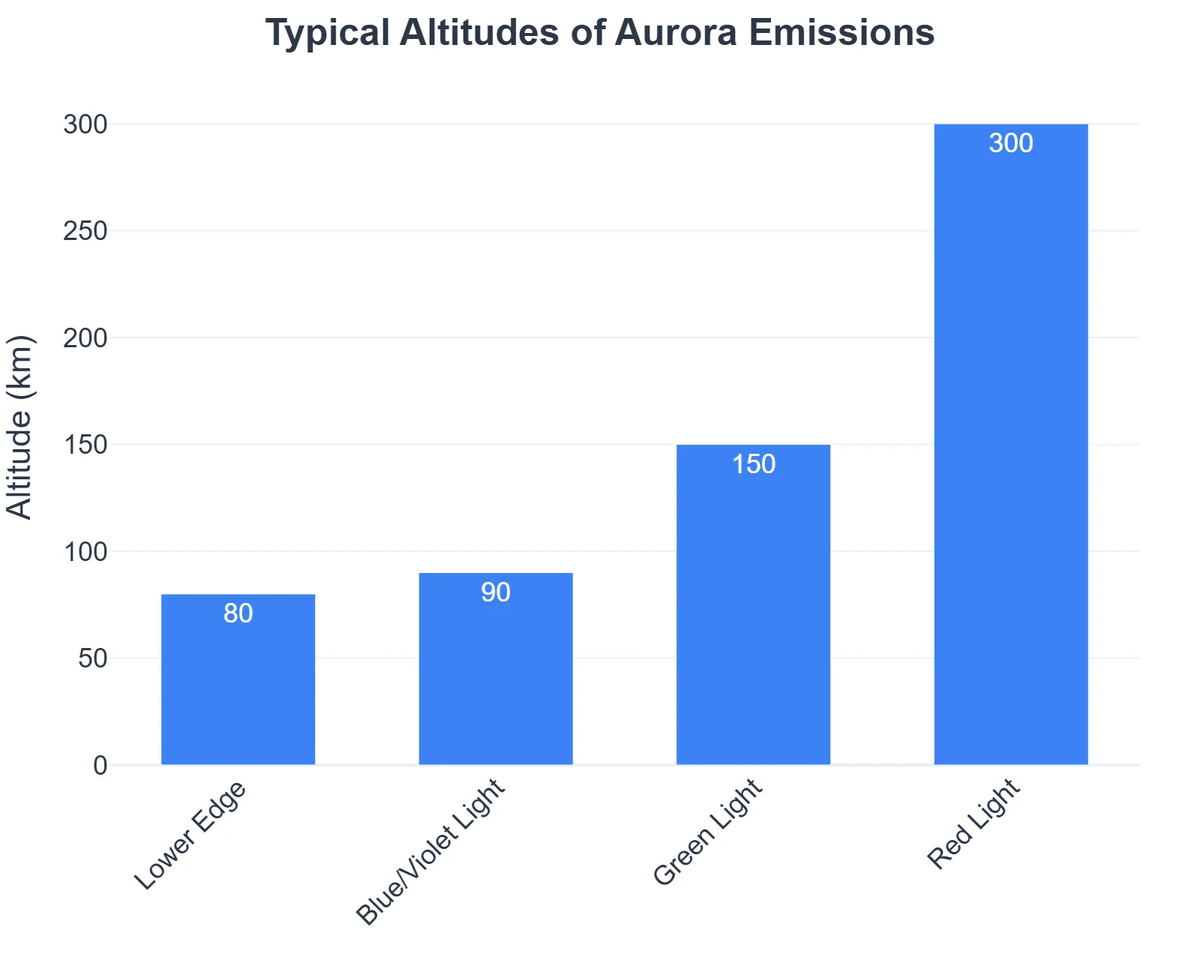
The specific color of the aurora depends on two main factors: the type of gas being hit and the altitude at which the collision occurs. Different gases emit light at different wavelengths when excited:
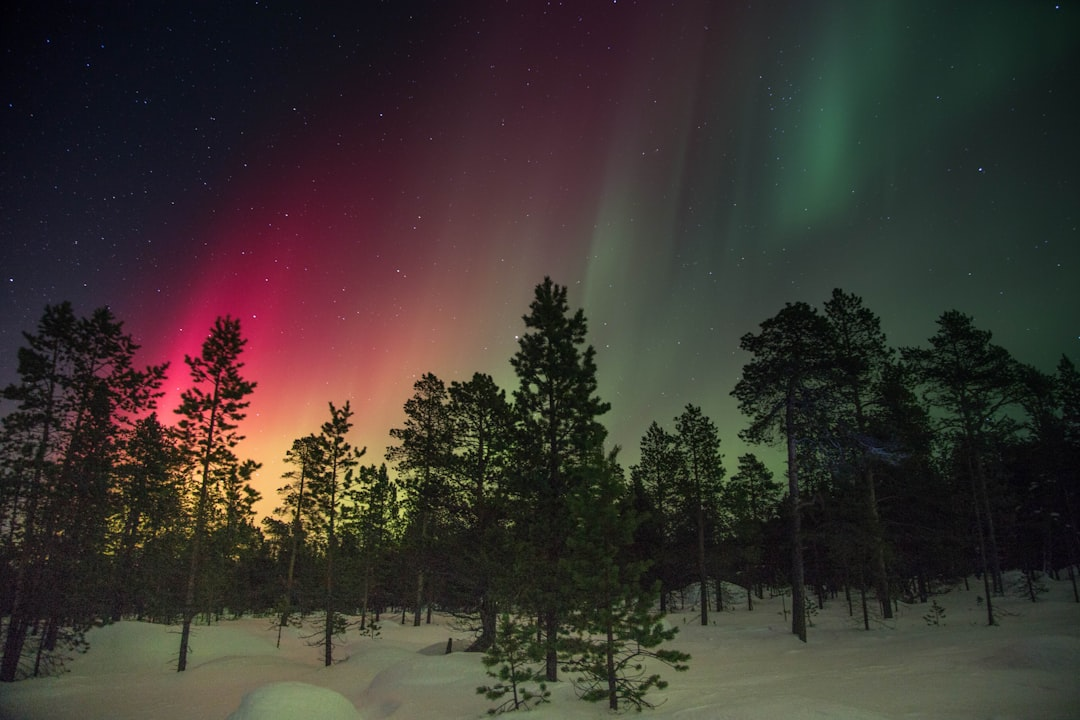
- 💚 Green: The most common auroral color, produced by excited oxygen atoms at altitudes of about 100 to 250 km. Our eyes are most sensitive to green light, making it the dominant color seen.
- ❤️ Red: Rarer and often seen at higher altitudes (above 250 km), red light is also emitted by oxygen atoms. This occurs when oxygen atoms transition from a higher energy state than for green light, or at lower energy levels when excited by less energetic particles.
- 💙 Purple/Blue: Produced by nitrogen molecules and ions. Blue light is typically from ionized nitrogen, while purple/pink hues are a mix of red from oxygen and blue from nitrogen. These tend to occur at lower altitudes (below 100 km).
The combination of these colors creates the stunning, dynamic displays we see. For more details on this, you can read about the science behind the dazzling colours of Aurora Borealis.
Where and When to See the Aurora
Witnessing the aurora is a bucket-list item for many, but it requires being in the right place at the right time. Understanding the science helps you optimize your chances.
The Auroral Oval: Prime Viewing Zones
As discussed, the Earth’s magnetic field funnels charged particles towards the magnetic poles. This creates an “auroral oval” – a band of increased auroral activity centered around the magnetic poles, not the geographic poles. Key regions within this oval include:

- 🌎 Northern Hemisphere: Alaska, Northern Canada (Yukon, Northwest Territories), Iceland, Greenland, Norway, Sweden, Finland, and parts of Northern Russia.
- 🌍 Southern Hemisphere: Antarctica, southern New Zealand, Tasmania (Australia), and southernmost parts of Chile and Argentina.
Best Conditions for Aurora Hunting
To maximize your chances of seeing the aurora:
- ➡️ Clear, Dark Skies: Light pollution is the enemy. Get away from city lights.
- ➡️ Winter Months: Longer nights offer more viewing time. In the Northern Hemisphere, September to March is generally best.
- ➡️ Solar Activity: Monitor space weather forecasts. High Kp-index (a measure of geomagnetic activity) indicates a better chance. Strong solar winds and CMEs increase the probability.
- ➡️ Local Time: The hours around midnight (10 PM to 2 AM local time) are often peak viewing times.
Recommended Video
Beyond the Visuals: Impact and Significance
The aurora is more than just a beautiful light show; it’s a visible indicator of space weather that can have tangible impacts on our technology and daily lives. It also holds deep cultural significance for many indigenous communities.
Geomagnetic Storms and Their Effects
While a mild aurora is harmless, very strong solar events (like powerful CMEs) can trigger significant geomagnetic storms. These can:
- 🔌 Disrupt Power Grids: Induce currents in long power lines, potentially leading to blackouts.
- 🛰️ Affect Satellites: Damage electronics, disrupt communication, and cause GPS errors.
- ✈️ Impact Aviation: Force re-routing of flights over polar regions due to communication interference.
- 📱 Interfere with Radio Communications: Disrupt shortwave radio signals.
Understanding these space weather phenomena is crucial for protecting our increasingly technology-dependent infrastructure.
Cultural Significance and Mythology
For millennia, before the science of aurora explained was understood, various cultures developed rich mythologies and beliefs about the Northern and Southern Lights. From spirits dancing in the sky to omens of war or peace, these stories reflect humanity’s awe and wonder at this celestial phenomenon. Indigenous communities, particularly in the Arctic, often have deep spiritual connections to the aurora, viewing it as a powerful and sacred entity.
Conclusion
The aurora, whether Borealis or Australis, is a stunning reminder of the dynamic interplay between our Sun and our planet. It’s a complex, yet elegant, demonstration of physics in action – from the nuclear fusion powering the Sun to the quantum leaps of electrons in Earth’s atmosphere. Every shimmering curtain of light is a testament to the colossal forces at play in our solar system.
Far from being just a pretty display, the aurora offers a window into the broader field of space weather, highlighting the invisible forces that shape our world and beyond. For more insights into the hidden science that governs our surroundings, explore The Science of Everyday: How the World Really Works.
Frequently Asked Questions
What causes the different colors in the aurora?
The varying colors are caused by different types of gas atoms (primarily oxygen and nitrogen) in Earth’s atmosphere being excited by solar particles. Oxygen typically produces green and red light, while nitrogen can result in blue or purple hues.
Where are the best places to see the aurora?
Auroras are most visible in high-latitude regions near the Earth’s magnetic poles. For the Aurora Borealis, popular locations include Norway, Iceland, Canada, Alaska, and Finland. For the Aurora Australis, southern parts of New Zealand, Australia, and Chile are ideal, along with Antarctica.
Is the aurora dangerous to observe?
No, observing the aurora itself is not dangerous. The particles causing the lights are interacting with the atmosphere at very high altitudes, and Earth’s magnetic field protects us from any harmful radiation. However, very strong solar storms that cause intense auroras can sometimes affect power grids or satellite communications.