

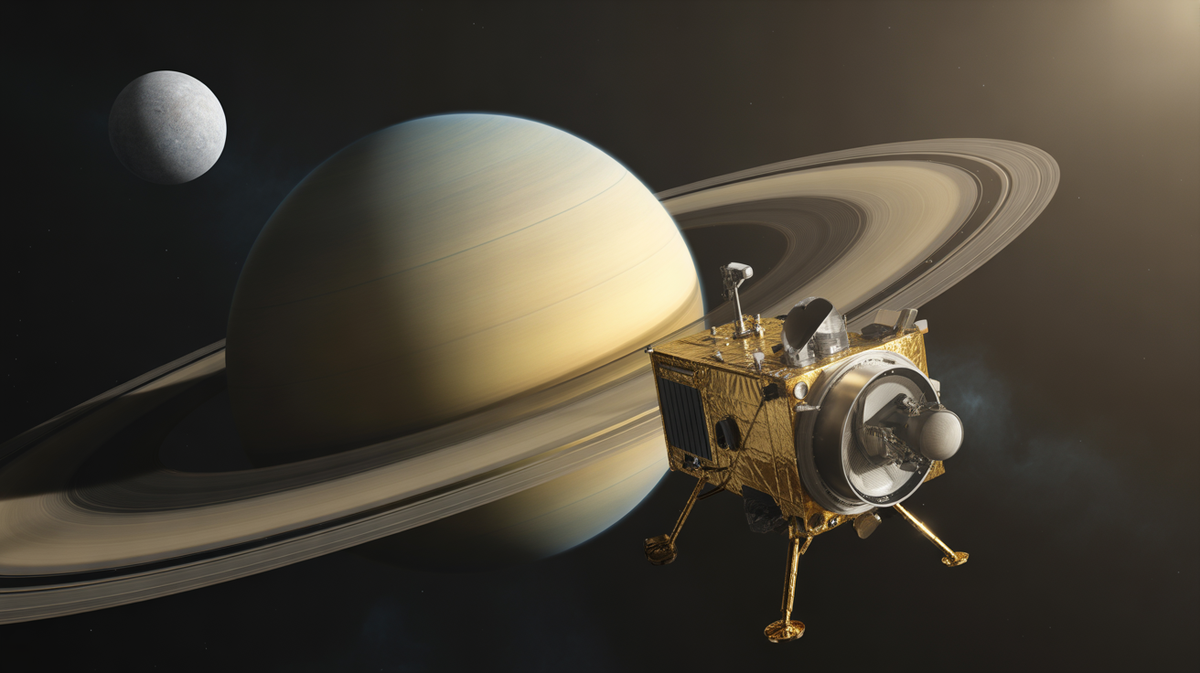
The Cassini NASA mission stands as one of humanity’s most ambitious and successful endeavors in space exploration. For over 13 years, the Cassini-Huygens spacecraft meticulously studied Saturn and its intricate system of rings and moons, fundamentally reshaping our understanding of the gas giant and the potential for life beyond Earth. Launched in 1997 and arriving at Saturn in 2004, Cassini provided an unprecedented close-up view, revealing secrets of alien worlds and inspiring a generation of planetary scientists.
💡 Key Takeaways
- The Cassini-Huygens mission was a cooperative venture between NASA, ESA, and ASI, providing unprecedented insights into Saturn and its complex system.
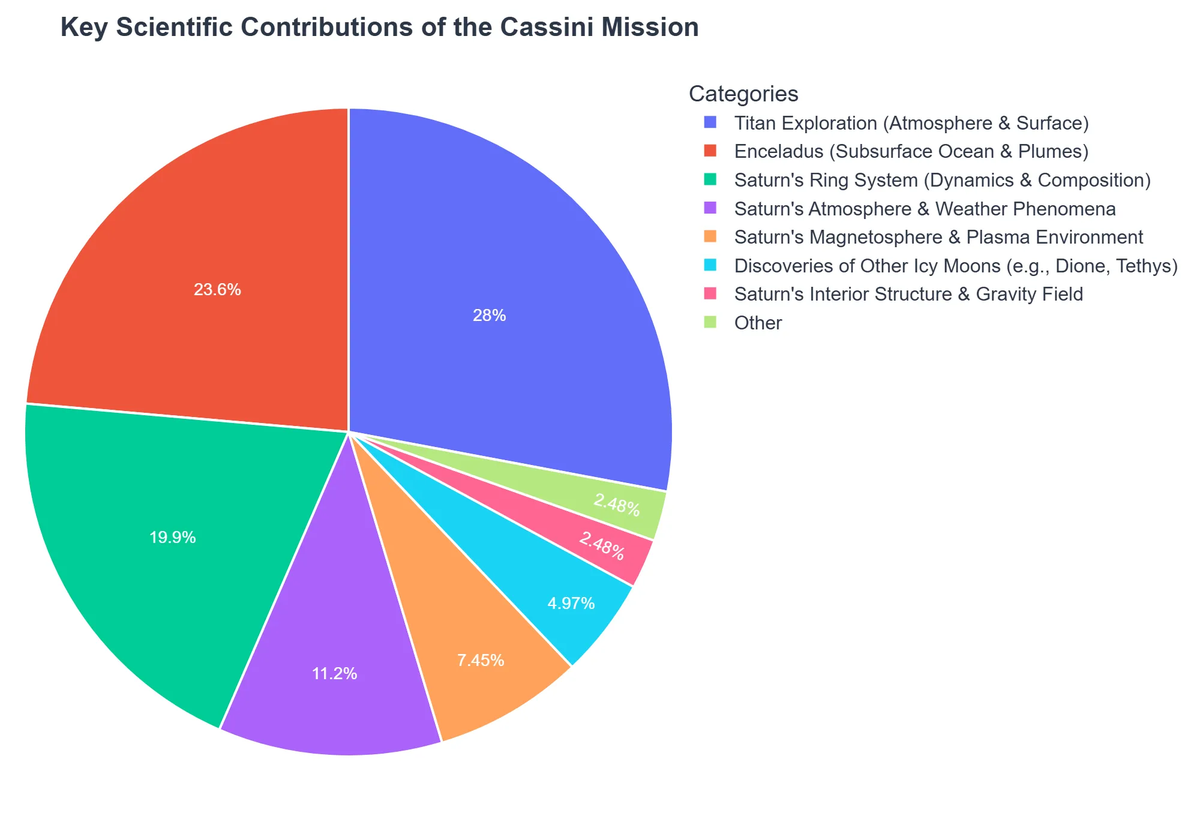
- Cassini’s discoveries revealed active cryovolcanism on Enceladus and confirmed liquid methane seas on Titan, indicating potential for habitability.
- The mission significantly advanced our understanding of planetary ring dynamics and the diverse nature of Saturn’s numerous moons.
- Cassini’s grand finale involved a series of daring dives into Saturn’s atmosphere, yielding unique data before its planned destruction.
“Cassini didn’t just explore Saturn; it completely redefined our concept of what’s possible in the outer solar system, revealing active worlds where we least expected them.”
— Astrid Bellweather, Astrophysicist & Science Communicator
This comprehensive guide dives deep into Cassini’s incredible journey, highlighting its groundbreaking discoveries, the fascinating worlds it explored, and the enduring legacy it left behind in the annals of cosmic exploration.
In This Article
- — 💡 Key Takeaways
- → The Grand Journey Begins: Launch and Mission Objectives
- — 🔭 Core Objectives of the Cassini Mission
- → Unveiling Saturn’s Majesty: Rings, Atmosphere, and Magnetosphere
- — 🪐 Saturn’s Iconic Rings
- — 💨 Atmospheric Insights
- — 🧲 Probing the Magnetosphere
- → Exploring Saturn’s Enigmatic Moons: Titan and Enceladus
- — 💧 Enceladus: A Water World
- — ☁️ Titan: A Moon with an Atmosphere and Lakes
- → Cassini’s Daring Grand Finale: A Legacy of Discovery
- — ☄️ The Grand Finale Maneuvers
- — 🔥 Plunge into Saturn’s Atmosphere
- → The Enduring Impact of Cassini-Huygens
The Grand Journey Begins: Launch and Mission Objectives
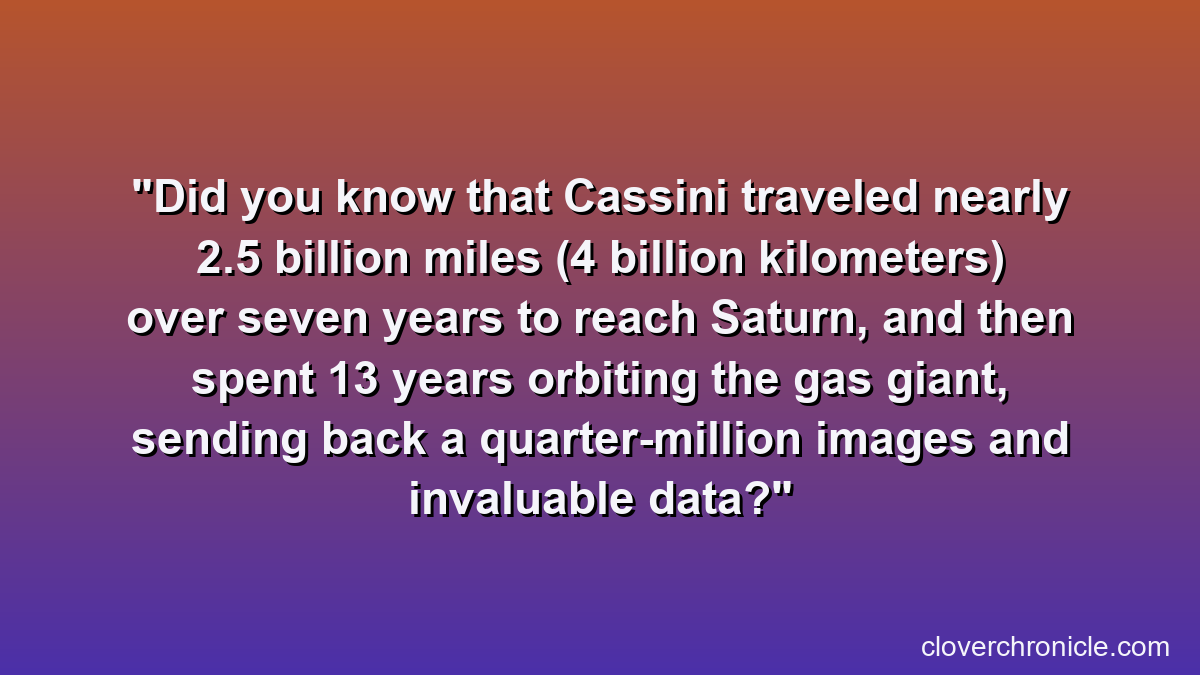
The Cassini-Huygens mission was a collaborative triumph, a joint project between NASA, the European Space Agency (ESA), and the Italian Space Agency (ASI). The spacecraft, comprising the Cassini orbiter and the Huygens probe (designed to land on Titan), embarked on its epic voyage from Earth on October 15, 1997.
After a seven-year interplanetary cruise, covering billions of kilometers and utilizing gravity assists from Venus (twice) and Jupiter, Cassini successfully entered Saturn’s orbit on July 1, 2004. Its mission was ambitious, designed to provide a comprehensive study of the Saturnian system.
🔭 Core Objectives of the Cassini Mission
- ✅ To determine the three-dimensional structure and dynamic behavior of Saturn’s rings.
- ✅ To determine the composition of the satellite surfaces and the geological history of each object.
- ✅ To determine the nature and origin of the dark material on Iapetus’s leading hemisphere.
- ✅ To characterize the magnetosphere’s three-dimensional structure and dynamic behavior.
- ✅ To characterize the atmospheric dynamics of Saturn.
- ✅ To characterize the structure and dynamics of Titan’s atmosphere and surface.
Unveiling Saturn’s Majesty: Rings, Atmosphere, and Magnetosphere
Cassini’s unparalleled proximity to Saturn allowed scientists to unravel many long-standing mysteries surrounding the ringed planet. Its instruments provided stunning images and invaluable data on Saturn’s most iconic features.
🪐 Saturn’s Iconic Rings
The rings of Saturn, a hallmark of the planet, were a primary focus for Cassini. The spacecraft revealed their immense complexity and dynamic nature. It showed that the rings are not solid structures but billions of individual pieces of water ice, ranging from microscopic dust grains to house-sized boulders, orbiting the planet.
- 💡 Ring Composition: Confirmed the rings are predominantly water ice, with traces of rocky material.
- ✅ Dynamics: Discovered new rings and observed complex gravitational interactions, including “propeller” features caused by embedded moonlets.
- ➡️ Seasonal Changes: Tracked subtle changes in the rings over Saturn’s long seasons, revealing how solar illumination affects their appearance.
💨 Atmospheric Insights
Cassini peered through Saturn’s thick, hazy atmosphere, providing unprecedented views of its weather patterns and structure.
- 🌀 Hexagonal Jet Stream: Captured breathtaking images of the persistent hexagonal storm at Saturn’s North Pole, a massive feature still not fully understood.
- ⚡ Storm Activity: Observed massive, long-lived storms, including the Great White Spots, providing insights into gas giant meteorology.
- 📈 Wind Speeds: Measured extreme wind speeds, particularly near the equator, reaching up to 1,800 kilometers per hour (1,100 mph).
🧲 Probing the Magnetosphere
Saturn’s vast magnetosphere, the region of space controlled by its magnetic field, was also extensively studied. Cassini’s instruments analyzed how the solar wind interacts with Saturn, its rings, and its moons, producing spectacular aurorae and energetic particle environments.
Exploring Saturn’s Enigmatic Moons: Titan and Enceladus
While Saturn itself was a marvel, some of Cassini’s most astonishing discoveries came from its repeated close flybys of the planet’s diverse moons. Titan and Enceladus, in particular, proved to be extraordinary worlds.
💧 Enceladus: A Water World
Perhaps one of the most exciting revelations of the Cassini mission was the discovery of active water vapor plumes erupting from the south polar region of Enceladus. These geysers hinted at something truly profound:
- 🌊 Subsurface Ocean: Strong evidence pointed to a vast, global liquid water ocean beneath the moon’s icy crust.
- ♨️ Hydrothermal Activity: Later data suggested that this ocean might contain hydrothermal vents, similar to those found on Earth’s ocean floor, which provide energy for diverse ecosystems.
- 🦠 Habitability Potential: The presence of liquid water, heat, and organic molecules makes Enceladus a prime candidate in the search for extraterrestrial life within our solar system.
Cassini’s close flybys of this small, icy moon fundamentally changed our understanding of where life might exist. For more details on these incredible findings, explore our related article: Cassini Spacecraft: Saturn’s Rings and Moons Unveiled.
☁️ Titan: A Moon with an Atmosphere and Lakes
Titan, Saturn’s largest moon, is unique in our solar system for its thick, hazy atmosphere, reminiscent of early Earth. The Huygens probe, deployed from Cassini, made a historic landing on Titan’s surface in January 2005, providing humanity’s first direct view of a world with a dense atmosphere beyond Earth.
- 💧 Methane Cycle: Cassini confirmed Titan has an active methane cycle, much like Earth’s water cycle, complete with clouds, rain, rivers, lakes, and seas of liquid methane and ethane.
- 🗻 Surface Features: Revealed a diverse landscape of dunes, mountains, and cryovolcanic features, sculpted by liquid methane and ice.
- 🌌 Atmospheric Chemistry: Studied the complex organic chemistry occurring in Titan’s nitrogen-rich atmosphere, which produces a variety of hydrocarbons.
The data from Cassini and Huygens has been instrumental in planning future missions to this fascinating moon. Delve deeper into the possibilities with our guide on NASA Titan Mission: Exploring Saturn’s Moon and discover more about its enduring legacy in Titan Unveiled: Cassini’s Legacy and Future Exploration.
Cassini’s Daring Grand Finale: A Legacy of Discovery
After 13 years of unparalleled scientific exploration, Cassini was running low on fuel. To prevent any chance of contaminating potentially habitable moons like Enceladus or Titan with Earth microbes, NASA orchestrated a dramatic end to the mission.
☄️ The Grand Finale Maneuvers
From April to September 2017, Cassini executed 22 daring orbits, plunging through the uncharted gap between Saturn and its innermost ring. This “Grand Finale” phase allowed the spacecraft to collect unique, never-before-possible data, directly sampling Saturn’s upper atmosphere and the material in its rings.
🔥 Plunge into Saturn’s Atmosphere
On September 15, 2017, Cassini made its final, planned plunge into Saturn’s atmosphere, transmitting data until its signal was lost. This intentional destruction ensured that the spacecraft would not become space debris and potentially compromise the pristine environments of Saturn’s moons. It was a fitting, scientifically rich conclusion to a mission that constantly pushed boundaries.
Recommended Video
The Enduring Impact of Cassini-Huygens
The Cassini-Huygens mission truly revolutionized our understanding of Saturn and its system. It provided a treasure trove of data that will keep scientists busy for decades, offering insights not just into a distant gas giant but also into fundamental processes that govern planetary formation and the conditions necessary for life.
- 🔭 Redefined Habitable Zones: Cassini expanded the concept of habitability beyond Earth-like conditions, showing that liquid water can exist in diverse forms and locations.
- 📚 Foundation for Future Missions: The discoveries, particularly regarding Enceladus and Titan, are directly informing the design and objectives of upcoming missions, such as Dragonfly to Titan.
- 🌟 Inspiration and Education: Cassini’s incredible images and groundbreaking findings have captured the public imagination, inspiring new generations to pursue careers in science and engineering.
The data continues to be analyzed, yielding new insights even years after the mission’s end, solidifying Cassini’s place as one of the most successful interplanetary missions in history. It remains a cornerstone in our quest for knowledge about the cosmos, a testament to humanity’s insatiable curiosity in Cosmic Queries: Probing the Mysteries of the Universe. To learn more about the mission directly from NASA, visit NASA Science: Cassini-Huygens. You can also explore detailed mission information from the Jet Propulsion Laboratory at JPL: Cassini-Huygens.
What was the primary goal of the Cassini mission?
The primary goal of the Cassini-Huygens mission was to study Saturn and its many moons, rings, and magnetosphere in detail, seeking to understand the planet’s formation, evolution, and potential for harboring life.
What major discoveries did Cassini make about Enceladus?
Cassini discovered active geysers erupting from Enceladus’s south pole, indicating a subsurface ocean of liquid water, which could potentially harbor microbial life.
How did Cassini contribute to our understanding of Titan?
The Huygens probe, deployed by Cassini, landed on Titan, providing the first direct surface images. Cassini’s instruments mapped Titan’s surface, revealing methane lakes, rivers, and a complex atmospheric cycle, similar to Earth’s water cycle.
When did the Cassini mission end and why?
The Cassini mission concluded on September 15, 2017, with a controlled plunge into Saturn’s atmosphere. This ‘Grand Finale’ was designed to protect potential ocean-bearing moons like Enceladus and Titan from Earth microbes that might have contaminated the spacecraft.