Primates to Humans: Tracing Our Evolution
Our journey from early primate ancestors to the complex beings we are today is one of the most compelling stories in natural history. It’s a tale written in bones, genes, and ancient tools, revealing a profound continuum that connects all life. Understanding the arc of primate evolution is not just about looking back; it’s about comprehending the fundamental forces that shaped our present and continue to influence our future.
💡 Key Takeaways
- Human evolution is a complex, non-linear process spanning millions of years, rooted in primate lineage.
- Key adaptations like bipedalism, increased brain size, and tool use were crucial milestones.
- Genetic evidence strongly supports our shared ancestry with other primates, revealing subtle yet profound changes.
- Environmental shifts and social structures played significant roles in shaping human development.
“Our genomes are living archives, each nucleotide a testament to the deep evolutionary continuity that links us directly to our ancient primate forebears. Understanding this thread illuminates not just where we came from, but who we are.”
— Julian Aris, Evolutionary Biologist & Geneticist
This comprehensive guide delves into the key milestones, defining characteristics, and pivotal shifts that marked the incredible trajectory of the evolution of primates to humans. From the earliest tree-dwelling mammals to the advent of bipedalism, brain expansion, and complex culture, we’ll explore the evidence that illuminates our shared ancestry and unique adaptations. For a deeper dive into the fundamental principles governing all life forms, explore The Code of Life: Decoding Genetics, Evolution, and Existence.
In This Article
- → Primates to Humans: Tracing Our Evolution
- — 💡 Key Takeaways
- → The Primate Lineage: Our Earliest Roots
- — Defining Primates 🐒
- — Key Primate Characteristics 🌳
- → Divergence from Our Primate Ancestors
- — The Last Common Ancestor (LCA) 🕰️
- — Key Evolutionary Branches 🌱
- → The Dawn of Bipedalism: A Revolutionary Step
- — Why Walk Upright? 🤔
- — Early Hominin Evidence 👣
- → Brain Expansion and Tool Use
- — Cognitive Leap 🧠
- — The Stone Age Revolution 🛠️
- → From Homo Erectus to Homo Sapiens: Journeys Across Continents
- — Homo Erectus: The Global Traveler 🌍
- — Neanderthals and Denisovans 🧊
- — The Rise of Homo Sapiens ✨
- → What Makes Us Human? Cultural and Social Evolution
- — Language and Symbolism 🗣️🎨
- — Complex Social Structures 🤝
- — The Future of Human Evolution 🚀
- → Conclusion
The Primate Lineage: Our Earliest Roots

To understand human evolution, we must first understand primates. Our story begins tens of millions of years ago, long before anything resembling a human walked the Earth. The primate order emerged from small, arboreal, insect-eating mammals.
Defining Primates 🐒
Primates are a diverse order of mammals, characterized by a unique suite of traits that evolved primarily for life in the trees. These adaptations laid the groundwork for our own lineage.
- ✅ Grasping Hands and Feet: Possessing five-fingered hands and five-toed feet, often with opposable thumbs/big toes, crucial for climbing and manipulating objects.
- ✅ Enhanced Vision: Forward-facing eyes allowing for stereoscopic (3D) vision, critical for judging distances in arboreal environments. Reduced reliance on smell.
- ✅ Large Brains: Relative to body size, primates generally have larger brains than other mammals, indicating increased cognitive complexity.
- ✅ Long Lifespans and Parental Care: Primates typically have longer gestation periods, fewer offspring at a time, and extended periods of parental care, fostering learning and social development.
- ✅ Generalized Skeleton: A flexible skeleton, allowing for a wide range of movements, not specialized for a single mode of locomotion.
Key Primate Characteristics 🌳
Early primates, like Purgatorius, set the stage. Over millions of years, these characteristics became more refined, leading to the diversification into prosimians (lemurs, lorises, tarsiers) and anthropoids (monkeys, apes, humans).
- ➡️ Arboreal Adaptations: Many primate traits, such as highly flexible joints and prehensile hands, are direct results of adaptations to life in trees.
- ➡️ Dietary Flexibility: Most primates are omnivorous, with teeth adapted for various foods, allowing them to exploit diverse ecological niches.
- ➡️ Social Complexity: Many primate species live in complex social groups, which fostered communication, learning, and cooperation, traits that would become paramount in human evolution.
Divergence from Our Primate Ancestors
The pivotal moment in our evolutionary journey was the split from our closest living relatives – chimpanzees and bonobos. This divergence, occurring roughly 6-7 million years ago, marked the beginning of the hominin lineage.
The Last Common Ancestor (LCA) 🕰️
We did not evolve from chimpanzees, but rather, we share a common ancestor with them. This LCA was likely a knuckle-walking ape, adapted to both arboreal and terrestrial environments. The genetic evidence strongly supports this close relationship. For a deeper understanding of our nearest relatives, read about Chimpanzee Evolution: Our Closest Relatives.
Key Evolutionary Branches 🌱
After the LCA, two distinct paths emerged:
- Ape Lineage: Evolved into modern chimpanzees, gorillas, and orangutans. Their evolution often involved further specialization for arboreal life and unique social structures. For more on this, consider exploring Ape Evolution: Understanding Our Closest Primate Relatives.
- Hominin Lineage: The branch leading to modern humans, characterized by the development of bipedalism, increasing brain size, and reliance on culture and tools.
The initial changes were subtle, perhaps driven by environmental shifts that favored adaptations for ground dwelling and resource gathering.
The Dawn of Bipedalism: A Revolutionary Step
Perhaps the most defining feature distinguishing early hominins from other apes is bipedalism – the ability to walk upright on two legs. This adaptation appeared early in our lineage, preceding significant brain expansion.

Why Walk Upright? 🤔
Multiple hypotheses attempt to explain the evolutionary advantages of bipedalism:
- 💡 Energy Efficiency: Bipedal locomotion can be more energy-efficient over long distances than knuckle-walking.
- 💡 Thermoregulation: Standing upright exposes less surface area to direct sun, potentially reducing heat stress in open environments.
- 💡 Food Carrying: Frees the hands for carrying food, water, or infants.
- 💡 Increased Visibility: Allows for a better view over tall grasses, aiding in spotting predators or food sources.
- 💡 Foraging Efficiency: Enables better access to arboreal foods while standing, or terrestrial foods spread across a wider area.
The exact combination of pressures that led to bipedalism is still debated, but its impact on human evolution is undeniable. It fundamentally changed how our ancestors interacted with their environment.
Early Hominin Evidence 👣
Fossil discoveries like “Lucy” (Australopithecus afarensis) provide compelling evidence of early bipedalism dating back over 3 million years. Her skeletal structure, particularly the pelvis and leg bones, clearly indicates an upright gait, though she likely retained some arboreal capabilities. Learn more about the physical changes in our lineage by exploring Anatomy and Evolution: Decoding Life’s Blueprint.
Other early bipedal species include Ardipithecus ramidus (4.4 million years ago) and Orrorin tugenensis (6 million years ago), pushing back the timeline for this crucial adaptation.
Brain Expansion and Tool Use
While bipedalism defined early hominins, the subsequent increase in brain size and the development of sophisticated tool use truly set the genus Homo apart.
Cognitive Leap 🧠
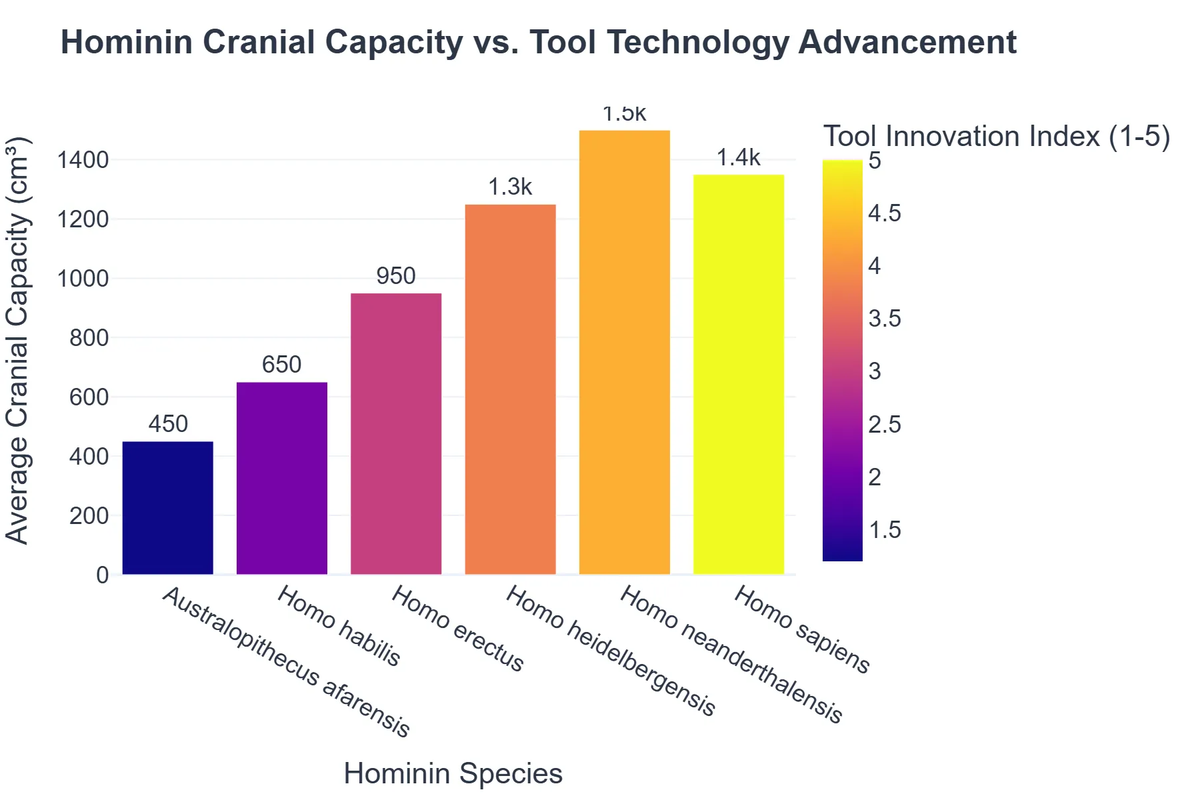
Over millions of years, the hominin brain underwent significant enlargement, particularly in the neocortex, the area associated with higher cognitive functions like reasoning, language, and self-awareness. This expansion wasn’t linear but occurred in bursts, often coinciding with environmental changes and behavioral innovations.
- ✅ Increased Complexity: A larger brain facilitated more complex problem-solving, planning, and memory.
- ✅ Social Intelligence: Enhanced cognitive abilities likely fostered more intricate social interactions and cooperation within groups.
- ✅ Language Development: Though direct evidence is scarce, brain reorganization suggests the neural architecture for language began to develop.
The Stone Age Revolution 🛠️
The earliest stone tools, known as Oldowan tools, date back 2.6 million years and are attributed to species like Homo habilis (“handy man”). These simple choppers and flakes mark the beginning of the Stone Age.
The development of tools was a feedback loop with brain expansion:
- Tools as Extensions: Tools allowed early humans to access new food sources (e.g., bone marrow), process food more efficiently, and defend themselves.
- Cognitive Demands: Manufacturing tools required foresight, planning, and fine motor skills, further driving brain development.
- Cultural Transmission: Tool-making techniques were learned and passed down through generations, indicating early forms of cultural learning and tradition.
Later technologies, like Acheulean handaxes (associated with Homo erectus), demonstrate increasing sophistication and standardization, reflecting greater cognitive abilities and perhaps teaching.
From Homo Erectus to Homo Sapiens: Journeys Across Continents
The genus Homo saw remarkable diversification and global dispersal, culminating in the emergence of our own species.
Homo Erectus: The Global Traveler 🌍
Appearing about 1.9 million years ago, Homo erectus was the first hominin to leave Africa. They were characterized by a larger brain than earlier hominins, a more modern body proportion, and the controlled use of fire. Their extensive fossil record across Asia and Europe indicates a remarkable ability to adapt to diverse environments. For a detailed exploration of our ancestral past, consider Human Evolution: A Deep Dive into Our Ancestral Past.
Neanderthals and Denisovans 🧊
Descended from an earlier wave of Homo out of Africa (likely Homo heidelbergensis), Neanderthals (Homo neanderthalensis) thrived in Europe and Asia during glacial periods, demonstrating impressive adaptations to cold climates, sophisticated hunting techniques, and even symbolic behavior. Denisovans, known primarily from genetic evidence and limited fossils in Siberia, were a related group. Both interbred with modern humans.
The Rise of Homo Sapiens ✨
Modern humans, Homo sapiens, originated in Africa approximately 300,000 years ago. Our defining traits include a uniquely shaped skull with a high forehead and a chin, advanced cognitive capabilities, and a profound capacity for symbolic thought, complex language, and art. We ultimately dispersed globally, replacing or assimilating other hominin populations. According to the Smithsonian Institution, the introduction to human evolution highlights these critical migrations. (Introduction to Human Evolution | The Smithsonian Institution’s Human Origins Program)
What Makes Us Human? Cultural and Social Evolution
While biological changes were crucial, the acceleration of cultural and social evolution truly distinguishes Homo sapiens.
Language and Symbolism 🗣️🎨
The development of complex language was a game-changer. It allowed for the efficient transmission of knowledge, the coordination of large groups, and the creation of shared narratives. Symbolic thought, evident in cave art, rituals, and personal adornment, speaks to a uniquely human capacity for abstract thinking and meaning-making beyond immediate survival.
The evolution of the human mind is a fascinating area of study, tracing how our cognitive abilities developed over millions of years. (A natural history of the human mind: tracing evolutionary changes in…)
Complex Social Structures 🤝
Humans developed highly complex social structures, including kinship systems, elaborate cooperative behaviors, and the division of labor. These enabled us to build larger, more resilient communities and exploit a wider range of resources.
- ➡️ Cooperation and Altruism: The ability to cooperate on a large scale, even with non-relatives, is a hallmark of human societies.
- ➡️ Innovation and Learning: Cumulative culture, where knowledge and technologies build upon previous generations, led to rapid innovation.
- ➡️ Adaptability: Our social and cultural flexibility has allowed us to adapt to virtually every environment on Earth, far beyond what our biological adaptations alone would permit.
The Future of Human Evolution 🚀
Evolution is an ongoing process. While biological changes may be slower in highly technological societies, cultural evolution continues at an unprecedented pace. Factors like global migration, medical advancements, and artificial intelligence may play roles in shaping our future biological and cultural trajectory.
Recommended Video
Conclusion
The journey from humble primates to complex humans is a testament to the power of evolution. It’s a story of gradual biological shifts – from bipedalism and brain expansion to the development of sophisticated tools and symbolic thought – interwoven with leaps in social and cultural complexity.
Our human evolution is not a linear march but a branching tree, with many experimental paths. By tracing this incredible lineage, we gain profound insights into our place in the natural world, our shared history with all living things, and the remarkable adaptability that defines our species. Understanding the path of `evolution primates` provides a critical lens through which to view not just our past, but also the possibilities for our future.
Frequently Asked Questions
What are the earliest known human ancestors?
The earliest known human ancestors, or hominins, include species like Sahelanthropus tchadensis and Ardipithecus, dating back millions of years.
How did bipedalism impact human evolution?
Bipedalism freed the hands for tool use and carrying, improved long-distance travel efficiency, and likely played a role in thermoregulation, profoundly impacting subsequent human development.
What genetic evidence links humans to other primates?
Genetic similarities, such as chromosome banding patterns, shared pseudogenes, and a high percentage of identical DNA sequences, strongly indicate a common ancestor between humans and other great apes.
When did Homo sapiens first appear?
Fossil and genetic evidence suggests Homo sapiens first emerged in Africa roughly 300,000 years ago, evolving from earlier Homo species.