


Cosmos Program: Unveiling the Secrets of Soviet Spacecraft
The vast expanse of space has always captivated humanity, pushing the boundaries of scientific discovery and technological prowess. During the Cold War, no nation exemplified this ambition more profoundly than the Soviet Union, especially through its enigmatic Cosmos Program. Far more than just a single mission, “Cosmos” served as a blanket designation for an astonishing array of Soviet spacecraft, many of which conducted vital, and often clandestine, operations.
💡 Key Takeaways
- The Cosmos Program was the Soviet Union’s most extensive space program, launching thousands of diverse satellites.
- Much of the program’s activities were shrouded in secrecy, leading to speculation and mystery in the West.
- Cosmos missions spanned a wide array of objectives, including military, scientific, and technological tests.
- It played a crucial, often underestimated, role in the Cold War’s strategic balance and technological advancements.
“The Cosmos Program wasn’t just about rockets and satellites; it was a vast, silent symphony of technological ambition, often pushing the boundaries of what was known, its true scope hinting at a future that felt both alien and inevitable.”
— Astrid Bellweather, Astrophysicist & Science Fiction Consultant
This comprehensive guide delves deep into the fascinating world of the Cosmos Program, exploring its origins, the diverse types of Soviet spacecraft it encompassed, and the indelible legacy it left on space exploration. Prepare to unravel the secrets of some of the most significant, yet often overlooked, chapters in the history of spaceflight.
In This Article
- → Cosmos Program: Unveiling the Secrets of Soviet Spacecraft
- — 💡 Key Takeaways
- → What Was the Cosmos Program? A Definitive Overview
- → The Driving Forces Behind Cosmos: The Soviet Space Program’s Ambitions
- — Strategic Imperatives of the Cold War
- — Scientific and Technological Advancement
- → Key Categories of Cosmos Satellites 🛰️
- → Noteworthy Missions and Unveiled Secrets
- — The Veil of Secrecy
- → The Enduring Legacy of Soviet Spacecraft Under the Cosmos Banner
- → Conclusion: The Cosmos Program’s Place in Space History
What Was the Cosmos Program? A Definitive Overview

Unlike well-publicized missions like Sputnik or Vostok, the Cosmos Program was not a single, grand project but rather a series of thousands of uncrewed Soviet satellites launched from 1962 onwards. This broad designation was applied to a multitude of spacecraft with diverse objectives, ranging from scientific research and telecommunications to military reconnaissance and missile warning systems. It essentially became the default name for any Soviet satellite that didn’t have a more specific public designation, especially those whose true purpose was classified.
- ✅ Broad Designation: Covered a vast spectrum of missions, from military to scientific.
- ➡️ Strategic Ambiguity: Allowed the Soviet Union to maintain secrecy about sensitive missions.
- 💡 Longevity: The program continued well into the post-Soviet era, with Russia still launching Cosmos-series satellites today.
The Driving Forces Behind Cosmos: The Soviet Space Program’s Ambitions
The sheer scale and diversity of the Cosmos Program were direct reflections of the Soviet Union’s multifaceted ambitions during the intense competition of the `space race`. Driven by a blend of scientific curiosity, national pride, and strategic necessity, the `Soviet space program` poured immense resources into developing advanced `Soviet spacecraft` technologies.
Strategic Imperatives of the Cold War
Much of the impetus for the Cosmos Program stemmed from military requirements. During the Cold War, both the U.S. and the Soviet Union sought to gain a decisive advantage in space. Satellites under the Cosmos banner were crucial for:
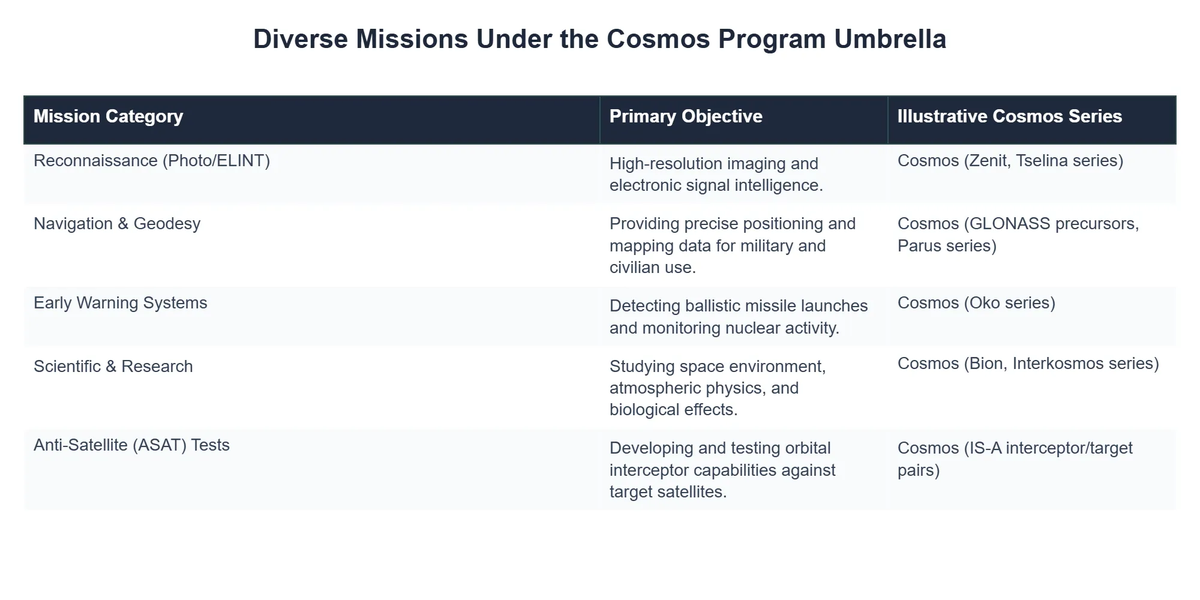
- ➡️ Reconnaissance: Gathering intelligence on adversary capabilities and movements.
- 💡 Missile Warning: Detecting ballistic missile launches.
- ⚙️ Navigation & Communication: Supporting military operations globally.
The program also served as a proving ground for new technologies and operational procedures, often testing components or systems destined for more prominent crewed missions or intercontinental ballistic missiles. For more on the strategic context, refer to external analyses like U.S. Intelligence and the Soviet Space Program. U.S. Intelligence and the Soviet Space Program.
Scientific and Technological Advancement
While military objectives were paramount, the Cosmos Program also facilitated significant scientific research. Many Cosmos satellites carried instruments for studying the Earth’s atmosphere, magnetosphere, and radiation belts, contributing invaluable data to the understanding of our planet’s environment in space. Furthermore, it allowed the Soviet Union to quietly test and refine technologies for future scientific probes and crewed missions, keeping their advancements under wraps from the West.
For a detailed look into the broader historical context, you might find our article on Cosmic Queries: Probing the Mysteries of the Universe insightful, as it covers the various endeavors to understand the cosmos.
Key Categories of Cosmos Satellites 🛰️
The versatility of the Cosmos Program is best understood by examining the diverse categories of satellites it encompassed. These were not generic devices but highly specialized machines designed for specific tasks.
- ✅ Reconnaissance Satellites: A large portion of Cosmos missions were dedicated to photographic and electronic intelligence gathering. These satellites provided critical surveillance capabilities, monitoring military installations and movements globally.
- ➡️ Navigation Satellites: Early versions of what would become the GLONASS system, these satellites provided positioning data for military and later civilian use, revolutionizing navigation.
- 💡 Communication Satellites: Used for secure military communications and later for civilian telecommunications across the vast Soviet Union.
- ⚙️ Scientific Research Satellites: Many Cosmos missions were dedicated to space physics, meteorology, biological experiments (some carrying animals), and studying cosmic rays.
- ⚡ Missile Defense Early Warning: A crucial category, these satellites were designed to detect launches of intercontinental ballistic missiles, providing vital minutes of warning time.
- 🧪 Testbed Flights & Unannounced Missions: Perhaps the most intriguing aspect, the Cosmos designation was often used for test flights of new spacecraft designs (including prototypes for crewed programs or planetary probes) or for missions that failed to achieve their primary objective and whose true purpose was not publicly disclosed. This included experimental flights related to programs like the TKS Spacecraft: The Soviet Union’s Unsung Spacecraft or early prototypes that influenced later developments like the Voskhod Spacecraft: Pioneering Multi-Crew Space Missions.
Noteworthy Missions and Unveiled Secrets
While individual Cosmos missions often remained shrouded in secrecy, the sheer volume of launches and the subsequent declassification of records have slowly unveiled the program’s true scope and impact. Many Cosmos missions performed groundbreaking work, even if their achievements were not celebrated publicly at the time.

The Veil of Secrecy
One of the primary “secrets” of the Cosmos Program was its very existence as a catch-all designation. When a mission failed or had an unannounced purpose, it was often simply given a Cosmos number. This allowed the Soviet Union to maintain an aura of success in its public announcements while quietly dealing with setbacks or pursuing highly classified military objectives. This practice sometimes led to misinterpretations by Western intelligence, as detailed in works like Cold War Space Sleuths: The Untold Secrets of the Soviet Space.
Some Cosmos flights were known to be test flights for more ambitious future projects, including components for space stations, lunar landers, or even the ill-fated Soviet space shuttle, as discussed in Buran Spacecraft: Unraveling the Mystery of the Soviet Shuttle. The insights gained from these “secret” test flights were invaluable for the continued development of Soviet space technology.
The Enduring Legacy of Soviet Spacecraft Under the Cosmos Banner
The Cosmos Program, despite its often-anonymous nature, was absolutely central to the development of Soviet space capabilities. It quietly built the foundation for many of the Soviet Union’s and later Russia’s most significant space achievements. The sheer number of `Soviet satellites` launched under this designation demonstrates an unparalleled commitment to space dominance during the Cold War.
- ✅ Technological Prowess: Proved the Soviet Union’s ability to mass-produce reliable spacecraft for diverse missions.
- ➡️ Foundation for Future Systems: Many current Russian space systems, from navigation (GLONASS) to reconnaissance, trace their lineage directly back to technologies developed and tested under the Cosmos Program.
- 💡 Contribution to Global Space Knowledge: Despite the secrecy, the scientific data gathered by Cosmos satellites contributed to humanity’s collective understanding of Earth’s near-space environment.
The program serves as a testament to the ingenuity and strategic foresight of the Soviet space program, operating extensively in the shadows of the more famous human spaceflights and planetary probes. Its impact continues to be felt in modern space operations.
Recommended Video
Conclusion: The Cosmos Program’s Place in Space History
The Cosmos Program stands as a colossal, yet often understated, achievement of the Soviet Union. Far from being a single story, it is a complex tapestry woven from thousands of individual missions, each contributing to the strategic, scientific, and technological advancements of its era. These `Soviet spacecraft`, operating under a veil of secrecy, were instrumental in shaping the course of the `space race` and laid the groundwork for many aspects of contemporary space exploration.
By understanding the Cosmos Program, we gain a deeper appreciation for the full scope of Soviet space endeavors, recognizing that behind the celebrated triumphs were countless unsung missions diligently working to probe the mysteries of the universe and secure a strategic advantage. Its legacy reminds us that true progress in space often involves a blend of public ambition and quiet, persistent innovation.
Frequently Asked Questions
What was the Cosmos Program?
The Cosmos Program was the umbrella designation used by the Soviet Union for a wide variety of uncrewed satellite missions, often with military or experimental objectives, that were not given more specific public names.
Why was the Cosmos Program so secretive?
Secrecy was a hallmark of the Soviet space program, particularly for Cosmos missions, to conceal their true military, intelligence, or experimental nature, preventing the West from gaining insights into Soviet technological capabilities.
How many satellites were launched under the Cosmos Program?
Over 2,500 satellites were launched under the Cosmos designation from 1962 onwards, making it one of the most prolific space programs in history.
What types of missions did Cosmos satellites undertake?
Cosmos missions included reconnaissance, communication, navigation, early warning, scientific research, and testing of new spacecraft technologies, covering nearly every aspect of space utility.