


Dark Matter: A Comprehensive Guide and Explanation
The cosmos is full of mysteries, and few are as profound and pervasive as dark matter. Despite its elusive nature, scientific observations over decades have painted a compelling picture: a vast, invisible substance that dominates the universe’s mass and orchestrates the very fabric of galaxies. In this comprehensive guide, we’ll delve into what this enigmatic entity is, why scientists believe it exists, and the ongoing quest to unravel its true identity.
💡 Key Takeaways
- Dark matter is an invisible substance accounting for about 27% of the universe’s mass.
- Its existence is inferred from gravitational effects on visible matter and light, not direct observation.
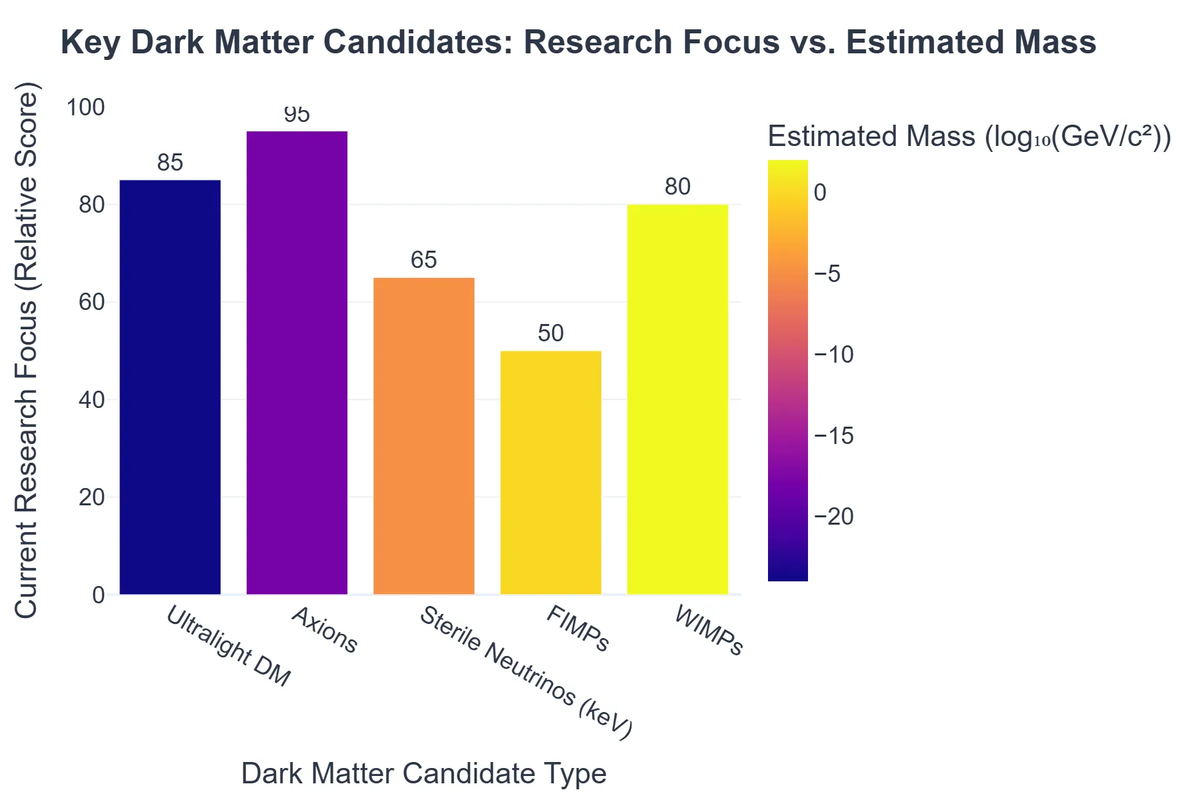
- Leading candidates for dark matter include WIMPs and axions, but none have been definitively detected.
- Ongoing experiments worldwide are actively searching for direct evidence of dark matter particles.
“The concept of dark matter challenges our very understanding of the cosmos, yet it’s crucial for our most robust models of galactic structure. It’s truly the universe’s greatest unsolved mystery, and its discovery will reshape physics and inspire new narratives.”
— Astrid Bellweather, Astrophysicist & Science Fiction Consultant
As part of our exploration into Cosmic Queries: Probing the Mysteries of the Universe, understanding dark matter is fundamental to comprehending the universe’s structure and evolution. Prepare to journey into the unseen forces shaping our reality.
In This Article
- → Dark Matter: A Comprehensive Guide and Explanation
- — 💡 Key Takeaways
- → 🌌 What is Dark Matter? The Universe’s Invisible Component
- — 💡 Why “Dark”? Understanding its Properties
- → 🔭 The Compelling Evidence for Dark Matter
- — 🔄 Galactic Rotation Curves
- — Gravitational Lensing
- — ✨ The Cosmic Microwave Background (CMB)
- — 💥 Galaxy Cluster Dynamics (e.g., Bullet Cluster)
- → ⚛️ Dark Matter vs. Dark Energy: Understanding the Distinction
- → 🔬 Leading Theories on the Nature of Dark Matter
- — 👻 Weakly Interacting Massive Particles (WIMPs)
- — 🌊 Axions
- — Sterile Neutrinos
- — 🌑 MACHOs (Massive Compact Halo Objects)
- → 🔬 The Quest to Detect Dark Matter: Current Experiments
- — ⬇️ Direct Detection Experiments
- — ⬆️ Indirect Detection Experiments
- — ⚛️ Collider Experiments
- → 🌌 The Profound Impact of Dark Matter on Cosmic Structure
- — 🏗️ Formation of Galaxies and Clusters
- — 🌐 Cosmic Web
- → ✨ Conclusion: The Unfolding Mystery of the Universe
🌌 What is Dark Matter? The Universe’s Invisible Component
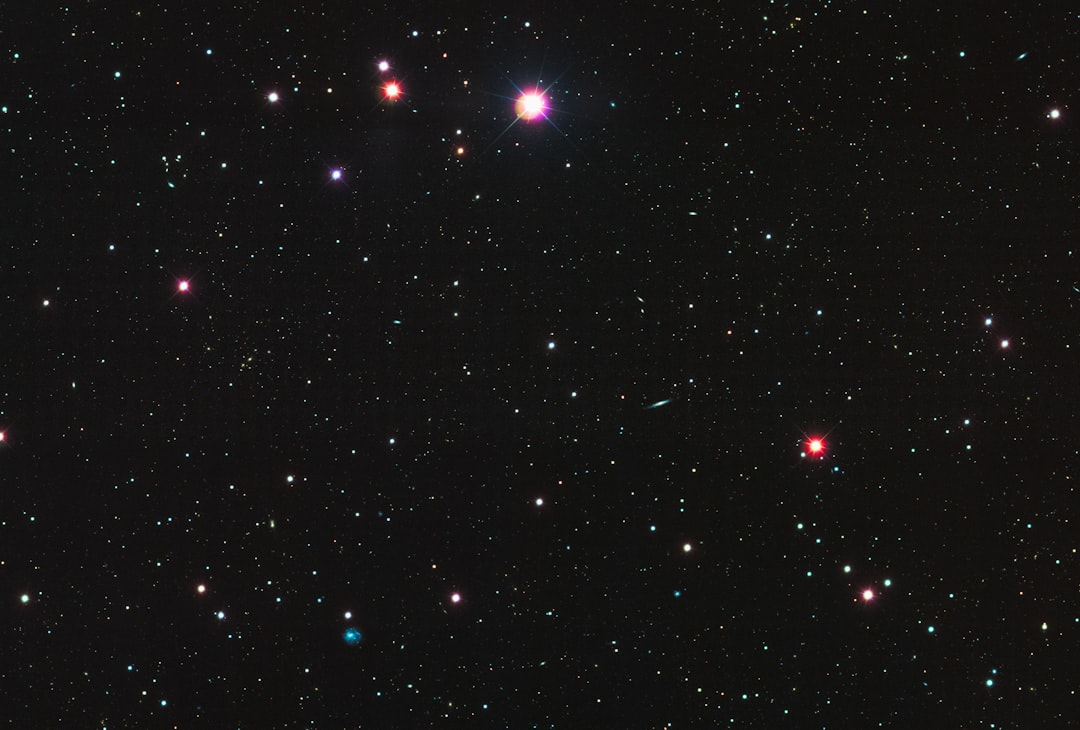
At its core, dark matter is a hypothetical form of matter that is thought to account for approximately 27% of the total mass-energy density of the universe. Unlike ordinary, or baryonic, matter—which makes up everything we can see and touch, from stars and planets to ourselves—dark matter does not absorb, reflect, or emit light. This makes it inherently “dark” and undetectable by conventional electromagnetic means.
The term “dark matter” was coined to describe a substance that interacts with regular matter only through gravity. It doesn’t interact via the strong force, weak force, or electromagnetism, which is why it hasn’t been directly observed. Its presence is inferred solely through its gravitational effects on visible matter, radiation, and the large-scale structure of the cosmos.
💡 Why “Dark”? Understanding its Properties
- ✅ No Light Interaction: It doesn’t emit or reflect any form of electromagnetic radiation (light, radio waves, X-rays, etc.), making it invisible to telescopes.
- ✅ Gravitational Influence: Its primary, and currently only, detectable interaction is through gravity. This gravitational pull is what allows scientists to infer its existence.
- ✅ Non-Baryonic: It is not composed of protons, neutrons, or electrons, which are the building blocks of ordinary matter. This is crucial because the observed abundance of baryonic matter doesn’t account for the gravitational effects attributed to dark matter.
🔭 The Compelling Evidence for Dark Matter
While we can’t see dark matter, the evidence for its existence is overwhelming and comes from multiple independent astronomical observations. This convergence of evidence is what makes the scientific community confident that something like dark matter must exist.
🔄 Galactic Rotation Curves
One of the earliest and most significant pieces of evidence came from observations of galaxy rotation. In the 1970s, pioneering astronomer Vera Rubin and her colleagues observed that stars at the outer edges of spiral galaxies orbit at roughly the same speed as stars closer to the center.
According to Newtonian mechanics, if the visible matter were all there was, stars further out should orbit slower due to less gravitational pull. The only way for them to maintain their observed high velocities is if there’s a substantial amount of unseen mass—a “dark halo”—enveloping the galaxy, providing extra gravitational force. This phenomenon is often cited as the bedrock for the concept of dark matter evidence.
Gravitational Lensing
When light from a distant galaxy or quasar passes through a massive object (like a galaxy cluster) on its way to Earth, the mass of that object can bend the light, much like a giant cosmic lens. This effect, known as gravitational lensing, allows astronomers to map the distribution of mass in the cluster.
Observations reveal that the amount of mass required to produce the observed lensing effects is far greater than the mass accounted for by visible stars and gas. This extra, unseen mass is attributed to dark matter, which is forming gravitational wells that warp spacetime.
✨ The Cosmic Microwave Background (CMB)
The CMB is the afterglow radiation from the Big Bang, offering a snapshot of the early universe (about 380,000 years old). Tiny temperature fluctuations in the CMB provide crucial insights into the early distribution of matter.
The patterns of these fluctuations are best explained by models that include both ordinary matter and a significant component of non-baryonic dark matter. Without dark matter, the universe’s structure would have evolved very differently, and the CMB wouldn’t look as it does today.
💥 Galaxy Cluster Dynamics (e.g., Bullet Cluster)
The Bullet Cluster (1E 0657-56) is a famous example of two galaxy clusters that have collided. Observations of this event provide perhaps the most direct visual evidence for dark matter.
- ✅ X-ray Observations: Hot gas (ordinary matter) from the two colliding clusters, which emits X-rays, slammed into each other and slowed down, remaining near the center.
- ✅ Gravitational Lensing Maps: Maps of the total mass distribution, created using gravitational lensing, show that the bulk of the mass (attributed to dark matter) passed straight through the collision, largely unaffected by the drag forces experienced by the gas.
This distinct separation of ordinary and dark matter during the collision strongly supports the idea that dark matter does not interact electromagnetically and primarily interacts through gravity.
The Dark Energy Survey, in particular, has been instrumental in creating detailed guides for spotting dark matter distribution across the cosmos, further reinforcing its pervasive influence. ([External Link: Dark Energy Survey Reveals Detailed Guide to Spotting Dark Matter])
⚛️ Dark Matter vs. Dark Energy: Understanding the Distinction
It’s common to confuse dark matter with dark energy, but they are fundamentally different components of our universe. While both are “dark” in that they don’t interact with light, their roles and properties are distinct:
- ✅ Dark Matter: Acts as an attractive gravitational force, pulling things together. It’s a form of matter that helps clump galaxies and clusters together. Think of it as the invisible scaffolding on which the universe’s large-scale structure is built.
- ✅ Dark Energy: Acts as a repulsive force, pushing things apart. It’s responsible for the observed accelerating expansion of the universe. It doesn’t cluster; instead, it’s thought to be a property of space itself.
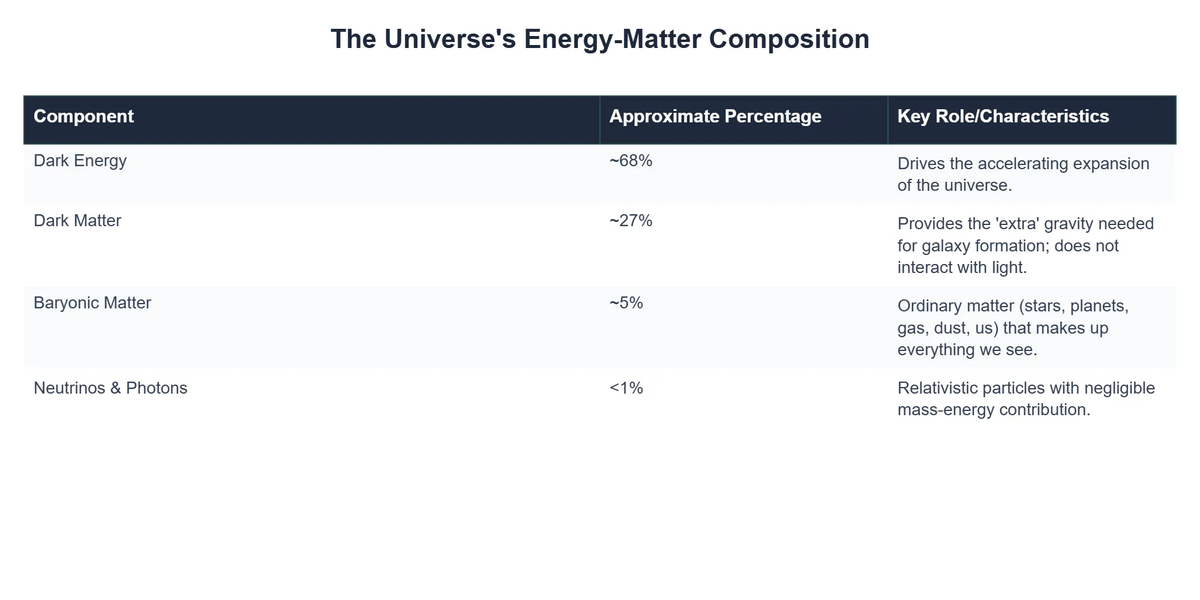
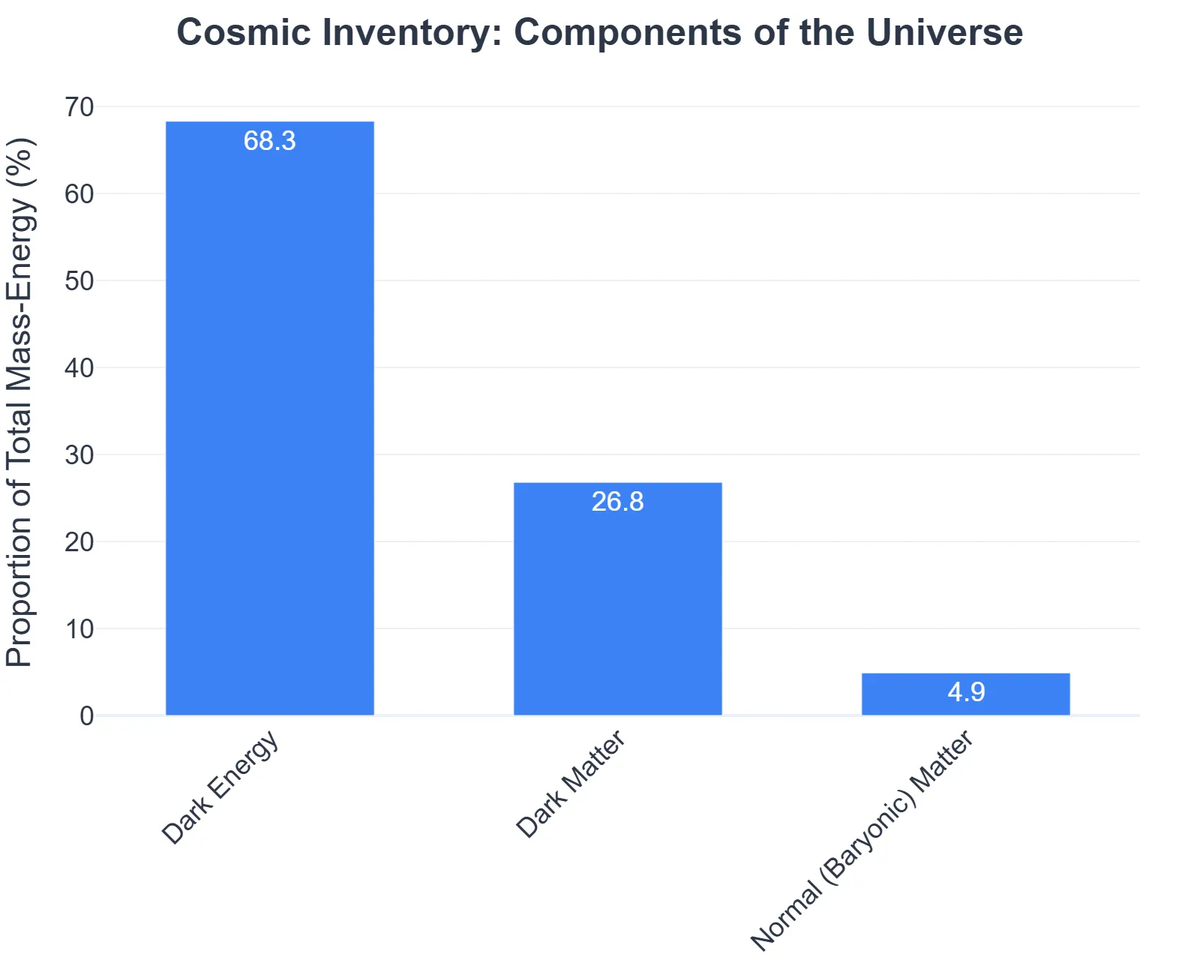
Together, dark matter and dark energy make up about 95% of the universe’s total mass-energy budget, with ordinary matter accounting for only the remaining 5%. For a more in-depth comparison, explore our guide on Dark Matter and Dark Energy Explained: Unveiling the Universe’s Hidden Mass.
🔬 Leading Theories on the Nature of Dark Matter
While the evidence for dark matter is robust, its exact composition remains one of the greatest unsolved puzzles in astrophysics and particle physics. Scientists have proposed several candidates, each with unique properties:
👻 Weakly Interacting Massive Particles (WIMPs)
WIMPs are perhaps the most popular hypothetical candidates. As their name suggests, they are theorized to be particles that:
- ➡️ Massive: Much heavier than protons.
- ➡️ Weakly Interacting: They interact only through gravity and the weak nuclear force (responsible for radioactive decay), making them very difficult to detect. They do not interact via the strong force or electromagnetism.
Many particle physics theories, such as supersymmetry, naturally predict the existence of WIMP-like particles.
🌊 Axions
Axions are much lighter than WIMPs, hypothesized to solve a problem in quantum chromodynamics (the theory of strong interactions in Quantum Physics Explained: A Clear Guide for Beginners). They are extremely light and interact very feebly, potentially converting into photons in the presence of strong magnetic fields.
Sterile Neutrinos
Neutrinos are known particles, but they are too light and move too fast to account for all of dark matter (they are “hot dark matter,” whereas observations point to “cold dark matter” which moves slowly). However, a hypothetical heavier, non-interacting version called a “sterile neutrino” could potentially be a dark matter candidate.
🌑 MACHOs (Massive Compact Halo Objects)
Initially, some scientists considered if dark matter could simply be ordinary baryonic matter that is hard to see, such as brown dwarfs, white dwarfs, or even primordial black holes. These are known as MACHOs. However, extensive surveys have largely ruled out MACHOs as a significant component of dark matter, as they account for only a tiny fraction of the required mass.
🔬 The Quest to Detect Dark Matter: Current Experiments
The hunt for dark matter is one of the most active and exciting areas of modern physics. Scientists are employing various strategies to directly or indirectly detect these elusive particles.
⬇️ Direct Detection Experiments
These experiments aim to directly observe dark matter particles interacting with ordinary matter. They typically involve highly sensitive detectors, often placed deep underground to shield them from cosmic rays and other background noise. The idea is to detect the tiny recoil of an atomic nucleus when a dark matter particle (e.g., a WIMP) collides with it. Projects like XENONnT, LUX-ZEPLIN (LZ), and PandaX are leading the charge.
⬆️ Indirect Detection Experiments
Indirect detection searches for the byproducts of dark matter annihilation or decay. If dark matter particles collide with each other in regions where they are dense (like the galactic center or dwarf galaxies), they might annihilate into detectable standard model particles (like gamma rays, neutrinos, or antimatter particles).
Telescopes like the Fermi Gamma-ray Space Telescope, the Alpha Magnetic Spectrometer (AMS-02) on the International Space Station, and neutrino observatories like IceCube are key players in this search.
⚛️ Collider Experiments
Particle accelerators like the Large Hadron Collider (LHC) at CERN aim to produce dark matter particles in controlled collisions. If WIMPs or other new particles are created, they would carry away energy and momentum that would be “missing” from the collision products, leaving a distinct signature.
CERN has dedicated efforts to this pursuit, as detailed in our article on CERN’s Dark Matter Quest: Experiments at the Forefront.
🌌 The Profound Impact of Dark Matter on Cosmic Structure
Beyond its mysterious nature, dark matter plays a critical and pervasive role in shaping the universe we observe. Its gravitational influence is not just about holding galaxies together; it’s fundamental to the formation and evolution of all large-scale cosmic structures.
🏗️ Formation of Galaxies and Clusters
Without dark matter, the universe’s early density fluctuations would not have had enough gravitational pull to overcome the expansion of space and form the structures we see today. Dark matter provided the gravitational scaffolding necessary for ordinary matter to clump together, eventually forming stars, galaxies, and galaxy clusters. This concept is central to understanding Dark Matter: The Invisible Architect of Galaxies and Dark Matter’s Gravity: Shaping the Cosmos.
🌐 Cosmic Web
The universe isn’t uniformly distributed; it forms a vast, interconnected network of filaments, walls, and voids—the “cosmic web.” Simulations show that this large-scale structure is primarily driven by the gravitational clustering of dark matter, with ordinary matter subsequently falling into these dark matter “halos.”
Recommended Video
✨ Conclusion: The Unfolding Mystery of the Universe
Dark matter remains one of the universe’s most enduring enigmas, a silent, invisible force that dictates the cosmos’s grand architecture. While we are still striving for a definitive answer to “what is dark matter,” the scientific evidence supporting its existence is robust and multifaceted.
From the peculiar rotation of galaxies to the gravitational bending of light by colossal clusters, dark matter’s ghostly presence is undeniably felt. The ongoing efforts in direct detection, indirect observation, and collider experiments promise to bring us closer to unveiling the true nature of this mysterious substance.
Understanding dark matter is not just about identifying a new particle; it’s about completing our picture of the universe, refining our cosmological models, and perhaps even hinting at new physics beyond the Standard Model. The quest continues, pushing the boundaries of human knowledge into the very heart of the cosmos.
Frequently Asked Questions
How do we know dark matter exists if we can’t see it?
Its existence is inferred from its gravitational effects on visible matter, radiation, and the large-scale structure of the universe, such as anomalous galaxy rotation curves and gravitational lensing.
What are the leading theories for what dark matter could be?
Leading candidates include Weakly Interacting Massive Particles (WIMPs), axions, and other exotic particles not part of the Standard Model of particle physics.
Are scientists close to detecting dark matter?
While no direct detection has yet occurred, numerous experiments are ongoing deep underground and in space, aiming to observe interactions between dark matter particles and ordinary matter.