


Black Hole of Our Galaxy: Sagittarius A* and the Milky Way’s Core Explained
Deep within the heart of our Milky Way galaxy lies a cosmic enigma, a supermassive entity that holds immense gravitational power over billions of stars, including our own Sun. This celestial giant is known as Sagittarius A* (pronounced “Sagittarius A-star”), the black hole of our galaxy. For centuries, its existence was theorized, a gravitational phantom pulling at the fabric of spacetime. Today, thanks to groundbreaking astronomical observations, we’re slowly unraveling its mysteries, providing unprecedented insights into the life and evolution of galaxies.
💡 Key Takeaways
- Sagittarius A* (Sgr A*) is the supermassive black hole at the center of the Milky Way galaxy.
- Despite its immense mass, Sgr A* is relatively quiet, accreting gas at a very low rate.
- Observations using radio telescopes, like the Event Horizon Telescope, provide critical insights into its structure and behavior.
- Studying Sgr A* helps us understand black hole formation, galactic evolution, and the fundamental laws of physics.
“Sagittarius A* isn’t just a cosmic vacuum cleaner; it’s the gravitational anchor around which our entire galaxy dances. Its very existence challenges our understanding of spacetime, making it the ultimate blend of scientific wonder and sci-fi inspiration.”
— Astrid Bellweather, Astrophysicist & Science Fiction Consultant
Understanding Sagittarius A* is crucial not just for comprehending our galactic home, but for advancing our knowledge of supermassive black holes across the universe. Join us as we journey to the very core of the Milky Way, exploring the nature, behavior, and profound influence of this colossal object.
In This Article
- → Black Hole of Our Galaxy: Sagittarius A* and the Milky Way’s Core Explained
- — 💡 Key Takeaways
- → What is Sagittarius A* (Sgr A*)?
- — 🤔 Understanding Supermassive Black Holes
- → Locating the Milky Way’s Core: Home of Sagittarius A*
- — 🌌 The Galactic Center: A Hub of Activity
- → Unveiling the Invisible: Observing Sagittarius A*
- — 🔭 Techniques for Peering into the Core
- — 📸 The Landmark EHT Image
- → The Influence of Sagittarius A* on the Milky Way
- — ✨ Gravitational Dance: Stars Orbiting Sgr A*
- — ⚡ Flares and Bursts: A Glimpse of Activity
- → Future of Sagittarius A* Research
- → Conclusion
What is Sagittarius A* (Sgr A*)?
Sagittarius A* (Sgr A*) is the supermassive black hole located at the very center of our Milky Way galaxy. It’s not merely a theoretical construct; overwhelming evidence confirms its presence, most notably through the precise orbits of stars that swing incredibly close to it.
🤔 Understanding Supermassive Black Holes
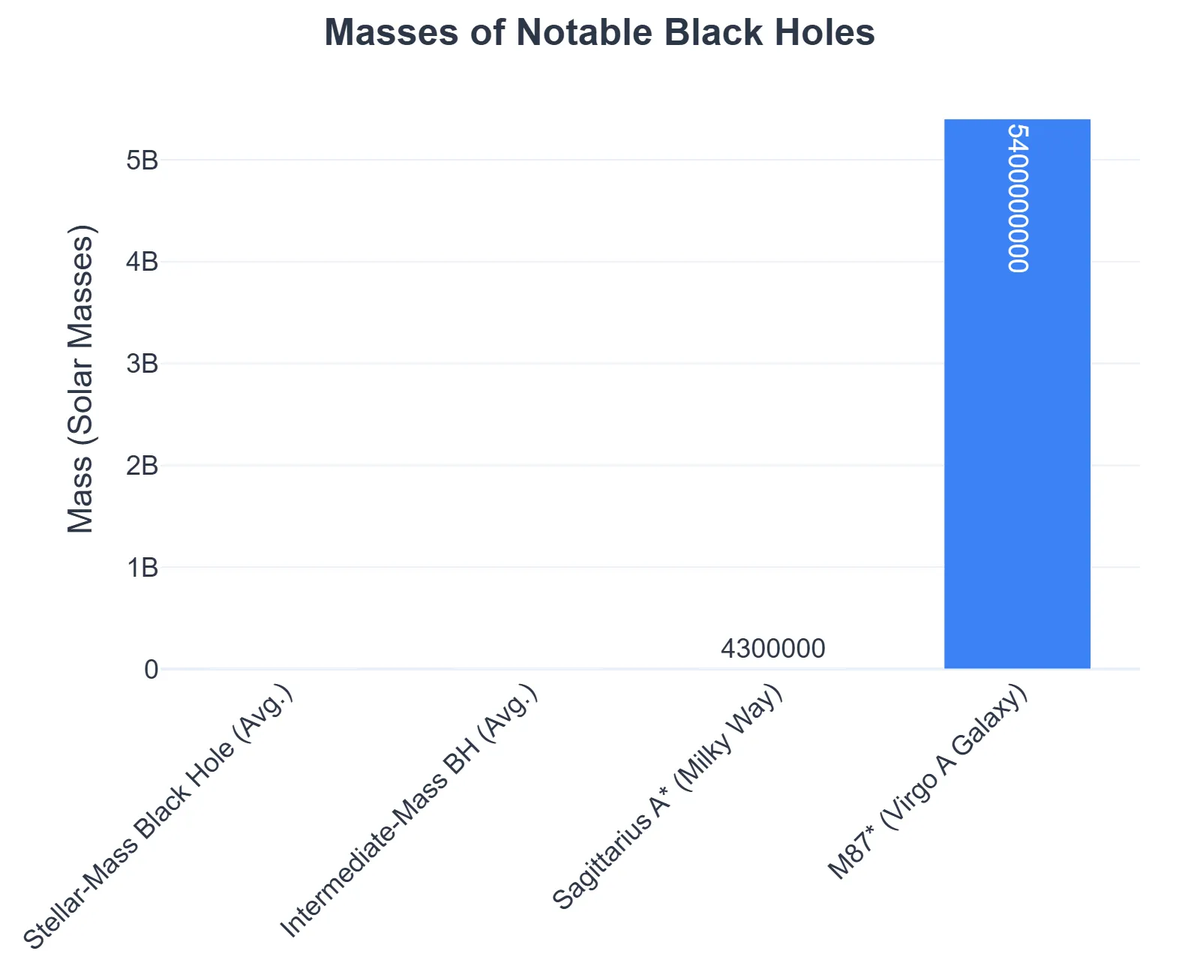
Supermassive black holes (SMBHs) are the largest type of black holes, with masses ranging from hundreds of thousands to billions of times that of our Sun. Unlike stellar-mass black holes, which form from the collapse of massive stars, the formation mechanism of SMBHs is still an active area of research. They are believed to reside at the heart of most, if not all, massive galaxies, playing a critical role in galaxy formation and evolution.
- ✅ Immense Mass: Sgr A* has an estimated mass of about 4.3 million times that of our Sun.
- ➡️ Extreme Density: All this mass is packed into a region only about 17 times the diameter of the Sun, or roughly the size of Mercury’s orbit.
- 💡 Event Horizon: Like all black holes, Sgr A* possesses an event horizon, a boundary beyond which nothing, not even light, can escape its gravitational pull.
To dive deeper into the fundamental concepts of these cosmic devourers, read our comprehensive guide: Black Hole Explained: A Comprehensive Guide. For more on their galactic role, see: Supermassive Black Holes: The Heart of Galaxies.
Locating the Milky Way’s Core: Home of Sagittarius A*
The location of Sagittarius A* is precisely at the Galactic Center, an area of intense activity and extreme conditions. From Earth’s perspective, this region is obscured by vast clouds of interstellar dust and gas, making direct optical observation impossible.
🌌 The Galactic Center: A Hub of Activity
Our solar system is located approximately 26,000 light-years away from the galactic center, residing in one of the Milky Way’s spiral arms. The central region is not merely a void occupied by a black hole; it’s a bustling environment:
- ✨ Dense Star Clusters: Home to millions of stars packed into a relatively small volume, far denser than in our solar neighborhood.
- 💨 Hot Gas & Dust: Swirling clouds of gas and dust glow brightly in radio and X-ray wavelengths, providing clues to the activity near the black hole.
- 🔭 Energetic Phenomena: Frequent flares, bursts of radiation, and high-energy particle interactions are common occurrences due to the extreme gravitational and magnetic fields.
Despite being hidden from optical view, astronomers use various wavelengths of light – particularly radio, infrared, and X-ray – to penetrate the obscuring dust and study this fascinating region and the supermassive black hole in our galaxy.
Unveiling the Invisible: Observing Sagittarius A*
Observing a black hole galaxy is an immense challenge because black holes by definition do not emit light. Instead, astronomers rely on indirect evidence and, more recently, direct imaging of its shadow.
🔭 Techniques for Peering into the Core
For decades, the strongest evidence for Sagittarius A* came from tracking the orbits of stars extremely close to the galactic center. Stars like S2, for example, complete a full orbit around Sgr A* in just 16 years, moving at speeds up to 2.7% the speed of light. Such rapid, tight orbits can only be explained by the presence of an incredibly massive and compact object – a black hole.
Astronomers use a variety of telescopes and techniques:
- ➡️ Radio Telescopes: Capable of piercing through dust clouds, they observe the radio emissions from gas and dust spiraling towards Sgr A*.
- ➡️ Infrared Telescopes: Detect the heat signatures of stars and gas in the core.
- ➡️ X-ray Observatories: Capture high-energy flares and emissions from the superheated accretion disk around the black hole.
📸 The Landmark EHT Image
In May 2022, the Event Horizon Telescope (EHT) collaboration made history by releasing the first-ever image of Sagittarius A. This monumental achievement followed their 2019 image of M87‘s black hole.
The image doesn’t show the black hole itself, but rather the “shadow” of its event horizon against the backdrop of glowing hot gas circling it. The bright ring of light is caused by gravitational lensing, where the black hole’s immense gravity bends light from the surrounding gas, creating a distorted view. This image provided undeniable visual confirmation of our galaxy hole and its unique spacetime warping effects. You can learn more about this groundbreaking observation from the source itself: Astronomers Reveal First Image of the Black Hole at the Heart of Our Galaxy.
For more on how these visualizations are created and what they tell us, explore our guide: Black Hole Visualization: Exploring 3D Structure and Spacetime Warping.
The Influence of Sagittarius A* on the Milky Way
Despite its immense mass, Sagittarius A* does not “suck in” the entire Milky Way. Its gravitational influence is primarily dominant only in its immediate vicinity, affecting stars and gas clouds within a few light-years of the galactic core. The vast majority of stars in the galaxy, including our Sun, orbit the collective gravitational center of the entire galaxy, not just the black hole.
✨ Gravitational Dance: Stars Orbiting Sgr A*
The stars closest to Sgr A* move at incredible speeds, tracing highly elliptical orbits. These orbits are crucial for accurately measuring the black hole’s mass and confirming its nature. While the black hole doesn’t directly influence stars far away, its presence is a fundamental component of the galaxy’s overall gravitational potential, which dictates the orbital paths of everything within the Milky Way.
⚡ Flares and Bursts: A Glimpse of Activity
Although generally quiet compared to the active galactic nuclei (AGN) of other galaxies, Sagittarius A* is not entirely dormant. It occasionally exhibits powerful flares in X-ray and infrared wavelengths, indicating bursts of activity as gas and dust fall into its accretion disk. These flares offer astronomers unique opportunities to study the extreme physics near the event horizon.
Recent studies suggest that even relatively recently, on cosmic timescales, the black hole in our galaxy may have been significantly more active. For instance, observations by NASA’s IXPE mission found evidence that the Milky Way’s central black hole woke up about 200 years ago for a brief period, blasting out intense X-rays before returning to its quieter state. Read more on NASA’s official site: Milky Way’s Central Black Hole Woke Up 200 Years Ago, NASA’s IXPE Finds.
Future of Sagittarius A* Research
The study of Sagittarius A* is a rapidly evolving field, with new discoveries constantly reshaping our understanding of supermassive black holes. Future research promises to reveal even more about this cosmic behemoth.
- 🚀 Next-Generation Telescopes: Advanced observatories, both ground-based and space-based, will provide sharper images and more precise measurements of Sgr A* and its surroundings.
- 🔬 Multiwavelength Campaigns: Coordinated observations across the electromagnetic spectrum will offer a more complete picture of the black hole’s activity and interactions with its environment.
- 💡 Testing General Relativity: The extreme gravity near Sgr A* makes it an ideal laboratory for testing Einstein’s theory of General Relativity under conditions impossible to replicate on Earth.
- ➡️ Understanding Galactic Evolution: Continued study will help answer fundamental questions about how supermassive black holes grow, how they interact with their host galaxies, and their role in the overall evolution of the universe.
Recommended Video
Conclusion
Sagittarius A*, the supermassive black hole of our galaxy, stands as a testament to the awe-inspiring power and complexity of the universe. From its elusive nature to its pivotal role in shaping the Milky Way’s core, it continues to be a frontier of astronomical discovery. The recent image from the Event Horizon Telescope has opened a new era in understanding this enigmatic object, moving it from theoretical certainty to observed reality.
As we continue to probe the mysteries of the universe, Sagittarius A* will remain a focal point for scientists, offering unparalleled opportunities to unravel the deepest secrets of gravity, spacetime, and the cosmic ballet that governs galaxies. Explore more cosmic queries and uncover the vastness of space at Cosmic Queries: Probing the Mysteries of the Universe.
Frequently Asked Questions
What is Sagittarius A*?
Sagittarius A* (Sgr A*) is the supermassive black hole located at the very center of our Milky Way galaxy, about 26,000 light-years from Earth.
How big is Sagittarius A*?
It has a mass equivalent to about 4 million Suns, but its event horizon, the point of no return, is surprisingly small – roughly the size of Mercury’s orbit.
Can Sagittarius A* harm Earth?
No, Sgr A* is too distant to pose any gravitational or radiative threat to our solar system. Its influence is primarily on the stars in the immediate galactic core.
How do scientists study Sagittarius A*?
Scientists study Sgr A* by observing the orbits of stars very close to it and by using radio telescopes, like the Event Horizon Telescope, to image its shadow.