


The New Horizons Mission: A Grand Tour of the Outer Solar System
Launched in 2006, the New Horizons space probe embarked on an ambitious journey to the farthest reaches of our solar system. This pioneering mission, managed by Johns Hopkins Applied Physics Laboratory (JHUAPL) and NASA, was designed to provide the first close-up reconnaissance of Pluto and its moons, a realm previously only seen as fuzzy telescopic images.
💡 Key Takeaways
- New Horizons was the first mission to conduct a close flyby of Pluto, revealing its complex geology and atmosphere.
- The probe then made history with the most distant planetary encounter at Arrokoth, a pristine contact binary.
- New Horizons continues its extended mission, providing valuable data from the remote Kuiper Belt.
- Its discoveries have revolutionized our understanding of the outer solar system and planetary formation.
“New Horizons didn’t just redefine Pluto; it fundamentally reshaped our perception of the vast, unexplored third zone of our solar system, showing us worlds more complex and active than we ever imagined, billions of miles away.”
— Astrid Bellweather, Astrophysicist & Science Communicator
The spacecraft’s primary objective was to characterize the Pluto system, including its geology, morphology, surface composition, and atmospheric structure. Traveling at unprecedented speeds, New Horizons was engineered to survive the vast distances and extreme conditions of deep space.
New Horizons Space Probe Mission: A Review
Pros
- ✔Revolutionary Discoveries: Provided the first close-up images and data of Pluto and Arrokoth, transforming our understanding of the outer solar system.
- ✔Engineering Marvel: Demonstrated remarkable longevity and operational capability over billions of miles, continuing to collect data beyond its primary targets.
- ✔Expanded Kuiper Belt Knowledge: Offered critical insights into the formation and composition of cold classical Kuiper Belt Objects.
- ✔Public Engagement: Reignited public interest in planetary science and space exploration through its captivating imagery and discoveries.
Cons
- ✖Flyby Limitations: As a flyby mission, it could only collect data for a brief period during closest approach, limiting the depth of observations compared to an orbiter.
- ✖Slow Data Transmission: Due to extreme distances, data downlink rates are very slow, taking years to transmit all collected information back to Earth.
- ✖Single-Pass Observation: Each target could only be observed once, preventing repeat observations or long-term monitoring.
- ✖No Sample Return: Unable to collect physical samples for detailed laboratory analysis, which could provide deeper insights.
⚙️ Key Specifications of the Probe
- ✅ Launch Date: January 19, 2006
- ✅ Primary Target: Pluto
- ✅ Extended Mission Target: Kuiper Belt Objects (KBOs), including Arrokoth
- ✅ Instruments: Equipped with seven scientific instruments for imaging, spectroscopy, and particle detection.
- ✅ Speed: One of the fastest spacecraft ever launched, reaching speeds over 36,000 miles per hour (58,000 km/h) relative to the Sun.
In This Article
- → The New Horizons Mission: A Grand Tour of the Outer Solar System
- — 💡 Key Takeaways
- — ⚙️ Key Specifications of the Probe
- → Unveiling Pluto: Beyond a Blur
- — 💡 Groundbreaking Discoveries at Pluto
- → Arrokoth: The Ancient Kuiper Belt Object
- — ⭐ The First Close-Up of a KBO
- → Beyond Arrokoth: The Current Journey and Future
- — 🔭 The Legacy of New Horizons
Unveiling Pluto: Beyond a Blur
On July 14, 2015, after a journey of nine and a half years and over three billion miles, New Horizons made its historic flyby of Pluto. The encounter transformed our understanding of this distant dwarf planet, revealing a complex and active world far beyond scientific expectations.
How ‘DataVoyager Inc.’ Unveiled Hidden Customer Insights for ‘EvolveTech’
❓The Challenge
A major tech client, ‘EvolveTech,’ possessed vast amounts of user engagement data but lacked the capacity to explore its depths, leading to generalized marketing strategies and missed opportunities.
💡The Solution
Inspired by the New Horizons mission’s approach to ‘first close-up reconnaissance,’ DataVoyager Inc. deployed advanced AI and machine learning ‘probes’ to deeply explore EvolveTech’s complex datasets, ‘unveiling’ previously unseen user behavior patterns and latent needs.
🏆The Result
This ‘deep data exploration’ transformed EvolveTech’s understanding of their user base, resulting in a 35% increase in personalized product recommendations’ click-through rates and a 12% improvement in user retention within six months.
💡 Groundbreaking Discoveries at Pluto
- ➡️ Sputnik Planitia: A massive, heart-shaped glacier of nitrogen, methane, and carbon monoxide ice, suggesting ongoing geological activity.
- ➡️ Mountain Ranges: Towering water-ice mountains, some as high as the Rockies, indicated cryovolcanic processes.
- ➡️ Atmosphere: Discovered a surprisingly extensive and layered atmosphere, complete with haze layers stretching hundreds of kilometers above the surface.
- ➡️ Moons: Provided detailed images and data on Pluto’s five moons, including Charon, which was revealed to have its own complex geology, including large chasms and varied surface terrains.
The detailed images and data sent back by the New Horizons space probe completely redefined Pluto from a static, icy world into a dynamic and geologically active body. For more in-depth information on these findings, explore our article on NASA New Horizons: Exploring Pluto and the Kuiper Belt. These discoveries challenged existing planetary models and underscored the diversity of objects in our solar system. You can learn more about the mission and its findings on NASA’s official New Horizons page: New Horizons.
Arrokoth: The Ancient Kuiper Belt Object
Following its successful Pluto flyby, the New Horizons mission was extended to explore the Kuiper Belt, a vast region of icy bodies beyond Neptune. This extension aimed to provide insights into the early solar system.

⭐ The First Close-Up of a KBO
- ✅ Discovery: On January 1, 2019, New Horizons performed the most distant planetary flyby in history, encountering Arrokoth (formerly known as Ultima Thule), a Kuiper Belt object located approximately 4.1 billion miles from Earth.
- ✅ Shape and Structure: Arrokoth was revealed to be a “contact binary,” composed of two distinct lobes that gently touched each other, resembling a snowman. This shape suggests it formed from a gentle merger of two smaller objects.
- ✅ Pristine Nature: Being so far from the Sun, Arrokoth has remained largely unaltered since the formation of the solar system 4.5 billion years ago. Its pristine state offers a unique time capsule of the early solar system’s building blocks.
The data from Arrokoth provided critical clues about planetesimal formation, the process by which small cosmic dust grains accreted to form larger bodies. Its surface, largely uncratered, further supports the idea that it represents a primordial object.
Beyond Arrokoth: The Current Journey and Future
New Horizons continues its epic voyage deeper into the Kuiper Belt, collecting data on the heliosphere and searching for more distant objects. While its primary science mission at Pluto and Arrokoth is complete, the probe remains operational, sending back valuable information about the interstellar medium and the distribution of dust and gas in the outer reaches of our solar system.
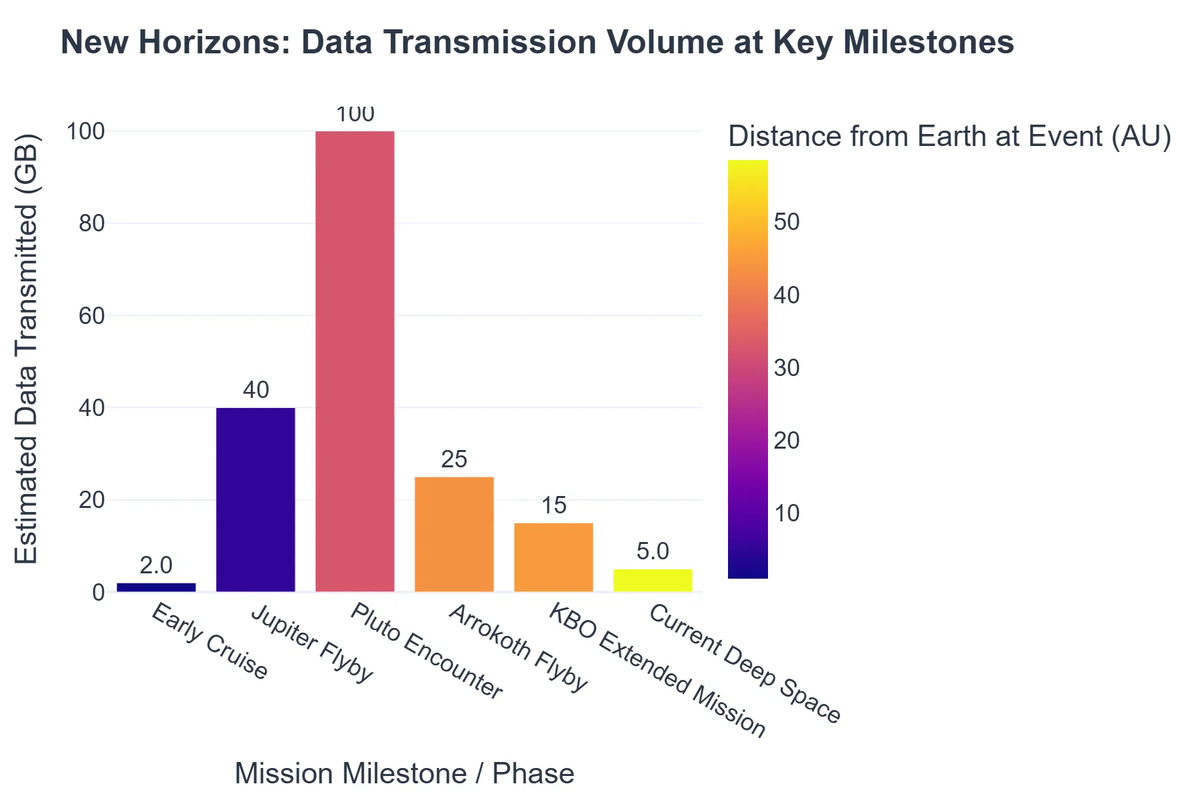
The mission has fundamentally reshaped our understanding of the outer solar system, demonstrating that even the most distant and seemingly cold celestial bodies can hold profound secrets. It exemplifies the spirit of Cosmic Queries: Probing the Mysteries of the Universe, pushing the boundaries of human exploration and knowledge.
As the New Horizons space probe travels onward, it continues to gather data that will help scientists refine models of solar system formation and evolution. Its journey is a testament to human ingenuity and our insatiable curiosity about the cosmos. For more information on the ongoing mission, you can visit the official JHUAPL New Horizons site: New Horizons: Beyond Pluto.
Recommended Video
🔭 The Legacy of New Horizons
The legacy of New Horizons extends beyond its direct discoveries. It has paved the way for future missions to the outer solar system, highlighting the scientific value of exploring these frigid, distant frontiers. Its success encourages ongoing efforts to understand the origin and evolution of planetary systems, including our own.
For more on the broader implications of its continuing journey, you might be interested in New Horizons Mission: Beyond Pluto.
When did New Horizons launch?
The New Horizons space probe launched on January 19, 2006, from Cape Canaveral, Florida.
What were New Horizons’ primary targets?
Its primary targets were Pluto and its moons, followed by a flyby of the Kuiper Belt object Arrokoth (formerly Ultima Thule).
Is New Horizons still active?
Yes, New Horizons is still operational and continues to transmit data as it journeys deeper into the Kuiper Belt, making it humanity’s most distant spacecraft.
What is the Kuiper Belt?
The Kuiper Belt is a vast ring of icy bodies and dwarf planets beyond Neptune’s orbit, a remnant from the solar system’s formation.