


Quantum Entanglement: Understanding “Spooky Action at a Distance”
Welcome to the fascinating realm of quantum entanglement, a phenomenon so bizarre that even Albert Einstein famously dubbed it “spooky action at a distance.” In the world of quantum physics, particles don’t always behave as we expect, and entanglement is perhaps the most counter-intuitive example of this, challenging our fundamental understanding of reality.
💡 Key Takeaways
- Quantum entanglement describes a unique connection where two particles remain linked, sharing the same fate even when separated by vast distances.
- Albert Einstein famously dubbed this phenomenon ‘spooky action at a distance,’ as it appears to violate the principle of locality.
- Experiments, particularly those testing Bell’s Theorem, have consistently confirmed the reality of entanglement, challenging classical physics.
- Entanglement is a cornerstone of emerging technologies like quantum computing, cryptography, and secure communication.
“Quantum entanglement isn’t just a bizarre theoretical concept; it’s a fundamental reality that reveals the deep interconnectedness of our universe at its most microscopic level. It challenges our intuitions but opens incredible new doors for understanding and technology.”
— Garrison Leo, Science Educator & Author
In This Article
- → Quantum Entanglement: Understanding “Spooky Action at a Distance”
- — 💡 Key Takeaways
- → What Exactly is Quantum Entanglement?
- → The History of “Spooky Action”: From Einstein’s Doubt to Modern Validation
- — ⚙️ How Quantum Particle Entanglement Works: A Simplified Explanation
- → Real-World Applications & Future Potential of Quantum Entanglement
- → The Frontier of Quantum Entanglement Research
What Exactly is Quantum Entanglement?
At its core, quantum entanglement describes a unique, intrinsic connection between two or more quantum particles, such as photons, electrons, or even atoms. When these particles become entangled, they essentially form a shared quantum state, meaning their individual fates are intrinsically linked, regardless of the physical distance separating them. It’s a profound concept that highlights the non-classical nature of the subatomic world.
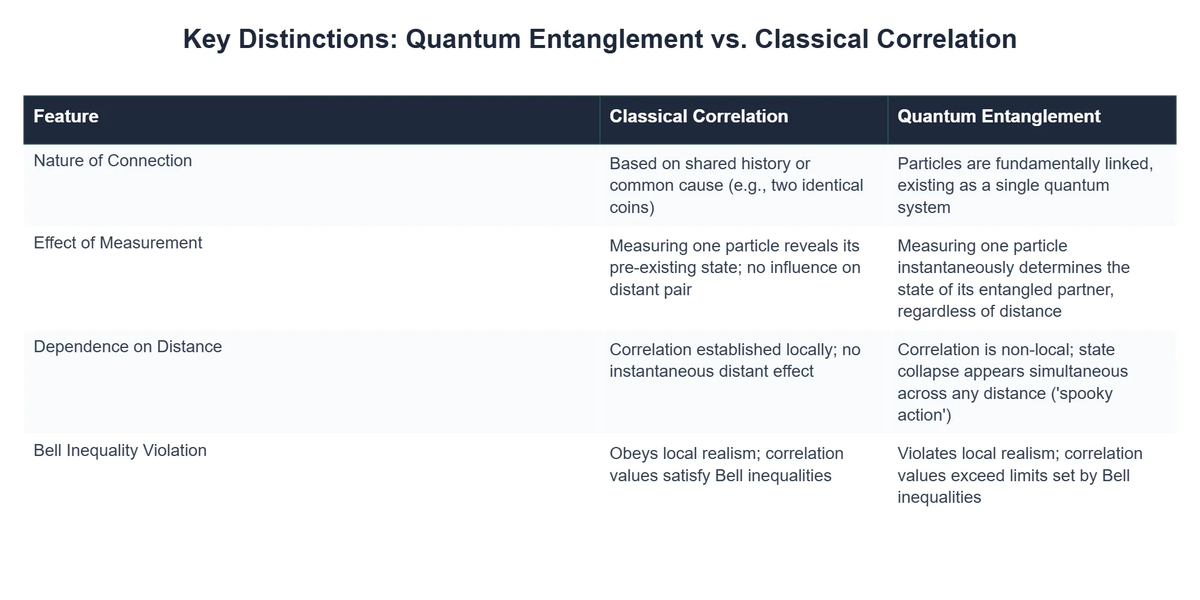
- ✅ Interconnected States: If you measure a property (like spin or polarization) of one entangled quantum particle, you instantaneously know the corresponding property of the other, even if it’s light-years away. Their states are perfectly correlated.
- ➡️ Instantaneous Correlation: This correlation happens immediately, defying the classical speed limit of light. This seeming “faster-than-light” communication is what troubled Einstein and led to his famous phrase, einstein entanglement.
- 💡 Beyond Classical Understanding: Unlike classical correlations (e.g., pulling one red sock from a pair tells you the other is also red), the properties of entangled particles are not predetermined before measurement. The act of measuring one particle collapses the shared quantum state, instantly defining the properties of all entangled particles.
This concept is a cornerstone of modern quantum physics, revealing a universe far stranger and more interconnected than our everyday experience suggests. It’s a key topic explored in depth within The Science of Everyday: How the World Really Works.
The History of “Spooky Action”: From Einstein’s Doubt to Modern Validation
While the theoretical groundwork for understanding the behavior of light and matter at atomic and subatomic levels was laid by pioneers like Max Planck (whose work on black-body radiation introduced the concept of energy quanta, a precursor to Max Planck quantum optics), it was Einstein, Boris Podolsky, and Nathan Rosen who formalized the challenge to entanglement in their 1935 EPR paradox paper.
Their argument suggested that if entanglement were real, it would imply “non-local” influences – actions at a distance that happen faster than light – which seemed to violate the principle of locality in physics. They believed that there must be “hidden variables” determining the outcomes, rather than true spooky action. For decades, this remained a theoretical debate, fueling the discussion around the completeness of quantum mechanics.
However, groundbreaking experiments, particularly those initiated by John Bell’s Theorem in the 1960s and subsequent experimental verifications by physicists like Alain Aspect (1980s) and Anton Zeilinger (Nobel Prize 2022), have repeatedly demonstrated that entanglement is indeed a real phenomenon. These experiments have shown that there are no hidden local variables at play; the “spooky action” is an intrinsic feature of the quantum world. Learn more about the practical implications of Zeilinger’s work in Anton Zeilinger and Quantum Entanglement: Everyday Impact.

For a detailed historical perspective on this fascinating concept, explore the Quantum entanglement – Wikipedia page.
⚙️ How Quantum Particle Entanglement Works: A Simplified Explanation
Let’s imagine two quantum particles, specifically photons, that are generated in such a way that their properties, such as polarization (the direction their electric field oscillates), are interdependent. These are known as entangled pairs:
Quantum Entanglement: Capabilities and Limitations
Pros
- ✔Enables exponentially faster quantum computation.
- ✔Powers ultra-secure communication through quantum cryptography.
- ✔Forms the basis for highly sensitive quantum sensors.
- ✔Offers profound insights into the fundamental nature of reality.
Cons
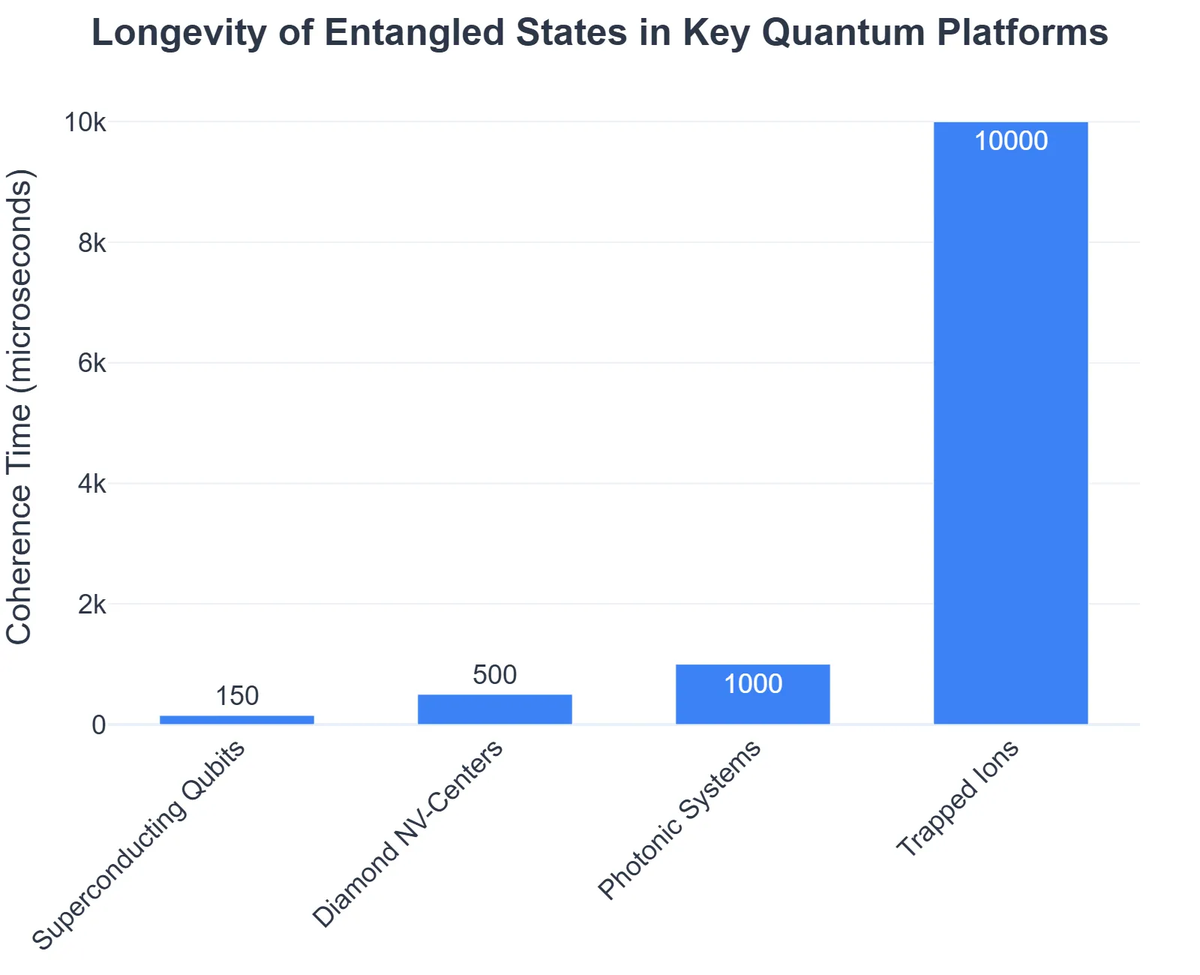
- ✖Extremely fragile and susceptible to environmental decoherence.
- ✖Technically challenging to generate, control, and maintain.
- ✖Significant hurdles in scaling up for practical applications.
- ✖Requires highly specialized and costly experimental setups.
- ✅ Creation of Entangled Pairs: A special non-linear crystal can be used to split a single high-energy photon into two new entangled photons, often referred to as a “down-conversion” process. Let’s call them Photon A and Photon B.
- ➡️ Spatial Separation: Photon A can be sent to one laboratory, while Photon B is sent to another laboratory, potentially thousands of miles away. Crucially, no information can pass between them at classical speeds.
- 💡 Measurement of One Particle: When a physicist in the first lab measures Photon A’s polarization (e.g., they find it to be vertically polarized).
- ⚡ Instantaneous Determination of the Other: Immediately, without any time delay, Photon B (no matter how far away) is guaranteed to have the complementary polarization (e.g., horizontally polarized). If Photon A was measured horizontally, Photon B would be vertical. This is the essence of quantum particle entanglement – their fates are inextricably linked.
This isn’t just a correlation that implies pre-existing properties; it’s a fundamental interconnectedness that exists before any measurement. The act of measuring one particle forces both particles to “decide” their states simultaneously, even across vast distances. This defies classical intuition, where information would have to travel between them to establish such a correlation.
Real-World Applications & Future Potential of Quantum Entanglement
Beyond its mind-bending theoretical implications, quantum entanglement is not merely a philosophical curiosity. It’s the bedrock of emerging technologies that promise to revolutionize various fields, ushering in a new era of quantum-powered capabilities:
- 🔐 Quantum Cryptography (QKD): Entanglement enables ultra-secure communication. If an eavesdropper attempts to intercept entangled photons, their attempt to measure them would instantly disturb the delicate entangled state, alerting the communicating parties. This makes the communication virtually unhackable, providing an unprecedented level of security.
- 💻 Quantum Computing: Entangled states, particularly those involving multiple qubits (quantum bits), allow quantum computers to perform complex calculations far beyond the capabilities of even the most powerful classical supercomputers. This could lead to breakthroughs in drug discovery, materials science, financial modeling, and artificial intelligence, by exploring vast computational spaces simultaneously.
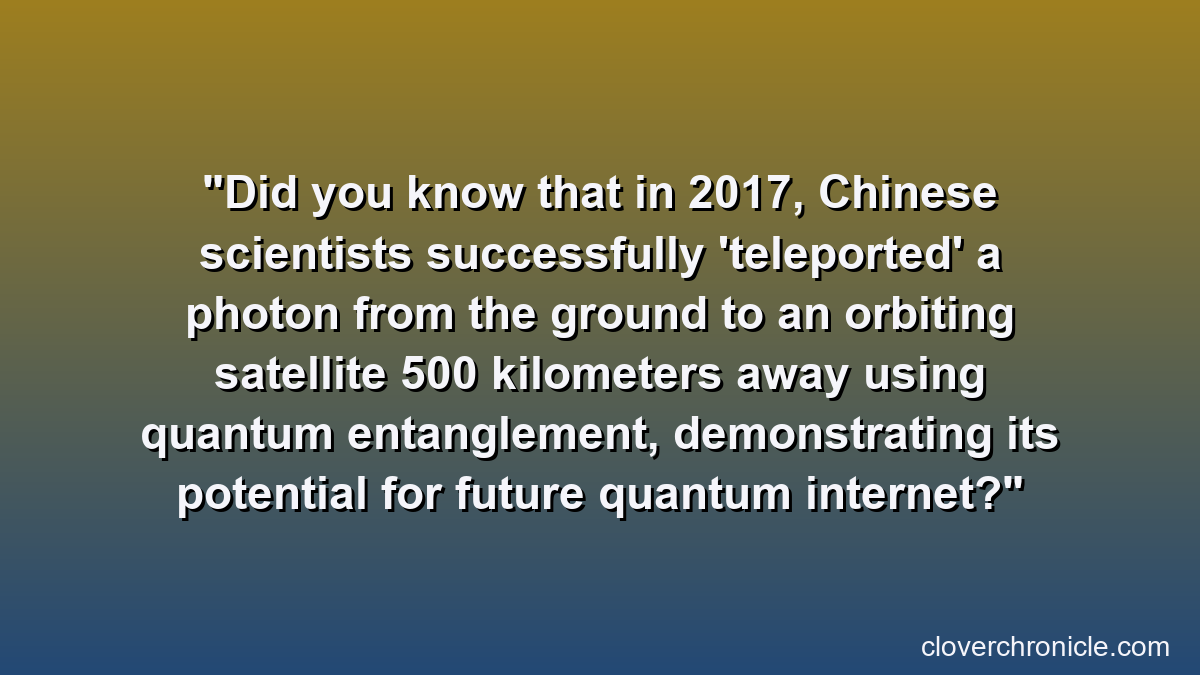
- 📡 Quantum Teleportation: While not teleportation in the sci-fi sense of moving objects, quantum teleportation involves transferring quantum information (the exact state of a particle) from one location to another using entangled particles. This is a crucial primitive for building quantum networks and, eventually, a global quantum internet.
- 🔬 Enhanced Sensing and Metrology: Entangled particles can be used to create extremely precise sensors, pushing the limits of measurement. This has potential applications in medical imaging, navigation systems, highly sensitive gravitational wave detectors, and fundamental scientific measurements.
The real-world applications of this “spooky” phenomenon are expanding rapidly, driving some of the most exciting scientific breakthroughs shaping our world today.
Recommended Video
The Frontier of Quantum Entanglement Research
Research into quantum entanglement is a vibrant and rapidly evolving field, attracting brilliant minds from around the globe. Scientists are continuously pushing the boundaries of what’s possible, exploring new ways to harness and understand this mysterious connection:
- Expanding entanglement to more particles and larger distances, aiming for robust quantum networks spanning continents.
- Developing more robust and stable entangled states that can withstand environmental interference, crucial for practical applications in quantum computing and communication.
- Exploring the fundamental nature of entanglement and its relationship to other profound theories, such as gravity and the structure of spacetime, potentially leading to a unified theory of everything.
- Investigating entanglement’s role in biological systems, though this remains highly speculative.
Proving the reality of quantum particle entanglement has been a monumental task, with landmark experiments like those detailed by Caltech’s research on proving quantum entanglement is real solidifying its place in physics. As we continue to unravel the mysteries of the quantum world, entanglement will undoubtedly remain at the forefront, challenging our perceptions and opening doors to unimaginable technological advancements.
What is quantum entanglement?
Quantum entanglement is a phenomenon where two or more particles become linked in such a way that the quantum state of each particle cannot be described independently of the others, even when separated by large distances.
Why did Einstein call it ‘spooky action at a distance’?
Einstein used this term because entanglement implies an instantaneous connection between particles, seemingly faster than the speed of light, which challenged his understanding of locality and relativity.
Has quantum entanglement been proven?
Yes, numerous experiments, most notably those related to Bell’s Theorem, have repeatedly confirmed the existence and properties of quantum entanglement, ruling out alternative classical explanations.
What are the potential applications of entanglement?
Entanglement is crucial for developing quantum computing, quantum cryptography (for secure communication), quantum teleportation, and advanced quantum sensors.