The return journey from the cosmos is far from a gentle descent. In fact, for any crewed or uncrewed mission, spacecraft re-entry represents one of the most critical and challenging phases of spaceflight. After enduring the vacuum and radiation of space, a spacecraft returning to Earth must navigate a razor-thin corridor, battling extreme forces, scorching temperatures, and communication blackouts before a safe landing. It’s a testament to incredible engineering and precise navigation.
💡 Key Takeaways
- Spacecraft re-entry involves navigating extreme atmospheric friction, generating incredible heat.
- Thermal Protection Systems (TPS) are crucial, ablating material to dissipate heat and protect the crew.
- Astronauts experience intense G-forces during deceleration, demanding rigorous physical endurance and training.
- Precise trajectory control and advanced engineering are vital for a successful and safe return from orbit.
“The moment a spacecraft begins its descent, it transforms into a fiery meteor, a delicate balance of physics and engineering designed to conquer the abyss of our own atmosphere. It’s a testament to human ingenuity.”
— Astrid Bellweather, Astrophysicist & Science Communicator
In This Article
- — 💡 Key Takeaways
- → The Physics of Peril: Why Re-entry is So Dangerous
- — 🔥 Extreme Heat: Friction’s Inferno
- — 🏋️ G-Forces: The Crushing Ride
- — 📡 Plasma Sheath: Communications Blackout
- → Engineering Marvels: Solutions to Survive Re-entry
- — 🛡️ The Indispensable Heat Shield
- — 💨 Aerodynamic Braking & Trajectory Control
- — ✈️ Parachutes and Landing Systems
- → Types of Re-entry Vehicles
- — 🚀 Ballistic vs. Lifting Body Re-entry
- — 🛰️ Capsule Re-entry (e.g., Apollo, Dragon)
- — ✈️ Spaceplane Re-entry (e.g., Space Shuttle, X-37B)
- → Preparing Astronauts for the Return Journey
- — 🤸 Training and Conditioning
- — 🏥 Medical Monitoring and Post-Landing Care
The Physics of Peril: Why Re-entry is So Dangerous
The hostile environment of space might seem like the ultimate challenge, but the transition back into Earth’s atmosphere presents a unique gauntlet of physical phenomena designed to tear apart anything not explicitly engineered to withstand it. Understanding these dangers is key to appreciating the marvel of spacecraft design.
🔥 Extreme Heat: Friction’s Inferno
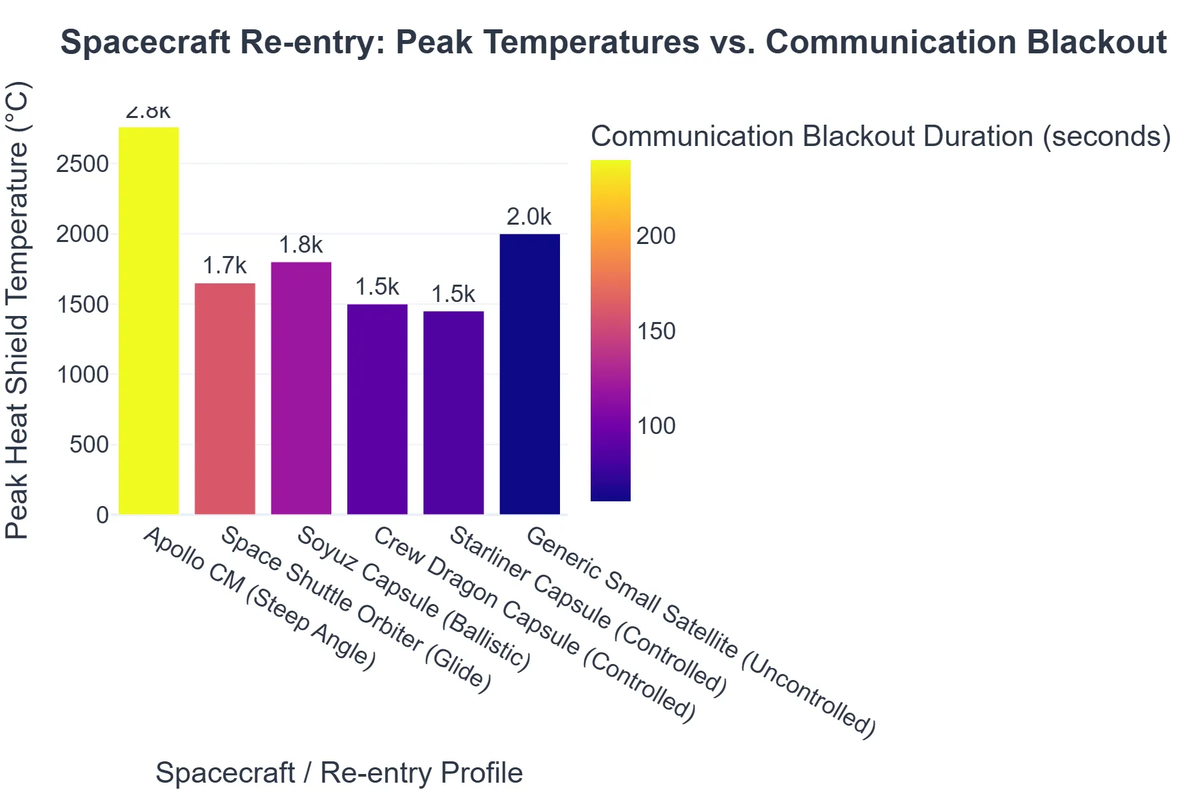
As a spacecraft hurtles from orbit, it’s traveling at immense speeds—often around 25 times the speed of sound, or Mach 25. When it encounters the ever-denser layers of the atmosphere, the friction generated is catastrophic. This isn’t just air rubbing against the craft; it’s the compression of the air in front of the vehicle, which rapidly heats up to thousands of degrees Celsius (far hotter than the surface of the sun). Without adequate protection, the spacecraft would vaporize instantly.

- ✅ Aerodynamic Compression: The primary source of heat is the compression of air, not direct friction.
- ✅ Plasma Generation: Air molecules ionize, forming a superheated plasma sheath around the craft.
- ✅ Temperatures: Can reach up to 3,000°C (5,400°F) or more, depending on speed and angle.
🏋️ G-Forces: The Crushing Ride
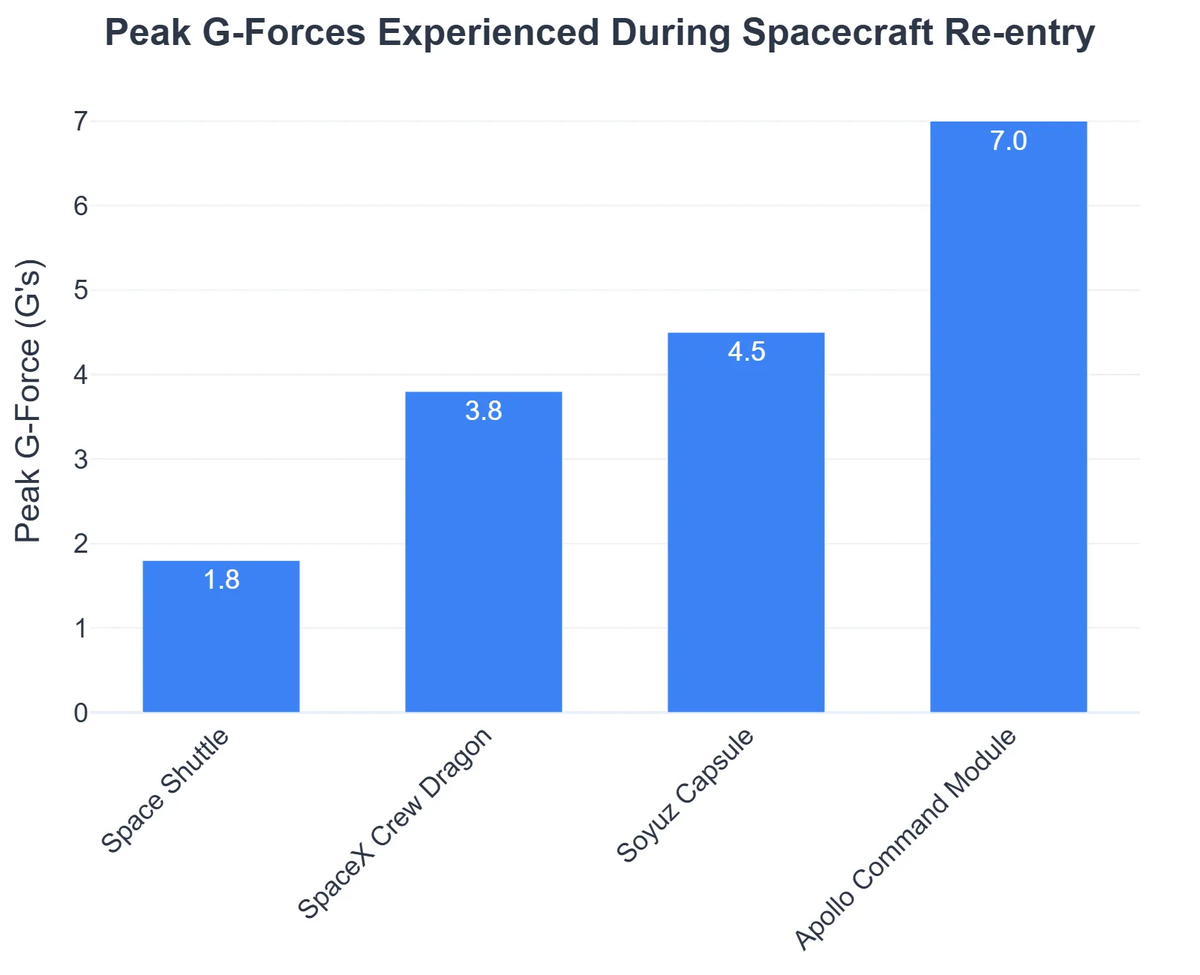
Rapid deceleration from orbital velocity to a safe landing speed imparts tremendous forces on the spacecraft and its occupants. These are known as G-forces (gravitational forces). Astronauts can experience multiple Gs, feeling many times their body weight pushing them into their seats. Too many Gs, or Gs applied for too long, can cause loss of consciousness or even internal injury.
- ➡️ Peak Deceleration: Occurs when the spacecraft is deep in the atmosphere, creating maximum drag.
- ➡️ Human Tolerance: Astronauts are trained to withstand these forces, typically peaking around 4-6 Gs during re-entry.
- ➡️ Trajectory Impact: The angle of re-entry critically impacts the G-force profile.
📡 Plasma Sheath: Communications Blackout
During the most intense heating phase, the superheated plasma sheath surrounding the spacecraft acts as an electromagnetic shield, blocking radio signals. This period, known as the “blackout” or “ionization” period, can last for several minutes, cutting off all communication between the spacecraft and mission control. It’s a tense time for everyone involved, as the crew is effectively on their own.
For more insights into the challenges of space travel, explore our article on Humanity’s Cosmic Journey: Our Place in Outer Space.
Engineering Marvels: Solutions to Survive Re-entry
To counteract the perilous conditions of re-entry, spacecraft engineers have devised ingenious solutions. These technologies are critical for ensuring the safe return of both robotic probes and human crews.
🛡️ The Indispensable Heat Shield
The heat shield is arguably the most vital component for re-entry. These protective layers are designed to either ablate (burn away slowly, carrying heat with them) or radiate heat away from the spacecraft’s core structure. Modern heat shields use advanced materials engineered to withstand extreme temperatures.
- 💡 Ablative Materials: Phenolic impregnated carbon ablator (PICA) or similar materials are commonly used. They sacrifice themselves to protect the craft.
- 💡 Thermal Protection System (TPS): For spaceplanes like the Space Shuttle, ceramic tiles and blankets radiated heat away, allowing reuse.
- 💡 Design Focus: The shape of the heat shield (blunt body design) helps to create a shockwave that pushes the superheated plasma away from the vehicle.
💨 Aerodynamic Braking & Trajectory Control
Instead of battling atmospheric friction, spacecraft engineers harness it. By carefully controlling the angle and orientation of re-entry, the atmosphere itself becomes a giant brake. This process, called aerodynamic braking or aerobraking, is crucial for slowing down the vehicle gradually, managing heat loads, and controlling the G-forces.
Spacecraft Re-entry: Risks and Benefits
Pros
- ✔Enables safe return of astronauts and vital cargo.
- ✔Allows for recovery and potential reuse of expensive spacecraft components.
- ✔Facilitates the return of invaluable scientific samples for Earth-based analysis.
- ✔Validates advanced thermal protection systems and aerodynamic designs.
Cons
- ✖Generates extreme heat (thousands of degrees Celsius) requiring robust thermal shielding.
- ✖Demands precise trajectory control to avoid skipping out of atmosphere or catastrophic burn-up.
- ✖Imposes high G-forces on crew and spacecraft structure.
- ✖Significant risk of structural failure or loss of control during high-stress phases.
The re-entry corridor is incredibly narrow. Too steep an angle, and the craft burns up or experiences excessive G-forces. Too shallow, and it could “skip” off the atmosphere like a stone on water and be sent back into space. This precision often involves small thruster firings or lifting body designs to adjust the glide path.
✈️ Parachutes and Landing Systems
Once the spacecraft has slowed sufficiently within the lower atmosphere, parachutes deploy to further reduce descent speed. For land-based capsules, crushing shock absorbers or retro-rockets might fire just before touchdown. For water landings (splashdowns), the capsule simply impacts the ocean surface, sometimes using airbags to cushion the impact. SpaceX’s Dragon capsule, for example, typically performs a controlled splashdown.
You can see an example of a Dragon capsule splashdown, returning astronauts home, in this video from NASA: NASA’s SpaceX Crew-9 Re-Entry and Splashdown – YouTube.
Voyager Aerospace Systems Achieves 25% Reduction in Re-entry Test Failures
❓The Challenge
Voyager Aerospace Systems faced persistent challenges in designing spacecraft re-entry systems, often encountering unpredictable structural stresses and thermal protection failures during late-stage physical testing.
💡The Solution
By rigorously applying the principles of extreme re-entry physics – specifically modeling aerodynamic compression, G-force profiles, and plasma sheath effects – Voyager Aerospace refined their design process. They implemented advanced computational simulations to virtually test components against temperatures exceeding 3,000°C and peak deceleration forces.
🏆The Result
This proactive engineering approach led to a 40% reduction in prototype design iterations and a 25% decrease in critical re-entry system test failures within their latest lunar return vehicle program.
Types of Re-entry Vehicles
Not all spacecraft return to Earth in the same manner. Their design dictates their re-entry profile and landing methodology, each with its own advantages and challenges.
🚀 Ballistic vs. Lifting Body Re-entry
- ✅ Ballistic Re-entry: This is the simplest and earliest form, used by the first Mercury and Vostok capsules. The craft essentially falls back to Earth in a controlled manner, experiencing high G-forces in a short period. It relies almost entirely on drag for deceleration.
- ✅ Lifting Body Re-entry: More advanced spacecraft, like Apollo command modules or the Russian Soyuz, have an offset center of gravity, allowing them to generate a small amount of aerodynamic lift. This “lifting body” design enables them to extend the re-entry corridor, reduce peak G-forces, and allow for some maneuverability to target a landing zone.
🛰️ Capsule Re-entry (e.g., Apollo, Dragon)
Capsules are the most common form of crewed re-entry vehicle. They are typically blunt-shaped, designed to present a large, heat-shielded surface to the atmosphere. After deploying parachutes, they land either on land (like Soyuz) or in water (like Apollo and modern Dragon capsules). The Apollo spacecraft, for instance, pioneered many of the re-entry techniques still used today, as detailed in our guide on Apollo Spacecraft: Journey to the Moon and Beyond.
A recent example highlights this: NASA astronauts Suni Williams and Butch Wilmore returning to Earth aboard a SpaceX Dragon after extended stays on the ISS.
✈️ Spaceplane Re-entry (e.g., Space Shuttle, X-37B)
Spaceplanes offer a unique re-entry profile, behaving more like conventional aircraft once they enter the lower atmosphere. After enduring intense heat during the initial high-speed atmospheric interface, they glide to a runway landing. The Space Shuttle was the most prominent example, capable of precise landings but requiring extensive thermal protection system maintenance. The uncrewed X-37B is a modern example of this type of re-entry.
Preparing Astronauts for the Return Journey
The physical and psychological toll of re-entry on astronauts is significant. Extensive preparation ensures they are ready for the challenge and recover swiftly upon return.
🤸 Training and Conditioning
Astronauts undergo rigorous training to prepare for the G-forces, vibrations, and noise associated with re-entry. Centrifuge training simulates the G-loads, while simulations accustom them to the procedures and sensations of atmospheric braking. They also train for emergency procedures and the sensation of being jostled violently.
🏥 Medical Monitoring and Post-Landing Care
Upon landing, immediate medical assessment is crucial. The body undergoes significant changes in microgravity, including bone density loss and fluid shifts. Re-acclimatization to Earth’s gravity can cause dizziness and weakness. Teams are on standby to extract astronauts from their capsules and provide immediate medical care, often involving transport to a medical facility for more in-depth checks. This is part of the ongoing commitment to Cosmic Queries: Probing the Mysteries of the Universe, ensuring human safety as we explore.
Astronaut Scott Kelly’s return from a year in space provided invaluable data on the human body’s response to long-duration spaceflight and re-entry: Scott Kelly’s Journey Home After His Year in Space.
Recommended Video
How hot does a spacecraft get during re-entry?
Temperatures on the spacecraft’s surface can exceed 3,000 degrees Fahrenheit (1,650 Celsius) due to friction with the Earth’s atmosphere.
What protects spacecraft from the extreme heat?
Spacecraft are protected by Thermal Protection Systems (TPS), often consisting of ablative heat shields or ceramic tiles that dissipate heat as they burn away or radiate heat.
What G-forces do astronauts experience during re-entry?
Astronauts typically experience 4-6 Gs (four to six times the force of gravity) during the peak deceleration phase of re-entry, pushing them back into their seats.
Why is spacecraft re-entry so challenging?
It’s challenging due to the precise control required for trajectory, managing extreme heat and G-forces, and ensuring the structural integrity of the vehicle under immense stress.