


In the vast expanse of space, moments of profound human endeavor stand out. Among them, the Apollo-Soyuz Test Project (ASTP) holds a unique and indelible place in history. Launched in July 1975, this landmark mission brought together the American Apollo spacecraft and the Soviet Union’s Soyuz 19, marking an unprecedented era of collaboration amidst the lingering chill of the Cold War. It wasn’t just a technical achievement; it was a powerful symbol of détente, proving that even adversaries could unite for a common, scientific purpose. This article delves into the intricate details, profound significance, and enduring legacy of this historic encounter, a true beacon of space cooperation that laid the groundwork for future international ventures.
💡 Key Takeaways
- The Apollo-Soyuz Test Project was the first joint space mission between the United States and the Soviet Union.
- It served as a powerful symbol of détente, demonstrating cooperation during a tense period of the Cold War.
- The mission successfully tested compatible rendezvous and docking systems for future international space endeavors.
- It laid crucial groundwork for subsequent collaborations, including the Shuttle-Mir program and the International Space Station (ISS).
“The Apollo-Soyuz mission wasn’t just a technical marvel; it was a profound human statement. It proved that even ideological adversaries could connect across the vastness of space, laying the cosmic groundwork for genuine collaboration.”
— Astrid Bellweather, Astrophysicist & Science Fiction Consultant
In This Article
- — 💡 Key Takeaways
- → The Cold War Space Race: A Prelude to Cooperation
- — 🇺🇸 VS. 🇷🇺 Competing Ideologies
- → Forging the Future: The Genesis of Apollo-Soyuz
- — 🤝 Diplomacy Meets Engineering
- → Pioneers of Peace: The Apollo and Soyuz Crews
- — 🧑🚀 The American Apollo Crew
- — 👨🚀 The Soviet Soyuz 19 Crew
- → The Mission Unfolds: Launch, Rendezvous, and Docking
- — 🚀 Soyuz 19: The Soviet Endeavor
- — 🇺🇸 Apollo: The American Contribution
- — 🔗 The Historic Docking
- → 🤝 The Iconic Handshake and Collaborative Activities
- — 🌍 Cultural Exchange in Orbit
- — 🔬 Joint Scientific Experiments
- → A Bridge to the Future: The Enduring Legacy of ASTP
- — 🌍 Paving the Way for International Space Stations
- → Conclusion: A Handshake Across the Cosmos
The Cold War Space Race: A Prelude to Cooperation
For decades leading up to 1975, the United States and the Soviet Union were locked in an intense geopolitical struggle, often referred to as the Cold War space race. This era was defined by fierce competition to achieve technological firsts in space, from Sputnik’s launch to the lunar landings. Each nation viewed space exploration not just as scientific endeavor but as a crucial demonstration of ideological superiority and technological might.
🇺🇸 VS. 🇷🇺 Competing Ideologies
- 🚀 Early Soviet Dominance: The USSR achieved initial victories with Sputnik 1, Yuri Gagarin’s first human spaceflight, and the first spacewalk.
- 🌕 American Lunar Triumph: The U.S. responded decisively with the Apollo program, culminating in the historic Apollo 11 moon landing.
- Tensions remained high, yet behind the scenes, both nations began to recognize the immense cost and inherent dangers of unbridled competition.
By the early 1970s, a period of reduced tensions, known as détente, began to emerge. This shift in the political landscape opened the door for previously unthinkable joint ventures, laying the groundwork for unprecedented space cooperation.
Forging the Future: The Genesis of Apollo-Soyuz
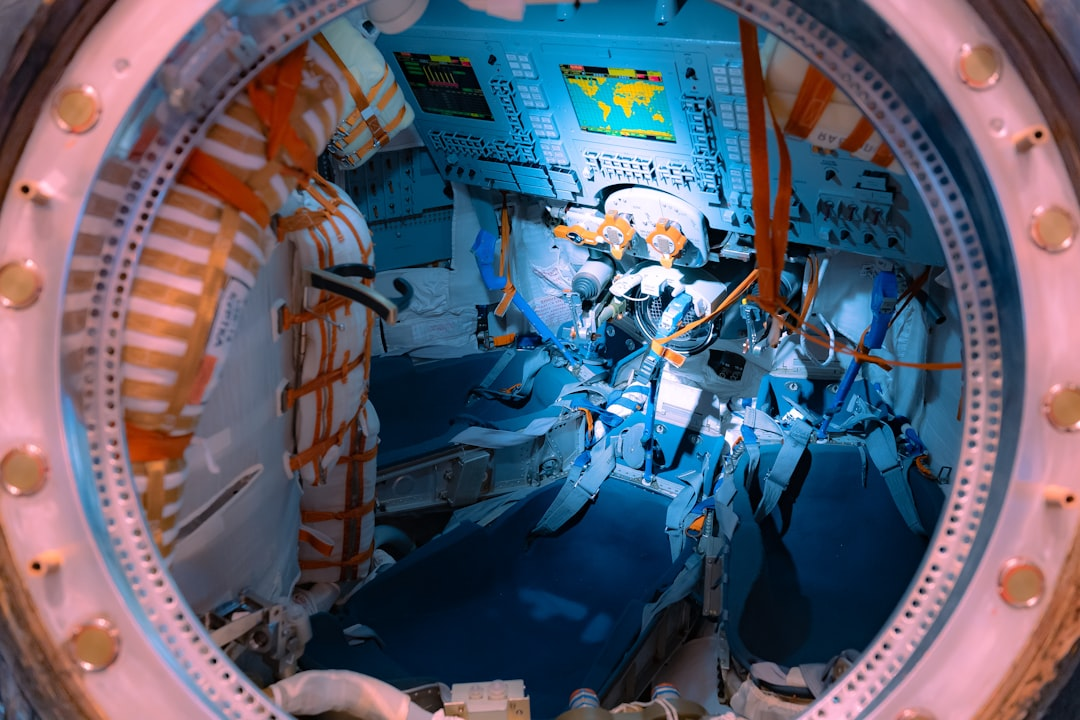
The idea of a joint U.S.-Soviet space mission had been proposed intermittently since the early 1960s but gained serious traction only with the onset of détente. Leaders on both sides saw the potential for a visible symbol of peace and mutual understanding.
🤝 Diplomacy Meets Engineering
- ✅ Early Negotiations: Formal discussions began in 1970, focusing on the technical feasibility of docking two vastly different spacecraft.
- ➡️ The Androgynous Peripheral Attach System (APAS): A critical challenge was designing a universal docking mechanism that could link the American Apollo and Soviet Soyuz modules. This led to the development of APAS, a revolutionary system allowing either side to act as the active or passive docking port.
- The agreement for the Apollo-Soyuz Test Project was formally signed in May 1972, setting the stage for intensive training and preparation.
This initiative required immense dedication from engineers, scientists, and diplomats, all working across language and cultural barriers to achieve a common goal. For more insights into the broader scope of space exploration, explore our Cosmic Queries: Probing the Mysteries of the Universe pillar page.
Pioneers of Peace: The Apollo and Soyuz Crews
The human element of the Apollo-Soyuz Test Project was as crucial as the technological innovation. The mission brought together experienced space travelers from both nations, who undertook rigorous joint training to ensure seamless operations in orbit.
🧑🚀 The American Apollo Crew
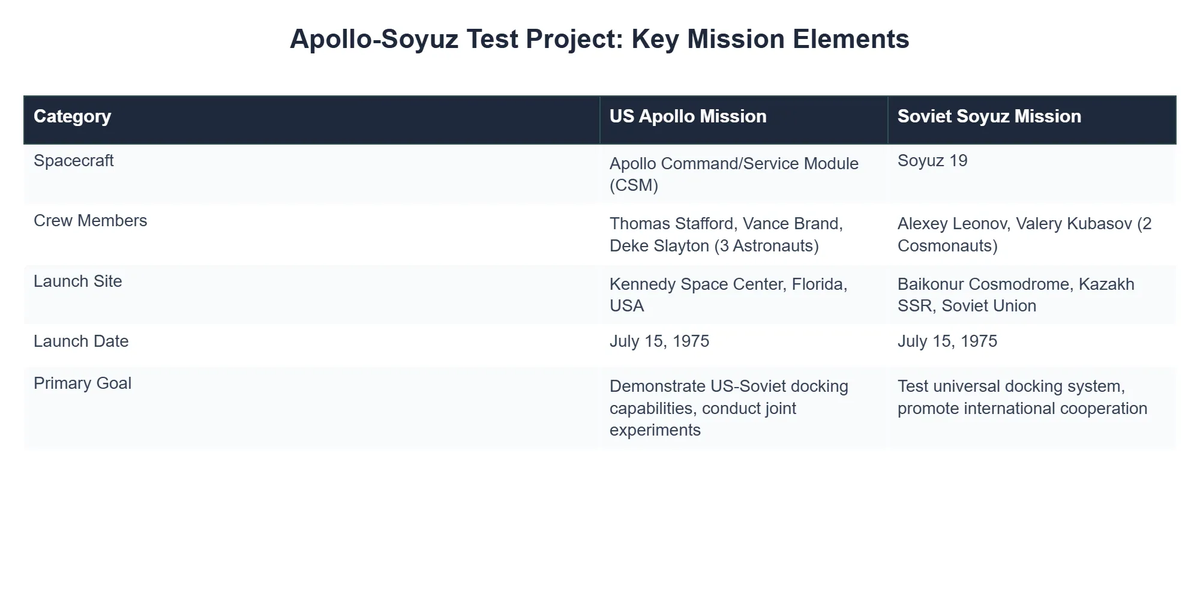
- Thomas P. Stafford: Commander, a veteran of Gemini and Apollo 10.
- Vance D. Brand: Command Module Pilot, on his first spaceflight.
- Donald K. “Deke” Slayton: Docking Module Pilot, one of the original Mercury Seven astronauts, finally making his first spaceflight after being grounded for medical reasons.
👨🚀 The Soviet Soyuz 19 Crew
- Alexei A. Leonov: Commander, a legendary cosmonaut who performed the first spacewalk.
- Valery N. Kubasov: Flight Engineer, a veteran of Soyuz 6.
Their training involved extensive language lessons, joint simulations, and cultural exchanges, building camaraderie that transcended political divides. This spirit of collaboration paved the way for future international ventures, much like the multinational efforts seen in the development of the International Space Station Virtual Tour: A Journey to Orbit.
The Mission Unfolds: Launch, Rendezvous, and Docking
The operational phase of the Apollo-Soyuz Test Project was a masterclass in precision engineering and orbital mechanics. Both spacecraft had distinct characteristics, yet they were designed to meet and integrate seamlessly in low Earth orbit.
Apollo-Soyuz Test Project: Pros and Cons
Pros
- ✔Pioneered international cooperation in space during the Cold War.
- ✔Developed and tested compatible docking systems for future missions.
- ✔Symbolized détente and improved US-Soviet relations.
- ✔Set a precedent for future international space programs like the ISS.
Cons
- ✖High cost for what was largely a symbolic mission.
- ✖Limited immediate scientific breakthroughs compared to earlier space efforts.
- ✖Did not immediately lead to sustained, continuous joint space programs.
- ✖Some critics viewed it more as a political ‘stunt’ than a critical scientific step.
🚀 Soyuz 19: The Soviet Endeavor
- 🗓️ Launch: July 15, 1975, from Baikonur Cosmodrome.
- 🛰️ Spacecraft: A modified Soyuz 7K-TM vehicle, specifically adapted for the ASTP mission with the new APAS docking system.
- The Soyuz spacecraft, while different in design from its American counterpart, was a robust and reliable platform, a testament to Soviet engineering, much like the ambitious Buran Spacecraft: Unraveling the Mystery of the Soviet Shuttle project that followed years later.
🇺🇸 Apollo: The American Contribution
- 🗓️ Launch: July 15, 1975 (several hours after Soyuz), from Kennedy Space Center, Launch Complex 39B.
- 🛰️ Spacecraft: A command and service module (CSM) left over from the Apollo moon program, fitted with a custom-built docking module. This module served as an airlock and adapter, allowing crew members to transfer between the two spacecraft with their different atmospheric compositions.
🔗 The Historic Docking
Two days after launch, on July 17, 1975, the momentous rendezvous and docking occurred. The Apollo crew executed the final approach and docking maneuvers. When the latches engaged, it was more than a technical feat; it was a powerful symbol of two nations literally connecting in space. For official details on the mission, you can refer to the NASA Apollo-Soyuz Test Project page.
🤝 The Iconic Handshake and Collaborative Activities
The image of U.S. astronaut Thomas Stafford and Soviet cosmonaut Alexei Leonov shaking hands through the open hatch of their docked spacecraft remains one of the most enduring symbols of the Apollo-Soyuz Test Project. This gesture, broadcast globally, encapsulated the mission’s spirit of peace and collaboration.
🌍 Cultural Exchange in Orbit
- 📸 Photo Opportunities: The crews exchanged flags, gifts, and even shared meals, fostering a unique camaraderie.
- 🗣️ Bilingual Communication: Astronauts and cosmonauts spoke each other’s languages, a result of their joint training, further breaking down barriers.
🔬 Joint Scientific Experiments
Beyond the symbolic gestures, ASTP was a real scientific mission. Over the two days the spacecraft were docked, the crews conducted a range of joint experiments, demonstrating the benefits of international scientific collaboration:
- 💡 Artificially Induced Solar Eclipse: The Apollo spacecraft maneuvered to block the sun from Soyuz, allowing Soviet cosmonauts to photograph the sun’s corona.
- 💨 Universal Furnace: Experiments with material science, studying the effects of microgravity on material properties.
- 🦠 Microbial Exchange: Studies to understand how microorganisms behaved in a shared space environment.
- The success of these experiments underscored the potential for greater international scientific endeavors. More historical context can be found on the Apollo–Soyuz Wikipedia page.
A Bridge to the Future: The Enduring Legacy of ASTP
The Apollo-Soyuz Test Project concluded on July 24, 1975, with both spacecraft landing safely in their respective territories. Its impact, however, resonated far beyond the technical success of the mission itself.

🌍 Paving the Way for International Space Stations
- ✅ Foundation for Cooperation: ASTP demonstrated that complex international space missions were not only possible but beneficial.
- ➡️ Shuttle-Mir Program: It directly influenced the Shuttle-Mir program of the 1990s, where American Space Shuttles docked with the Russian Mir space station.
- 🛰️ International Space Station (ISS): Crucially, ASTP laid the philosophical and technical groundwork for the International Space Station, the largest ongoing international collaborative project in space history.
While it didn’t immediately end the Cold War space race, ASTP undeniably softened its edges and fostered an environment of trust and mutual respect between the two superpowers in the realm of space exploration. It moved the narrative from competition to collaboration, showcasing humanity’s shared desire to explore the cosmos. This collaborative spirit is central to understanding the evolution of space exploration, from individual missions to complex programs like the Lunar Reconnaissance Orbiter (LRO): Mapping the Moon’s Mysteries[/dynamic_link}] which exemplifies international scientific data sharing.
Recommended Video
Conclusion: A Handshake Across the Cosmos
The Apollo-Soyuz Test Project stands as a towering achievement not just in spaceflight, but in diplomatic history. It transcended political divides, proving that shared scientific ambition could foster peace and understanding between nations locked in a prolonged ideological struggle. The sight of American astronauts and Soviet cosmonauts embracing in orbit was a powerful testament to the triumph of human ingenuity and goodwill over geopolitical friction.
This mission was a critical turning point, marking a definitive shift from the competitive intensity of the Cold War space race towards an era of sustained space cooperation. The legacy of Soyuz 19 and its Apollo counterpart lives on in every international mission launched today, reminding us that the vastness of space offers not just challenges to overcome, but also infinite opportunities for humanity to unite.
Frequently Asked Questions
What was the primary goal of the Apollo-Soyuz Test Project?
The primary goal was to test compatible rendezvous and docking systems for future international space rescue and cooperation missions, as well as to symbolize a period of détente between the US and USSR.
When did the Apollo-Soyuz mission take place?
The mission launched on July 15, 1975, with the historic docking of the Apollo and Soyuz spacecraft occurring on July 17, 1975.
Who were the commanders of the Apollo and Soyuz spacecraft?
The Apollo commander was Thomas Stafford, and the Soyuz 19 commander was Alexei Leonov.
What was the lasting legacy of the Apollo-Soyuz mission?
Its lasting legacy includes paving the way for sustained international cooperation in space, directly influencing programs like the Shuttle-Mir missions and the development of the International Space Station (ISS).