The Dawn of Commercial Spaceflight: SpaceX and the ISS
In the evolving landscape of space exploration, the collaboration between SpaceX and the International Space Station (ISS) stands as a monumental shift. For decades, government agencies predominantly shouldered the immense costs and complexities of launching crew and cargo into orbit. However, with the advent of private aerospace companies, particularly SpaceX, a new era of access to low-Earth orbit (LEO) has begun. This partnership has fundamentally reshaped how supplies are delivered and astronauts are transported to humanity’s orbital outpost, making SpaceX ISS Missions a cornerstone of modern space operations.
💡 Key Takeaways
- SpaceX revolutionized human spaceflight with its Crew Dragon spacecraft, ending reliance on Russian Soyuz for astronaut transport.
- The Falcon 9 rocket is the workhorse behind SpaceX’s reliable and cost-effective resupply missions to the International Space Station.
- Commercial partnerships, like the one with NASA, are vital for the sustained operation and expansion of human presence in low Earth orbit.
- SpaceX’s capabilities enhance scientific research and technological development aboard the ISS, enabling more experiments and crew time.
“SpaceX’s consistent delivery of both crew and critical cargo to the ISS underscores a new era of reliable, commercial access to low Earth orbit, profoundly accelerating scientific discovery and human presence beyond Earth.”
— Astrid Bellweather, Astrophysicist & Science Communicator
Through key contracts with NASA, specifically the Commercial Resupply Services (CRS) program and the Commercial Crew Program (CCP), SpaceX has proven its capability to reliably ferry essential supplies and, crucially, human beings to the ISS. This commercial model has not only injected innovation but also significantly reduced the cost of accessing space, paving the way for more ambitious endeavors.
In This Article
- → The Dawn of Commercial Spaceflight: SpaceX and the ISS
- — 💡 Key Takeaways
- → Dragon: Powering Cargo Resupply to the ISS
- → Crew Dragon: Revolutionizing Human Spaceflight
- → The Mechanics of a SpaceX ISS Mission
- — ⚙️ Launch and Ascent
- — 🛰️ Orbital Rendezvous and Docking
- — 🔄 Return and Reusability
- → The Future and Broader Impact of SpaceX’s ISS Contributions
Dragon: Powering Cargo Resupply to the ISS
SpaceX’s Dragon spacecraft was the first privately developed spacecraft to resupply the International Space Station, marking a historic milestone in 2012. Designed primarily for Cargo Delivery, the original Dragon capsule has served as a vital lifeline, bringing scientific experiments, provisions, and equipment to the orbiting laboratory.
Key features and capabilities of the Dragon cargo missions include:
- ✅ Pressurized Cargo: Dragon’s main cabin is pressurized, allowing it to transport sensitive equipment, food, and personal items for the crew in a shirt-sleeve environment.
- ✅ Unpressurized Cargo: An external “trunk” section enables the transport of larger components or scientific instruments that can withstand the vacuum of space, often for installation on the ISS exterior.
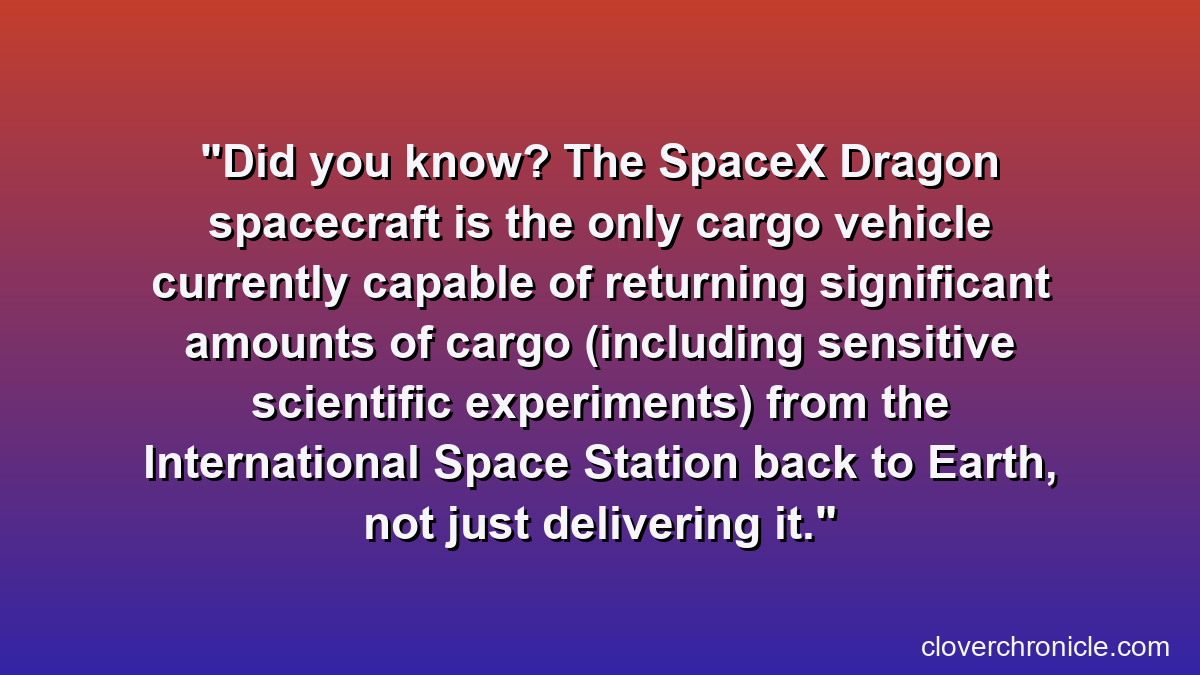
- ✅ Return Capability: Unlike many other cargo vehicles that burn up in the atmosphere, Dragon is uniquely capable of returning cargo to Earth. This allows for the retrieval of completed experiments, damaged equipment, and unwanted materials from the ISS, a critical service for ongoing research.
- ✅ Automated Docking: While earlier Dragon capsules were berthed to the ISS using the station’s robotic arm, the upgraded Cargo Dragon (based on the Crew Dragon design) now performs fully autonomous dockings, streamlining operations.
The reliability of these resupply missions has been instrumental in maintaining the ISS’s operational integrity and supporting hundreds of scientific investigations annually. The ability to return critical samples and equipment has profound implications for research conducted in microgravity, distinguishing SpaceX’s cargo capabilities.
AstroLabs Research Consortium Achieves 40% Cost Savings in Orbital Logistics
❓The Challenge
AstroLabs Research Consortium faced escalating costs and significant logistical hurdles in sending sensitive experimental payloads to low-Earth orbit, hindering their microgravity research timeline and budget.
💡The Solution
Inspired by the advent of commercial spaceflight and its proven reliability, AstroLabs shifted their strategy to partner with a private space logistics provider offering cost-effective and dependable two-way cargo transport, including crucial return capabilities for samples.
🏆The Result
This strategic pivot resulted in a 40% reduction in average payload launch and return costs, enabling AstroLabs to increase their annual experimental throughput by 25% and accelerate research findings.
Crew Dragon: Revolutionizing Human Spaceflight
Building upon the success of the cargo Dragon, SpaceX developed the Crew Dragon, a spacecraft specifically designed to transport astronauts to and from the ISS. This achievement under NASA’s Commercial Crew Program ended a nearly decade-long reliance on Russian Soyuz vehicles for crew transport, bringing human launch capability back to American soil.
The Crew Dragon represents a new generation of human-rated spacecraft with advanced features:
- ➡️ Autonomous Flight: Crew Dragon is largely autonomous, from launch to docking to splashdown. While astronauts can take manual control if necessary, the system is designed to handle most operations automatically.
- ➡️ Enhanced Safety Systems: Integrated launch escape engines (SuperDraco thrusters) are built directly into the side of the capsule, capable of propelling the spacecraft and its crew to safety in milliseconds during an emergency at any point during ascent.
- ➡️ Reusable Design: Like the Falcon 9 booster, the Crew Dragon capsule is designed for reusability, further reducing costs and turnaround times for future missions.
- ➡️ Modern Interior: The capsule features a sleek, touch-screen controlled interior, offering a more spacious and technologically advanced environment for the crew compared to previous generations of spacecraft.
The Demo-2 mission in 2020, carrying astronauts Bob Behnken and Doug Hurley, marked the first crewed flight of a privately built spacecraft and the first human spaceflight from the U.S. since 2011. Since then, regular crew rotation missions have become a routine part of iss spacex operations, ensuring a continuous human presence on the station. To understand the broader historical context of human spaceflight, you might find our article on Gemini Missions: NASA’s Stepping Stone to the Moon highly informative.
The Mechanics of a SpaceX ISS Mission
A typical spacex iss mission, whether for crew or cargo, involves a meticulously choreographed sequence of events, leveraging SpaceX’s integrated launch and spacecraft systems.
⚙️ Launch and Ascent
Every SpaceX mission to the ISS begins with the launch of a Falcon 9 rocket from Kennedy Space Center or Cape Canaveral Space Force Station in Florida. The Falcon 9 is a two-stage-to-orbit medium-lift launch vehicle, renowned for its reusability.
- 💡 First Stage Separation: Minutes after liftoff, the Falcon 9’s first stage separates and performs a controlled descent, either landing back at Cape Canaveral on Landing Zone 1 or on an autonomous drone ship in the Atlantic Ocean. This reusability is central to SpaceX’s cost-saving strategy.
- 💡 Second Stage Ignition: The second stage then ignites, carrying the Dragon spacecraft the rest of the way to orbit.
🛰️ Orbital Rendezvous and Docking
Once in orbit, the Dragon spacecraft embarks on a complex pursuit of the ISS, which orbits Earth at approximately 28,000 km/h (17,500 mph).
- ✅ Phased Approach: Over 1-2 days, Dragon performs a series of precise orbital maneuvers, gradually raising its altitude and adjusting its velocity to match that of the space station.
- ✅ Automated Docking: Utilizing its advanced navigation systems, including GPS, cameras, and lidar, Crew Dragon and the latest Cargo Dragon variants autonomously navigate to a docking port on the ISS, typically the International Docking Adapter (IDA) for crew, or a Common Berthing Mechanism (CBM) for cargo (though Cargo Dragon now also uses IDA).
🔄 Return and Reusability
SpaceX’s commitment to reusability extends beyond the Falcon 9 booster, significantly impacting the economics of space access.
- ➡️ Dragon Departure: After weeks or months docked to the station, Dragon undocks, either autonomously for Crew Dragon or unberthed by the robotic arm for older Cargo Dragons, carrying return cargo or crew.
- ➡️ Deorbit Burn: The spacecraft performs a deorbit burn, slowing itself down to begin its descent into Earth’s atmosphere.
- ➡️ Splashdown: Dragon splashes down in the Atlantic Ocean (for Crew Dragon) or the Pacific Ocean (for Cargo Dragon), where recovery teams retrieve the capsule and its precious contents. These recovered capsules are then refurbished for future missions, further lowering the overall cost of a spacex to iss journey.
This full cycle of launch, delivery, and return with reusable components distinguishes SpaceX and offers a more sustainable model for space operations. For those fascinated by the broader scope of missions, our article on Mars Missions: A Complete Guide to Past, Present, and Future Journeys explores another frontier.
The Future and Broader Impact of SpaceX’s ISS Contributions
The successful cadence of SpaceX missions to the ISS has ushered in a new era for space exploration, proving the viability of commercial partnerships for complex space operations. This ongoing collaboration is more than just about ferrying astronauts and supplies; it represents a fundamental shift in how humanity accesses and utilizes space.
The impact of SpaceX ISS Missions is far-reaching:
- 📈 Cost Reduction: Reusability of both rockets and spacecraft significantly lowers the per-launch cost, making space access more affordable for government agencies and, eventually, private entities.
- ✅ Increased Access and Flexibility: By providing reliable and frequent access, SpaceX enables more scientific research, technology demonstrations, and a more consistent human presence on the ISS. This flexibility allows for faster adaptation to research needs and operational requirements.
- 🌍 Catalyst for Commercial Space Economy: SpaceX’s success has validated the commercial space model, encouraging investment and innovation from other private companies. This competition fosters technological advancement and expands the overall space industry. NASA has explicitly stated the importance of its commercial partners in delivering crucial resources for station science. Learn more about NASA’s commercial partnerships.
- 🚀 Paving the Way for Deeper Space: The experience gained from ISS missions, particularly in autonomous rendezvous, docking, and human-rated spacecraft design, is directly applicable to future deep-space missions. Concepts like lunar Gateway or future Mars missions will undoubtedly benefit from the lessons learned in low-Earth orbit. SpaceX’s long-term vision extends far beyond the ISS. You can explore their broader mission goals on their official website: SpaceX Official Site.
As we continue to probe the mysteries of the universe, understanding these foundational logistical capabilities is key. This era of commercial spaceflight is not just about getting to the ISS; it’s about building the infrastructure and expertise for humanity’s next giant leaps into the cosmos. For a comprehensive exploration of diverse cosmic phenomena and space endeavors, delve into our pillar page: Cosmic Queries: Probing the Mysteries of the Universe.
Recommended Video
What is the primary purpose of SpaceX missions to the ISS?
SpaceX missions primarily serve to transport astronauts (via Crew Dragon) and vital supplies, equipment, and scientific experiments (via Cargo Dragon) to and from the International Space Station.
How many types of SpaceX Dragon spacecraft are there for ISS missions?
There are two main types: Crew Dragon, designed for human transportation, and Cargo Dragon (Dragon 2), specifically for resupply missions.
What rocket does SpaceX use for ISS missions?
SpaceX primarily uses its Falcon 9 rocket to launch both Crew Dragon and Cargo Dragon spacecraft to the International Space Station.
Has SpaceX ever failed an ISS mission?
While minor anomalies have occurred, SpaceX has maintained a highly successful track record for ISS resupply and crew rotation missions, with no total mission failures resulting in loss of ISS access.