


Imagine standing at the very edge of the ultimate cosmic abyss, a point of no return where the laws of physics as we know them are stretched to their limits. This isn’t just science fiction anymore. Thanks to advancements in virtual reality (VR) technology, we can now embark on an unprecedented journey to explore the enigmatic region known as the event horizon.
💡 Key Takeaways
- Experience a scientifically accurate 360° VR simulation of a black hole.
- Learn about gravitational lensing and spacetime distortion firsthand.
- Explore the mysteries of cosmology from an unprecedented perspective.
- Discover the potential of VR for educational and immersive science visualization.
“Event Horizon isn’t just a VR experience; it’s a profound leap in visualizing the unseeable. It makes the abstract physics of a black hole tangibly real, offering an unparalleled bridge between science and imagination.”
— Astrid Bellweather, Astrophysicist & Science Fiction Consultant
This article will delve into the transformative potential of an “Event Horizon: A 360° Virtual Reality Black Hole Experience,” explaining how these immersive simulations are revolutionizing our understanding and appreciation of the universe’s most mysterious objects. From the physics that defines these cosmic behemoths to the cutting-edge tech that brings them to life, prepare to step beyond the brink.
In This Article
- — 💡 Key Takeaways
- → What Exactly Is the Event Horizon?
- — 🌀 Beyond the Edge of Visibility
- → Why Virtual Reality for Black Hole Visualization?
- — 🌌 Unlocking Unprecedented Perspectives
- — Challenges and Breakthroughs in Black Hole VR
- → Key Features of a VR Black Hole Experience
- — ⚛️ Immersive Scientific Accuracy
- — Interactive and Educational Elements
- → Getting Started: Equipment and Astronomy Apps
- — 🎧 Essential Gear: VR Headsets
- — 📱 Top Astronomy Apps and Experiences
- → Beyond Visualization: The Future of Cosmic VR
- — 🔬 Research and Education
- — The Next Frontier
- → Conclusion
What Exactly Is the Event Horizon?
At the heart of every black hole lies a singularity, a point of infinite density where matter is crushed out of existence. Surrounding this singularity is the event horizon, a boundary beyond which nothing—not even light—can escape the black hole’s gravitational pull. It’s often referred to as the “point of no return.”
🌀 Beyond the Edge of Visibility
- ✅ A Gravitational Boundary: The event horizon isn’t a physical surface but a conceptual boundary defined by gravity. Once you cross it, the escape velocity exceeds the speed of light.
- ➡️ Spacetime Distortion: Near the event horizon, spacetime itself is dramatically warped. Time can appear to slow down for an observer far away, while an infalling object would experience extreme tidal forces, a phenomenon known as “spaghettification.”
- 💡 No Light Escapes: The reason black holes are “black” is precisely because light cannot escape from within their event horizon, making direct observation impossible. Our understanding comes from observing their effects on surrounding matter and gravitational waves. For a deeper dive, explore Event Horizon: Exploring the Edge of a Black Hole.
Why Virtual Reality for Black Hole Visualization?
Given the extreme conditions and sheer scale, direct observation of a black hole’s immediate vicinity is impossible. This is where virtual reality black hole experiences become indispensable tools. They offer a safe, immersive, and scientifically accurate way to explore these cosmic wonders.
🌌 Unlocking Unprecedented Perspectives
- ✅ Overcoming Scale and Distance: Black holes are unfathomably distant and massive. VR allows us to shrink those distances and experience their true scale in a way no flat image or video ever could.
- ➡️ Experiencing Spacetime: Simulating the extreme relativistic effects near a black hole, such as gravitational lensing and time dilation, is a complex task. VR platforms can accurately render these distortions, offering a tangible sense of how spacetime is warped.
- 💡 Safe Exploration: VR provides a completely safe environment to “fall” into a black hole without the catastrophic consequences of reality. This allows for repeated exploration and learning.
Challenges and Breakthroughs in Black Hole VR
Creating accurate black hole visualization in VR is a monumental task. It requires sophisticated computational astrophysics to simulate light paths and gravitational effects. Early visualizations were often simplified, but recent breakthroughs, including those from NASA, leverage supercomputer simulations to produce highly realistic black hole 360 view experiences. One notable effort from NASA has provided stunning new visualizations that take viewers “beyond the brink” of a black hole, allowing for unprecedented insight into its immediate surroundings (Source: NASA).
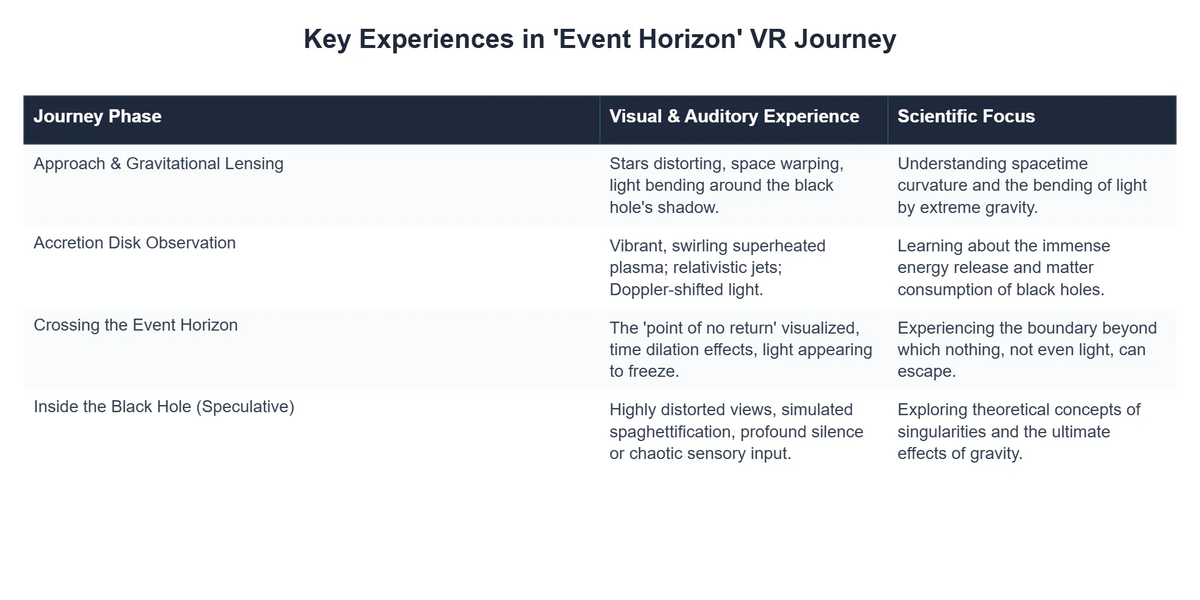
Key Features of a VR Black Hole Experience
A truly compelling virtual reality black hole experience goes beyond just pretty pictures. It integrates scientific accuracy with immersive storytelling.
⚛️ Immersive Scientific Accuracy
- ✅ Gravitational Lensing: Witness firsthand how the black hole’s immense gravity bends light, creating distorted views of distant stars and galaxies, and even the “Einstein ring” effect.
- ➡️ Accretion Disk Dynamics: Observe the swirling, superheated gas and dust of an accretion disk, often rendered with incredible detail, showcasing the fierce energies at play.
- 💡 Time Dilation Simulation: Some advanced VR experiences attempt to convey the perplexing concept of time dilation, allowing users to “see” how time might appear to slow down as they approach the event horizon.
Interactive and Educational Elements
- ✅ Guided Tours: Many experiences offer narrated journeys, providing scientific explanations of what you’re seeing, often incorporating real data from observatories.
- ➡️ Scalability: The ability to zoom in and out, or compare different types of black holes (stellar-mass vs. supermassive), enhances the educational value. Learn more about the scale of these objects in our article on Black Hole Appearance: Understanding the Event Horizon.
- 💡 User-Controlled Exploration: Some applications allow free movement around the black hole, letting users choose their path and experiment with different viewing angles.
Getting Started: Equipment and Astronomy Apps
Ready to embark on your own event horizon journey? Accessing these experiences is easier than ever, requiring readily available VR headsets and specialized software.
🎧 Essential Gear: VR Headsets
To experience the full immersion of a black hole 360 view, a dedicated VR headset is crucial. Options range from standalone units to PC-tethered systems:
- ✅ Standalone Headsets (e.g., Meta Quest series): These are convenient, all-in-one devices that don’t require a powerful PC. They offer a fantastic entry point into VR.
- ➡️ PC-Tethered Headsets (e.g., Valve Index, HP Reverb G2): These connect to a gaming PC and generally offer higher graphical fidelity and tracking precision, ideal for the most detailed simulations.
- 💡 Mobile VR (e.g., Google Cardboard, older Samsung Gear VR): While more basic, these use your smartphone and can offer a taste of VR for very little cost, though with less immersion and fidelity.
The accessibility of VR technology has significantly advanced, making it easier for everyone to explore phenomena like black holes safely and effectively. (Engineering.com)
📱 Top Astronomy Apps and Experiences
Once you have your hardware, you’ll need the software. Look for applications designed specifically for black hole visualization and space exploration:
- ✅ Universe Sandbox VR: While not exclusively black hole focused, this allows you to create and interact with celestial bodies, including black holes, and observe their gravitational effects.
- ➡️ Space Engine (VR-compatible): A highly detailed, procedural universe simulator that lets you explore galaxies, stars, and even black holes with incredible realism.
- 💡 NASA’s Official Visualizations: Keep an eye on official NASA channels and collaborations, as they often release cutting-edge virtual reality black hole experiences developed from real scientific data. Many general astronomy apps also incorporate VR modes for planetariums and deep-space objects.
For more insights into the powerful phenomena associated with these cosmic giants, consider reading our article on Black Hole Power: Energy, Jets, and Cosmic Influence.
Beyond Visualization: The Future of Cosmic VR
The use of VR for understanding black holes is just the beginning. This technology is poised to transform how we learn about and interact with the universe.
🔬 Research and Education
- ✅ Scientific Collaboration: VR platforms can facilitate collaborative research, allowing scientists to “walk through” complex datasets and simulations together, even when geographically separated.
- ➡️ Enhanced Learning: For students, a virtual reality black hole experience provides an unparalleled educational tool, making abstract concepts like spacetime curvature and relativity tangible and intuitive.
- 💡 Public Engagement: VR can make complex astrophysics accessible and exciting for the general public, fostering greater interest in science and space exploration.
The Next Frontier
Future developments may include haptic feedback for a more tactile experience, or even integration with live astronomical data streams to create near-real-time cosmic tours. The potential for a truly interactive journey into the heart of the cosmos, beyond the event horizon, is immense.
This pursuit of understanding the universe, from the smallest particles to the largest black holes, is at the core of our mission at Cosmic Queries: Probing the Mysteries of the Universe.
Recommended Video
Conclusion
The “Event Horizon: A 360° Virtual Reality Black Hole Experience” represents a monumental leap in our ability to grasp the most extreme phenomena in the cosmos. By leveraging advanced VR headsets and sophisticated astronomy apps, we can now safely traverse the perilous path towards a black hole’s event horizon, experiencing the profound distortions of spacetime and the awe-inspiring scale of these cosmic titans.
These immersive simulations not only provide breathtaking black hole visualization but also serve as invaluable educational tools, demystifying complex astrophysics for a wider audience. As VR technology continues to evolve, our cosmic journeys will only become more detailed, interactive, and truly unforgettable. The universe awaits your exploration, one virtual step at a time.
Frequently Asked Questions
What is ‘Event Horizon’ VR experience?
It’s a 360° virtual reality simulation designed to immerse users in a scientifically accurate depiction of approaching and experiencing a black hole.
Is the experience scientifically accurate?
Yes, ‘Event Horizon’ is developed with input from astrophysicists to ensure its portrayal of phenomena like gravitational lensing is as accurate as current understanding allows.
What equipment is needed to experience ‘Event Horizon’?
You will typically need a VR headset (e.g., Oculus, Vive, PSVR) and a compatible device (PC, console, or standalone). Specific requirements depend on the platform.
Can I learn about black holes from this experience?
Absolutely! While immersive, the experience aims to visually convey complex concepts like spacetime curvature and the event horizon, making them more understandable.