


Black Hole Power: Energy, Jets, and Cosmic Influence
When you imagine a black hole, you might picture an insatiable cosmic vacuum cleaner, passively devouring everything in its path. While their immense gravitational pull is undeniable, this image only tells half the story. In reality, black holes are among the most powerful engines in the universe, actively shaping galaxies and influencing cosmic evolution on colossal scales. Understanding the true nature of black hole power reveals a universe far more dynamic and interconnected than we often perceive.
💡 Key Takeaways
- Black holes convert gravitational energy into immense power, primarily through accretion disks.
- Relativistic jets, extending vast distances, are powerful conduits for this energy, affecting star formation and galaxy growth.
- The energy output from active galactic nuclei (AGN) can outshine entire galaxies.
- Understanding black hole power is crucial for comprehending cosmic evolution and the universe’s large-scale structure.
“Black holes are not just cosmic drains; they are the ultimate power plants of the universe, sculpting galaxies with their outflows. It’s the kind of raw, mind-bending energy that makes even our most ambitious science fiction feel a little tame.”
— Astrid Bellweather, Astrophysicist & Science Fiction Consultant
Far from being mere cosmic drains, these enigmatic objects are central to phenomena like quasars and active galactic nuclei (AGN), blasting out energy in forms that dwarf the output of entire galaxies. This article will delve into how black holes generate their incredible power, the mechanisms behind their iconic relativistic jets, and the profound influence they exert across the cosmos. Join us as we probe these mysteries and uncover the hidden engines of the universe.
In This Article
- → Black Hole Power: Energy, Jets, and Cosmic Influence
- — 💡 Key Takeaways
- → The Astonishing Power of Black Holes: Beyond Gravity
- — 🌌 Not Just Devourers: Engines of the Universe
- → Mechanisms of Energy Extraction from Black Holes
- — 🌪️ The Accretion Disk: A Cosmic Dynamo
- — 🌀 The Blandford-Znajek Process: Tapping into Spin
- — 💫 The Penrose Process: Theoretical Energy Harvesting
- → Relativistic Jets: Beacons of Black Hole Power
- — ⚡ What Are Black Hole Jets?
- — 🧩 The Formation Puzzle
- — 📏 Scale and Impact of Jets
- → Cosmic Influence: Shaping Galaxies and Beyond
- — 🌠 Feedback Loops: Star Formation and Galaxy Evolution
- — ✨ Quasars and Active Galactic Nuclei (AGN)
- → Observing and Measuring Black Hole Power
- — 🔭 Multi-Wavelength Astronomy
- — 📸 Imaging the Shadows and Jets
- → Conclusion: Black Holes – The Hidden Engines of the Cosmos
The Astonishing Power of Black Holes: Beyond Gravity

Black holes are regions of spacetime where gravity is so strong that nothing, not even light, can escape. But their “power” doesn’t come from merely consuming matter. Instead, it arises from the extreme physical processes that occur in their immediate vicinity, transforming gravitational energy into other forms of radiation and kinetic output.
🌌 Not Just Devourers: Engines of the Universe
The most massive black holes, known as supermassive black holes (SMBHs), reside at the centers of most galaxies, including our own Milky Way. When these SMBHs are actively accreting matter, they become “active galactic nuclei” (AGN), and the most luminous of these are observed as quasars. These are not just bright spots; they are titanic energy factories, outshining their host galaxies by hundreds or even thousands of times.
- ✅ Efficiency Unmatched: The processes around black holes can convert matter into energy with far greater efficiency than nuclear fusion.
- ✅ Cosmic Beacons: Quasars, powered by rapidly accreting SMBHs, were among the first objects to form in the early universe, serving as cosmic lighthouses.
Mechanisms of Energy Extraction from Black Holes
The energy output from black holes stems primarily from two astonishing mechanisms: the friction within the accretion disk and the tapping of the black hole’s own rotational energy.
🌪️ The Accretion Disk: A Cosmic Dynamo
Matter doesn’t fall directly into a black hole. Instead, as gas, dust, and stars approach, they form a vast, swirling disk around it, known as an accretion disk. The intense gravitational pull compresses and heats this material to incredible temperatures (millions of degrees Celsius or Fahrenheit) as it spirals inward due to friction and viscosity.
- 💡 Radiant Energy: This superheated plasma emits enormous amounts of radiation across the electromagnetic spectrum, from radio waves to X-rays and gamma rays.
- 💡 Gravitational Potential Energy: A significant fraction of the gravitational potential energy of the infalling matter is converted into kinetic energy and then into heat and light before crossing the event horizon.
🌀 The Blandford-Znajek Process: Tapping into Spin
One of the most powerful mechanisms for extracting energy from black holes relies on their rotation. For a spinning black hole (a Kerr black hole), spacetime itself is dragged around. This phenomenon, known as “frame-dragging,” has profound implications for energy generation.
The Blandford-Znajek process proposes that magnetic field lines, threading through the black hole’s ergosphere (a region where spacetime is dragged around so strongly that nothing can remain static), can be twisted and amplified by the black hole’s rotation. This twisting of magnetic fields acts like a gigantic dynamo, extracting rotational energy directly from the black hole and launching powerful jets of plasma.
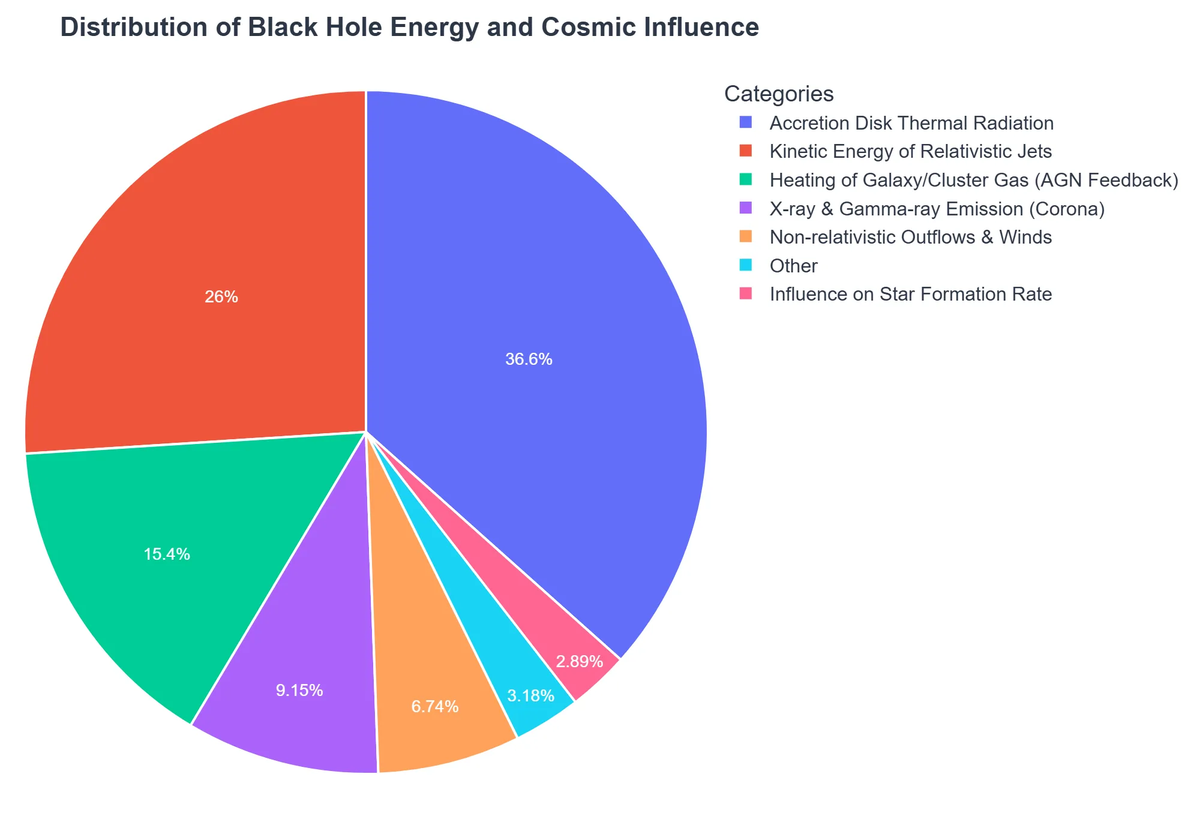
For a deeper understanding of how rotation influences these cosmic giants, explore our article on Rotating Black Holes: Understanding Cosmic Influence.
💫 The Penrose Process: Theoretical Energy Harvesting
A more theoretical concept, the Penrose process, describes how energy could be extracted from a rotating black hole. It involves sending a particle into the ergosphere, splitting it into two, with one part falling into the black hole and the other escaping with more energy than the original particle. While elegant in theory, direct astrophysical evidence of this process actively powering jets in the same way as Blandford-Znajek is less clear.
Relativistic Jets: Beacons of Black Hole Power
Perhaps the most visually striking manifestation of black hole power is the emission of relativistic jets—collimated beams of plasma that can extend millions of light-years into space.
⚡ What Are Black Hole Jets?
Black hole jets are colossal outflows of highly energetic particles, moving at speeds close to the speed of light. They are observed emanating from the poles of accreting supermassive black holes, perpendicular to the accretion disk.
- ➡️ Multi-wavelength Emission: These jets are detectable across the electromagnetic spectrum, from radio waves (synchrotron radiation from electrons spiraling in magnetic fields) to X-rays and gamma rays.
- ➡️ Collimation: The mechanism that collimates these beams into such narrow, powerful streams is thought to be strong magnetic fields generated by the accretion disk and the black hole itself.
🧩 The Formation Puzzle
While the exact mechanism of jet formation is still an active area of research, the prevailing theories involve strong magnetic fields. These fields are believed to be anchored in the accretion disk and twisted by the black hole’s rotation, creating a sort of magnetic funnel that channels and accelerates the plasma outwards.
As the Simons Foundation explains, magnetic fields play a crucial role in how black holes power plasma jets, effectively channeling the immense energy generated by the accretion process into these powerful outflows. (Source: How Black Holes Power Plasma Jets)
📏 Scale and Impact of Jets
The sheer scale of these jets is mind-boggling. They can extend far beyond the confines of their host galaxy, impacting the intergalactic medium and influencing cosmic structures on vast scales. For instance, Caltech research has highlighted truly gargantuan black hole jets, among the biggest ever observed, showcasing their profound reach into the universe. (Source: Gargantuan Black Hole Jets Are Biggest Seen Yet)
Cosmic Influence: Shaping Galaxies and Beyond
The energy and jets emanating from black holes are not just spectacular cosmic phenomena; they are vital players in the evolution of galaxies and the larger cosmic web. This is often referred to as “feedback” from the active galactic nucleus.
Black Hole Power: Cosmic Influence and Implications
Pros
- ✔Generates immense energy, powering luminous quasars and active galactic nuclei.
- ✔Crucial for regulating star formation and evolution within host galaxies.
- ✔Black hole jets distribute matter and energy across vast cosmic distances.
- ✔Provides a central gravitational anchor for galaxies.
Cons
- ✖Destructive tidal forces rip apart stars and gas clouds.
- ✖Emits high-energy radiation and jets potentially hazardous to nearby environments.
- ✖Can quench star formation, leading to ‘dead’ galaxies.
- ✖Represents an ultimate gravitational trap, from which nothing escapes.
🌠 Feedback Loops: Star Formation and Galaxy Evolution
Black hole feedback can have both positive and negative impacts on star formation within a galaxy:
- ✔️ Negative Feedback: Powerful jets and intense radiation from an AGN can heat or expel gas from the galaxy’s halo, preventing it from cooling down to form new stars. This regulates star formation, preventing galaxies from becoming too massive too quickly.
- ✔️ Positive Feedback: In some cases, the passage of jets through the interstellar medium can compress gas clouds, triggering bursts of star formation.
This intricate interplay between black holes and their host galaxies is crucial for understanding how galaxies grow and evolve over cosmic time. For insights into cosmic objects near black holes, see our discussion on Planets Around Black Holes: Unveiling Blanets and Rogue Planets.
✨ Quasars and Active Galactic Nuclei (AGN)
Quasars and other AGN represent periods of intense black hole activity. Their prodigious energy output in the early universe played a critical role in:
- Re-ionization: Emitting vast amounts of ultraviolet radiation, helping to re-ionize the neutral hydrogen gas that filled the early universe, making it transparent to light.
- Seeding Structure: Providing early energy injection that influenced the distribution of matter on large scales.
Observing and Measuring Black Hole Power
Detecting and characterizing the immense power of black holes requires sophisticated astronomical tools and techniques.
🔭 Multi-Wavelength Astronomy
Since black hole accretion and jets emit across the entire electromagnetic spectrum, astronomers use a variety of telescopes:
- ✅ Radio Telescopes: Ideal for detecting the diffuse emission from large-scale jets.
- ✅ X-ray Telescopes: Crucial for observing the inner, superheated regions of accretion disks and the bases of jets.
- ✅ Gamma-ray Telescopes: Capture the highest-energy emissions from highly relativistic particles within jets.
- ✅ Optical and Infrared: Used to observe the host galaxies and the effects of feedback.
📸 Imaging the Shadows and Jets
The Event Horizon Telescope (EHT) has provided groundbreaking direct images of the ‘shadow’ of supermassive black holes, such as M87* and Sagittarius A*. While these images don’t directly show the jets, they confirm the existence of the event horizon and the extreme spacetime curvature that gives rise to these powerful phenomena.
Recommended Video
Conclusion: Black Holes – The Hidden Engines of the Cosmos
Black holes are far more than just gravitational wells; they are dynamic, energetic powerhouses that profoundly influence their galactic environments and the evolution of the universe itself. From the scorching friction of accretion disks to the mind-bending efficiency of extracting energy from their own spin, the mechanisms behind black hole power continue to astonish scientists.
Their relativistic jets, extending for light-years, are not merely astronomical curiosities but active agents in shaping the cosmic landscape, regulating star formation, and providing crucial feedback that dictates the fate of galaxies. As our understanding of these incredible objects grows, we continue to unravel the intricate tapestry of cosmic evolution, affirming that black holes are indeed among the most important, and still mysterious, components of the universe.
For more deep dives into the cosmos, continue your journey with Cosmic Queries: Probing the Mysteries of the Universe.
Frequently Asked Questions
How do black holes generate such immense power?
Black holes generate power primarily through the friction and gravitational energy released from material spiraling into their accretion disks, which then gets ejected as powerful jets.
What are relativistic jets?
Relativistic jets are highly collimated beams of plasma, accelerated to near the speed of light, that erupt from the poles of supermassive black holes, carrying enormous amounts of energy far into space.
How do these jets affect galaxies?
These powerful jets can heat and displace gas within galaxies, inhibiting star formation in some regions while potentially triggering it in others, thus playing a crucial role in galaxy evolution.
Is it possible to harness black hole energy?
While theoretically immense, harnessing black hole energy is currently beyond our technological capabilities. Concepts like Penrose processes explore energy extraction, but remain speculative.