
Einstein and the Big Bang: His Actual View
Albert Einstein, a name synonymous with genius, revolutionized our understanding of space, time, gravity, and the universe itself. His theories, particularly General Relativity, laid the foundational mathematical framework for modern cosmology. Yet, when it comes to the Big Bang theory – the prevailing model for the universe’s origin – Einstein Big Bang connection is often misunderstood.
💡 Key Takeaways
- Einstein initially favored a static universe, leading him to introduce the cosmological constant.
- He later accepted an expanding universe after Hubble’s discoveries, famously calling the constant his ‘biggest blunder’.
- While he didn’t directly predict the Big Bang, his work on general relativity laid foundational groundwork for its theoretical development.
- His cosmological views evolved significantly as new astronomical evidence emerged, showcasing scientific adaptability.
“Einstein’s dance with the Big Bang theory is a fascinating reflection of science itself—constantly evolving, sometimes stumbling, but always driven by new evidence. His ‘blunder’ was, in fact, a testament to his adaptability and the profound impact of his initial framework on our understanding of cosmic origins.”
— Astrid Bellweather, Astrophysicist & Science Fiction Consultant
Did Einstein predict the Big Bang? Did he accept it readily? The truth is nuanced, reflecting a fascinating journey of scientific discovery and personal intellectual evolution. This article will meticulously explore Einstein’s initial resistance to an expanding universe, his famous “blunder,” and how his perspective shifted in light of overwhelming empirical evidence.
For a deeper exploration of the cosmos and its many enigmas, dive into our comprehensive guide on Cosmic Queries: Probing the Mysteries of the Universe.
In This Article
- → Einstein and the Big Bang: His Actual View
- — 💡 Key Takeaways
- → The Pre-Big Bang Consensus: Einstein’s Static Universe
- — 🌌 The Cosmological Constant’s Role
- — 🤔 Why a Static Universe?
- → Georges Lemaître and the Expanding Universe
- — ✨ Lemaître’s “Primeval Atom”
- — 🥶 Initial Reception of the Expanding Model
- → Hubble’s Discovery and Einstein’s “Biggest Blunder”
- — 🔭 Observational Evidence for Expansion
- — 😅 Einstein’s Recantation (and Nuances)
- → Einstein’s Evolving Perspective on an Evolving Cosmos
- — 🔄 From Static to Dynamic
- — 🌌 What Einstein’s ViewReallyWas
- → Why Einstein Didn’t “Predict” the Big Bang (But His Work Enabled It)
- — ✖️ Equations vs. Interpretation
- — фунда The Role of General Relativity
- → The Modern Understanding of the Big Bang
- — 🔬 Key Pillars of the Theory (CMB, Redshift, Abundances)
- — 🚀 Beyond Einstein’s Lifetime
- → Conclusion
The Pre-Big Bang Consensus: Einstein’s Static Universe
In the early 20th century, before the full implications of general relativity were widely understood in a cosmic context, the prevailing scientific belief was that the universe was static, eternal, and unchanging on large scales. This was a fundamental assumption held by many leading thinkers, including Einstein himself.
🌌 The Cosmological Constant’s Role
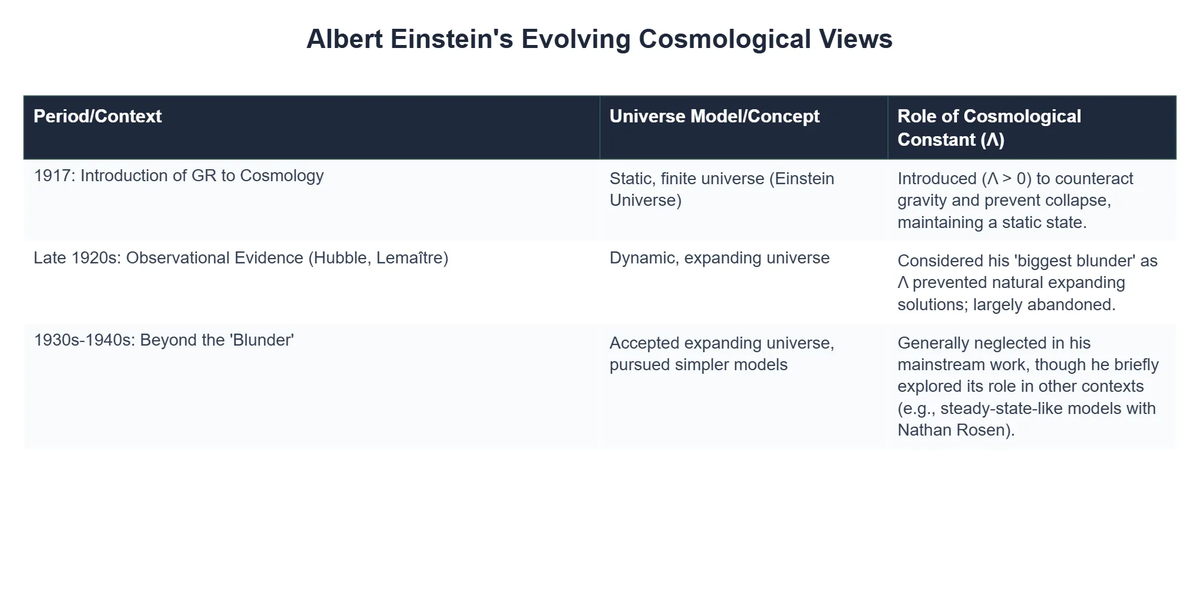
When Einstein developed his equations for General Relativity in 1915, they inherently suggested a dynamic universe – one that should either be expanding or contracting. This contradicted the accepted static model of his time. To reconcile his theory with the then-prevailing view of a static universe, Einstein introduced a term known as the cosmological constant (Lambda, Λ) into his field equations.
- ✅ Purpose: The cosmological constant acted as a repulsive force, counteracting gravity’s tendency to pull matter together, thus allowing for a stable, static universe.
- ➡️ Initial Belief: Einstein considered this a necessary component to ensure his equations accurately described the universe as he believed it to be.
🤔 Why a Static Universe?
The idea of a static universe was deeply ingrained for several reasons:
- 💡 Philosophical Comfort: A universe that has always been and always will be felt more stable and perhaps less “unsettling” than one with a definite beginning.
- 🔬 Lack of Evidence: There was no observational evidence at the time to suggest the universe was anything but static. Astronomical observations were not yet advanced enough to detect cosmic expansion.
- ✨ Olbers’ Paradox: This paradox, which questions why the night sky is dark if the universe is infinite and eternal with stars everywhere, also contributed to the static model’s appeal, as a finite or non-uniform universe wasn’t fully considered in this context.
Georges Lemaître and the Expanding Universe
While Einstein was adjusting his equations for a static cosmos, other brilliant minds were independently exploring the implications of General Relativity, leading them to a very different conclusion: an expanding universe.
✨ Lemaître’s “Primeval Atom”
A Belgian priest and physicist named Georges Lemaître was among the first to propose a theoretical model of an expanding universe. In 1927, he published a paper that used Einstein’s own general relativity equations to show that the universe must be expanding. He even provided an estimate for the expansion rate (Hubble’s Law) two years before Hubble’s famous publication. Lemaître later hypothesized that this expansion originated from a singular, extremely dense point, which he called the “primeval atom” – an early conceptualization of what we now call the Big Bang.
- ➡️ Pioneering Work: Lemaître’s mathematical deductions were groundbreaking, directly suggesting a dynamic universe.
- 💡 Initial Hypothesis: His “primeval atom” concept laid the groundwork for the idea of a cosmic origin point.
🥶 Initial Reception of the Expanding Model
Lemaître’s ideas initially met with skepticism, even from Einstein himself. During a Solvay Conference in 1927, Einstein reportedly told Lemaître that his mathematics were excellent, but his physics were “abominable” – a clear dismissal of the concept of an expanding universe. This highlights how deeply entrenched the static universe model was in scientific thought. To understand more about these early debates, consider exploring Big Bang vs. Steady State: The Debate on the Universe’s Origin.
Hubble’s Discovery and Einstein’s “Biggest Blunder”
The theoretical predictions of Lemaître and others were soon bolstered by observational evidence that would fundamentally change cosmology forever.
🔭 Observational Evidence for Expansion
In 1929, American astronomer Edwin Hubble, working with Milton Humason, published his groundbreaking observations that galaxies were moving away from Earth, and the speed at which they were receding was proportional to their distance. This phenomenon, known as the Hubble-Lemaître Law (or simply Hubble’s Law), provided empirical proof of an expanding universe.
- ✅ Redshift: Hubble observed the redshift of light from distant galaxies, indicating they were moving away.
- ➡️ Distance-Velocity Relation: The further away a galaxy, the faster it was receding, consistent with a uniform expansion of space.
😅 Einstein’s Recantation (and Nuances)
Upon learning of Hubble’s findings, Albert Einstein made a famous visit to Hubble at Mount Wilson Observatory in 1931. Confronted with the observational proof, Einstein publicly retracted his cosmological constant, calling its introduction his “biggest blunder” (or “greatest mistake”).
Einstein’s Relationship with the Expanding Universe and Big Bang Theory
Pros
- ✔His General Relativity provided the fundamental mathematical framework for an expanding universe.
- ✔He eventually accepted the expanding universe after strong observational evidence (Hubble’s Law).
- ✔His initial ‘cosmological constant’, though retracted, found renewed theoretical relevance with dark energy.
Cons
- ✖Initially resisted the idea of an expanding universe, adding a cosmological constant to force a static model.
- ✖Did not originate or actively champion the Big Bang theory itself (e.g., Lemaître’s primeval atom concept).
- ✖Expressed skepticism towards the idea of a singular, sudden beginning of the universe.
This statement is often interpreted as Einstein admitting he should have trusted his original equations, which inherently predicted a dynamic universe, rather than forcing them to fit a static one. His acknowledgement marked a pivotal moment in the acceptance of an expanding cosmos. While he may have regretted the introduction of the cosmological constant, the term has since been reintroduced into modern cosmology to explain the accelerating expansion of the universe (dark energy), showing that scientific concepts can evolve. You can read more about why Einstein did not immediately accept the Big Bang theory on Quora.
Einstein’s Evolving Perspective on an Evolving Cosmos
Einstein’s intellectual journey mirrored the seismic shifts occurring in cosmology. His initial skepticism gave way to acceptance of an expanding universe, though his precise Einstein’s View on the concept of a “Big Bang” beginning remained complex.
🔄 From Static to Dynamic
After Hubble’s observations, Einstein fully embraced the idea of an expanding universe. He recognized that his General Relativity equations, when left unadulterated by the cosmological constant, naturally described such a dynamic cosmos. This was a testament to his scientific integrity: he was willing to change his views in the face of compelling evidence.
- 💡 Adaptability: Einstein’s willingness to abandon a deeply held belief underscored his commitment to empirical truth.
- ✅ Validation: Hubble’s work validated the dynamic solutions to Einstein’s equations, proving their predictive power beyond his initial interpretation.
🌌 What Einstein’s View Really Was
While Einstein accepted the expansion of the universe, it’s crucial to distinguish this from fully endorsing the “Big Bang” as we understand it today. The term “Big Bang” itself was coined much later (derisively by Fred Hoyle in 1949) and the full theory, complete with its hot, dense early state and subsequent evolution, only solidified with later evidence like the Cosmic Microwave Background (CMB). Einstein largely focused on the dynamics of the universe’s expansion rather than its precise initial conditions or singularity, which remained highly theoretical and debated during his lifetime. His work on Einstein and Black Holes: Theory of Relativity’s Cosmic Legacy also highlights how his theories had profound implications for singular points in spacetime.
Why Einstein Didn’t “Predict” the Big Bang (But His Work Enabled It)
It’s a common misconception that Einstein’s equations directly predicted the Big Bang. While his General Relativity equations were the mathematical bedrock, the interpretation and acceptance of a singular origin point came through the work of others.
✖️ Equations vs. Interpretation
Einstein’s field equations described how spacetime is curved by matter and energy, and how that curvature dictates the motion of matter. When applied to the universe as a whole, they allowed for solutions that described an expanding or contracting cosmos. However, Einstein initially chose to interpret these solutions as needing adjustment to fit his static universe bias. It was Lemaître, Aleksandr Friedmann, and others who independently derived and emphasized the expanding solutions without the need for a cosmological constant.
- ➡️ Mathematical Framework: General Relativity provided the canvas.
- 💡 Cosmological Models: Different interpretations of those equations led to various models, with Lemaître championing the expanding one.
фунда The Role of General Relativity
Despite his initial resistance, Einstein’s General Theory of Relativity remains the cornerstone of modern cosmology and the Big Bang theory. Without it, the mathematical description of an expanding universe, the evolution of cosmic structures, and even the existence of spacetime itself would be incomplete. His theory provided the very language in which the universe’s origin story could be written, even if he wasn’t the first to articulate that specific chapter.
Modern studies into the universe’s origins, like those concerning the Hot Big Bang Theory: Unpacking the Early Universe, rely heavily on the principles Einstein laid down.
The Modern Understanding of the Big Bang
The Big Bang theory, as understood today, is far more detailed and robust than the initial concepts discussed during Einstein’s time. It rests on several pillars of evidence accumulated over decades after his passing.
🔬 Key Pillars of the Theory (CMB, Redshift, Abundances)
The overwhelming consensus for the Big Bang model is supported by:
- ✅ Cosmic Microwave Background (CMB) Radiation: The faint afterglow from the universe’s hot, dense early state, discovered in 1964. This is considered the strongest evidence for the Big Bang.
- ➡️ Redshift of Galaxies and Hubble’s Law: As discovered by Hubble, distant galaxies are receding from us, indicating an expanding universe.
- 💡 Abundance of Light Elements: The observed ratios of hydrogen, helium, and lithium in the universe precisely match the predictions for their formation during the Big Bang’s early nucleosynthesis.
- ⭐ Large-Scale Structure: The distribution of galaxies and galaxy clusters across the universe aligns with predictions from the Big Bang model regarding how matter clumped together over cosmic time.
🚀 Beyond Einstein’s Lifetime
While Einstein provided the critical theoretical tools, the full development and acceptance of the Big Bang theory required decades of further observational and theoretical work by countless scientists. His legacy is not in predicting the Big Bang, but in providing the scientific framework – General Relativity – that made its formulation and verification possible. The journey from initial idea to well-established scientific theory is a testament to the collaborative and iterative nature of scientific progress.

Recommended Video
Conclusion
Albert Einstein’s relationship with the Big Bang theory is a compelling narrative of scientific evolution. He began with a predisposition for a static universe, even modifying his elegant equations to accommodate this belief. However, faced with the undeniable observational evidence of cosmic expansion, spearheaded by Edwin Hubble, Einstein demonstrated true scientific humility by retracting his “greatest blunder.”
While he didn’t initially predict the Big Bang or fully conceptualize its “beginning” singularity as we do today, his General Theory of Relativity undeniably provided the essential mathematical blueprint for understanding an expanding universe. His work remains the bedrock of modern cosmology, allowing us to ask and perhaps one day answer even deeper questions about the universe’s origin and evolution. For those eager to explore the foundational questions of existence, the field of cosmic queries continues to expand, much like the universe itself.
Frequently Asked Questions
Did Einstein believe in the Big Bang?
Initially, no. He favored a static universe and introduced the cosmological constant to maintain it. However, he later accepted the expanding universe model, which is a cornerstone of the Big Bang, after observational evidence emerged.
What was Einstein’s ‘biggest blunder’?
He referred to the cosmological constant, which he introduced into his equations of general relativity to force a static universe, as his ‘biggest blunder’ after Edwin Hubble’s observations confirmed the universe was indeed expanding.
How did Einstein’s theory of relativity relate to the Big Bang?
His equations of general relativity provided the mathematical framework for describing a dynamic universe. Physicists like Friedmann and Lemaître later used these equations to model an expanding, Big Bang-like cosmos, despite Einstein’s initial resistance to such models.
Did Einstein predict the expanding universe?
No, he did not. Although his equations technically allowed for an expanding universe, he modified them with the cosmological constant to fit his preconceived idea of a static universe. It was Georges Lemaître who theoretically proposed the expanding universe and Edwin Hubble who provided observational evidence for it.