


The universe—vast, mysterious, and ever-expanding—has captivated humanity for millennia. Yet, how it all began remains one of the most profound questions in science. For much of the 20th century, two dominant cosmological models clashed, vying to explain our cosmic origins: the Big Bang Theory and the Steady State Theory. This article delves into the historic debate between these two powerful ideas, exploring their core principles, the evidence that supported or challenged them, and why one ultimately emerged as the prevailing scientific consensus.
💡 Key Takeaways
- The Big Bang and Steady State theories were the primary competing models for the universe’s origin in the mid-20th century.
- The Big Bang proposes an expanding universe from an extremely hot, dense state, while Steady State posited a continuously creating, unchanging universe.
- Key evidence like cosmic microwave background radiation and galaxy redshift strongly supported the Big Bang, leading to its widespread acceptance.
- The debate highlights how scientific understanding evolves through observation, evidence, and critical analysis.
“The Big Bang and Steady State theories weren’t just scientific models; they represented fundamentally different narratives for existence itself. Understanding their conflict reveals the epic scale of cosmological discovery.”
— Astrid Bellweather, Astrophysicist & Science Fiction Consultant
Understanding this pivotal scientific debate offers invaluable insight into how cosmic theories evolve and why evidence-based reasoning is paramount in our quest to probe the mysteries of the universe. For a broader exploration of cosmic concepts, visit our pillar page on Cosmic Queries: Probing the Mysteries of the Universe.
In This Article
- — 💡 Key Takeaways
- → The Big Bang Theory: A Universe in Evolution
- — 💡 Core Principles of the Big Bang
- — ➡️ Key Predictions and Early Evidence
- → The Steady State Theory: A Universe Unchanging
- — 💡 Core Principles of the Steady State
- — ⚛️ The Concept of Continuous Creation
- → The Core of the Debate: Divergent Visions
- — ↔️ Expansion vs. Eternal Consistency
- — ⏳ Age and Evolution of the Cosmos
- → The Evidence That Tipped the Scales
- — 🔭 Edwin Hubble’s Expanding Universe
- — CMB The Discovery of Cosmic Microwave Background (CMB)
- — ⚛️ Abundance of Light Elements
- — Galaxies Evolution of Galaxies and Quasars
- → Legacy and Modern Cosmology
- — Why the Big Bang Prevailed
- — The Steady State’s Enduring Influence
- → Conclusion: A Universe Unveiled
The Big Bang Theory: A Universe in Evolution
The Big Bang Theory proposes that the universe began as an extremely hot, dense point about 13.8 billion years ago and has been expanding and cooling ever since. This model is not about an explosion in space, but rather the expansion of space itself, carrying galaxies along with it.
💡 Core Principles of the Big Bang
- ✅ Cosmic Beginning: The universe had a definite beginning from an infinitely dense singularity.
- ✅ Expansion: Space itself is expanding, stretching light waves and carrying galaxies apart.
- ✅ Evolution: The universe has evolved over time, starting hot and dense, then cooling to form stars, galaxies, and larger structures.
- ✅ Predictive Power: It makes specific, testable predictions about the universe’s past and present state.
This theory, championed by figures like Georges Lemaître and Edwin Hubble, provides a framework for understanding the entire history of the cosmos. To learn more about its foundational aspects, read our article on Big Bang Theory: A Comprehensive Guide to the Universe’s Origin.
➡️ Key Predictions and Early Evidence
Even in its early stages, the Big Bang model offered compelling predictions:
Big Bang vs. Steady State: The Debate on the Universe’s Origin
Pros
- ✔Strongly supported by the discovery of Cosmic Microwave Background (CMB) radiation.
- ✔Naturally explains the observed expansion of the universe and Hubble’s Law.
- ✔Accurately predicts the observed abundance of light elements (e.g., Hydrogen, Helium).
- ✔Consistent with observations showing the universe evolves over cosmic time.
Cons
- ✖Steady State theory failed to explain the Cosmic Microwave Background radiation.
- ✖Steady State relies on the unobserved continuous creation of new matter.
- ✖Contradicted by observations of an evolving universe (e.g., distant galaxies look different).
- ✖The Big Bang theory does not fully explain the initial singularity or what came before it.
- 🔭 Expansion of the Universe: Confirmed by Edwin Hubble’s observations of redshifted galaxies.
- 🔥 Cosmic Microwave Background (CMB): A remnant thermal radiation from the early universe.
- ⚛️ Abundance of Light Elements: The predicted ratio of hydrogen, helium, and lithium formed in the primordial universe.
The Steady State Theory: A Universe Unchanging
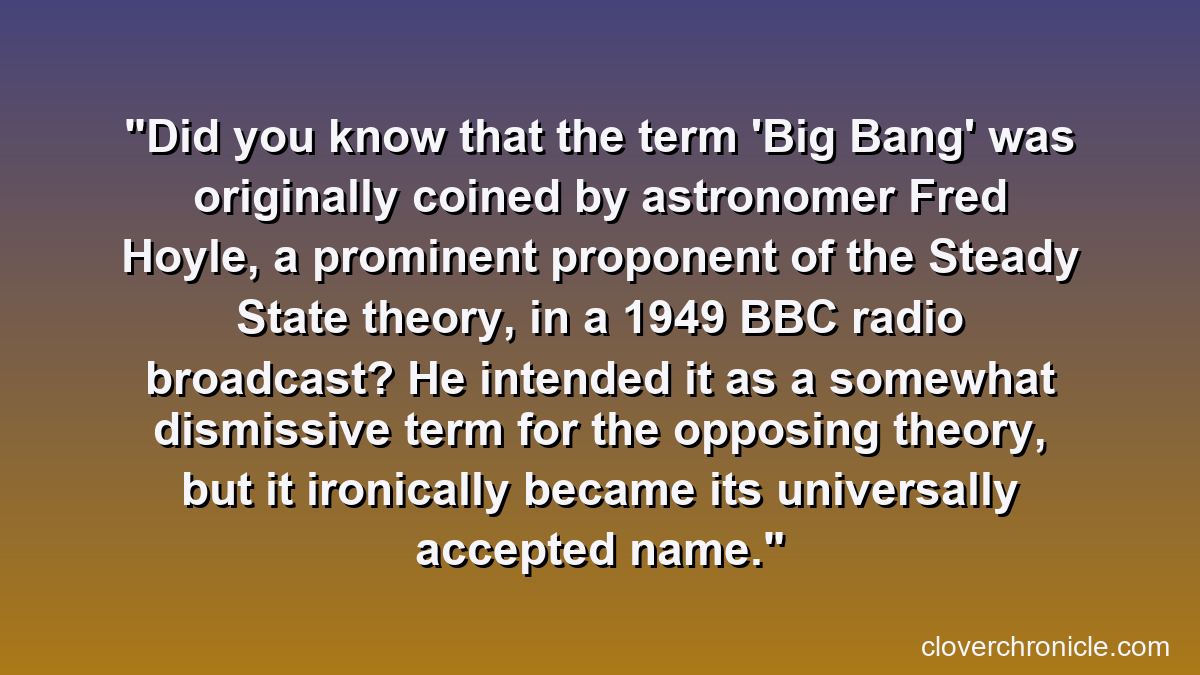
In stark contrast to the Big Bang, the Steady State Theory, primarily developed by Hermann Bondi, Thomas Gold, and Fred Hoyle in the mid-20th century, proposed a universe that is eternal, infinite, and, on large scales, unchanging in its overall appearance. It doesn’t have a beginning or an end.
💡 Core Principles of the Steady State
- 🌌 Perfect Cosmological Principle: The universe looks the same at all times and in all places, on a large scale.
- ✨ Continuous Creation: To account for the observed expansion without a decrease in density, the theory posited that new matter is continuously created, albeit at an unobservable rate, to fill the voids left by expanding space.
- ♾️ No Beginning or End: The universe has always existed and will always exist in its current state.
For a detailed exploration of this fascinating alternative, consider reading Steady State Theory: An Alternative to the Big Bang.
⚛️ The Concept of Continuous Creation
The idea of continuous creation was a radical departure from conventional physics, suggesting that matter could spontaneously appear from nothing. While the rate of creation would be incredibly small (estimated at about one hydrogen atom per cubic meter per billion years), it was crucial for maintaining the universe’s constant density despite its expansion. This mechanism was necessary to reconcile an expanding universe with an unchanging appearance, a central tenet of the Steady State Theory.
The Core of the Debate: Divergent Visions
The clash between the Big Bang Theory and the Steady State Theory was fundamental, representing two profoundly different philosophical and scientific views on the cosmos. This intellectual battle shaped early cosmological research.
↔️ Expansion vs. Eternal Consistency
- Big Bang: The universe is dynamically evolving, with its density and temperature changing as it expands and cools. This implies a hot, dense past and a cooler, more diffuse future.
- Steady State: Despite expansion, the universe maintains a constant average density and temperature because new matter is created to compensate. This means its large-scale properties are eternally consistent.
⏳ Age and Evolution of the Cosmos
- Big Bang: Posits a finite age for the universe (approximately 13.8 billion years), with a clear evolutionary timeline from primordial plasma to galaxies.
- Steady State: Suggests an infinite age, where the universe has always appeared roughly the same, with no grand evolutionary narrative from a singular beginning.
The Evidence That Tipped the Scales
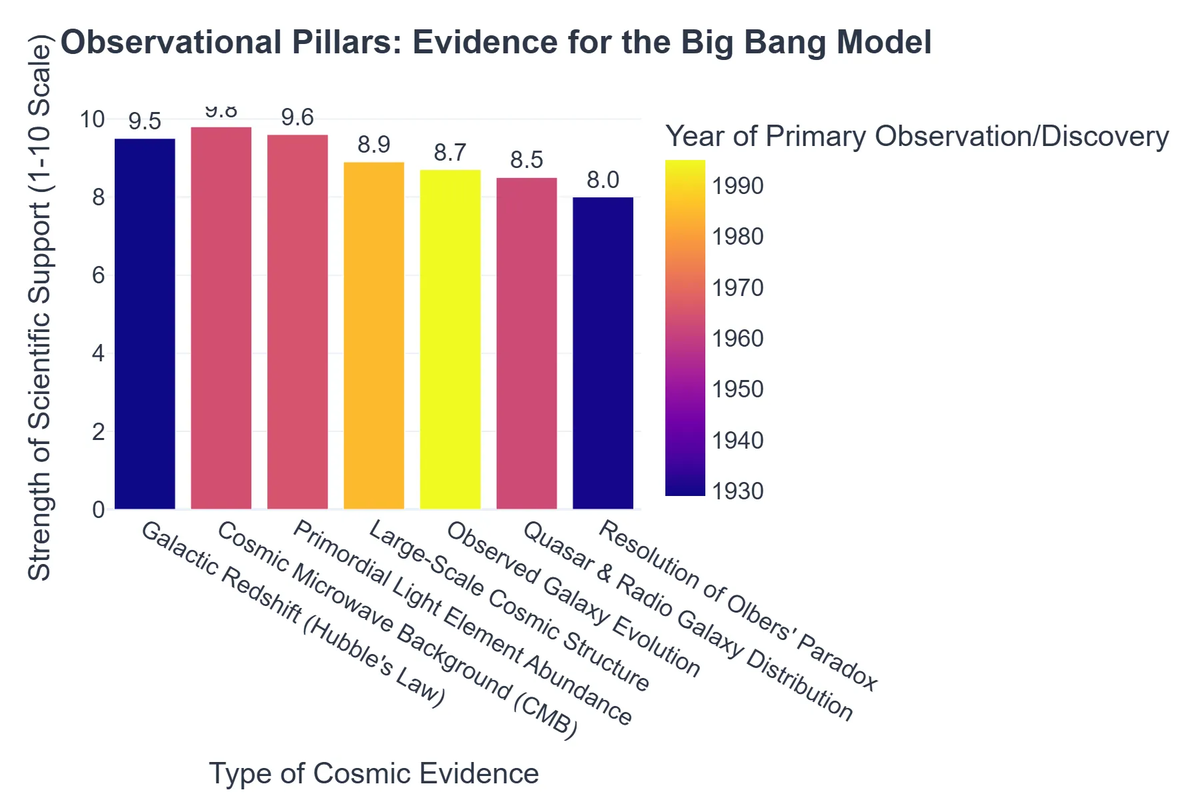
Scientific theories are ultimately judged by how well they align with observational evidence. While both the big bang theory and steady state theory offered explanations for an expanding universe, a series of key discoveries decisively favored the Big Bang model.
🔭 Edwin Hubble’s Expanding Universe
Hubble’s 1929 observations, showing that distant galaxies are receding from us at speeds proportional to their distance (Hubble’s Law), provided the first strong evidence for an expanding universe. While both theories could accommodate expansion, the Big Bang interpreted it as evidence of a dynamic, evolving cosmos. For more on this, see Big Bang Expansion: Understanding the Universe’s Growth.
CMB The Discovery of Cosmic Microwave Background (CMB)
This was arguably the most crucial piece of evidence. In 1964, Arno Penzias and Robert Wilson accidentally discovered a faint, uniform glow of microwave radiation coming from all directions in space. This “echo” of the Big Bang, predicted by George Gamow, Ralph Alpher, and Robert Herman decades earlier, was precisely what the Big Bang model expected as the leftover heat from the universe’s fiery birth. The Steady State Theory had no natural explanation for the CMB, and attempts to fit it into the model proved convoluted.
The homogeneity and isotropy of the Cosmic Microwave Background Radiation provided undeniable support for a hot, dense early universe.
⚛️ Abundance of Light Elements
The Big Bang nucleosynthesis model accurately predicted the observed cosmic abundance of light elements like hydrogen (about 75%), helium (about 25%), and traces of lithium. These elements are theorized to have formed in the first few minutes after the Big Bang, during a period of intense heat and density. The Steady State Theory struggled to explain these precise ratios without invoking arbitrary processes.
Galaxies Evolution of Galaxies and Quasars
As astronomers observed more distant (and thus older) galaxies, they noticed significant differences in their structure and composition compared to closer, younger galaxies. This evolutionary sequence—galaxies changing over cosmic time—is a natural prediction of the Big Bang model, which describes a universe that evolves. The Steady State, with its “perfect cosmological principle,” predicted that the universe should look the same everywhere and at all times, making these observed evolutionary effects difficult to explain.
Legacy and Modern Cosmology
By the late 1960s, the overwhelming weight of observational evidence, particularly the discovery of the CMB, had firmly established the Big Bang Theory as the dominant paradigm in cosmology. The debate between the big bang theory and steady state theory effectively concluded.
Why the Big Bang Prevailed
The Big Bang’s success lay in its ability to:
- ✅ Explain Observed Phenomena: It provided coherent explanations for the expansion of the universe, the CMB, and the abundance of light elements.
- ✅ Make Testable Predictions: Its predictions were specific and later confirmed by observation.
- ✅ Simplicity and Coherence: While complex in its details, its core premise offered a more natural explanation for the evolving universe than the continuous creation required by the Steady State.
The Steady State’s Enduring Influence
Despite its scientific obsolescence, the Steady State Theory played a crucial role in the development of cosmology. It served as a vital intellectual adversary, pushing proponents of the Big Bang to refine their models and seek stronger observational proof. It also highlighted the importance of fundamental principles in constructing cosmic theories.
Recommended Video
Conclusion: A Universe Unveiled
The historic debate between the Big Bang Theory and the Steady State Theory is a powerful testament to the scientific method in action. It illustrates how competing ideas are rigorously tested against empirical evidence, leading to the refinement and ultimate acceptance of models that best describe reality.
Today, the Big Bang Theory, specifically the Hot Big Bang Theory, enriched with concepts like inflation and dark matter/energy, remains the cornerstone of modern cosmology. It continues to guide our understanding of the universe’s past, present, and future, as scientists worldwide continue to probe its deepest mysteries and push the boundaries of knowledge. The journey to understand the Origin of the Universe Theories is an ongoing, thrilling adventure.
Frequently Asked Questions
What is the core difference between the Big Bang and Steady State theories?
The Big Bang theory describes the universe as having a definite beginning, expanding from an extremely hot and dense state. In contrast, the Steady State theory proposed that the universe has always existed and is unchanging in its large-scale properties, with new matter continuously appearing to maintain constant density as it expands.
What key evidence supported the Big Bang theory over Steady State?
The most compelling evidence for the Big Bang includes Edwin Hubble’s discovery of the expanding universe (redshift of galaxies), the abundance of light elements (hydrogen and helium) in the universe, and critically, the discovery of the Cosmic Microwave Background (CMB) radiation in 1964, which is considered the ‘afterglow’ of the Big Bang.
When did the Steady State theory fall out of favor?
The Steady State theory largely fell out of favor after the discovery of the Cosmic Microwave Background (CMB) radiation in 1964 by Arno Penzias and Robert Wilson. The CMB provided strong observational evidence that was a direct prediction of the Big Bang model, but not the Steady State model.