

For decades, Saturn’s largest moon, Titan, remained an enigmatic dot in the night sky, shrouded by a thick, orange haze. That changed dramatically with the arrival of the Cassini-Huygens mission, a monumental endeavor by NASA, the European Space Agency (ESA), and the Italian Space Agency. This groundbreaking mission fundamentally reshaped our understanding of this unique celestial body, revealing a world with startling similarities to early Earth, yet utterly alien in its chemistry.
💡 Key Takeaways
- Cassini revolutionized our understanding of Titan, revealing its Earth-like hydrological cycle with liquid methane.
- Titan is unique in having a dense atmosphere, surface liquids, and subsurface ocean, making it a prime target for habitability studies.
- Upcoming missions like Dragonfly will provide unprecedented insights into Titan’s complex chemistry and geology.
- The legacy of Cassini continues to inspire new generations of planetary science and exploration.
“Titan is more than just a moon; it’s a cosmic canvas, a natural laboratory where familiar geological processes unfold with alien chemistry. It pushes the boundaries of what we consider ‘life-sustaining’ environments, a truly exhilarating prospect for both science and imagination.”
— Astrid Bellweather, Astrophysicist & Science Fiction Consultant
The cassini titan investigations unveiled a dynamic world featuring lakes and rivers of liquid methane and ethane, a robust hydrocarbon cycle, and tantalizing hints of a subsurface ocean. Cassini’s legacy extends far beyond its operational lifespan; it has laid the indispensable groundwork for future exploration, most notably with the upcoming Dragonfly mission, poised to unlock even deeper secrets of this fascinating moon. This article delves into Cassini’s profound impact on our knowledge of Titan and explores the exciting prospects for its continued exploration. For a comprehensive overview of the broader cosmic mysteries, explore our pillar page on Cosmic Queries: Probing the Mysteries of the Universe.
In This Article
- — 💡 Key Takeaways
- → Cassini’s Transformative View of Titan
- — The Huygens Probe: A Historic Landing
- — Unveiling Titan’s Atmosphere and Surface
- — The Hydrocarbon Cycle: Rivers, Lakes, and Seas
- → Titan’s Unique Chemistry and Astrobiological Potential
- — Organic Richness Beyond Earth
- — Subsurface Ocean: A Hidden World
- → The Legacy of Cassini-Huygens Mission
- — Key Discoveries and Scientific Impact
- — Paving the Way for Future Missions
- → Dragonfly: NASA’s Bold Leap to Titan
- — Why Dragonfly? The Mission’s Objectives
- — How Dragonfly Will Explore Titan’s Diverse Environments
- — Anticipated Discoveries from Dragonfly Titan
- → Challenges and Future Prospects for Titan Exploration
- — Navigating an Alien World
- — Beyond Dragonfly: Long-Term Visions
- → Conclusion: Titan’s Enduring Mystery and Promise
Cassini’s Transformative View of Titan
Before Cassini, Titan was a blur, its surface hidden by an opaque atmosphere. The mission’s instruments, particularly its radar and infrared capabilities, pierced this veil, revealing a remarkably active and diverse landscape. This marked a monumental shift in planetary science, offering the first detailed glimpse of a moon with its own weather and geological processes.
 The Huygens Probe: A Historic Landing
- ✅ First Landing in the Outer Solar System: On January 14, 2005, the ESA-built Huygens probe, carried by Cassini, made a historic descent through Titan’s atmosphere, becoming the first spacecraft to land on a moon in the outer solar system.
- ➡️ Atmospheric Profile: During its 2.5-hour descent, Huygens collected unprecedented data on Titan’s atmospheric composition, temperature, and pressure, revealing a complex, nitrogen-rich atmosphere.
- 💡 Surface Imagery: Upon landing, Huygens sent back images of a landscape resembling a riverbed, strewn with pebble-sized “water ice” rocks, sculpted by liquid methane flows. This provided direct evidence of geological activity on Titan’s surface.
 Unveiling Titan’s Atmosphere and Surface
Cassini’s orbital observations revolutionized our understanding of Titan’s atmospheric dynamics and surface features. Its synthetic aperture radar (SAR) peered through the haze, mapping vast regions of the moon.
- ✅ Atmospheric Layers: Cassini revealed a multi-layered atmosphere extending hundreds of kilometers above the surface, rich in organic molecules formed by sunlight interacting with methane and nitrogen.
- ➡️ Dynamic Weather: The spacecraft observed methane clouds, precipitation, and evidence of seasonal changes, indicating an active hydrological cycle driven by methane and ethane, much like Earth’s water cycle.
- 💡 Diverse Landscapes: Beyond the polar lakes and seas, Cassini identified vast dune fields, mountainous regions, and plains, suggesting a complex geological history and ongoing surface modification.
 The Hydrocarbon Cycle: Rivers, Lakes, and Seas
One of Cassini’s most astonishing discoveries was the confirmation of stable bodies of liquid on Titan’s surface. Unlike Earth, these are not water but hydrocarbons.
- ✅ Lakes and Seas: Cassini mapped numerous lakes and seas, particularly in the polar regions, including Kraken Mare, Ligeia Mare, and Punga Mare, which are vast bodies of liquid methane and ethane.
- ➡️ River Networks: Extensive river and stream networks, carved by liquid hydrocarbons, were observed flowing into these lakes and seas, demonstrating active erosional processes.
- 💡 Evaporation and Condensation: Evidence of evaporation from these bodies and subsequent condensation and precipitation was gathered, completing the picture of a true, albeit alien, liquid cycle.
Titan’s Unique Chemistry and Astrobiological Potential
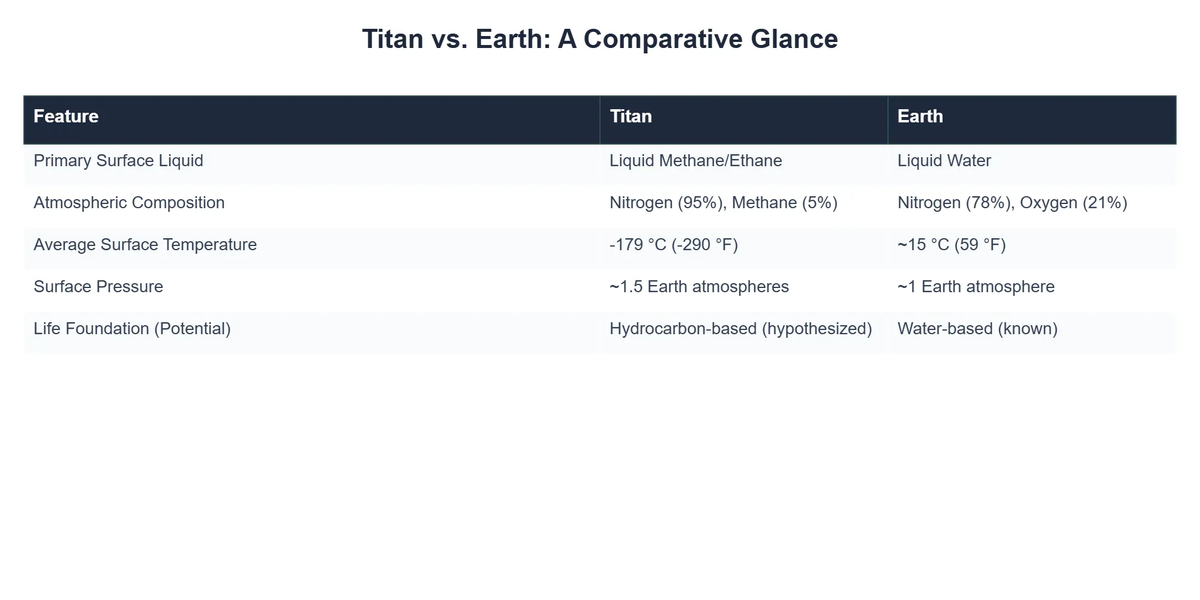
Titan’s extreme cold (around -179°C or -290°F) and hydrocarbon-based chemistry present a stark contrast to Earth. Yet, the presence of complex organic molecules and liquid environments makes it a prime target in the search for extraterrestrial life, or at least, the conditions necessary for its emergence.
 Organic Richness Beyond Earth
Titan’s atmosphere is a veritable factory for organic chemistry. Solar radiation breaks down nitrogen and methane, leading to a cascade of reactions that produce a diverse array of complex hydrocarbons and nitriles, which then fall to the surface as aerosols or rain.
- ✅ Prebiotic Chemistry: The presence of such abundant and complex organic molecules makes Titan an ideal natural laboratory for studying prebiotic chemistry – the chemical precursors to life.
- ➡️ Analog to Early Earth: Scientists often view Titan as a frozen analog to early Earth, before the advent of oxygenic photosynthesis, where complex organic molecules were readily available.
 Subsurface Ocean: A Hidden World
One of Cassini’s most profound discoveries was the evidence for a deep, global liquid water ocean beneath Titan’s icy crust. This discovery significantly elevates Titan’s astrobiological interest.
- ✅ Gravitational Measurements: Subtle shifts in Titan’s rotation and gravity field, detected by Cassini, strongly indicate the presence of a subsurface ocean.
- ➡️ Water and Ammonia: This ocean is believed to be composed of water, likely mixed with ammonia, which acts as an antifreeze, allowing it to remain liquid despite the moon’s overall cold temperatures.
- 💡 Hydrothermal Activity: The potential for hydrothermal vents on the seafloor of this internal ocean, similar to those found in Earth’s deep oceans, suggests a possible energy source for life, independent of sunlight.
The Legacy of Cassini-Huygens Mission
The Cassini-Huygens mission operated for 13 years in the Saturnian system, far exceeding its initial four-year primary mission. Its Grand Finale plunge into Saturn’s atmosphere in 2017 was a dramatic conclusion designed to protect Titan and other moons from potential terrestrial contamination. The data it collected continues to be analyzed and yields new insights.
For more on Cassini’s broader impact on understanding the Saturn system, read our article on Cassini Spacecraft: Saturn’s Rings and Moons Unveiled.
 Key Discoveries and Scientific Impact
Cassini’s contributions to planetary science are immense. Its findings didn’t just add to our knowledge; they fundamentally changed our perception of icy moons.
- ✅ The first in-depth study of an outer solar system moon with an atmosphere and liquid surface.
- ➡️ Confirmation of a global subsurface ocean on Titan.
- 💡 Detailed mapping of a complex hydrocarbon cycle, analogous to Earth’s water cycle.
- 🔥 Unprecedented insights into prebiotic chemistry in an extraterrestrial environment.
 Paving the Way for Future Missions
The wealth of data from Cassini has been crucial in designing the next generation of missions. Understanding Titan’s environment, its potential hazards, and its scientific riches has guided the development of new technologies and mission concepts. The mission proved that complex, sustained exploration of such distant and alien worlds is not only possible but incredibly rewarding.
Dragonfly: NASA’s Bold Leap to Titan
Building directly on Cassini’s legacy, NASA is preparing for its most ambitious mission to Titan yet: Dragonfly. This nuclear-powered rotorcraft is unlike any previous planetary explorer, designed to hop between various locations on Titan’s surface, offering unprecedented mobility and scientific reach. For a more focused discussion, see our article on Dragonfly Mission to Titan: Exploring an Alien Ocean World and Dragonfly: NASA’s Mission to Saturn’s Moon Titan.
 Why Dragonfly? The Mission’s Objectives
The Dragonfly Titan mission aims to answer fundamental questions about the potential for life beyond Earth and the processes that shape complex organic worlds.
- ✅ Astrobiology: Search for chemical biosignatures and assess Titan’s habitability, particularly focusing on how prebiotic chemistry progresses in an active liquid environment.
- ➡️ Organic Chemistry: Investigate the moon’s rich organic chemistry and the atmospheric and surface processes that drive it.
- 💡 Geomorphology: Characterize the diverse geological features of Titan’s surface and subsurface, including lakes, dunes, and impact craters.
- 🛠️ Atmospheric Science: Study the atmospheric methane cycle and its interaction with surface liquids and aerosols.
 How Dragonfly Will Explore Titan’s Diverse Environments
Dragonfly’s unique design as a dual-quadcopter will allow it to cover vast distances and access varied terrains, something no wheeled rover could achieve on Titan’s surface.
- ✅ Aerial Mobility: Titan’s dense atmosphere (four times denser than Earth’s at the surface) and low gravity make flight extremely efficient, allowing Dragonfly to fly for miles between sites.
- ➡️ Payload: It will carry a suite of instruments, including a mass spectrometer (DraMS) to analyze surface composition, cameras (DragonCam) for imagery, and meteorological sensors (DraGMet) to study the atmosphere.
- 💡 Targeted Exploration: Dragonfly will land at a relatively benign site, then perform a series of “hops” to scientifically compelling locations, such as dune fields, cryovolcanic flows, and potentially the shoreline of a dried-up lake.
 Anticipated Discoveries from Dragonfly Titan
The mission promises to deliver unparalleled insights into Titan’s evolution and potential for life.
- ✅ Prebiotic Building Blocks: Directly sample and analyze organic materials on Titan’s surface, looking for complex molecules that might be precursors to life.
- ➡️ Understanding Habitability: Assess whether the conditions on Titan (e.g., energy sources, liquid water in the subsurface ocean, organic molecules) could support the emergence of exotic life.
- 💡 Geological Processes: Observe ongoing geological processes like cryovolcanism, erosion, and sedimentation up close, providing a clearer picture of how Titan’s surface is shaped.
Challenges and Future Prospects for Titan Exploration
While extremely promising, exploring Titan presents significant challenges due to its extreme environment and vast distances. However, the scientific payoff justifies the immense effort.
 Navigating an Alien World
The challenges of operating on Titan are numerous:
- ✅ Extreme Cold: Equipment must be designed to function reliably in cryogenic temperatures.
- ➡️ Dense Atmosphere: While good for flight, it also limits visibility and requires robust navigation systems.
- 💡 Long Communication Delays: Signals take over an hour to travel from Earth to Titan, requiring a high degree of autonomy for the spacecraft.
- 🛰️ Power Source: Solar power is not feasible due to distance from the sun and thick atmosphere, necessitating radioisotope thermoelectric generators (RTGs).
 Beyond Dragonfly: Long-Term Visions
Dragonfly is just the next step. Scientists are already envisioning future missions to Titan that could build upon its findings:
- Submersible Missions: A submarine exploring Kraken Mare or Ligeia Mare would provide direct access to Titan’s liquid seas, studying their composition, currents, and potential for life. This is a particularly exciting prospect given the scale of these liquid bodies (Source: Space Nuts Podcast).
- Orbital Samplers: Missions to collect atmospheric samples and return them to Earth for detailed laboratory analysis.
- Cryobot/Hydrobot Missions: Probes designed to melt through Titan’s ice crust to directly explore the subsurface liquid water ocean, a truly audacious goal (Source: Springer Link).
Recommended Video
Conclusion: Titan’s Enduring Mystery and Promise
The Cassini-Huygens mission irrevocably changed our perception of Titan, transforming it from a distant enigma into a compelling world brimming with scientific fascination. Its remarkable discoveries—from a dynamic hydrocarbon cycle to the tantalizing possibility of a subsurface water ocean—have not only expanded our knowledge of the solar system but also ignited new avenues in the search for life beyond Earth.
As NASA‘s Dragonfly mission prepares to take flight, it promises to carry forward Cassini’s legacy, exploring Titan with unprecedented detail and mobility. Each hop of the rotorcraft will bring us closer to unraveling the moon’s deepest secrets, pushing the boundaries of our understanding of planetary evolution and the potential for diverse forms of life. Titan stands as a testament to the universe’s boundless wonders, reminding us that the journey of cosmic discovery is far from over.
Frequently Asked Questions
What makes Titan unique among solar system moons?
Titan is the only moon in our solar system with a dense atmosphere and stable bodies of liquid on its surface, primarily composed of methane and ethane.
What were Cassini’s key discoveries about Titan?
Cassini revealed Titan’s Earth-like methane cycle, liquid lakes and seas, a subsurface ocean, and complex organic chemistry in its atmosphere.
Are there future missions planned for Titan?
Yes, NASA’s Dragonfly mission is set to launch in 2027, sending a rotorcraft lander to explore Titan’s surface and atmosphere.
Could life exist on Titan?
While surface conditions are too cold for liquid water-based life, Titan’s subsurface ocean or unique hydrocarbon chemistry present intriguing possibilities for exotic life forms, or at least pre-biotic chemistry.