


Mass Hysteria: Understanding Psychology, History & Cases
The human mind is a complex tapestry of individual thoughts, emotions, and experiences. Yet, at times, these individual threads can intertwine and manifest in powerful, collective phenomena. One of the most intriguing and, at times, unsettling of these is mass hysteria. But what exactly is it, and how does it sweep through communities, transcending individual psychology to impact groups?
💡 Key Takeaways
- Mass hysteria involves the rapid spread of symptoms among a large group without a clear physical cause, often triggered by psychological or social factors.
- Historically, outbreaks have ranged from dancing manias to perceived illness, revealing how cultural anxieties can manifest physically.
- Understanding its psychological underpinnings, like suggestibility and confirmation bias, is crucial to differentiating it from genuine health crises.
- Modern societal pressures and media can still contribute to mass psychogenic illness, making vigilance and critical analysis essential.
“Mass hysteria is a profound demonstration of the mind-body connection and the sheer power of social contagion; it reminds us that our cognitive interpretations and collective anxieties can profoundly shape our physiological experiences.”
— Eleanor Vance, Neuroscience Communicator & Cognitive Psychologist
In this comprehensive guide, we’ll delve deep into the world of collective psychogenic illness, exploring its psychological underpinnings, tracing its fascinating history through notable cases, and providing clarity on how it differs from other group phenomena. Understanding mass hysteria is not just an academic exercise; it offers vital insights into the power of suggestion, the dynamics of group behavior, and the fragility of our perceptions. For a broader perspective on the human condition, consider exploring The Human Enigma: Unlocking the Secrets of Our Body and Mind.
In This Article
- → Mass Hysteria: Understanding Psychology, History & Cases
- — 💡 Key Takeaways
- → What Exactly Is Mass Hysteria? Defining the Phenomenon
- — 🧠 Understanding the Terminology
- — 💡 Key Characteristics
- → The Psychology Behind Collective Outbreaks
- — 🎭 The Role of Social Contagion
- — 😨 Stress, Anxiety, and Suggestibility
- — 🤝 Groupthink and Conformity
- → A Journey Through History: Notable Cases of Mass Hysteria
- — 💃 The Dancing Plague of 1518
- — 🧙♀️ The Salem Witch Trials (1692-1693)
- — 😷 Tanganyika Laughter Epidemic (1962)
- — ⛽ The “Mad Gasser” of Mattoon (1944)
- → Differentiating Mass Hysteria from Other Phenomena
- — 🚨 Mass Panic vs. Mass Hysteria
- — 🌐 Collective Delusion vs. Shared Psychosis
- → Factors Contributing to and Triggering Mass Hysteria
- — 📡 Media Influence and Information Spread
- — 🚨 High Stress Environments
- — 🗣️ Lack of Clear Communication
- → How to Identify and Respond to Potential Outbreaks
- — ✅ Recognizing the Signs
- — 🛑 De-escalation Strategies
- — 🏥 The Role of Medical and Psychological Professionals
- → Conclusion
What Exactly Is Mass Hysteria? Defining the Phenomenon
Often misunderstood, mass hysteria is a fascinating and sometimes frightening manifestation of collective anxiety and suggestibility. It’s a phenomenon where symptoms of illness, often psychological in origin, spread rapidly through a group of people, with no apparent physical cause.
🧠 Understanding the Terminology
Medically, mass hysteria is frequently referred to as a Mass Psychogenic Illness (MPI). This term accurately conveys that the symptoms are psychological in origin (“psychogenic”) and affect a large group (“mass”). It’s characterized by the rapid spread of signs and symptoms of illness, affecting members of a cohesive group, originating from a nervous system disturbance involving excitation, loss, or alteration of function, without an organic basis for the symptoms.
💡 Key Characteristics
- ✅ Rapid Onset: Symptoms appear quickly within a defined group.
- ✅ Absence of Organic Cause: Medical examinations typically find no physical explanation for the symptoms.
- ✅ Physical Symptoms: Despite the psychological origin, symptoms can be genuinely debilitating, including headaches, nausea, dizziness, fainting, tremors, and even paralysis.
- ✅ Contagion: The symptoms appear to spread via social transmission, often through sight, sound, or belief.
- ✅ Stressful Environment: Often occurs in contexts of high stress, uncertainty, or confined groups.
The Psychology Behind Collective Outbreaks
The core of mass hysteria lies in intricate psychological processes that amplify individual anxieties into a shared experience. It’s a powerful demonstration of how our minds can influence our bodies, especially when influenced by others.
🎭 The Role of Social Contagion
Just as a yawn can be contagious, so too can physical symptoms in certain circumstances. This concept, known as social contagion, is central to MPI. When one person experiences distress or displays symptoms, others observing them, especially in an anxious state, can unconsciously begin to mimic those symptoms. This is often an unconscious process, not a deliberate act of faking.
😨 Stress, Anxiety, and Suggestibility
A predisposition to mass hysteria is often found in groups experiencing high levels of stress, anxiety, or uncertainty. In such environments, individuals become more suggestible. Belief in the presence of a threat (real or imagined) can trigger physiological responses, and seeing others react reinforces the belief, creating a feedback loop. This heightened suggestibility can lead to the “internalization” of symptoms.
🤝 Groupthink and Conformity
The powerful dynamics of group behavior play a significant role. When people are part of a cohesive group, there’s a natural tendency towards conformity. If a few individuals exhibit symptoms, others may subconsciously or consciously feel pressure to conform, even if they don’t fully understand why. The fear of being different or not “getting it” can fuel the spread. For a deeper understanding of how social pressures influence individual behavior, explore Conformity Studies: Classic Social Psychology Experiments, particularly the work highlighted in Asch Conformity Experiments: Understanding Social Pressure.
As noted by research on collective phenomena, understanding the pathways through which social information propagates within groups is crucial for comprehending mass panics and hysteria. For further reading, the British Psychological Society offers an interesting historical perspective on “Dancing plagues and mass hysteria”: https://www.bps.org.uk/psychologist/dancing-plagues-and-mass-hysteria.
A Journey Through History: Notable Cases of Mass Hysteria
History is replete with fascinating and often tragic examples of mass hysteria, demonstrating its recurring nature across cultures and centuries.
💃 The Dancing Plague of 1518
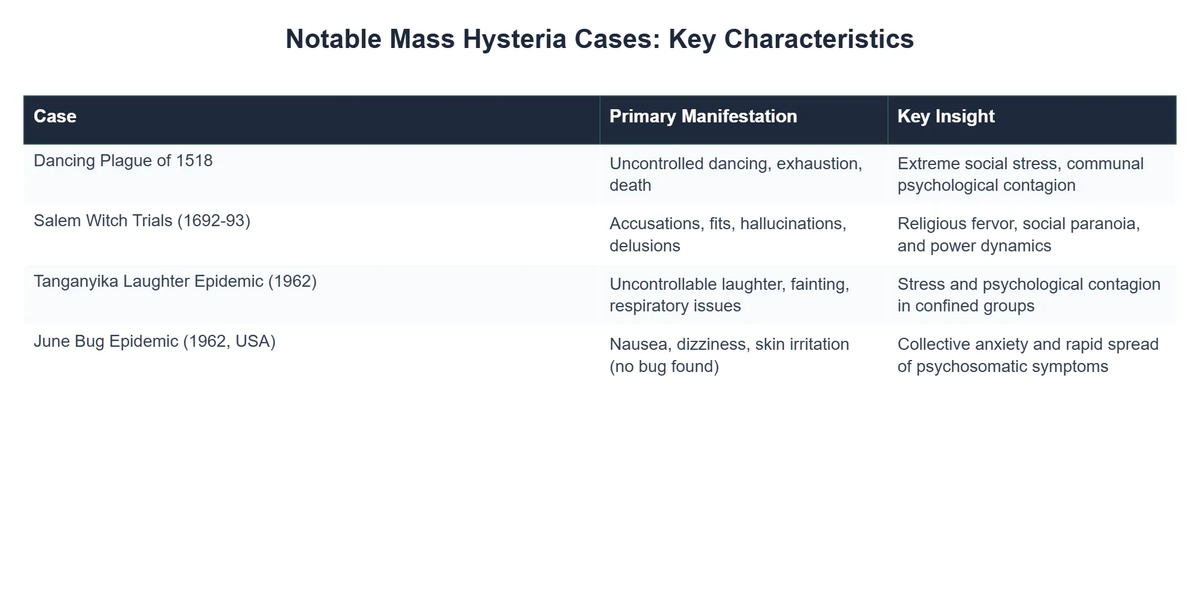
One of the most bizarre and well-documented cases, this phenomenon gripped Strasbourg (then part of the Holy Roman Empire). Frau Troffea began to dance uncontrollably in the street, followed by dozens, then hundreds of others. For weeks, people danced, seemingly against their will, many succumbing to exhaustion, heart attacks, or strokes. While various theories exist, psychological stress and extreme suggestibility are considered major factors.
🧙♀️ The Salem Witch Trials (1692-1693)
Though primarily a judicial and religious event, the Salem Witch Trials had elements of mass psychogenic illness. Accusations began when young girls experienced fits, convulsions, and strange behaviors, which they attributed to witchcraft. These symptoms spread, leading to widespread panic and the execution of many innocent people. The climate of fear, strict Puritanical beliefs, and community isolation created fertile ground for such a phenomenon.
😷 Tanganyika Laughter Epidemic (1962)
In a boarding school for girls in Kashasha, Tanzania, a bout of uncontrollable laughter began, spreading rapidly among students. The “epidemic” lasted for months, closing schools and affecting over 1,000 people across several villages. Symptoms included fits of laughter, crying, fainting, and even respiratory problems. It’s considered a classic modern example of MPI, triggered by the stresses of student life.
⛽ The “Mad Gasser” of Mattoon (1944)
In Mattoon, Illinois, a series of reports emerged where residents claimed to be affected by a mysterious gas, causing nausea, vomiting, paralysis, and coughing. Despite extensive investigation, no gas or perpetrator was ever found. Authorities concluded it was likely a case of mass hysteria, where initial anxieties were amplified by wartime tensions and media reports, leading to suggestible individuals manifesting symptoms.
Understanding Mass Hysteria: A Balanced Perspective
Pros
- ✔Provides a framework for understanding unusual group behaviors.
- ✔Informs public health responses and crisis management strategies.
- ✔Highlights the power of social influence and psychological vulnerability.
- ✔Encourages critical thinking and skepticism towards unverified claims.
Cons
- ✖Challenges in accurate diagnosis and differentiation from genuine illnesses.
- ✖Risk of mislabeling, leading to dismissal of real issues or stigmatization.
- ✖Complex, multifactorial causes make definitive explanations difficult.
- ✖Ethical dilemmas in studying or intervening without causing further distress.
For more examples of mysterious widespread illnesses, you can refer to “7 Mysterious Mass Illnesses That Defied Explanation” from History.com: https://www.history.com/articles/mysterious-illnesses-mass-hysteria.
Differentiating Mass Hysteria from Other Phenomena
While mass hysteria involves collective behavior, it’s crucial to distinguish it from related but distinct phenomena.
🚨 Mass Panic vs. Mass Hysteria
Mass panic typically involves a sudden, intense fear that spreads through a group, leading to irrational and often dangerous flight behavior (e.g., stampedes during emergencies). The key difference is the primary symptom: panic focuses on fear and escape, while mass hysteria involves the rapid spread of physical (though psychogenic) symptoms of illness.
🌐 Collective Delusion vs. Shared Psychosis
A collective delusion (or shared delusion) is the spontaneous, often transient, uncritical belief in something implausible by a large number of people (e.g., UFO sightings, urban legends). The symptoms are primarily cognitive (a false belief) rather than physical. Shared psychosis (or folie à deux and folie à plusieurs) is a rare psychiatric syndrome where a delusion is transmitted from one individual to one or more others who are usually related or closely associated. While both involve shared irrationality, shared psychosis is a clinical diagnosis involving direct psychological influence within a small, closely-knit group, whereas collective delusion is broader and often less deeply held.
Factors Contributing to and Triggering Mass Hysteria
While often unpredictable, several conditions can create a fertile ground for episodes of mass hysteria.
📡 Media Influence and Information Spread
In the modern age, the rapid dissemination of information (and misinformation) through news channels, social media, and word-of-mouth can significantly amplify anxiety and facilitate the spread of symptoms. A single unverified report can trigger widespread alarm, especially if it resonates with existing fears.
🚨 High Stress Environments
Groups under significant pressure—whether it’s academic stress in a school, occupational stress in a workplace, or societal stress during a crisis—are more vulnerable. When individuals are already emotionally or psychologically taxed, their capacity to rationally evaluate situations or resist suggestibility decreases.
🗣️ Lack of Clear Communication
In ambiguous or threatening situations, the absence of clear, authoritative, and calming communication from leaders or institutions can exacerbate anxieties. Uncertainty breeds fear, which can then manifest in collective physical symptoms. The power dynamics within groups can also play a role; understanding how power influences behavior can provide insights into collective responses during crises, a topic explored further in Zimbardo Experiment: Understanding the Psychology of Power.
How to Identify and Respond to Potential Outbreaks
Recognizing and appropriately responding to mass hysteria is crucial to prevent its escalation and alleviate distress.
✅ Recognizing the Signs
- ➡️ Rapid onset of non-specific physical symptoms among a group, without an obvious cause.
- ➡️ Symptoms are often vague (e.g., headache, dizziness, nausea) and inconsistent.
- ➡️ Symptoms spread quickly via visual or auditory cues.
- ➡️ Affected individuals are often young, though it can affect all ages.
- ➡️ Absence of a definitive medical explanation for the cluster of symptoms.
🛑 De-escalation Strategies
Effective management focuses on calming the situation and providing reassurance:
- 💡 Prompt Medical Evaluation: Rule out genuine physical causes immediately to reassure those affected.
- 💡 Calm, Authoritative Communication: Leaders or medical professionals should provide clear, consistent, and reassuring information. Avoid sensationalism.
- 💡 Address Underlying Stressors: If possible, identify and mitigate the environmental or psychological stressors contributing to the anxiety.
- 💡 Disperse the Group (if feasible): Breaking up the collective dynamic can help disrupt the social contagion.
- 💡 Avoid Focusing on Symptoms: Redirect attention away from the symptoms themselves to prevent further reinforcement.
🏥 The Role of Medical and Psychological Professionals
Medical personnel are vital for ruling out genuine illness and providing initial reassurance. Psychologists and mental health professionals can help by explaining the psychogenic nature of the symptoms, offering coping strategies for anxiety, and addressing any underlying group or individual distress. The goal is to normalize the experience without validating the perceived physical threat, helping individuals understand their symptoms as a response to stress.
Recommended Video
Conclusion
Mass hysteria, or Mass Psychogenic Illness, remains a compelling and complex facet of human behavior. It serves as a powerful reminder of the intricate connections between our minds, bodies, and social environments. From historical dancing plagues to modern school epidemics, these events underscore the profound impact of collective anxiety, suggestibility, and social contagion.
By understanding the psychological mechanisms at play and learning from past incidents, we can be better equipped to recognize, prevent, and effectively manage such outbreaks. It’s a testament to the fact that while we strive to unlock the secrets of our individual minds, the dynamics of our collective consciousness continue to present one of the most intriguing human enigmas.
Frequently Asked Questions
What exactly is mass hysteria?
Mass hysteria, also known as mass psychogenic illness (MPI), is a phenomenon characterized by the rapid spread of symptoms of illness among a large group of people where there is no clear physical or environmental cause.
What causes mass hysteria outbreaks?
Outbreaks are typically triggered by psychological factors like stress, anxiety, fear, or suggestibility, often amplified by social contagion, media influence, and pre-existing societal tensions.
Can mass hysteria happen today?
Yes, while historical cases are well-documented, modern instances still occur, sometimes triggered by environmental scares, social media rumors, or collective stress within communities like schools or workplaces.
How is mass hysteria different from a real illness?
The key difference is the absence of a demonstrable physical or toxicological cause. Symptoms are real for those experiencing them, but their origin is psychological and social rather than biological or environmental.