
Fastest Growing Black Holes: Cosmic Gluttons and Monsters
In the vast expanse of the cosmos, few phenomena capture the imagination quite like black holes. These enigmatic regions of spacetime, where gravity is so intense that nothing—not even light—can escape, are often perceived as static devourers. However, recent astronomical discoveries have unveiled a more dynamic and terrifying reality: the existence of fastest growing black holes. These cosmic gluttons are not merely absorbing matter; they are rapidly expanding, consuming entire solar masses of material daily, and reshaping our understanding of galaxy evolution. They represent some of the most powerful and luminous objects in the universe, driving phenomena like quasars and playing a crucial role in the development of the largest structures we observe.
💡 Key Takeaways
- Fastest growing black holes are supermassive, devouring vast amounts of matter at extreme rates.
- Their rapid accretion powers incredibly luminous phenomena like quasars, outshining their host galaxies.
- These ‘cosmic gluttons’ play a crucial, yet complex, role in the formation and evolution of galaxies.
- Studying them provides unique insights into the early universe and the fundamental physics of accretion.
“The fastest growing black holes aren’t just cosmic curiosities; they are the universe’s ultimate engines, dramatically reshaping their host galaxies and challenging our understanding of cosmic evolution itself.”
— Astrid Bellweather, Astrophysicist & Science Fiction Consultant
Understanding these cosmic monsters provides invaluable insights into the early universe, the mechanisms of accretion, and the intricate dance between black holes and their host galaxies. For a deeper dive into the fundamental principles behind these phenomena, explore our pillar content on Cosmic Queries: Probing the Mysteries of the Universe.
In This Article
- → Fastest Growing Black Holes: Cosmic Gluttons and Monsters
- — 💡 Key Takeaways
- → What Makes a Black Hole “Fastest Growing”?
- — 💡 The Accretion Disk Explained
- — 🔥 Fueling the Cosmic Engine
- → Quasars: The Brightest Signatures of Gluttony
- — 💫 The Role of Supermassive Black Holes
- — 🔭 Unveiling Distant Quasars
- → Notable Giants: Identifying the Most Voracious Black Holes
- — 🌌 J0529-4351: A Record-Breaker
- — 🔥 Phoenix A*: A Historic Example
- → Why Do Some Grow Faster Than Others?
- — 💨 Environmental Factors
- — 🕰️ Early Universe Conditions
- → The Impact of Rapid Growth on Galaxy Evolution
- — 💨 Feedback Mechanisms
- — 💫 Shaping Cosmic Structures
- → The Future of Studying Cosmic Gluttons
- — 🔬 New Observatories and Techniques
- — ❓ Unanswered Questions
- → Conclusion
What Makes a Black Hole “Fastest Growing”?
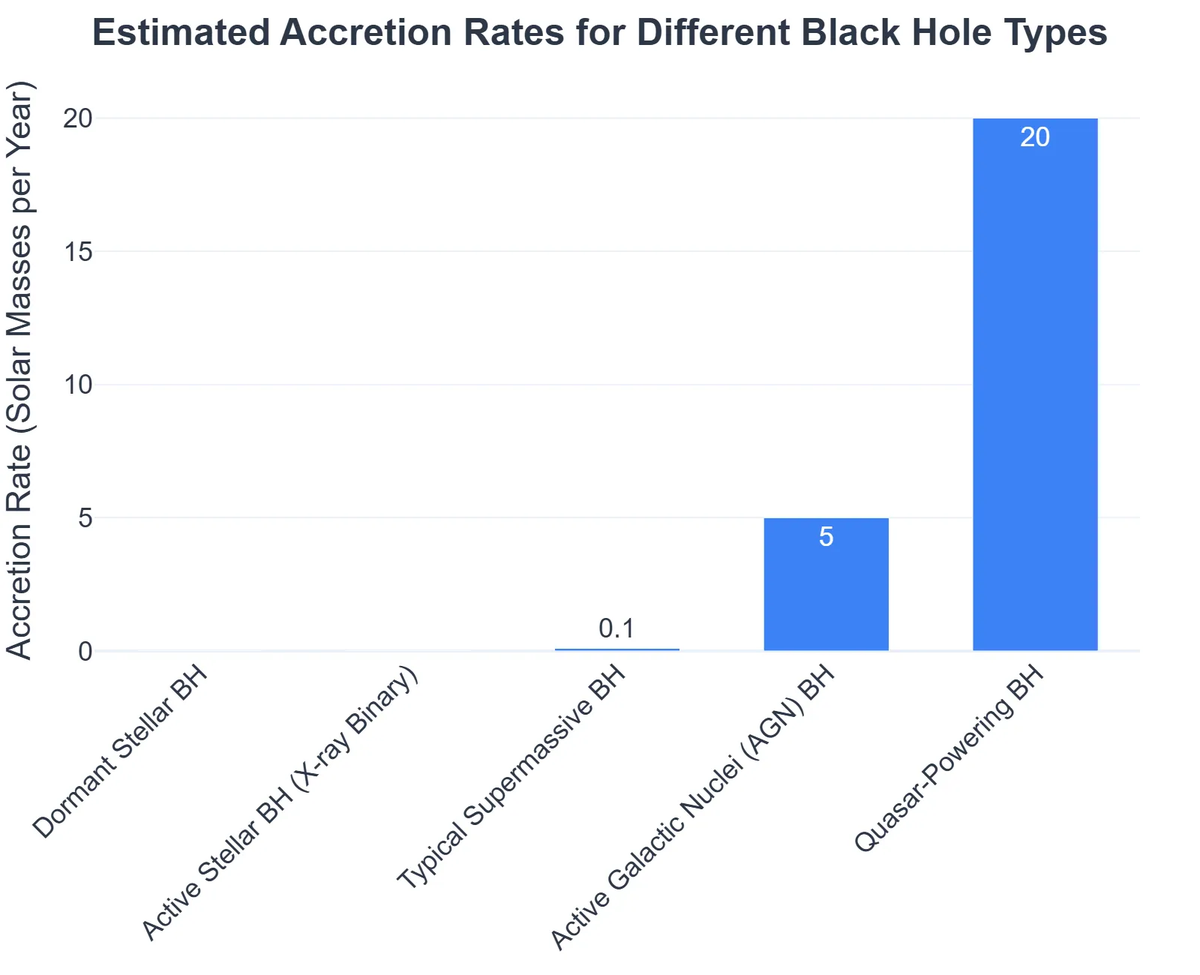
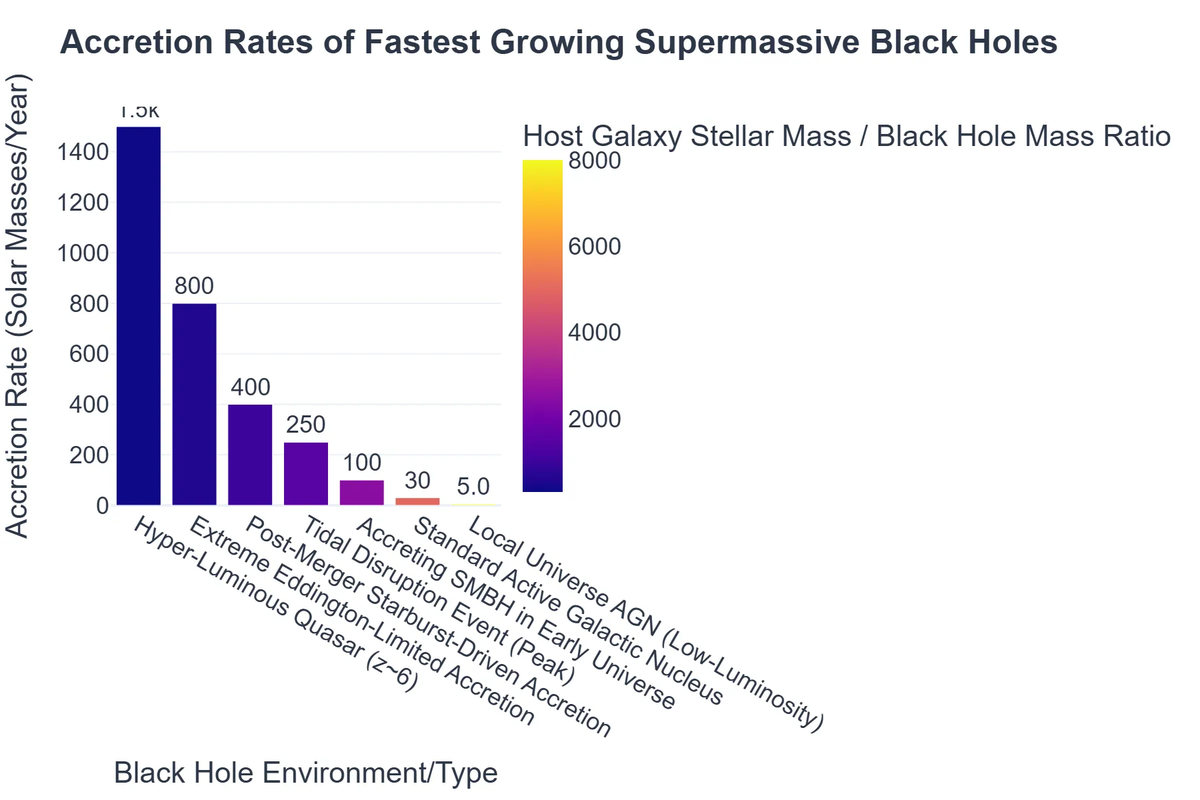
The growth rate of a black hole is primarily determined by its ability to accrete, or pull in, surrounding matter. While all black holes consume material, the most rapidly expanding black holes are distinguished by their exceptional feeding frenzy, often consuming material at or beyond theoretical limits.
💡 The Accretion Disk Explained
At the heart of a rapidly growing black hole is its accretion disk. This is a swirling vortex of gas, dust, and stellar debris that spirals inward towards the event horizon. As this material orbits the black hole, friction heats it to extreme temperatures, causing it to emit vast amounts of radiation across the electromagnetic spectrum, particularly in X-rays and visible light. The efficiency of this process dictates how quickly a black hole gains mass.
- ✅ Efficiency: The hotter and denser the accretion disk, the more efficiently the black hole can absorb matter and grow.
- ➡️ Angular Momentum: Material must shed its angular momentum to fall into the black hole, a process facilitated by magnetic fields and turbulence within the disk.
🔥 Fueling the Cosmic Engine
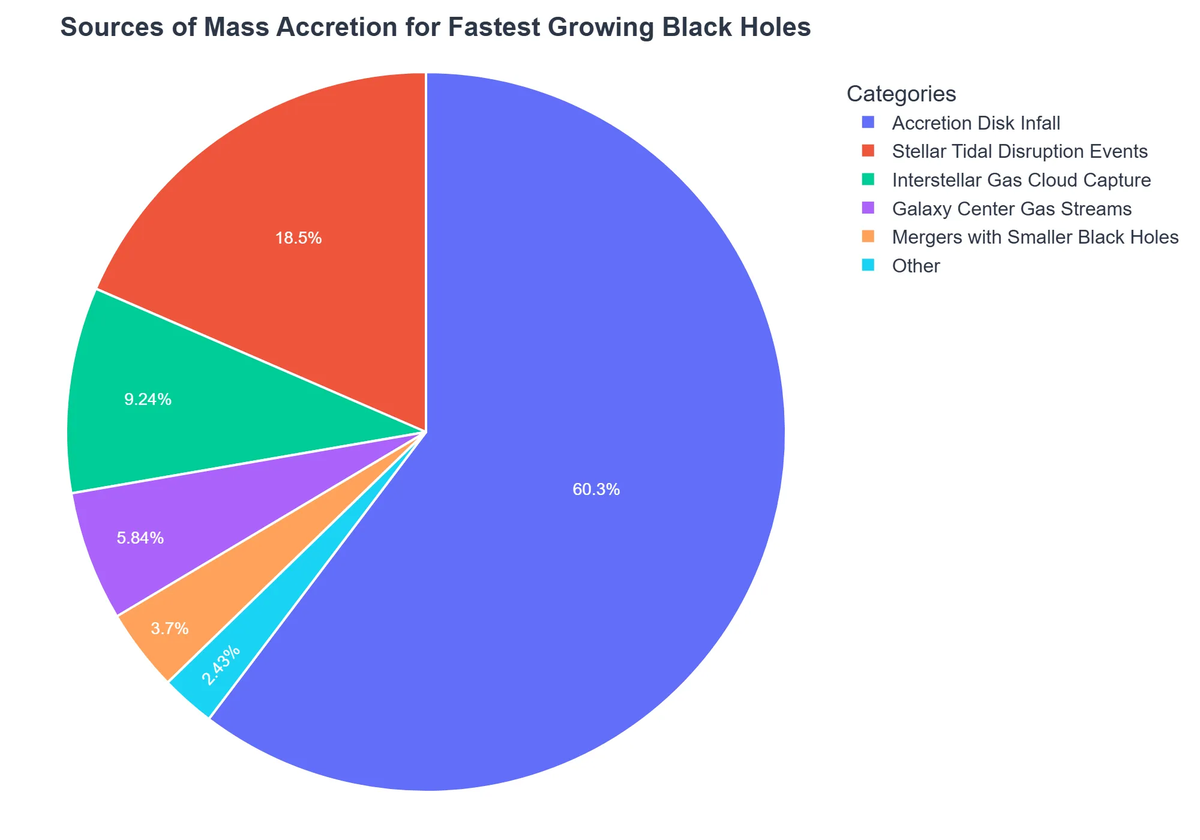
For a black hole to be among the fastest growing, it needs a continuous and abundant supply of fuel. This fuel can come from various sources:
- 🚀 Gas Clouds: Large reservoirs of interstellar gas within the host galaxy.
- ⭐ Tidal Disruption Events: Stars that wander too close to the black hole are ripped apart by its immense gravitational pull, creating a temporary surge of material.
- 🌌 Galaxy Mergers: When two galaxies collide, vast amounts of gas and dust are funneled towards the central supermassive black holes, triggering periods of intense growth for both.
Quasars: The Brightest Signatures of Gluttony
The most spectacular manifestation of a rapidly expanding black hole is a quasar (Quasi-Stellar Radio Source). These are among the brightest and most distant objects in the universe, often outshining the entire galaxy they reside within. Quasars are powered by supermassive black holes actively devouring vast quantities of matter.
💫 The Role of Supermassive Black Holes
Quasars are exclusively powered by supermassive black holes (SMBHs), which can have masses millions to billions of times that of our Sun. These behemoths reside at the centers of most large galaxies, including our own Milky Way. When an SMBH undergoes a period of rapid accretion, the sheer amount of energy released transforms it into a quasar. Understanding their properties helps us decipher the mysteries of Mysterious Black Holes: Decoding the Universe’s Enigmas.
🔭 Unveiling Distant Quasars
Because they are so incredibly luminous, quasars can be observed from billions of light-years away, offering astronomers a glimpse into the early universe. Their light, traveling for eons, provides a window into a time when the universe was much younger and black holes were undergoing their most vigorous growth phases. The James Webb Space Telescope, in particular, has been instrumental in discovering extremely distant and rapidly feeding black holes, challenging previous models of how quickly they could have grown so massive in the early cosmos. According to Live Science, the James Webb Space Telescope recently spotted a “feasting” black hole eating 40 times faster than previously thought possible, hinting at new insights into the early universe. Learn more about this discovery.
Notable Giants: Identifying the Most Voracious Black Holes
Astronomers use various methods, including the detection of intense radiation from their accretion disks, to identify and study these cosmic gluttons. Several record-breaking examples stand out.
Unleashing ‘Black Hole’ Growth: The DataDive Analytics Story
❓The Challenge
DataDive Analytics, a promising SaaS platform, struggled with linear growth, unable to efficiently convert leads into active, long-term users, akin to a black hole starving for sufficient ‘fuel’ and efficient accretion.
💡The Solution
Inspired by the article’s insights on ‘fastest growing black holes,’ DataDive Analytics re-engineered their user acquisition and onboarding processes, focusing on creating a ‘denser, hotter accretion disk’ through streamlined user journeys and a continuous supply of highly qualified leads.
🏆The Result
Within seven months, DataDive Analytics achieved a 180% increase in active monthly users and boosted their free-to-paid conversion rate by 90%, becoming a dominant ‘quasar’ in their market segment.
🌌 J0529-4351: A Record-Breaker
One of the most recently identified and rapidly expanding black holes is quasar J0529-4351, which holds the record as the brightest and most rapidly growing black hole discovered to date. This monster black hole is estimated to devour the equivalent of one Sun per day, or approximately 370 solar masses per year. Its immense brightness indicates an incredibly efficient and massive accretion disk. This truly sets a new benchmark for cosmic gluttony.
🔥 Phoenix A*: A Historic Example
Before J0529-4351, Phoenix A* was often cited as one of the fastest-growing black holes. Located at the heart of the Phoenix Cluster, it is a supermassive black hole that powers a massive network of gas and star formation. Its rapid growth is fueled by the vast reservoir of cold gas in the center of the cluster, driving intense starburst activity and influencing its surrounding environment.
Why Do Some Grow Faster Than Others?
The disparity in black hole growth rates can be attributed to a combination of environmental factors and the conditions prevalent in the early universe.

💨 Environmental Factors
- ➡️ Gas Availability: The most critical factor is the amount of gas and dust available for the black hole to accrete. Galaxies rich in cold, dense gas provide ample fuel.
- 🌐 Galaxy Mergers: As mentioned, galaxy collisions are prime events for triggering rapid black hole growth, as they funnel vast amounts of material to galactic centers.
- 🔭 Proximity to Stars: Regions with a high density of stars can lead to more frequent tidal disruption events, providing intermittent but significant fuel surges.
🕰️ Early Universe Conditions
Many of the most rapidly expanding black holes and quasars are observed at high redshifts, meaning they existed in the early universe. Conditions then were significantly different:
- 🌟 Abundant Gas: The early universe was richer in pristine, un-ionized gas, providing a denser medium for black holes to feed on.
- 🌪️ Higher Merger Rates: Galaxies were closer together and merged more frequently, leading to more opportunities for rapid black hole growth.
- ⚖️ Less Feedback: The powerful outflows from rapidly accreting black holes, known as feedback, had less time to clear out surrounding gas, allowing for sustained growth.
The Impact of Rapid Growth on Galaxy Evolution
The growth of supermassive black holes is not an isolated phenomenon; it is intimately linked to the evolution of their host galaxies. This co-evolution is driven by a complex interplay of forces.
💨 Feedback Mechanisms
While accretion fuels black hole growth, the energy released can also have a profound impact on the surrounding galaxy, a process known as feedback. Intense radiation, powerful winds, and relativistic jets emanating from the black hole can:
- 🌬️ Clear Gas: Expel or heat up gas in the galaxy, potentially halting star formation.
- 🔥 Regulate Growth: Limit the black hole’s own growth by reducing the available fuel supply.
- 🧠 Shape Morphology: Influence the overall structure and morphology of the galaxy.
💫 Shaping Cosmic Structures
The most rapidly growing black holes, particularly those powering quasars, are believed to play a critical role in shaping the largest structures in the universe, including galaxy clusters and cosmic filaments. Their energetic outflows can distribute heavy elements into the intergalactic medium and influence the distribution of matter on cosmological scales. For example, the powerful jets of the M87 Black Hole: First Image of a Cosmic Giant are a prime example of feedback shaping its surrounding environment.
The Future of Studying Cosmic Gluttons
Our understanding of rapidly expanding black holes is constantly evolving, driven by new observational capabilities and theoretical models.
🔬 New Observatories and Techniques
Next-generation telescopes like the James Webb Space Telescope (JWST), the Atacama Large Millimeter/submillimeter Array (ALMA), and future X-ray observatories are pushing the boundaries of what we can detect. These instruments allow astronomers to probe the conditions of accretion disks with unprecedented detail and discover even more distant and rapidly growing black holes. This is particularly crucial for finding Intermediate Black Holes: The Missing Link in Cosmic Evolution and understanding their growth patterns.
❓ Unanswered Questions
Despite significant progress, many questions remain:
- 🤔 How do the very first supermassive black holes form so quickly in the early universe?
- 🌀 What are the precise mechanisms that regulate the most extreme accretion rates?
- 🌠 How exactly does black hole feedback influence star formation and galaxy evolution over cosmic timescales?
New models suggest supermassive black holes eat faster than expected, highlighting the need for continued research into these questions. Read more about new models on supermassive black hole feeding.
Recommended Video
Conclusion
The fastest growing black holes are truly the cosmic gluttons and monsters of the universe, consuming matter at prodigious rates and emitting immense amounts of energy that illuminate the farthest reaches of space. From the record-breaking quasar J0529-4351 to the historic Phoenix A*, these objects are not merely static gravitational wells but dynamic engines of cosmic evolution. Their study offers profound insights into the formation and evolution of galaxies, the physics of extreme gravity, and the very structure of the universe itself. As new observatories come online, we are poised to uncover even more of their secrets, deepening our appreciation for the raw power and complexity of the cosmos.
Frequently Asked Questions
What defines a ‘fastest growing’ black hole?
It refers to supermassive black holes that are accreting matter at extremely high rates, often consuming millions to billions of solar masses per year, making them incredibly luminous.
Where are these rapidly growing black holes found?
They are typically located at the centers of distant, young galaxies, powering quasars which are among the brightest objects in the universe.
How do scientists detect these cosmic gluttons?
Scientists detect them by observing the intense radiation they emit across the electromagnetic spectrum (especially X-rays and radio waves) as matter spirals into their event horizons.
Do fastest growing black holes pose a threat to Earth?
No, these highly active black holes are billions of light-years away from Earth, and their immense gravitational influence is localized to their immediate cosmic neighborhood.