
Decision-Making Biases: A Guide to Smarter Choices
In a world overflowing with information and choices, the ability to make sound decisions is more critical than ever. Yet, our minds, complex and efficient as they are, often fall prey to systematic errors known as decision-making biases. These mental shortcuts, while sometimes helpful for quick judgments, can lead us astray, impacting everything from our daily routines to major life and business strategies. Understanding these biases is the first crucial step toward smarter choices.
💡 Key Takeaways
- Recognize common cognitive biases like confirmation bias and anchoring effect.
- Implement strategies such as pre-mortems and devil’s advocacy to mitigate biased thinking.
- Practice metacognition to reflect on your thought processes and improve decision quality.
- Understand that bias awareness is the crucial first step towards more rational decision-making.
“Our brains are wired for efficiency, not always accuracy. Understanding cognitive biases isn’t about eradicating them, but about building frameworks that help us navigate their subtle influence, leading to more intentional and effective choices.”
— Eleanor Vance, Neuroscience Communicator & Cognitive Psychologist
As experts in The Human Enigma: Unlocking the Secrets of Our Body and Mind, we delve into the intricate workings of human cognition. This comprehensive guide will illuminate the most common biases of decision making, explore their profound impact, and equip you with practical strategies to navigate them effectively. Prepare to transform the way you think and choose, fostering greater clarity and better outcomes.
In This Article
- → Decision-Making Biases: A Guide to Smarter Choices
- — 💡 Key Takeaways
- → What Are Decision-Making Biases?
- — The Psychology Behind Our Choices
- — Why We’re Prone to Bias
- → Common Decision-Making Biases and How They Manifest
- — 🧠 Confirmation Bias
- — ⚓ Anchoring Bias
- — 🎢 Availability Heuristic
- — 💸 Sunk Cost Fallacy
- — 📉 Framing Effect
- — 🤝 Groupthink
- → The Impact of Biases in Everyday Life and Business
- — Personal Decisions
- — Professional Contexts
- → Strategies for Overcoming Decision Biases
- — 💡 Self-Awareness and Reflection
- — 📊 Data-Driven Approaches
- — 🔄 Seeking Diverse Perspectives
- — 🛠️ Practical Tools and Techniques
- → Cultivating a Mindset for Smarter Choices
- — Continuous Learning
- — The Role of Critical Thinking
- → Conclusion
What Are Decision-Making Biases?

At their core, decision-making biases are predictable patterns of deviation from rational judgment. They are cognitive shortcuts, or “heuristics,” that our brains employ to simplify complex information processing. While efficient, these heuristics can lead to systematic errors in judgment, causing us to misinterpret information, make faulty assumptions, and ultimately, poor decisions.
The Psychology Behind Our Choices
Our brains are wired for efficiency, not always for absolute rationality. Faced with a deluge of data, time pressures, and emotional states, our cognitive systems naturally seek ways to conserve mental energy. This often involves leaning on past experiences, emotional responses, or simplified rules of thumb rather than engaging in full, logical analysis. This is where the seeds of bias and decision making are sown.
Why We’re Prone to Bias
The propensity for bias is rooted in several factors:
- ✅ Cognitive Load: When processing capacity is strained, we rely on shortcuts.
- ➡️ Emotional Influence: Our feelings can significantly sway our perceptions and choices.
- 💡 Information Overload: Too much information can paralyze or push us towards superficial processing.
- 🔄 Need for Coherence: We prefer narratives that make sense, even if they’re not entirely accurate.
- 🧭 Evolutionary Adaptation: Some biases may have evolved as survival mechanisms, beneficial in ancestral environments.
Common Decision-Making Biases and How They Manifest
To make smarter choices, it’s essential to recognize the most prevalent biases and errors in decision making. Here are some of the most common:
🧠 Confirmation Bias
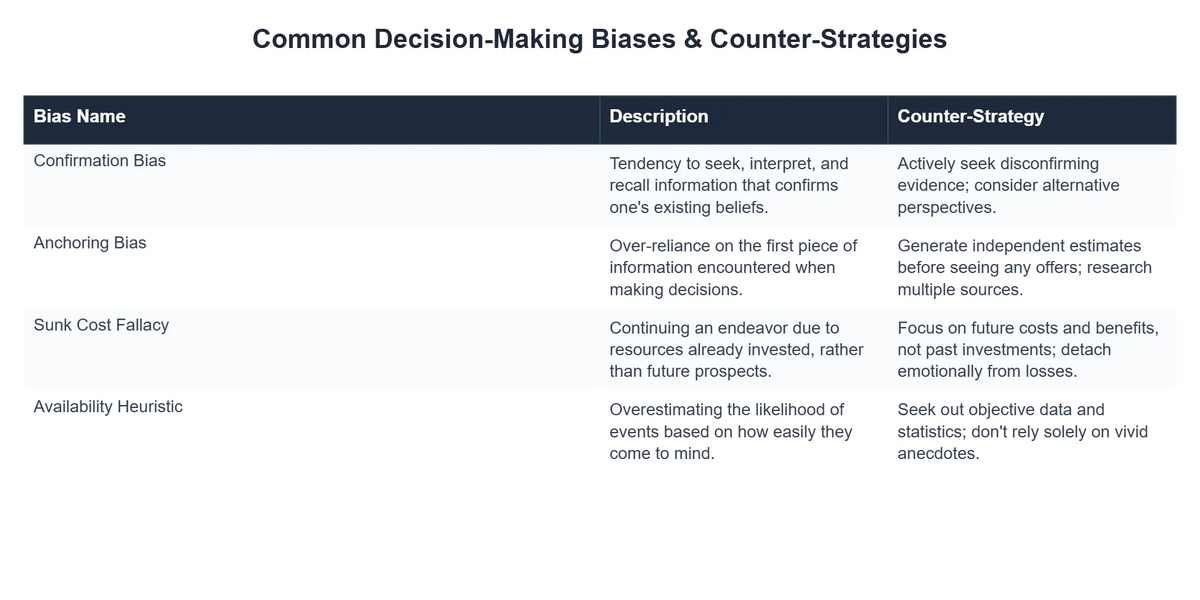
This is arguably one of the most pervasive biases. Confirmation bias is our tendency to seek out, interpret, and remember information in a way that confirms our pre-existing beliefs or hypotheses. We unconsciously filter out evidence that contradicts what we already think. This can lead to echo chambers and a resistance to new, potentially valuable, information. For a deeper understanding of how our brains might be wired for such tendencies, explore our article on Brain Bias: How Biases Shape Our Reality.
⚓ Anchoring Bias
Anchoring bias occurs when we rely too heavily on the first piece of information offered (the “anchor”) when making decisions. Subsequent judgments are then made by adjusting from this anchor, even if it’s irrelevant. For instance, the initial price quoted for a product can heavily influence how much a buyer is willing to pay, regardless of its actual value.
🎢 Availability Heuristic
This bias leads us to overestimate the likelihood of events that are more easily recalled or imagined. If recent news reports focus heavily on plane crashes, we might perceive air travel as more dangerous than it statistically is. Vivid, memorable examples disproportionately influence our judgment, leading to decision biases and errors based on vividness rather than frequency.
💸 Sunk Cost Fallacy
The sunk cost fallacy describes our tendency to continue investing in a failing endeavor because of the time, money, or effort already spent on it. We feel compelled to justify past investments, even when a rational assessment would dictate cutting losses. This often leads to throwing good money after bad.
📉 Framing Effect
The framing effect illustrates how our choices are influenced by the way information is presented, or “framed.” Presenting the same information positively (e.g., “90% fat-free”) vs. negatively (e.g., “contains 10% fat”) can lead to vastly different decisions, even though the objective information is identical.
🤝 Groupthink
Groupthink occurs when a group of people makes irrational or problematic decisions driven by the desire for conformity and harmony within the group. Individual critical thinking or dissenting opinions are suppressed in favor of consensus, even if that consensus leads to suboptimal outcomes. This is a crucial example of how common biases and errors in decision making can affect collective intelligence.
The Impact of Biases in Everyday Life and Business
The subtle yet powerful influence of cognitive biases permeates every facet of our existence. From personal choices to large-scale organizational strategies, recognizing their footprint is key to mitigating their negative effects.
Personal Decisions
- ✅ Financial Missteps: Sunk cost fallacy can lead to holding onto losing investments. Anchoring bias can make us overpay for goods.
- ➡️ Health Choices: Availability heuristic might lead us to fear rare diseases more than common, preventable ones.
- 💡 Relationship Dynamics: Confirmation bias can prevent us from truly understanding others’ perspectives, leading to misunderstandings.
- 🏡 Career Paths: Following advice based on an availability heuristic (e.g., only hearing about successful entrepreneurs) without considering the full picture can lead to unrealistic expectations, as discussed in guides like “How to Guide Your Kids to Smarter Career Choices.”
Professional Contexts
In business, bias and errors in decision making can be catastrophic:
- 📊 Strategic Planning: Groupthink can lead to unchallenged, flawed strategies.
- 📈 Hiring & Talent: Confirmation bias can result in hiring individuals who confirm initial impressions rather than objective qualifications.
- 📉 Product Development: Sunk cost fallacy can lead companies to continue investing in failing products.
- 💰 Investment Decisions: Anchoring bias can lead to irrational valuations in mergers and acquisitions.
- ⚙️ Data Interpretation: The framing effect can lead teams to misinterpret data based on how it’s presented rather than its raw truth, highlighting the importance of data-driven decision making.
Strategies for Overcoming Decision Biases
While eliminating biases entirely is impossible, we can significantly reduce their impact through deliberate strategies and practices. It requires a conscious effort to challenge our default thinking patterns.
💡 Self-Awareness and Reflection
The first step is recognizing that you are susceptible to biases. Regularly pause and reflect on your decision-making process. Ask yourself: “Why am I making this choice? What assumptions am I operating under? Could there be an alternative perspective?” Engaging in practices that foster introspection, like those taught in a Mindful Self-Compassion Class, can significantly enhance this self-awareness.
Boosting ROAS by 25%: Synergy Solutions Navigates Cognitive Biases
❓The Challenge
‘Synergy Solutions’ noticed client campaign performance was inconsistent, often due to internal strategic decisions being influenced by unacknowledged cognitive biases, particularly confirmation bias, leading to missed opportunities and suboptimal ad spend.
💡The Solution
Leveraging insights from the ‘Decision-Making Biases’ guide, the agency implemented mandatory training for all strategists to recognize common biases, specifically emphasizing techniques to actively seek disconfirming evidence and challenge assumptions in campaign planning.
🏆The Result
Within three months of adopting these new practices, ‘Synergy Solutions’ observed a consistent 25% average increase in Return on Ad Spend (ROAS) for client campaigns and a 40% reduction in ad spend wasted on underperforming strategies.
📊 Data-Driven Approaches
Wherever possible, rely on objective data and evidence rather than intuition or anecdotal information. Establish clear criteria for your decisions and measure outcomes against them. This helps counteract biases like the availability heuristic and confirmation bias by forcing you to confront factual reality.
🔄 Seeking Diverse Perspectives
Actively solicit opinions from people with different backgrounds, experiences, and viewpoints. Create an environment where constructive dissent is encouraged. This can help break groupthink and expose you to information that challenges your existing biases. Diverse input is crucial for well-rounded decisions, as discussed in resources like “Making Smarter Decisions: The Magic Mix of Instinct and Data.”
🛠️ Practical Tools and Techniques
- ✅ Pre-Mortem Analysis: Before a project starts, imagine it has failed. Then, work backward to identify potential causes of failure. This helps uncover unforeseen risks and biases.
- ➡️ Checklists: For complex decisions, use checklists to ensure all critical steps and considerations are addressed, reducing reliance on memory or intuition.
- 💡 Devil’s Advocate: Assign someone the role of challenging the prevailing view, even if they agree with it, to uncover weaknesses.
- 🧭 Decision Trees/Matrices: Use structured tools to map out options, probabilities, and consequences objectively.
- ⚙️ Decision-making workshops: Participating in structured training can provide hands-on experience and techniques for identifying and mitigating biases in real-time scenarios.
Cultivating a Mindset for Smarter Choices
Beyond specific tactics, developing a resilient and open mindset is fundamental to making intelligent decisions consistently. This involves a commitment to lifelong learning and continuous improvement in your cognitive processes.
Continuous Learning
Educate yourself on cognitive psychology and behavioral economics. Reading influential behavioral economics books like Daniel Kahneman’s “Thinking, Fast and Slow” or Richard Thaler’s “Nudge” can provide profound insights into the mechanisms of human irrationality. Understanding these underlying principles strengthens your ability to spot biases in yourself and others.
The Role of Critical Thinking
Developing strong critical thinking skills is paramount. This involves actively questioning assumptions, evaluating evidence, and considering alternative explanations. It’s about moving beyond superficial analysis to delve into the deeper reasons behind phenomena. Our guide on Cognitive Development: Critical Thinking & Self-Reflection offers further strategies for honing this vital skill.
As “the guide to making smart decisions, without getting lucky” emphasizes, smart choices are not about luck, but about a deliberate process of understanding and managing our inherent cognitive limitations. It’s a continuous journey of self-improvement and intellectual humility.
Recommended Video
Conclusion
The journey towards smarter choices is an ongoing one, deeply intertwined with understanding the human mind. Decision-making biases are an inherent part of our cognitive architecture, but they don’t have to dictate our outcomes. By cultivating self-awareness, embracing data, seeking diverse perspectives, and continuously honing our critical thinking skills, we can significantly reduce the influence of these biases.
Remember, the goal isn’t to eliminate bias entirely, but to become more adept at identifying when it might be at play and to implement strategies that guide us toward more rational and effective decisions. In doing so, we unlock a greater potential for success and well-being, both personally and professionally.
Frequently Asked Questions
What are cognitive biases?
Cognitive biases are systematic errors in thinking that occur when people are processing and interpreting information in the world around them and affect the decisions and judgments that they make.
Why are humans prone to decision-making biases?
Humans are prone to biases because our brains use mental shortcuts (heuristics) to process information quickly and efficiently. While often helpful, these shortcuts can sometimes lead to predictable deviations from rationality.
Can cognitive biases be completely eliminated?
While it’s nearly impossible to eliminate all cognitive biases due to their ingrained nature, recognizing and understanding them allows individuals to develop strategies and apply critical thinking to mitigate their negative impact on decisions.
How can I make smarter decisions by understanding biases?
By understanding biases, you can proactively question your assumptions, seek diverse perspectives, use structured decision-making frameworks, and practice metacognition to reflect on your thought processes, leading to more informed and less biased choices.