Tectonic Processes: Understanding Earthquakes and Plate Tectonics
Our planet Earth is a dynamic system, constantly changing beneath our feet in ways that are often imperceptible until a powerful force reminds us of its immense power. At the heart of these monumental shifts lies the science of plate tectonics – a unifying theory in geology that explains the movement of Earth’s outermost layer and the resulting phenomena, most notably earthquakes.
💡 Key Takeaways
- Earth’s outer shell is broken into large plates constantly in motion.
- Plate boundaries are sites of intense geological activity, including earthquakes and volcanic eruptions.
- Understanding tectonic processes is crucial for predicting natural hazards and comprehending Earth’s evolution.
- Different types of plate boundaries produce distinct geological features and seismic patterns.
“The subtle dance of tectonic plates is a fundamental driver of Earth’s climate systems and surface evolution. Every tremor tells a story of our planet’s ongoing, powerful transformation.”
— Marcus Sterling, Geophysical Explorer & Climate Dynamics Analyst
Understanding these fundamental tectonic processes isn’t just for geologists; it’s crucial for anyone seeking to grasp the very dynamics shaping our world, from towering mountain ranges to devastating seismic events. This comprehensive guide will demystify plate tectonics and earthquakes, providing you with a clear, authoritative overview of these unseen forces.
In This Article
- → Tectonic Processes: Understanding Earthquakes and Plate Tectonics
- — 💡 Key Takeaways
- → What Are Tectonic Plates? The Earth’s Dynamic Puzzle Pieces
- — Layers of the Earth: A Quick Overview
- — Defining Tectonic Plates
- → The Engine Beneath Our Feet: Mechanisms of Plate Motion
- — Convection Currents in the Mantle
- — Ridge Push, Slab Pull, and Slab Suction
- → Types of Plate Boundaries: Where the Action Happens
- — Convergent Boundaries (Collision)
- — Divergent Boundaries (Separation)
- — Transform Boundaries (Sliding)
- → Understanding Earthquakes: When Plates Collide, Slip, or Spread
- — What Causes an Earthquake?
- — Seismic Waves: The Earth’s Vibrations
- — Measuring Earthquakes: Magnitude and Intensity
- → Major Tectonic Features and Their Impact
- — Mountain Ranges and Volcanic Arcs
- — Oceanic Trenches and Mid-Ocean Ridges
- → Predicting and Preparing for Tectonic Activity
- — The Challenges of Earthquake Prediction
- — Mitigation and Preparedness Strategies
- → Conclusion
What Are Tectonic Plates? The Earth’s Dynamic Puzzle Pieces
To comprehend tectonic processes, we must first understand the Earth’s structure. Our planet isn’t a solid, static ball; it’s composed of several distinct layers, each with unique properties.
Layers of the Earth: A Quick Overview
- ✅ Crust: The outermost, thinnest layer, ranging from 5 to 70 km thick. It’s where we live!
- ✅ Mantle: A thick, viscous layer beneath the crust, extending to about 2,900 km. Though solid, it can flow very slowly over geological timescales.
- ✅ Outer Core: A liquid layer of iron and nickel, responsible for Earth’s magnetic field.
- ✅ Inner Core: A solid ball of iron and nickel at the Earth’s center, due to immense pressure.
The crust and the uppermost, rigid part of the mantle together form what is known as the lithosphere. This lithosphere isn’t a single, continuous shell; it’s broken into numerous large and small rigid slabs, much like pieces of a jigsaw puzzle. These are our magnificent tectonic plates.
Defining Tectonic Plates
Tectonic plates are massive, irregularly shaped slabs of solid rock, generally composed of both oceanic and continental lithosphere. They vary greatly in size, with some covering entire continents and oceans (like the Pacific Plate) and others being much smaller. These plates are not stationary; they are in constant, albeit slow, motion, moving a few centimeters per year – roughly the rate at which fingernails grow.
The Engine Beneath Our Feet: Mechanisms of Plate Motion
What drives these colossal plates across the Earth’s surface? The primary force is internal heat, generating convection currents within the mantle. For a more detailed exploration of the forces at play, you might find our article on Tectonic Plate Motion: Decoding Earth’s Engine particularly insightful.
Convection Currents in the Mantle
💡 The Earth’s mantle is not molten, but it behaves like a very viscous fluid over millions of years. Heat from the core causes mantle material to become less dense and rise. As it cools near the surface, it becomes denser and sinks, creating a continuous cycle of rising and sinking material – much like boiling water in a pot. These slow-moving currents exert drag on the overlying tectonic plates, causing them to move.
Ridge Push, Slab Pull, and Slab Suction
While convection is the main driver, other forces contribute significantly:
- ➡️ Ridge Push: At mid-ocean ridges (where new crust is formed), the elevated topography creates a gravitational force that pushes the plates away from the ridge.
- ➡️ Slab Pull: As oceanic crust cools and ages, it becomes denser and eventually sinks back into the mantle at subduction zones. The weight of this sinking slab pulls the rest of the plate along behind it. This is considered the strongest driving force.
- ➡️ Slab Suction: The downward pull of a subducting plate can also create a localized suction effect on the overriding plate.
Types of Plate Boundaries: Where the Action Happens
The interactions between tectonic plates at their boundaries are responsible for almost all of Earth’s major geological features and most of its seismic activity. There are three main types of plate boundaries, each associated with distinct geological phenomena. For an excellent visual overview of these boundaries, consider resources like National Geographic’s explanation of Plate Tectonics.
Convergent Boundaries (Collision)
Convergent boundaries occur where two plates move towards each other, resulting in a collision. The outcome depends on the types of plates involved:
- 🌍 Oceanic-Continental: The denser oceanic plate subducts (sinks) beneath the lighter continental plate. This process forms deep ocean trenches, volcanic arcs on the continent (like the Andes Mountains), and frequent strong earthquakes.
- 🌊 Oceanic-Oceanic: One oceanic plate subducts beneath another. This creates deep ocean trenches and volcanic island arcs (like the Mariana Islands and the Aleutian Islands), along with significant seismic activity.
- 🏔️ Continental-Continental: Neither plate subducts easily because both are relatively buoyant. Instead, they crumple and uplift, forming towering mountain ranges (like the Himalayas) and causing widespread, often powerful, earthquakes.
Divergent Boundaries (Separation)
Divergent boundaries are where two plates move apart from each other. As they separate, molten rock (magma) from the mantle rises to fill the gap, creating new crust. This process is known as seafloor spreading.
- 🌊 Mid-Ocean Ridges: Most divergent boundaries are found in the ocean basins, forming vast underwater mountain ranges known as mid-ocean ridges (e.g., the Mid-Atlantic Ridge). Volcanic activity here is effusive and less explosive, and earthquakes are generally shallower and less powerful.
- 🌍 Rift Valleys: On continents, divergent boundaries can create rift valleys (e.g., the East African Rift Valley), which are elongated depressions that may eventually widen to form new ocean basins.
Transform Boundaries (Sliding)
At transform boundaries, two plates slide horizontally past each other. Crust is neither created nor destroyed at these boundaries. The friction between the plates can cause immense stress to build up, which is then released as earthquakes.
- ↔️ Strike-Slip Faults: The most famous example is the San Andreas Fault in California, where the Pacific Plate slides past the North American Plate. Earthquakes at transform boundaries are typically shallow but can be very powerful.
Understanding Earthquakes: When Plates Collide, Slip, or Spread
Earthquakes are sudden tremors or shaking of the ground, caused by the rapid release of energy in the Earth’s lithosphere. This energy builds up as tectonic plates interact and deform the rocks along their boundaries. The British Geological Survey provides an excellent resource on what causes earthquakes.
What Causes an Earthquake?
Earthquakes primarily occur along faults – fractures in the Earth’s crust where blocks of rock have moved past each other. As plates move, stress accumulates along these faults. When the stress exceeds the strength of the rocks, they suddenly slip, releasing the stored energy in the form of seismic waves. This sudden rupture and slip is known as an earthquake.
- 💥 Focus (Hypocenter): The point within the Earth where the earthquake rupture begins.
- ⬆️ Epicenter: The point on the Earth’s surface directly above the focus. This is where the shaking is usually strongest.
Seismic Waves: The Earth’s Vibrations
The energy released during an earthquake travels through the Earth in the form of seismic waves. There are several types of seismic waves, but the most important for understanding earthquake damage are:
- 📏 P-waves (Primary waves): These are compressional waves, meaning they push and pull the ground in the direction of wave propagation. They are the fastest seismic waves and can travel through solids, liquids, and gases.
- 📐 S-waves (Secondary waves): These are shear waves, moving the ground perpendicular to the direction of wave propagation. They are slower than P-waves and can only travel through solids.
- 🌐 Surface waves: These waves travel along the Earth’s surface and are responsible for most of the shaking and damage experienced during an earthquake. They are slower than P and S waves but have larger amplitudes.
Measuring Earthquakes: Magnitude and Intensity
Earthquakes are quantified using two main scales:
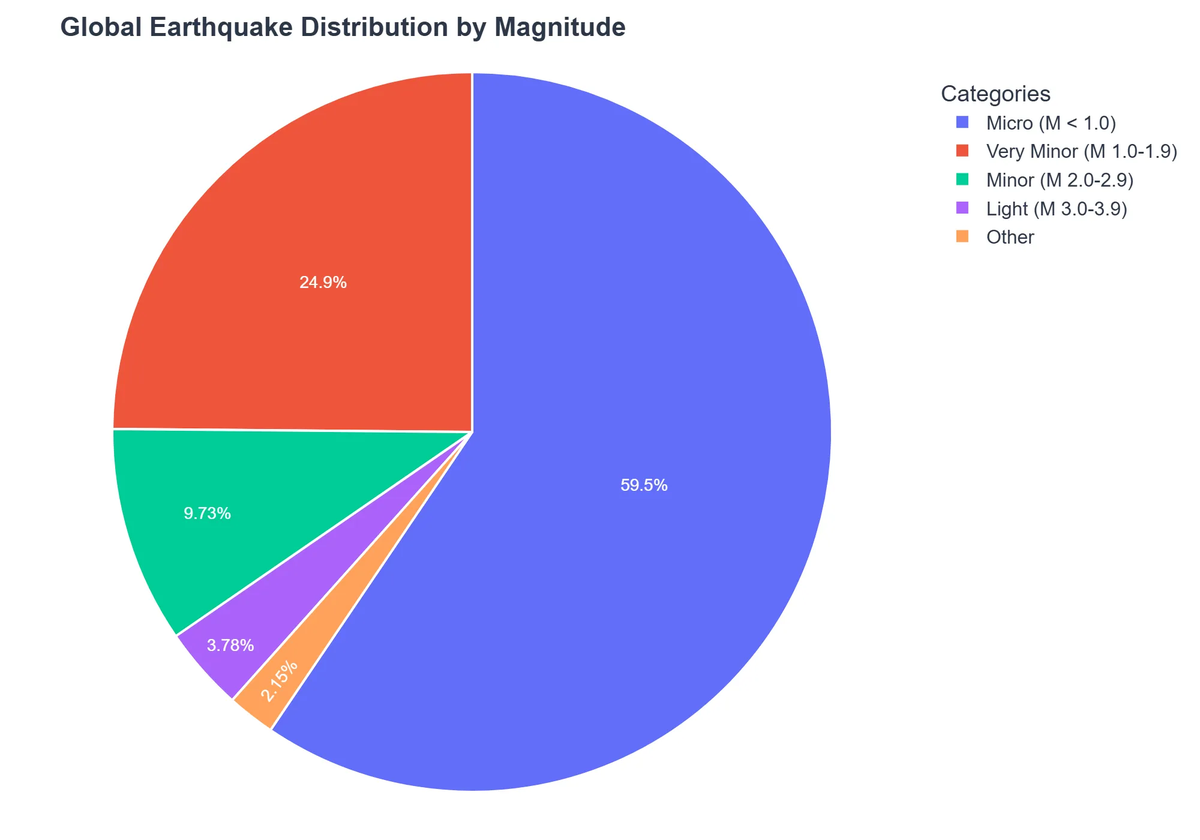
- 📊 Magnitude: Measures the energy released at the earthquake’s source. The Richter scale (now largely superseded by the Moment Magnitude Scale) is commonly known. Each whole number increase on the magnitude scale represents a tenfold increase in amplitude and approximately 32 times more energy released.
- 🏠 Intensity: Measures the effects of an earthquake at a particular location on the Earth’s surface. It’s based on observed effects on people, buildings, and the natural environment (e.g., Modified Mercalli Intensity scale). Intensity can vary greatly depending on distance from the epicenter, local geology, and building construction.
Major Tectonic Features and Their Impact
The relentless movement of tectonic plates over millions of years has sculpted Earth’s diverse landscapes. Understanding these features is central to the field of geology. For broader insights into Earth’s fundamental geological processes, see our article on Earth Science Essentials: Understanding Plate Tectonics.
Mountain Ranges and Volcanic Arcs
- 🏔️ Fold Mountains: Formed when continental plates collide and buckle, lifting vast areas of rock (e.g., Himalayas, Alps).
- 🌋 Volcanic Arcs: Formed above subducting oceanic plates, where melting rock rises to the surface (e.g., Andes, Cascade Range).
Oceanic Trenches and Mid-Ocean Ridges
- 🌊 Oceanic Trenches: Deep, narrow depressions on the seafloor, marking subduction zones (e.g., Mariana Trench, Peru-Chile Trench). They are the deepest parts of the ocean.
- ⛰️ Mid-Ocean Ridges: Underwater mountain ranges where new oceanic crust is generated at divergent boundaries (e.g., Mid-Atlantic Ridge).
Predicting and Preparing for Tectonic Activity
The study of these forces is a critical component of earth science, particularly in relation to natural hazard mitigation. While we’ve made immense strides in understanding Earth’s internal processes, predicting the exact timing and location of future earthquakes remains an elusive goal.
The Challenges of Earthquake Prediction
Despite significant research, reliable short-term earthquake prediction is currently not possible. Scientists can identify areas with high seismic risk based on historical data and plate boundary locations, but predicting the “when” of an earthquake with enough precision to issue warnings is extremely difficult. The complexity of fault systems, the varied nature of rock properties, and the long periods between large events make precise forecasting a major challenge.
Mitigation and Preparedness Strategies
- 🏗️ Building Codes: Implementing and enforcing strict earthquake-resistant building codes in seismically active regions.
- 🗺️ Hazard Mapping: Identifying and mapping active fault lines and areas prone to landslides or liquefaction during earthquakes.
- 🚨 Early Warning Systems: Systems that detect the initial P-waves (which are less damaging) and send rapid alerts to nearby areas before the more destructive S-waves and surface waves arrive, providing precious seconds to minutes for people to take cover.
- 📚 Public Education: Educating communities on what to do before, during, and after an earthquake (“Drop, Cover, and Hold On”).
- 🤝 International Cooperation: Sharing research and best practices globally to improve our collective understanding and response.
Understanding these fundamental geological processes is a testament to Earth’s Unseen Forces: The Hidden Dynamics of Our Planet and empowers us to build more resilient societies.
Recommended Video
Conclusion
The continuous dance of tectonic plates is a slow-motion ballet on a grand scale, orchestrating the Earth’s geological features and unleashing its most powerful forces. From the majestic rise of mountains to the sudden, jarring jolt of an earthquake, these phenomena are direct consequences of our planet’s dynamic interior.
By delving into the mechanics of plate tectonics and the causes of earthquakes, we gain not only a profound appreciation for Earth’s constant transformation but also critical knowledge that helps us prepare for and mitigate the impacts of these powerful natural events. As our understanding of earth science deepens, so too does our ability to coexist with our planet’s unseen, yet undeniable, forces.
Frequently Asked Questions
How do earthquakes occur?
Earthquakes occur when the stress built up by the movement of tectonic plates along fault lines is suddenly released, causing seismic waves to radiate through the Earth.
What are the main types of plate boundaries?
The three main types are divergent (plates move apart), convergent (plates move toward each other), and transform (plates slide past each other).
Can tectonic plate movements be predicted?
While the general direction and rates of plate movement are known, precisely predicting the timing, location, and magnitude of future earthquakes remains a significant scientific challenge.