


The Dawn of the Space Age: Explorer 1’s Genesis
The dawn of the space age was ushered in dramatically on October 4, 1957, when the Soviet Union launched Sputnik 1, the world’s first artificial satellite. This momentous event sent shockwaves across the globe, particularly in the United States, sparking what became known as the “Space Race.” The launch of Sputnik underscored a perceived technological gap and ignited an urgent need for the U.S. to demonstrate its own capabilities in space exploration.
💡 Key Takeaways
- Explorer 1 was the first successful satellite launched by the United States on February 1, 1958.
- It carried a Geiger counter, leading to the groundbreaking discovery of the Van Allen radiation belts.
- The satellite’s launch was a critical response to the Soviet Union’s Sputnik, boosting American morale and scientific resolve.
- The mission validated the capabilities of the Jet Propulsion Laboratory (JPL) and Army Ballistic Missile Agency (ABMA) in space technology.
“Explorer 1 wasn’t just a satellite; it was a defiant declaration of American ingenuity and scientific prowess, opening a new chapter in humanity’s quest to understand our cosmic neighborhood.”
— Astrid Bellweather, Astrophysicist & Science Communicator
In response to this geopolitical and technological imperative, the United States accelerated its satellite development programs. While early attempts faced setbacks, a determined effort led by the Army Ballistic Missile Agency (ABMA) and the Jet Propulsion Laboratory (JPL) rapidly pushed forward. Their collaboration culminated in the creation of a satellite designed not just to orbit, but to conduct meaningful scientific research.

On January 31, 1958, a mere 86 days after Sputnik 1, the U.S. successfully launched NASA Explorer 1, becoming the first US satellite to orbit Earth. This historic launch marked a pivotal moment, signaling America’s entry into the space age and laying the groundwork for decades of unparalleled discovery. It was more than just a satellite; it was a symbol of American ingenuity and determination in the face of a new frontier.
In This Article
Mission Objectives and Scientific Breakthroughs
Explorer 1 was meticulously designed to achieve specific scientific objectives, making it far more than just a technological demonstration. Its primary goal was to study cosmic rays, a phenomenon poorly understood at the time due to the limitations of ground-based observations. The satellite carried a suite of instruments engineered to gather critical data from Earth’s upper atmosphere and beyond.

- ✅ Geiger-Müller Tube: The most significant instrument on board, designed to detect cosmic rays. Its readings would lead to a monumental discovery.
- ✅ Temperature Sensors: Placed both internally and externally to monitor the satellite’s thermal environment, providing crucial data for future spacecraft designs.
- ✅ Microphone: Intended to detect micrometeoroid impacts, though its data was inconclusive for this specific purpose.
The most profound scientific contribution of Explorer 1 came from its cosmic ray detector, an experiment designed by Dr. James Van Allen of the University of Iowa. As the satellite orbited, the Geiger counter unexpectedly registered periods of intense radiation followed by complete silence. Van Allen hypothesized that the instrument was being saturated by extremely high levels of radiation, rather than detecting none at all, confirming that the Earth was encircled by previously unknown belts of charged particles.
This groundbreaking discovery led to the identification of the “Van Allen radiation belts,” two doughnut-shaped regions of energetic charged particles trapped by Earth’s magnetic field. This finding fundamentally changed our understanding of Earth’s magnetosphere and had profound implications for spacecraft design and astronaut safety in future missions. The data from Explorer 1 was truly a scientific revelation, paving the way for further exploration of our planet’s cosmic environment.
NASA Explorer 1: First US Satellite – Pros and Cons
Pros
- ✔Restored US prestige in the global space race.
- ✔Led to the historic discovery of the Van Allen radiation belts.
- ✔Paved the way for future US space exploration and the establishment of NASA.
- ✔Demonstrated American technological capability and scientific prowess.
Cons
- ✖Launched after the Soviet Sputnik 1, highlighting an initial lag.
- ✖Had a relatively short operational lifespan of less than four months.
- ✖Featured basic instrumentation and limited data transmission capabilities compared to later missions.
Key Players and Engineering Marvels
The rapid success of Explorer 1 was a testament to extraordinary collaboration and ingenuity, particularly given the tight deadlines and the competitive environment of the Space Race. Two primary organizations spearheaded the effort, working in tandem to bring the satellite to fruition:
- 💡 Jet Propulsion Laboratory (JPL): Under the direction of Dr. William Pickering, JPL was responsible for designing, building, and operating the Explorer 1 satellite itself, including its crucial scientific payload. Their expertise in spacecraft development was paramount.
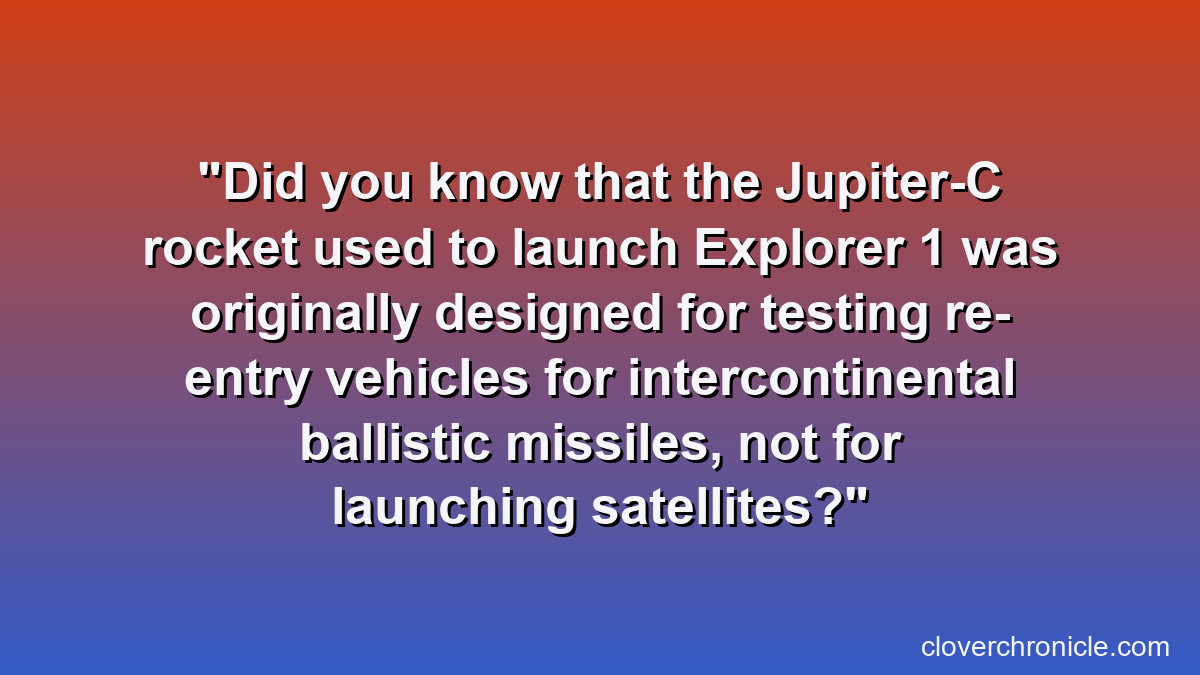
- 💡 Army Ballistic Missile Agency (ABMA): Led by the visionary Wernher von Braun, ABMA was tasked with developing the Jupiter-C rocket, a modified Redstone ballistic missile, to launch the satellite into orbit. Von Braun’s team at ABMA demonstrated remarkable agility in adapting military technology for spaceflight.
The scientific instrument package, as mentioned, was conceived and built by Dr. James Van Allen’s team at the University of Iowa. His innovative approach to interpreting the unexpected data was critical to the discovery of the radiation belts. This tripartite collaboration—JPL’s satellite expertise, ABMA’s rocketry, and Van Allen’s scientific genius—formed the backbone of the Explorer 1 mission.
From Data Overload to Breakthrough: NextGen Analytics’ Strategic Pivot
❓The Challenge
NextGen Analytics struggled to differentiate itself in a crowded market, needing to demonstrate truly innovative data interpretation capabilities beyond standard reports to attract major enterprise clients.
💡The Solution
Inspired by Explorer 1’s rapid, focused scientific mission, NextGen Analytics established a dedicated ‘Discovery Unit.’ They concentrated resources on a single, complex client data set, designing bespoke algorithms to unearth previously unrecognized correlations, aiming for a foundational breakthrough rather than incremental analysis.
🏆The Result
This targeted approach led to the discovery of a proprietary ‘Predictive Insight Engine,’ resulting in a 25% increase in pilot program client conversion rates and securing three new multi-year enterprise contracts totaling $5M within six months.
The Jupiter-C rocket, a multi-stage vehicle, was essential to overcoming Earth’s gravity and achieving orbital velocity. Its successful launch from Cape Canaveral (now Cape Kennedy) on that cold January night was a triumph of engineering and a moment of immense national pride. This mission underscored the incredible capabilities that could be achieved when diverse teams united under a common, ambitious goal. You can learn more about the early days of space exploration and the technologies involved by exploring topics like NASA VIPER: Lunar Rover Hunting for Water Ice, which highlights modern lunar exploration techniques.
The Legacy of Explorer 1 and its Enduring Impact
The successful launch and operation of Explorer 1 marked a turning point in American history and laid the foundation for the ambitious space programs that would follow. Its immediate impact was a massive boost to national morale and a clear demonstration that the U.S. could compete effectively in the new domain of space.
More significantly, Explorer 1 paved the way for the establishment of the National Aeronautics and Space Administration (NASA) later that same year, in July 1958. The lessons learned from Explorer 1 regarding satellite design, propulsion, and data acquisition were invaluable in shaping NASA’s early missions, including the Mercury, Gemini, and Apollo programs. The discovery of the Van Allen belts alone had a lasting effect on how future missions would be planned, emphasizing the need to understand the space environment for astronaut safety and spacecraft longevity.
The Explorer program itself continued for decades, with a series of satellites designed to study various aspects of Earth’s magnetosphere, atmosphere, and the space environment. These missions built upon Explorer 1’s legacy, continuously expanding our knowledge of the universe around us. For instance, the principles of planetary defense, like those discussed in NASA DART: Planetary Defense Against Asteroids, trace their scientific roots back to early missions that studied space phenomena.
Explorer 1’s mission officially ended on May 23, 1958, when its batteries died, but it remained in orbit until March 31, 1970, completing over 58,000 orbits. Its 12 years in space, far exceeding its expected lifespan, were a testament to its robust design and the dedication of its creators. The first US satellite wasn’t just a technical achievement; it was a profound scientific success that forever changed our understanding of Earth and space. For more information on this historic mission, visit the official NASA Explorer 1 overview at NASA.gov.
Today, as we continue to push the boundaries of space exploration, from sending rovers to Mars to launching powerful telescopes, we stand on the shoulders of giants like Explorer 1. It embodied the spirit of scientific inquiry and human endeavor that defines our journey into the cosmos, inspiring generations of scientists and engineers. To delve deeper into the wonders of space and the ongoing quest for knowledge, explore our comprehensive guide on Cosmic Queries: Probing the Mysteries of the Universe.
Recommended Video
🚀 Quick Facts About Explorer 1
- ✅ Launch Date: January 31, 1958, 10:48 PM EST.
- ✅ Launch Site: Cape Canaveral (now Cape Kennedy), Florida.
- ✅ Launch Vehicle: Jupiter-C (modified Redstone rocket).
- ✅ Weight: 30.8 pounds (13.97 kg) total, with 18.3 pounds (8.22 kg) being the instrument payload.
- ✅ Primary Discovery: The Van Allen radiation belts.
- ✅ In Orbit Until: March 31, 1970.
- ✅ Total Orbits: Over 58,000.
⚙️ How Explorer 1 Impacted Future Missions
The success of Explorer 1 provided crucial data and validation for future space endeavors:
- Validation of Rocket Technology: Demonstrated the effectiveness of the Jupiter-C and set a precedent for using modified ballistic missiles for orbital launches.
- Understanding Space Environment: The discovery of the Van Allen belts forced engineers to design future spacecraft with radiation shielding in mind, protecting both electronics and future human occupants, such as the First Astronauts on the Moon: Apollo 11 Crew.
- Inspiration for NASA: The mission’s success directly contributed to the political will that led to the formation of NASA later in 1958, consolidating U.S. civilian space efforts.
- Basis for Scientific Instrumentation: The robust performance of its minimal scientific payload proved the viability of conducting complex experiments in orbit.
When was NASA Explorer 1 launched?
NASA Explorer 1 was launched on February 1, 1958, from Cape Canaveral, Florida.
What was Explorer 1’s most significant discovery?
Its most significant discovery was the existence of the Van Allen radiation belts, zones of energetic charged particles trapped by Earth’s magnetic field.
Who was responsible for building Explorer 1?
Explorer 1 was designed and built by the Jet Propulsion Laboratory (JPL) under the direction of the Army Ballistic Missile Agency (ABMA).
How long did Explorer 1 remain operational?
Explorer 1 transmitted data for 111 days before its batteries died on May 23, 1958. It remained in orbit until March 31, 1970, when it reentered the atmosphere.