The concept of a parallel universe theory has captivated scientists, philosophers, and the public for decades. Far from mere science fiction, the idea that our universe might not be the only one, but rather one of an infinite — or at least very large — number of universes, is a serious area of inquiry in modern theoretical physics. This grand collection of all possible universes, including our own, is commonly referred to as the multiverse.
💡 Key Takeaways
- The multiverse concept suggests our universe is just one of many, possibly with different physical laws.
- Quantum mechanics, particularly the Many-Worlds Interpretation, provides a theoretical framework for parallel realities.
- Different theories, from bubble universes to M-theory, offer diverse views on how other universes might exist.
- While unproven, the idea challenges our understanding of reality, causality, and the nature of existence.
“The concept of a multiverse isn’t just science fiction; it emerges from profound questions in quantum mechanics and cosmology, pushing the boundaries of what we conceive as reality.”
— Astrid Bellweather, Astrophysicist & Science Communicator
Delving into the multiverse isn’t just about imagining other realities; it’s about pushing the boundaries of what we understand about space, time, and the fundamental laws of physics. It asks profound questions about our place in the cosmos and challenges our traditional view of a singular existence. As we explore these intricate theories, we begin to appreciate the vastness and complexity that the universe, or perhaps universes, truly hold. For a broader perspective on these profound cosmic questions, consider our comprehensive resource on Cosmic Queries: Probing the Mysteries of the Universe.
In This Article
- — 💡 Key Takeaways
- → What is the Parallel Universe Theory?
- → Major Types of Multiverse Theories
- — ➡️ The Level I Multiverse: Infinite Universes
- — ➡️ The Level II Multiverse: Bubble Universes & Eternal Inflation
- — ➡️ The Level III Multiverse: Quantum Parallel Universes
- — ➡️ The Level IV Multiverse: Mathematical Universes
- → The Role of Quantum Mechanics and String Theory
- → Stephen Hawking and the Multiverse
- → Is There Evidence for Parallel Universes?
- → Conclusion: The Enduring Quest for Other Realities
What is the Parallel Universe Theory?
At its core, the parallel universe theory postulates the existence of universes beyond our own observable cosmos. These aren’t just distant galaxies or unexplored regions of our universe, but entirely separate cosmic entities, each with its own set of physical laws, dimensions, or initial conditions. The specific characteristics of these parallel universes vary dramatically depending on the theoretical framework:
- ✅ Infinite Space: Some theories suggest that if space is truly infinite, then eventually all possible cosmic arrangements must repeat, leading to “other Earths” with “other yous” existing far beyond our observational horizon.
- ✅ Separate Bubbles: Others propose that our universe is just one “bubble” in a larger, ever-inflating cosmic foam, where new universes are constantly budding off.
- ✅ Quantum Splits: A particularly intriguing branch, often tied to quantum mechanics, suggests that every quantum event with multiple possible outcomes causes the universe to split, creating new parallel realities for each outcome.
It’s crucial to understand that these aren’t just speculative musings but are often derived from mathematical models and extensions of established physical theories, attempting to resolve paradoxes or fill gaps in our understanding of the cosmos.
Major Types of Multiverse Theories
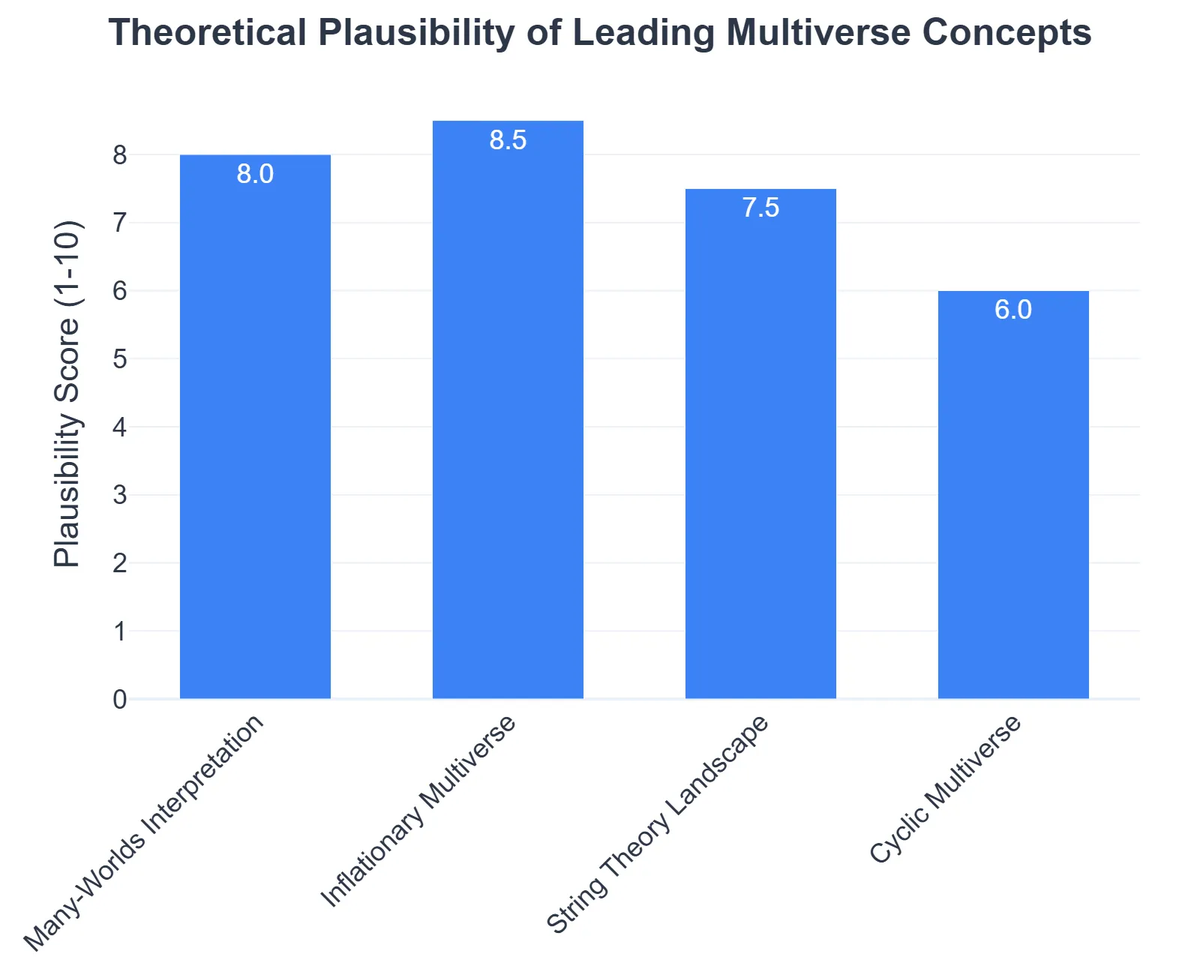
The concept of the multiverse isn’t a single, monolithic idea but rather a collection of distinct hypotheses, each with its own basis in physics and cosmology. Max Tegmark, a prominent cosmologist, categorized these into four levels, helping to clarify the diverse landscape of multiverse theories.
➡️ The Level I Multiverse: Infinite Universes
This is arguably the simplest and most intuitive form of the multiverse. If our universe is spatially infinite (which current cosmological models suggest is possible), and the distribution of matter within it is uniform over large scales, then eventually, patterns of particles must repeat. Given enough space, there would be exact copies of our observable universe, and thus, exact copies of ourselves, existing unfathomably far away. While not “parallel” in the sense of being separate dimensions, they are spatially distinct regions that are effectively parallel copies of our own.
➡️ The Level II Multiverse: Bubble Universes & Eternal Inflation
This level stems from the theory of cosmic inflation, which posits that the universe underwent an extremely rapid expansion phase shortly after the Big Bang. In the theory of “eternal inflation,” this inflationary process never truly ends; instead, it continues indefinitely in a larger, overarching space, occasionally giving rise to new “bubble universes” that detach and expand on their own. Each bubble could have different physical constants and dimensions, leading to wildly different cosmic realities. This theory forms the basis for many modern discussions about the multiverse, suggesting our universe is just one of many such bubbles in a vast cosmic ocean. For more on the interconnectedness, see Multiverse and Parallel Dimensions: Theories and Possibilities.
➡️ The Level III Multiverse: Quantum Parallel Universes
Perhaps the most conceptually challenging, the Level III multiverse arises from the Many-Worlds Interpretation (MWI) of quantum mechanics. Unlike other interpretations, MWI asserts that every time a quantum measurement is made, the universe “splits” into multiple parallel universes, one for each possible outcome. For instance, if a quantum particle can be in two states (e.g., spin up or spin down), then upon measurement, one universe observes it as spin up, and another parallel universe observes it as spin down. In this view, all possibilities allowed by quantum mechanics are actualized in some branch of the constantly diverging “universal wavefunction.” This is the essence of the quantum parallel universe concept. You can read more about it on Wikipedia’s Multiverse entry.
Parallel Universe Theory: Pros & Cons
Pros
- ✔Potentially resolves paradoxes in quantum mechanics (e.g., Many-Worlds Interpretation).
- ✔Offers a solution to the universe’s fine-tuning problem.
- ✔Expands our conceptual understanding of reality and existence.
- ✔Provides a framework for various theoretical physics models.
Cons
- ✖Currently lacks direct empirical evidence, making it untestable.
- ✖Raises complex philosophical and existential questions.
- ✖Could be viewed as unfalsifiable, potentially hindering scientific progress.
- ✖May lead to theoretical complexities without practical implications.
➡️ The Level IV Multiverse: Mathematical Universes
This highly abstract level, also proposed by Tegmark, suggests that all mathematically consistent structures exist as universes. If the laws of physics are ultimately mathematical, then any universe that can be described by a consistent set of mathematical equations exists. Our universe would merely be one such mathematical structure among countless others. This theory takes the idea of parallel universes to its most extreme logical conclusion, implying that everything that can be conceived mathematically, exists.
The Role of Quantum Mechanics and String Theory
Both quantum mechanics and string theory play pivotal roles in fueling the discourse around the multiverse and parallel universe theory.
- 💡 Quantum Mechanics: As discussed with the Level III Multiverse, the inherent probabilistic nature of quantum mechanics, particularly the “measurement problem,” directly led to interpretations like the Many-Worlds Interpretation. This view eliminates the need for wave function collapse by asserting that all possible outcomes of a quantum event actually occur, each in its own distinct parallel reality. This provides a direct mechanism for the creation of parallel universes.
- 💡 String Theory and M-Theory: This is where the concept of parallel universe string theory comes into play. String theory and its overarching framework, M-theory, propose that the fundamental building blocks of the universe are not point-like particles but tiny, vibrating strings. Crucially, these theories require the existence of extra spatial dimensions beyond the familiar three (plus time). While most of these dimensions are thought to be “compactified” or curled up, some theories, like brane cosmology, suggest that our entire universe could be a “brane” (a higher-dimensional membrane) floating within a larger, higher-dimensional “bulk.” Other branes, representing other universes, could exist parallel to ours within this bulk, possibly interacting with us via gravity. This offers a compelling framework for the existence of Level II-like parallel universes. To delve deeper into these advanced concepts, explore Quantum Mechanics & String Theory: Beyond the Standard Model.
These theoretical frameworks provide the mathematical underpinnings and conceptual possibilities for the multiverse, transforming it from pure speculation into a subject of rigorous scientific investigation.
Stephen Hawking and the Multiverse
When discussing the multiverse, it’s impossible to overlook the contributions of the late theoretical physicist Stephen Hawking. His work, particularly in his later years, significantly influenced the public and scientific understanding of the multiverse, offering new insights into the nature of its existence.

Hawking, along with his collaborator Thomas Hertog, developed a theory that refined the concept of eternal inflation. While eternal inflation suggests an infinite number of bubble universes, each with potentially different laws of physics, Hawking and Hertog proposed a “top-down” approach. They argued that the universe’s initial state wasn’t entirely random, but rather that only a finite number of universes, with specific properties, would be able to host life and observers. Their “no-boundary proposal” for the universe’s origin implied a simpler, more constrained set of possible universes.
This particular parallel universe theory Stephen Hawking worked on aimed to make the multiverse concept more testable, suggesting that by studying our own universe, we might be able to infer properties of the larger multiverse from which it originated. It was a move towards making predictions about the multiverse’s structure, rather than just describing its potential existence. For a more detailed account of his final theories, see Stephen Hawking’s Multiverse Theory: A Final Cosmic Vision.
Is There Evidence for Parallel Universes?
Currently, there is no direct observational evidence to confirm the existence of parallel universes. The multiverse remains a theoretical framework, albeit one supported by mathematical consistency within various cosmological and quantum theories. However, scientists continue to explore potential indirect signs:
- ✅ Cosmic Microwave Background (CMB) Anomalies: Some theories suggest that collisions between our universe and other bubble universes in the Level II multiverse might leave detectable “bruises” or patterns in the cosmic microwave background (the afterglow of the Big Bang). While some anomalies have been observed, they are currently explained by other phenomena and do not provide conclusive proof of cosmic collisions.
- ✅ Gravitational Effects: If other branes (in the context of string theory’s Level II/IV multiverse) exist parallel to ours, they might exert gravitational pull on our universe. However, detecting such subtle effects amidst the known gravitational forces is exceedingly difficult.
- ✅ The Fine-Tuning Problem: The observation that the fundamental constants of our universe seem exquisitely “fine-tuned” for the existence of life is sometimes cited as indirect evidence for a multiverse. If there are countless universes with varying constants, then it’s not surprising that we find ourselves in one where life is possible, rather than our universe being a statistical anomaly. This is more of a philosophical argument than direct scientific evidence, but it adds weight to the plausibility for some.
While the search continues, most scientists agree that any definitive proof of parallel universes would require revolutionary new observational techniques or theoretical breakthroughs. As Space.com highlights, the quest to understand the multiverse is ongoing and pushes the boundaries of scientific inquiry.
Recommended Video
Conclusion: The Enduring Quest for Other Realities
The journey into the parallel universe theory and the concept of the multiverse is a testament to humanity’s insatiable curiosity and our relentless pursuit of understanding the cosmos. While definitive proof remains elusive, these theories push the boundaries of scientific thought, offering profound implications for our understanding of existence, reality, and our place within a potentially infinite tapestry of universes. As science progresses, perhaps future discoveries will one day illuminate these hidden realities, revealing a universe far grander and more complex than we currently imagine.
What is the core idea behind parallel universe theory?
The core idea is that there are multiple universes coexisting, each potentially with different physical laws, constants, or histories unfolding simultaneously.
How does quantum mechanics relate to the multiverse?
The Many-Worlds Interpretation of quantum mechanics suggests that every quantum measurement or decision causes the universe to split into multiple parallel realities, each representing a different outcome.
Has the existence of parallel universes been proven?
No, the existence of parallel universes is currently a theoretical concept. While there’s intriguing scientific speculation, direct empirical evidence is still lacking.
Are parallel universes infinite?
Some theories, like the Many-Worlds Interpretation, imply an infinite number of universes, while others, like the bubble universe theory, suggest a vast but potentially finite number within a larger ‘multiverse’.