


The Genesis of a Modern Space Alliance
The landscape of space exploration has undergone a dramatic transformation, moving from an exclusive domain of government agencies to a more collaborative ecosystem. At the forefront of this evolution is the profound and increasingly vital relationship between NASA and SpaceX. This partnership represents a paradigm shift, leveraging private sector innovation to achieve ambitious space exploration goals previously solely pursued by national space agencies. The collaboration has not only accelerated scientific discovery and technological advancement but has also significantly reduced the cost of accessing space, democratizing future nasa and spacex endeavors.
💡 Key Takeaways
- The partnership between NASA and SpaceX has revolutionized access to space, making missions more frequent and cost-effective.
- SpaceX’s commercial crew transportation capabilities have restored American human spaceflight from U.S. soil.
- This collaboration extends beyond crew transport to include cargo missions, satellite deployments, and future deep-space ambitions.
- The success of this public-private model sets a precedent for future space endeavors and interstellar exploration.
“The synergy between NASA’s deep institutional knowledge and SpaceX’s agile innovation is not just launching rockets; it’s accelerating humanity’s reach into the cosmos. It’s truly a new golden age of space exploration.”
— Astrid Bellweather, Astrophysicist & Science Communicator
Historically, space missions were entirely government-funded and operated, involving massive budgets and lengthy development cycles. However, recognizing the potential for efficiency and innovation within the private sector, NASA initiated programs designed to foster commercial capabilities. This strategic pivot paved the way for companies like SpaceX to develop robust launch vehicles and spacecraft, shifting NASA’s role to more of a customer and partner rather than the sole developer and operator. This approach has proven instrumental in enhancing the frequency and reliability of spaceflight missions.
In This Article
- → The Genesis of a Modern Space Alliance
- — 💡 Key Takeaways
- → The Commercial Crew Program: A New Era for Human Spaceflight
- — 🚀 Reinvigorating U.S. Human Launch Capability
- → Resupplying the ISS: The Commercial Resupply Services (CRS) Contracts
- — 📦 Keeping the International Space Station Thriving
- → Beyond Low-Earth Orbit: Lunar and Mars Ambitions
- — 🌕 Stepping Stones to the Moon and Mars
- → Challenges and Future Prospects of the Collaboration
- — 🤝 Navigating the Complexities of Public-Private Endeavors
The Commercial Crew Program: A New Era for Human Spaceflight
🚀 Reinvigorating U.S. Human Launch Capability
One of the most significant chapters in the NASA-SpaceX partnership is the Commercial Crew Program. After the retirement of the Space Shuttle program in 2011, NASA relied on Russian Soyuz spacecraft to transport astronauts to the International Space Station (ISS). To regain independent human spaceflight capabilities, NASA established the Commercial Crew Program, fostering competition among private companies to develop safe, reliable, and cost-effective crew transportation systems.
- ✅ Development of Crew Dragon: SpaceX rose to the challenge with its Crew Dragon spacecraft, designed to carry up to seven passengers or a mix of crew and cargo to low-Earth orbit.
- ✅ The Power of Falcon 9: The Crew Dragon is launched atop SpaceX’s workhorse rocket, the Falcon 9, renowned for its reusability, which significantly drives down launch costs.
- ✅ Historic Demo-2 Mission: In May 2020, the Demo-2 mission marked a historic milestone, successfully launching NASA astronauts Bob Behnken and Doug Hurley to the ISS, making SpaceX the first private company to send humans into orbit.
This program has not only restored U.S. launch capability but has also opened doors for broader access to space for both government and private citizens. It exemplifies how the spacex partnership has redefined what’s possible in human spaceflight. For a deeper understanding of how these services are structured, explore our detailed article on Commercial Resupply Services: The Backbone of Space Exploration.
For more specific details on the spacecraft involved in this groundbreaking collaboration, NASA provides comprehensive guides, such as their resource on [https://www.nasa.gov/wp-content/uploads/2021/07/spacex_spacecraft_and_vehicle_guide.pdf text=”SpaceX spacecraft and vehicle information”].
Resupplying the ISS: The Commercial Resupply Services (CRS) Contracts
📦 Keeping the International Space Station Thriving
Before human spaceflight, the foundation of the NASA-SpaceX collaboration was laid through the Commercial Resupply Services (CRS) contracts. These contracts were designed to ensure a steady flow of essential supplies, equipment, and scientific experiments to the International Space Station after the Space Shuttle’s retirement.
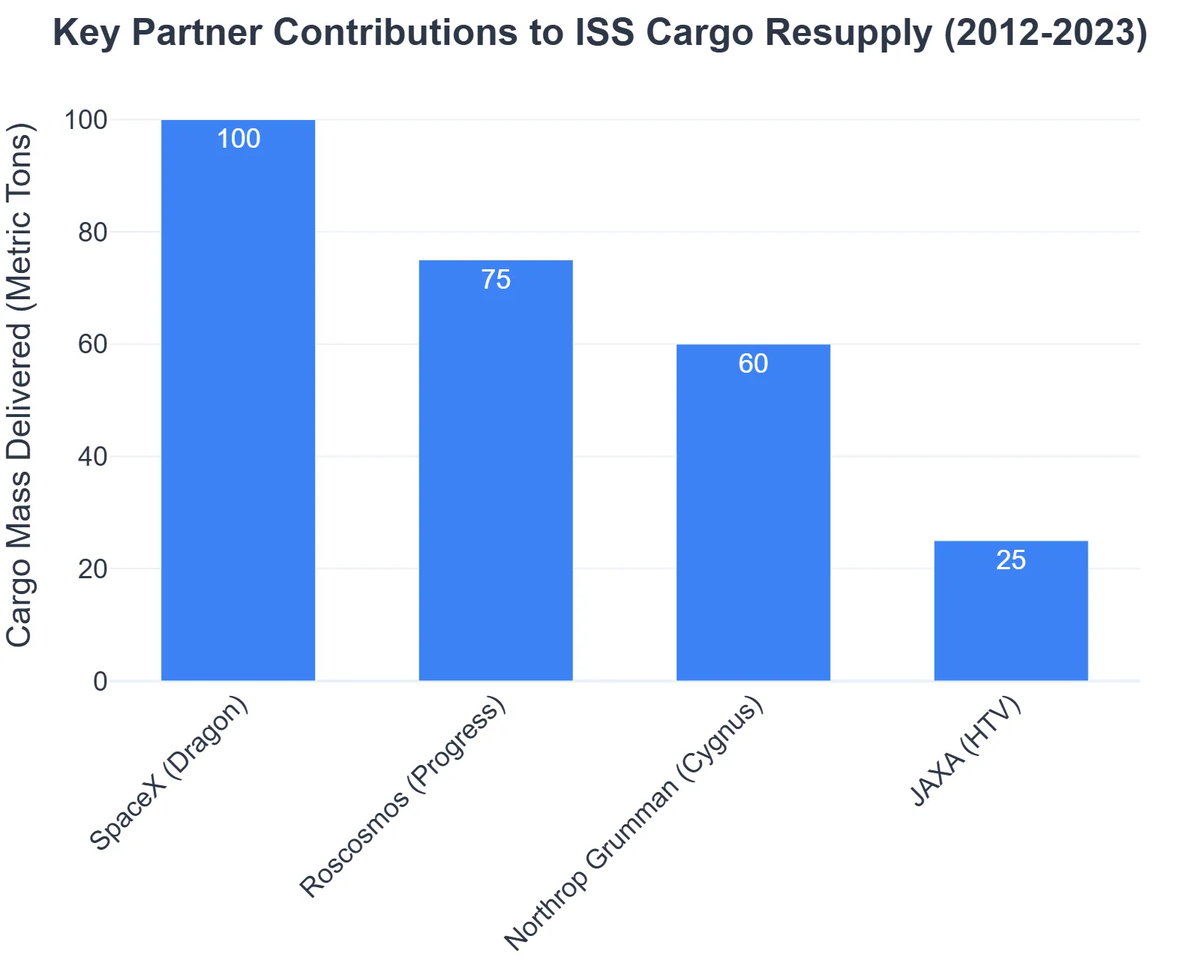
SpaceX’s Dragon cargo spacecraft, also launched by the Falcon 9 rocket, became a crucial lifeline for the orbiting laboratory. The ability of the Dragon to return critical scientific samples and equipment to Earth (unlike other uncrewed resupply vehicles that burn up in the atmosphere) provides an unparalleled advantage for research conducted on the ISS.
- ➡️ Regular Deliveries: SpaceX has conducted numerous successful CRS missions, delivering tons of vital cargo to the ISS, enabling continuous research and maintenance.
- ➡️ Scientific Returns: The unique return capability of the Dragon capsule allows scientists to analyze results from microgravity experiments on Earth, accelerating scientific breakthroughs.
- ➡️ Operational Efficiency: These commercial contracts have streamlined the resupply process, making it more cost-effective and frequent compared to traditional government-managed logistics.
This long-standing commitment underscores the robustness of the spacex partnership and its critical role in maintaining continuous human presence in low-Earth orbit. Understanding the broader context of such missions highlights the incredible efforts of various Aerospace Exploration Agencies: Missions and Pioneers. The ongoing CRS missions are pivotal, with the latest example being [https://www.nasa.gov/mission/nasas-spacex-crs-30/ text=”NASA’s SpaceX CRS-30″] mission, delivering a fresh batch of supplies and science.

Beyond Low-Earth Orbit: Lunar and Mars Ambitions
🌕 Stepping Stones to the Moon and Mars
The partnership extends far beyond the ISS, with ambitious plans for deep-space exploration, notably under NASA’s Artemis program. This next phase aims to return humans to the Moon and establish a sustainable lunar presence as a stepping stone for future missions to Mars. SpaceX is a central player in this grand vision.
- 💡 Starship Human Landing System (HLS): NASA selected SpaceX’s Starship as the Human Landing System (HLS) for the Artemis III mission, which aims to land the first woman and next man on the Moon. Starship’s immense capacity and innovative design are crucial for future deep-space endeavors.
- 💡 Lunar Gateway Support: While still in development, the potential for Starship to support the Lunar Gateway, a small space station orbiting the Moon, further solidifies the long-term nature of this collaboration.
- 💡 Mars Aspirations: Both NASA and SpaceX share a long-term vision of human exploration of Mars. While independent efforts are underway, the technologies and capabilities developed through their current partnership lay crucial groundwork for eventual Martian missions.
This forward-looking aspect of the nasa and spacex collaboration demonstrates a shared commitment to pushing the boundaries of human presence in the solar system. For those interested in the grand plans for humanity’s next giant leap, delve into our article on Moon Landing: The Future of Human Space Exploration. The collective efforts of both entities are paving the way to Mars, as highlighted by discussions around the [https://www.georgetownspace.org/contentmaster/nasa-and-spacex-moon-partnership-paves-the-way-to-mars text=”NASA and SpaceX Moon Partnership”].
Recommended Video
Challenges and Future Prospects of the Collaboration
🤝 Navigating the Complexities of Public-Private Endeavors
While immensely successful, the NASA-SpaceX partnership is not without its complexities. Integrating a private company’s rapid development cycles and iterative design philosophy with a government agency’s stringent safety protocols and bureaucratic processes requires careful navigation and continuous adaptation.
- ✅ Balancing Innovation and Oversight: NASA must provide robust oversight to ensure safety and mission success while allowing SpaceX the flexibility to innovate and operate efficiently.
- ✅ Funding and Timelines: Managing public funding and adhering to ambitious timelines requires constant communication and alignment between both parties.
- ✅ Technological Evolution: As technology advances, both organizations must continuously adapt their strategies to leverage new capabilities, such as Starship’s full reusability for even more ambitious missions.
Despite these challenges, the benefits of the spacex partnership are undeniable: increased launch cadence, reduced costs per launch, and accelerated technological development. This model is likely to serve as a blueprint for future public-private collaborations in space exploration, drawing from the insights discussed in our wider series, Cosmic Queries: Probing the Mysteries of the Universe. As the frontier of space expands, this alliance will continue to play a pivotal role in humanity’s journey among the stars.
What is the primary goal of the NASA and SpaceX partnership?
The primary goal is to provide reliable, cost-effective access to space for both human and cargo missions, fostering innovation in space exploration.
How has SpaceX contributed to human spaceflight for NASA?
SpaceX developed the Crew Dragon spacecraft and Falcon 9 rocket, enabling NASA to launch astronauts to the International Space Station from U.S. soil under the Commercial Crew Program.
What other collaborations exist between NASA and SpaceX?
Beyond crew and cargo resupply, NASA and SpaceX also collaborate on scientific missions, satellite launches, and are exploring future roles for Starship in lunar and Martian exploration.